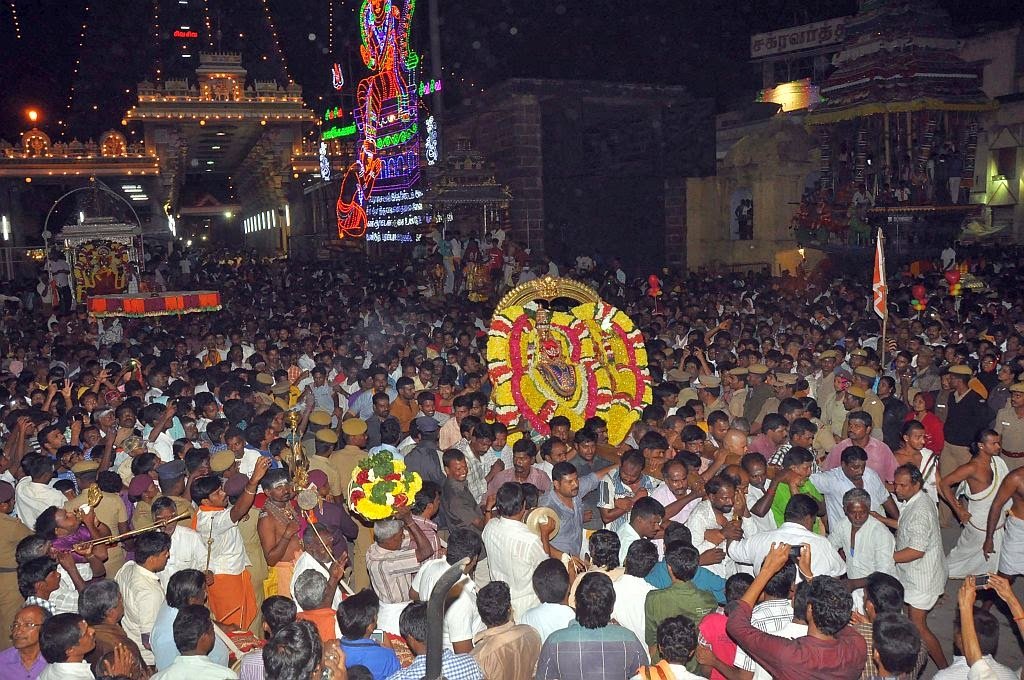
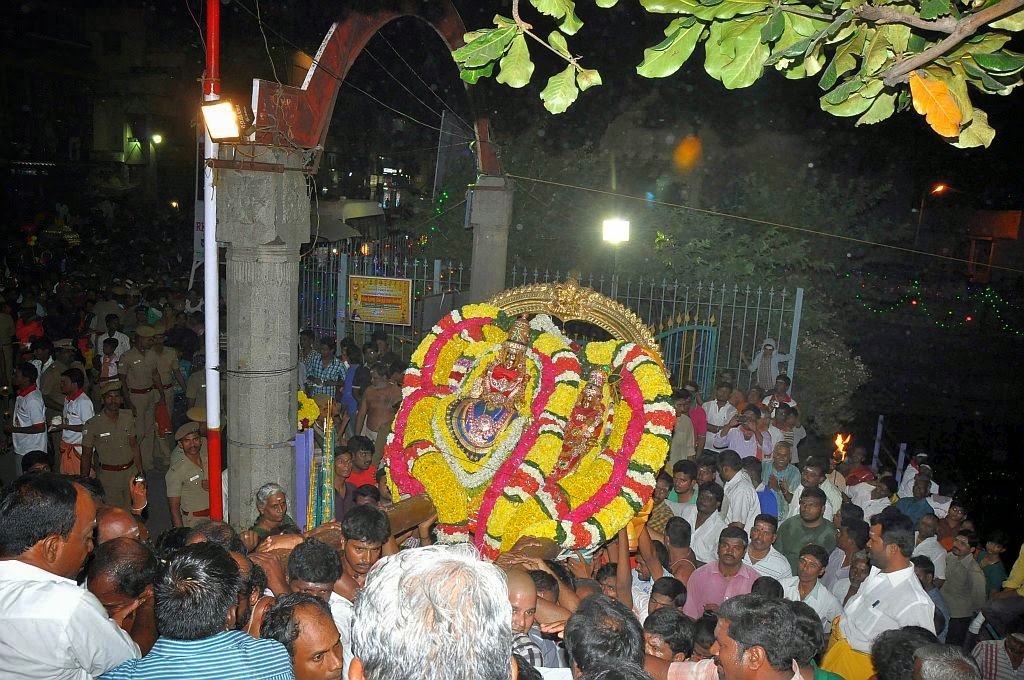
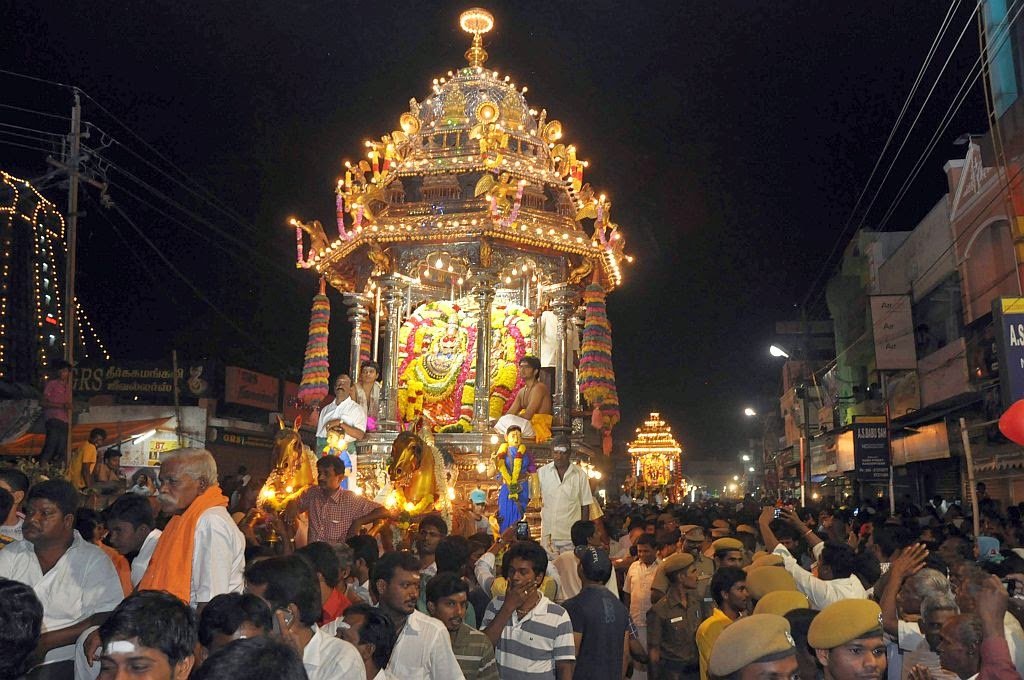
Deepam Festival. Day Five - Day: Chandrasekhara Rishaba Vahana
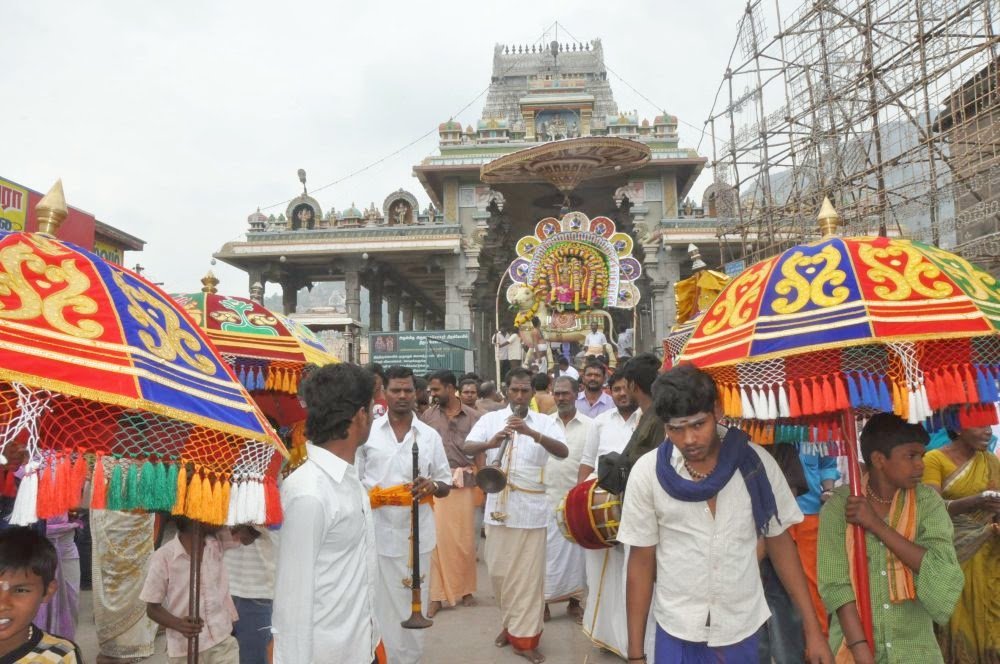 Musicians leading procession of Gods
|
|

Lord Chandrasekhara on Rishaba Vahana
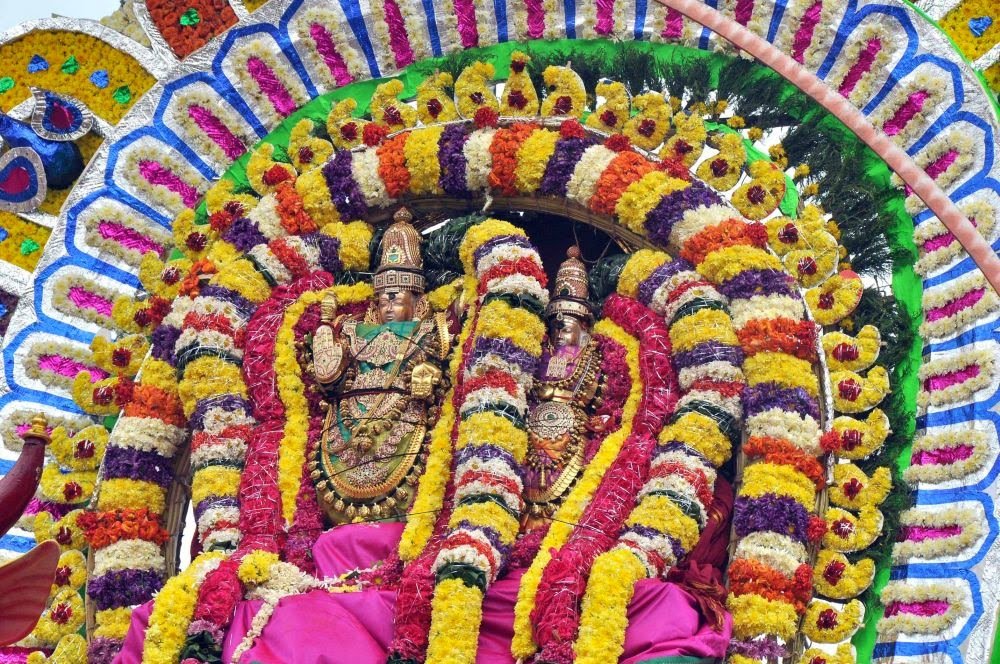
Close up of Lord Chandrasekhara on Vahana

Procession of Temple mada veedhis on Thiruvoodal Street
2014 Deepam Festival. Day Five - Night: Big Silver Rishaba
Big Silver Rishaba
[Narrative By Swami Abhishekananda 1970]
"The Festival begins nine or ten days before Thibam. Each evening there
are solemn processions round the Temple, which are over and above the
regular worship and the private offerings of puja which go on through
the day.
The day comes to its climax with the procession in the evening, which
lasts almost until midnight. It is led by Ganapati, the commander of the
heavenly hosts (gana-pati). Next comes Karttikeyi, the lord of the
Pleiades, also called Murugan or Subrahmaniyan in Tamilnadu, who like
Ganapati is a murti of Shiva and also his son. There is Uma or Parvati,
Shiva's consort; and on his white bull, Shiva Arunachala or
Annamalaiyar. According to custom they are carried on the Temple cars,
whose dimensions and decoration are on the grandest scale. Every evening
there are different cars, each more impressive than its predecessor. Of
these the most remarkable are the huge car of carved wood, more than
ten metres high, on which the statue is carried on a day during the
Festival and also the silver bull on which Shiva rides on the fifth day.
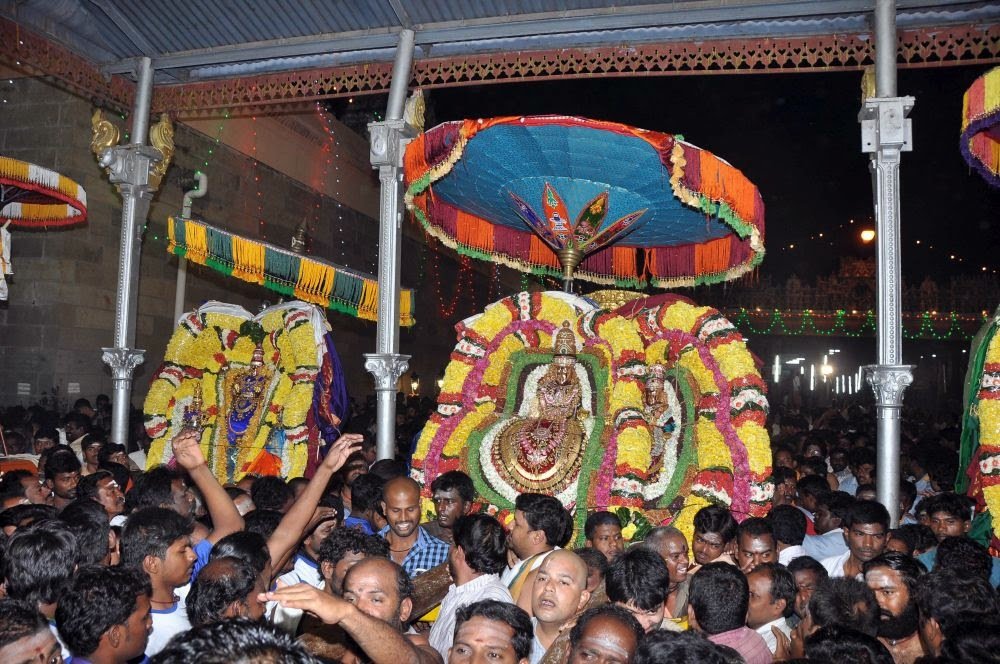
The Gods completing circumambulation of 1st and 2nd Prakaram
It was recommended not to miss the night of the silver bull, and I had
accordingly arrived in very good time . . . . The mandapam was crowded
with people who like us were waiting to see the procession. They plied
me with endless questions, which I answered as well as I could.
Saminathan, not knowing Tamil, remained silent, his eyes half shut, lost
in his prayer. I have to admit that my questioners were much more
impressed by Saminathan and his silence than by the answer that they
sought to extract from me; but they paid even less attention to the
disquisitions which one or other of the company sought remorselessly to
improve the occasion.
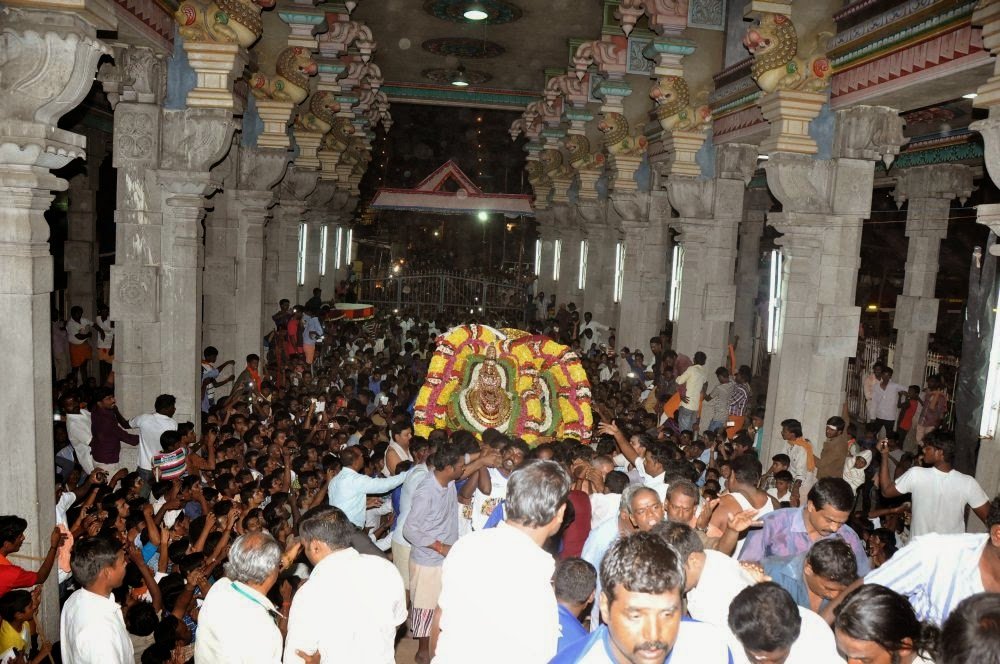
Gods being carried down the Alankaram Mandapam outside Raja Gopuram
During this time, in the Kalyana Mandapam, 'the portico of weddings,'
the priests were busy decorating the murtis, using silk and gold
brocade, flowers and valuable jewels. Meanwhile the cars were standing
outside the Temple, and on them also ornaments were being loaded. All
this seemed to go on interminably; but at last there was a sudden blare
of trumpets from the inner courtyard, their sound re-echoing loudly from
the high enclosure walls. Accompanying the trumpets was the low drone
of the tamburas, while the silvery melody of flutes pierced though the
noise of the crowd.
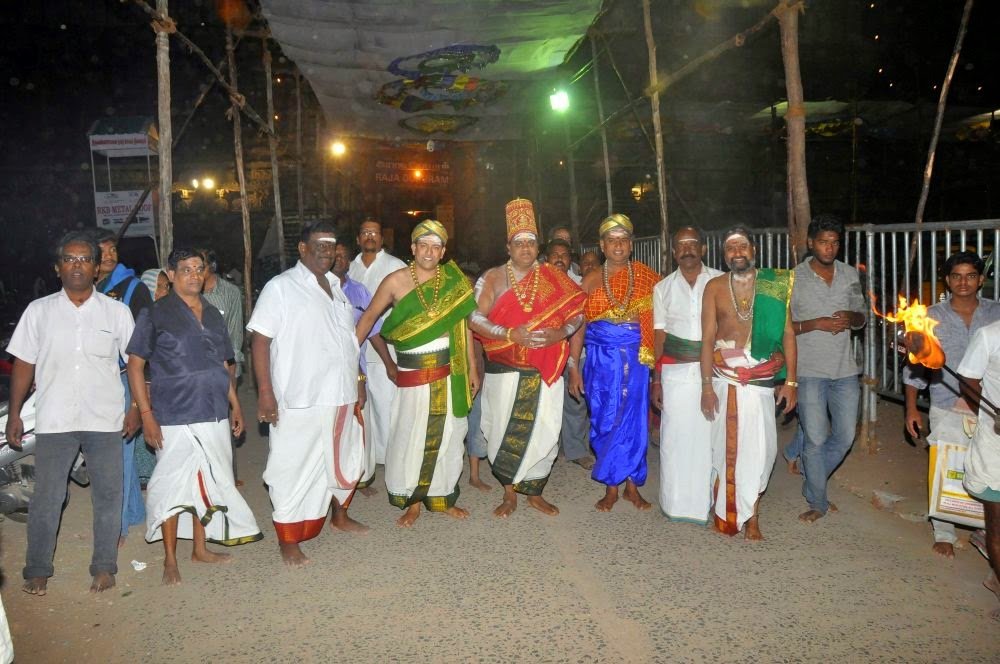
Priests walking down Alankaram Mandapam towards the Panchamoorthies
Now the file of murtis with their attendants emerged from their shrines,
and when they passed under porticos or gopurams the echo from the low
vaults become deafening. Soon they came to the Vallalla Gopuram where we
were standing. In front were the torch-bearers, next the musicians, and
last the palanquins, carried on the bare shoulders of devotees. On
either side was the tightly-packed crowd with outstretched arms, giving
cries of fervent devotion. Somewhere breaking coconuts on the ground,
while others held out at arm's length gilded trays of burning camphor.
The enthusiasm spread, swelled, multiplied itself irresistibly. Light,
heat, scents, sounds, bodies and souls too, all were joined together
into a single vast and vibrant outpouring of love in honour of the Lord
of Arunachala.

Huge crowds waiting to take darshan of the Panchamoorthies
We followed behind the procession, crossed the outermost courtyard,
passed under the huge gopuram over the East Gate and reached the long
colonnade which adjoins it on the east, where the cars were waiting. The
murtis were installed on the cars; and once again the work of
decoration was resumed with renewed zeal; flowers, jewels, lights in
even greater quantity. The crowd was now more tightly packed than ever.
The friend who was guiding me managed to open a path immediately in
front of the chief car, where the palanquin of Shiva Annamalaiyar was
mounted on the silver bull.
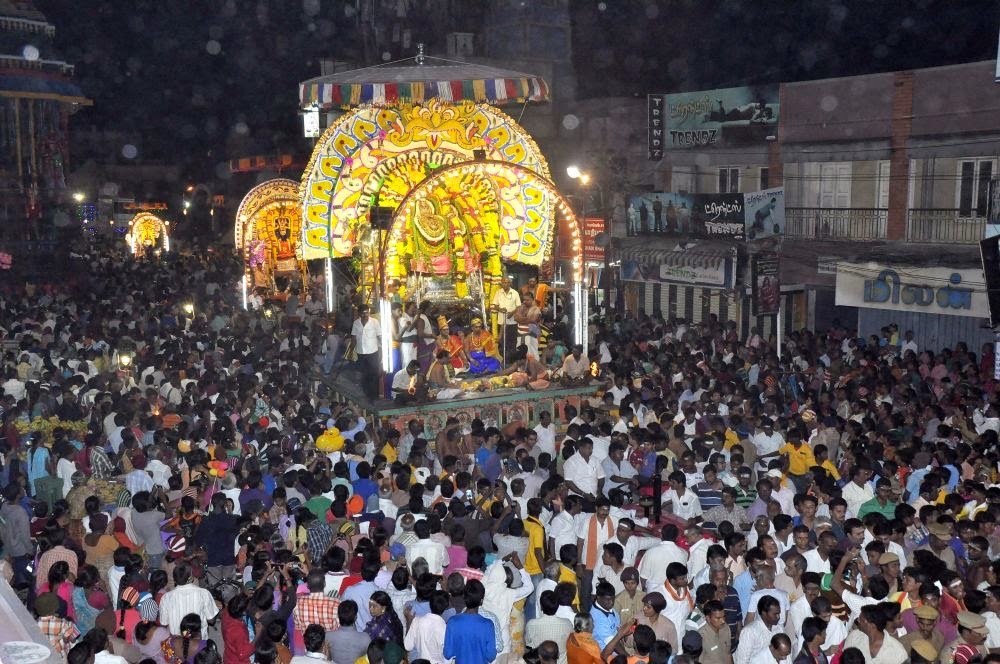
Procession of the Gods down Car Street
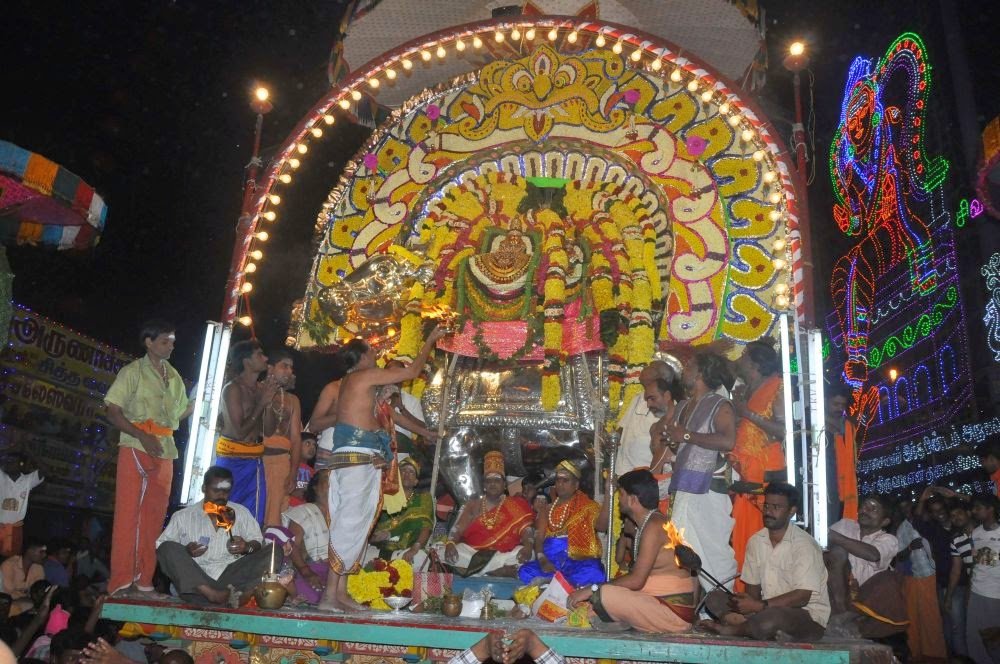
Gods giving darshan
Over him was held a huge ceremonial umbrella which touched the roof
overhead. Behind the car was a trailer with a dynamo, and thousands of
electric bulbs sparkled all over the palanquin, the platform, the
decorations, among the jewels, silks and flowers which adorned the
statue. Appusastri, who was standing near, was so moved that he cried
out: "How can one doubt any longer that it is the Lord himself upon his
car, who presents himself for our adoration!" Yet this Appusastri was an
old disciple of Ramana and Ganapati Muni, who more than anyone had
lectured me about advaita, proclaiming that whatever appears is maya,
that there is no distinction at the heart of Being, and that it is
vanity to worship God as an "Other"...!"
2014 Deepam Festival. Day Six - Morning: Elephant with 63 Nayanars
In the festivities of the morning of the sixth day, a glorious Silver
Elephant, (notice the sugar cane in its mouth) leads a procession of the
great Shiva devotees, the 63 Nayanars.
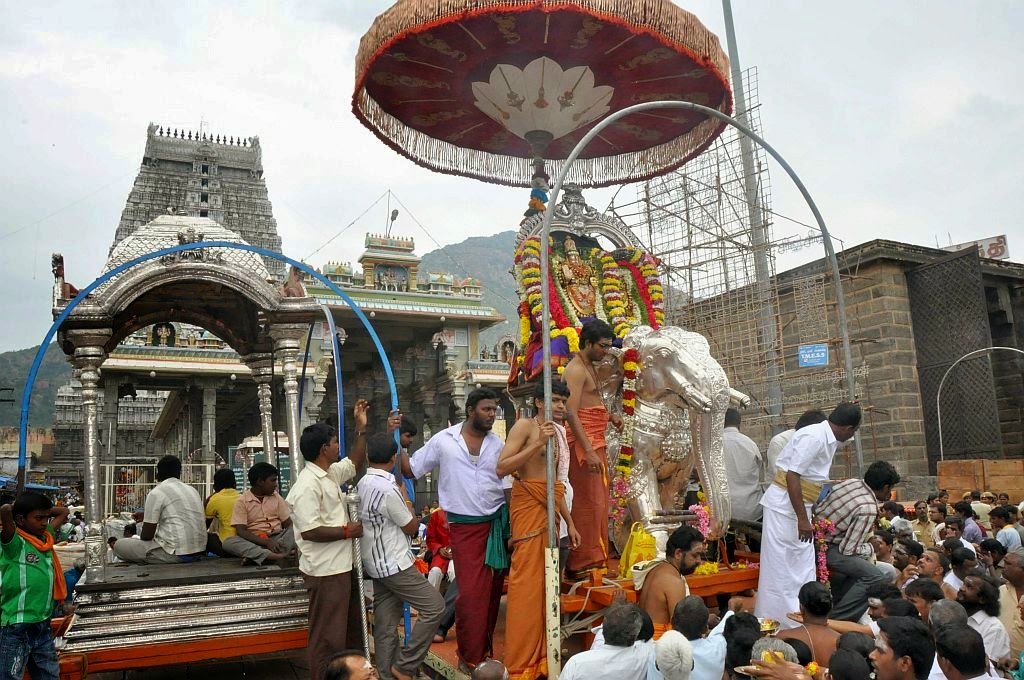
Glorious Silver Elephant
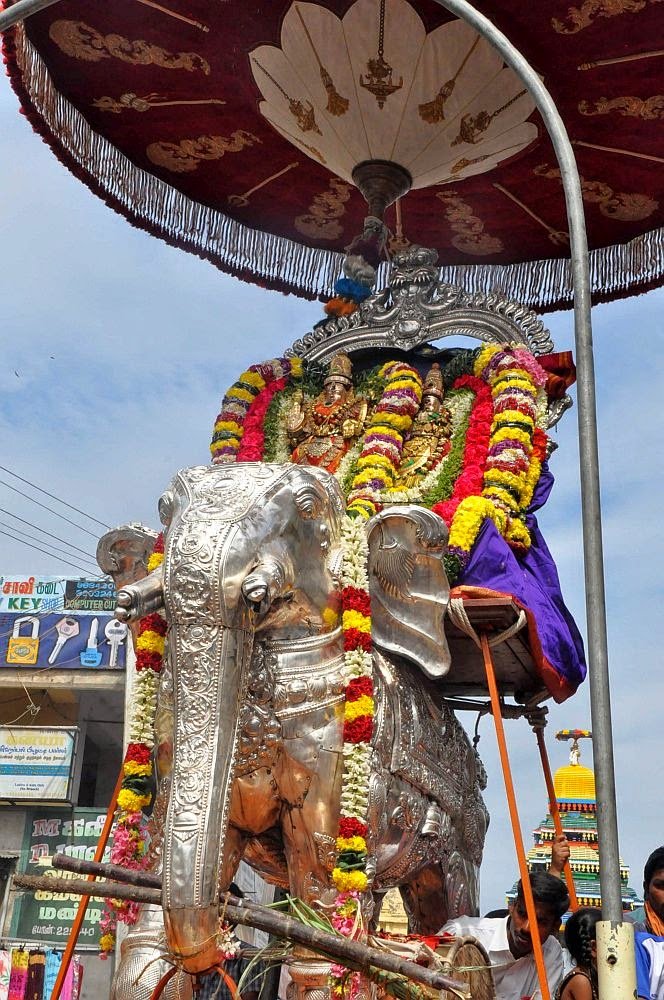
Lord Arunachaleswarar on the Silver Elephant
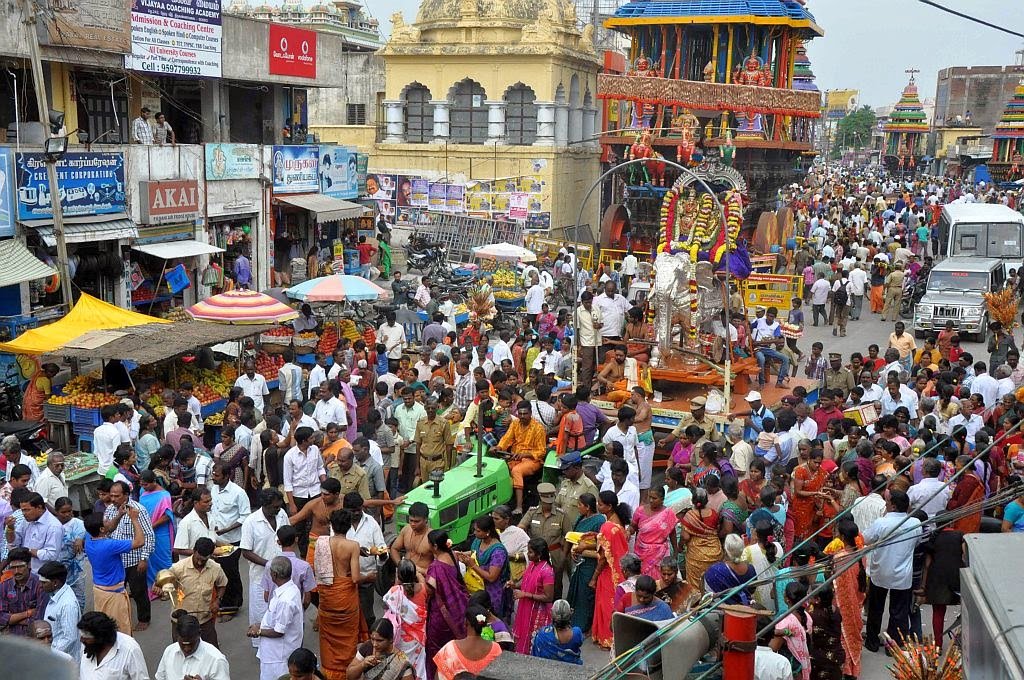
Procession starting on Car Street around the perimeter streets of Temple
On both sides of the below photograph, one can see individual palanquins of the Nayanars.
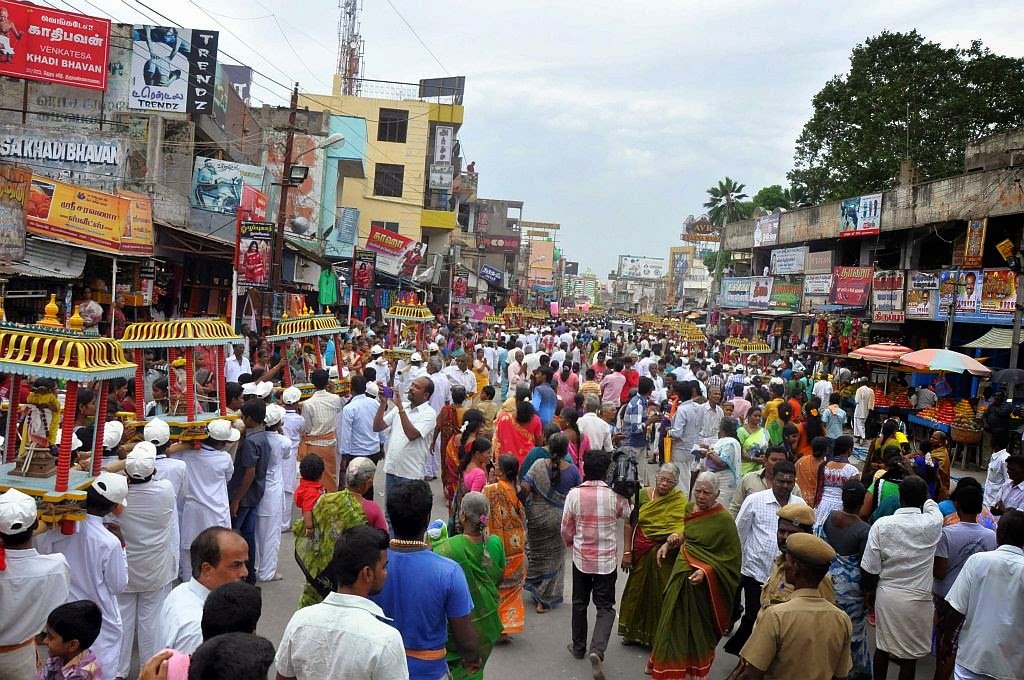
Individual palanquins of the Nayanars
The Nayanars are remembered as a group of 63 saints (poets) of the 6th
to 8th century who were great devotees of Lord Shiva. It was they who
influenced the Bhakti movement in Tamil Nadu.
Message of the Nayanars
"There have been many 'intellectuals' even in India who have looked down
upon the path of Bhakti (devotion) as something inferior to Jnana
(wisdom). Their short-sightedness becomes at once apparent when we study
the lives of the great Four Teachers (Appar, Sundarar, Manickavachagar
and Sambandar) and realise that these great Jnanis, too, were great
Bhaktas who loved to visit Temples and sing the glories of the Lord.
Love of the Lord cuts at the very root of our attachment to this world,
and snaps all worldly ties, to father, mother, son, wife or relatives.
As the stories of the Nayanars illustrate, the devotee is ever ready to
renounce all, in favour of devotion to Lord Siva.
Let us also never forget that in the case of all the Nayanars' devotion
invariably meant expansion of the heart, and, therefore, service and
charity. We have to take the individual tales of the Nayanars as
allegories exhorting us to rout out the inner obstacles to our Sadhana.
If we approach these saints with faith and devotion in our hearts, we
shall grasp the message they have for us. We shall also understand why
they gave such a great place to externals like the sacred ash,
Rudraksha, etc. These symbols remind one constantly of God: and, when
they are said to remove our sins, they remove our sinful tendencies,
too, by constantly reminding us of God, and keeping evil out of our
mind."
[By: Venkatesananda]
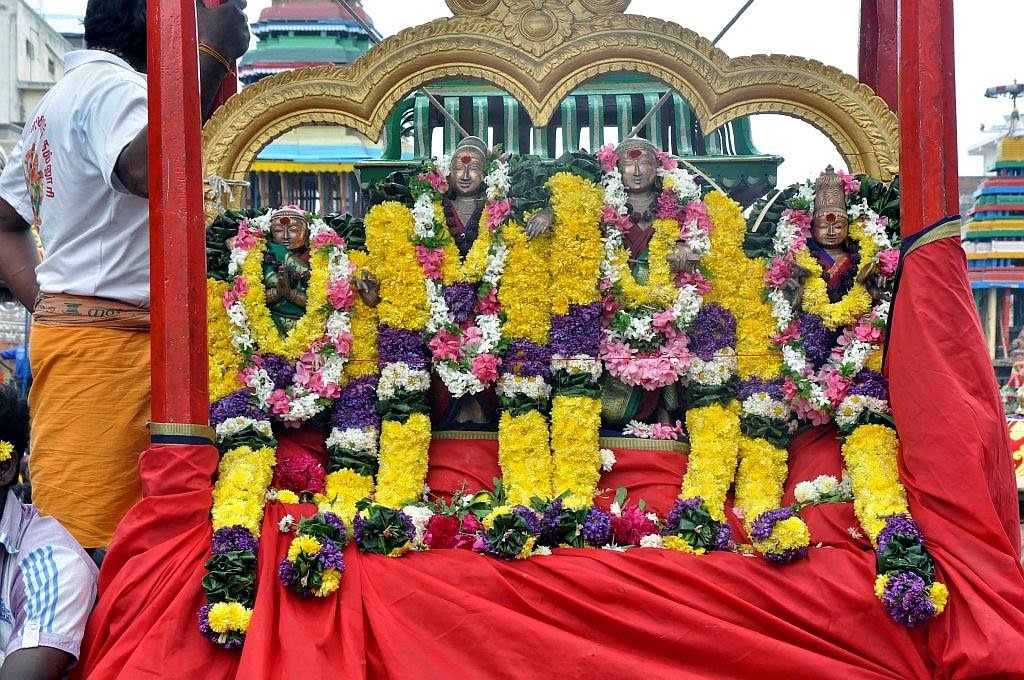
The Saiva Samaya Acharyas
Out of these 63 Nayanars, the four Saiva Samaya Acharyas; (left to
right) Tirugnasambandar, Tirunanvukkarasar (Appar), Sundarar and
Manikkavasagar are remembered best of all.
"The principal teachings of the four Saiva Samaya Acharyas is of love
and surrender to God; and of service to God and godly men. Love,
devotion, and service to God is the only way one can obtain His Grace.
God is One and He is Shiva. Man must get over his bonds which keep him
in ignorance in order that he may obtain inseparable union with Shiva
through the Lord's Grace."
2014 Deepam Festival. Day Six - Night: Silver Chariot
The below four photographs are of the night of the sixth day of 2014
Karthigai Deepam Festival at Tiruvannamalai. In this series Lord
Arunachaleswarar is being carried across Car Street to the tank on the
corner of Sannidhi Street, where his Silver Chariot awaits.
In the bottom two photographs the Lord in his Silver Chariot is going
around the four mada streets surrounding the perimeter of
Arunachaleswarar Temple.
|
|
|
|