
Day One 2014 Deepam Festival - Panchamoorthy Silver Vimana procession
This first day of Karthigai Deepam Festival (November 26, 2014) began in
the morning with the hoisting of the flag outside the Siva Sannidhi,
signifying the commencement of the Festival. At the ceremony, the flag
was hoisted amongst Vedic chanting and nagaswara music (drums and
cymbals). The priests then invited the sacred rivers, deities and rishis
to come and witness the occasion.
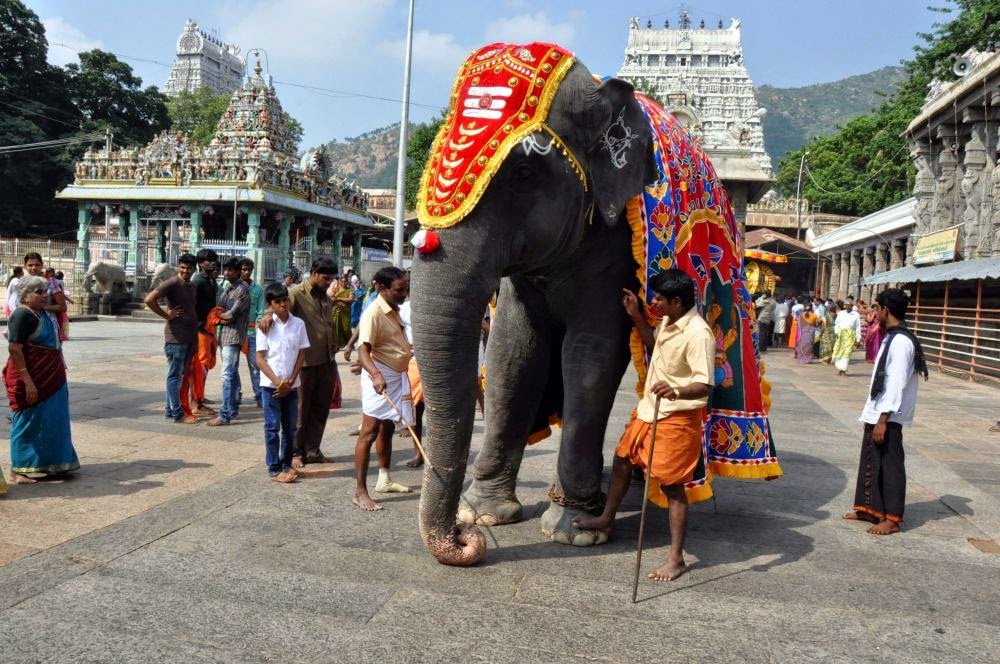
Rukku - Our Prized Temple Elephant leading the Panchamoorthies
|
|
After conclusion of the ceremony the
Panchamoorthies were taken around the perimeter streets surrounding the
Temple (mada veedhis) and then installed in the Kalyana Mandapam located
in the third prakaram of Arunachaleswarar Temple - and Diparadhana took
place.
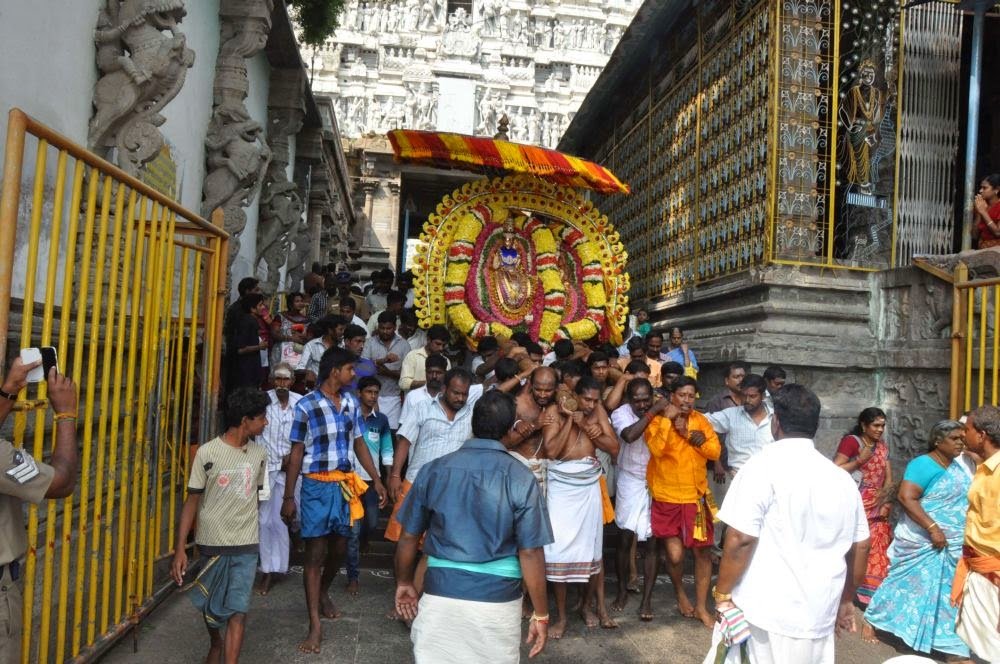
Carrying the Gods through the Temple
In this and other processions throughout the Festival, the
Panchamoorthies are: Vinayakar, Lord Annamalaiyar, Goddess Parashakti,
Lord Subramanya and Sri Chandikeswarar (representing all devotees).
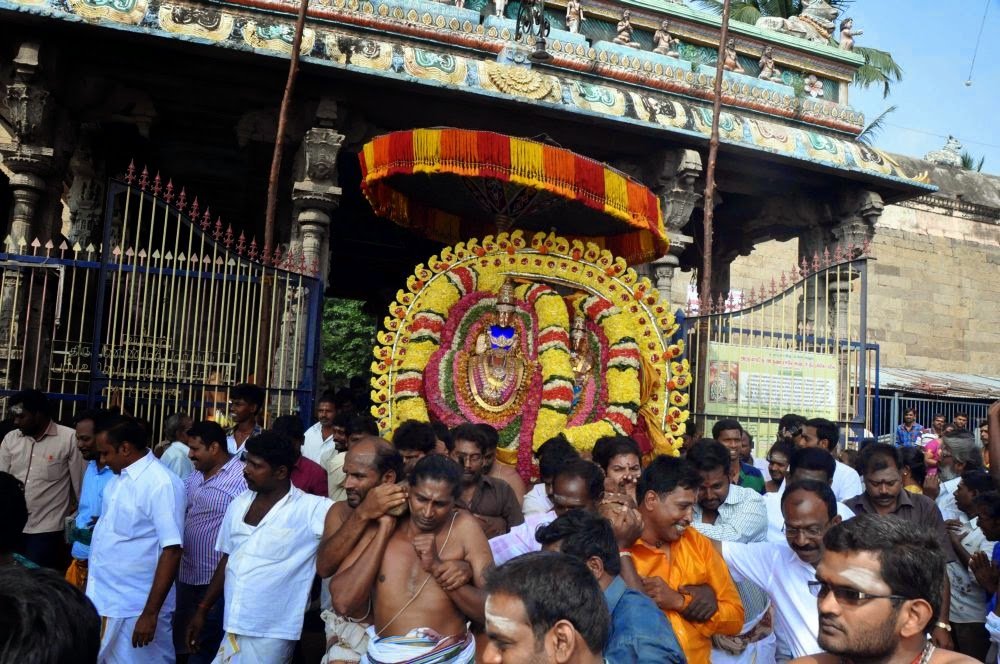
Exiting Temple through Thitti Vassal Gate next to Rajagopuram
Chandikeswarar
Below information about Chandikeswarar and why he follows the other murtis (idols) as their steward.
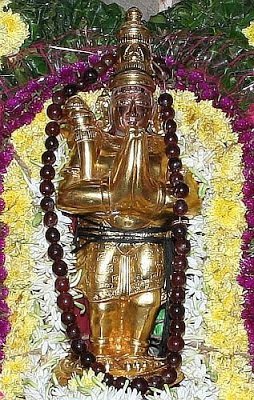
Chandikeswarar idol Arunachaleswarar Temple
"Chandikeswarar, a devotee of Lord Shiva was born in the village of
Seynalur on the banks of the river Manni in the Chola country. He was
given the name of Vicharasarman.
He was the son of the pious and learned Brahmin Yajnadatta.
Vicharasarman was of great intelligence. One day when the lad was going
to school, he saw a cowherd brutally assaulting a cow. Angry at the
behaviour of the cowherd, young Vicharasarman took upon himself the duty
of tending the cows of the village, to which the villagers acceded.
From that day the cows looked happier and yielded more milk. More than
the cow's udders could hold. Vicharasarman, seeing that the milk was
being wasted, collected it in vessels, set up lingams made of sand and
poured this excess milk to bathe the Shiva Lingas with intense piety.
The cowherd who had lost position on account of this Brahmin boy, saw
him in this act and found this a good cause for denouncing him. He
immediately brought it to the notice of the village elders as well as
Yajnadatta, Vicharasarman's father. The father saw his son pouring milk
on small sand mounds and without investigating, kicked one of the Lingas
in anger. Young Vicharasarman came out of his reverie and cut off the
leg of his father with an axe with which he had kicked a linga.
Shiva was pleased with the devotion of this boy and he appeared in
person along with Parvati his consort, before the boy. Shiva embraced
him and made him in charge of his ganas (devotees or followers). He was
also made the steward of his household, naming him
Chandikeswarar."
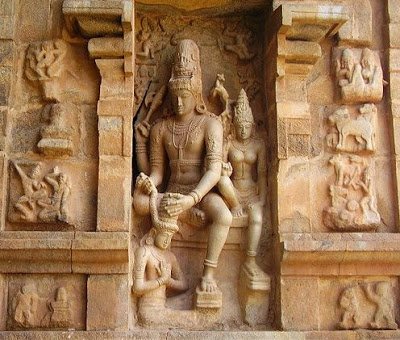
Gangai Konda Cholapuram Temple
"Siva seated on a throne with four arms carries axe and antelope in his
upper arms; with the lower hands the Lord is seen crowning Chandesa with
a garland of flowers, a symbol of affection and stewardship. Chandesa
is seen seated in front and with folded arms receiving the pride of
place bestowed on him by his Lord.
Chandesa is the embodiment of devotion and piety and the place he
attained is considered the highest, a Shiva devotee can achieve. It is
called the Chandesa padam, the abode of deliverance. According to Saiva
Siddhanta Siva bestows this grace, in the company of Shakti, His
consort. In the sculpture at the Gangai Konda Cholapuram Temple, Parvati
is seated by the side of Her Lord.
On the side walls is shown the story of Chandesa; Chandesa worshipping
Siva as a Linga; the cows standing by the side; his father watching the
happenings hiding himself behind the branches of a tree; disturbing
Chandesa's worship; perturbed Chandesa throwing his axe at his father
and Siva bestowing grace on both."
[By Dr. Nagaswamy]
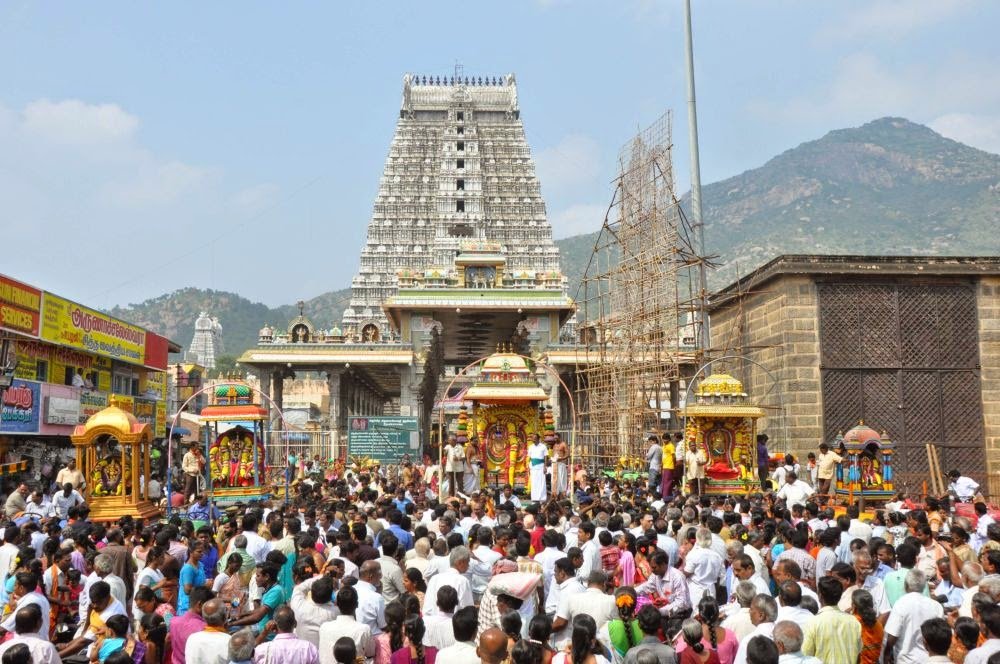
Panchamoorthies Darshan
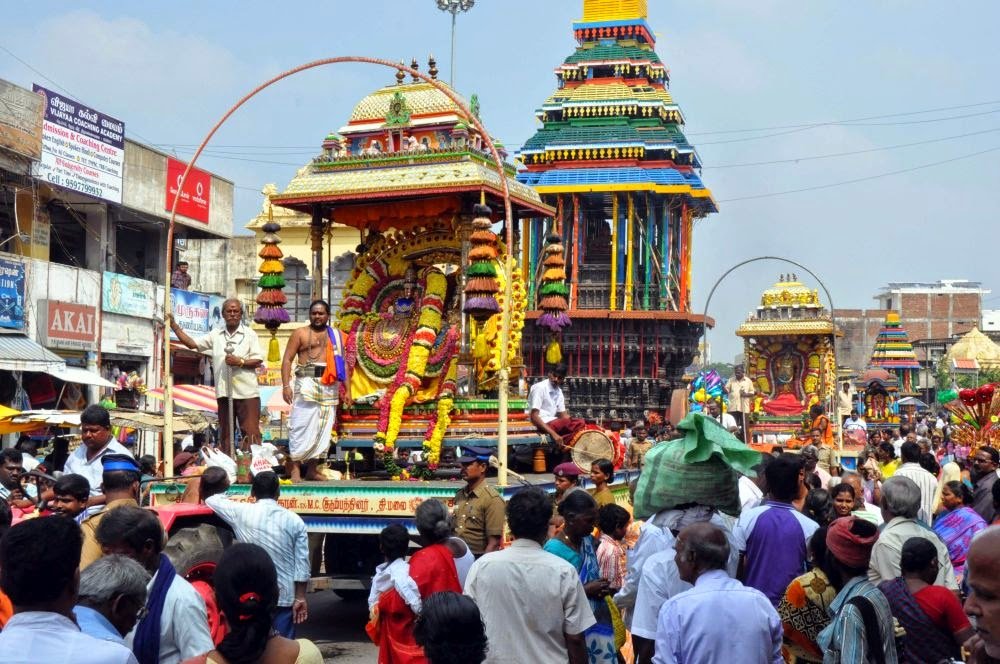
Procession of Panchamoorthies around Temple
2014 Deepam Festival. Day One - Evening: Adhikara Nandi Vahana
There are two types of Nandi (Nandikesvara) statues at Siva Temples, the
more common is that of the reclining bull (rishaba) and the other is
that of Adhikara Nandi. In the case of Arunachaleswarar Temple the
Adhikara Nandi of last night's function is in the form of a bull-headed
human standing on two legs.
Adhikara Nandi's two back hands hold a parasu (battle axe) and mrga
(antelope) and the two front hands are folded on the chest in a pose of
obeisance. Since he is the chief of the ganas (retinues) of Siva,
exercising his authority (adhikara) over them, he is christened as
'Adhikara Nandi.'
There are different accounts as to the origin of this manifestation.
Desirous of a son, a sage named Salankayana, propitiated Lord Vishnu,
who granted his wish by producing a boy exactly resembling Siva from the
right side of his body. He was named Nandikesvara. According to another
account, a sage called Nandi obtained the status of a Deva and the
headship of the ganas of Siva by propitiating him. A third account
depicts Adhikara Nandi as emerging from the yagasala (sacrificial shed)
of the blind sage Silada, in the form of a young lad resembling Siva,
thus bringing 'nandi' or joy to him. Silada adopted him as his son.

Panchamoorthies Deeparthana
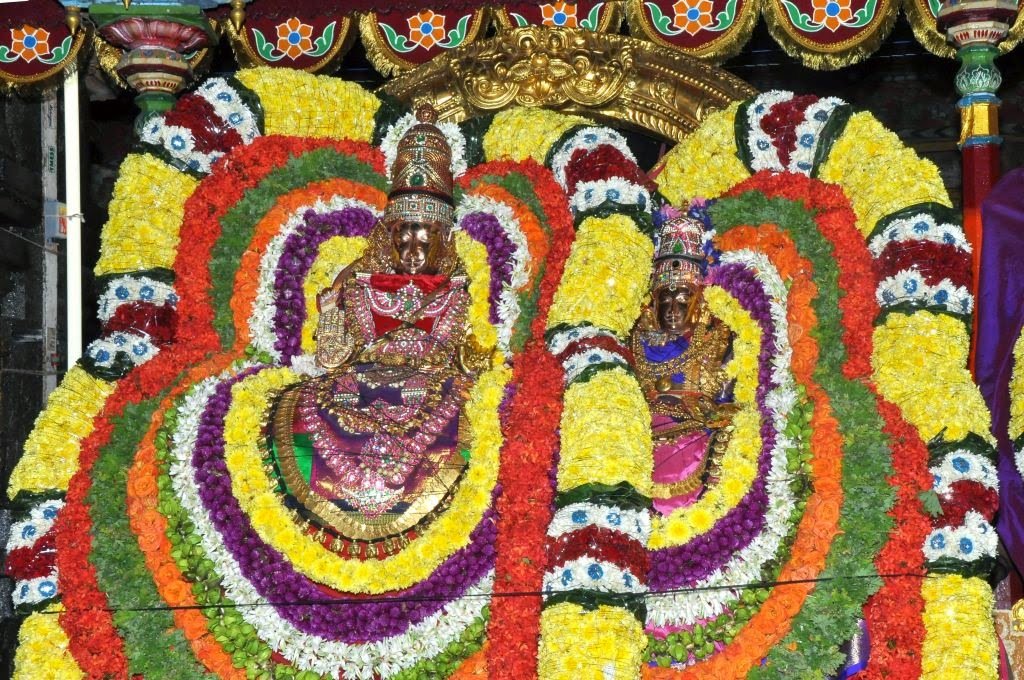
Arunachaleswarar
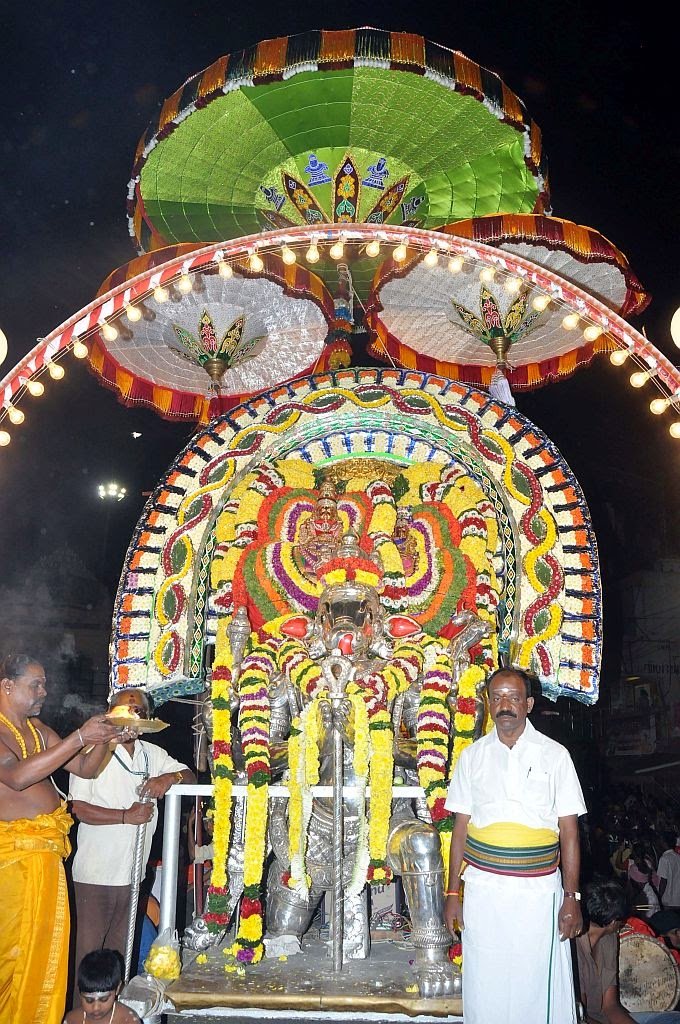
Arunachaleswarar on Adhikara Nandi Vahana
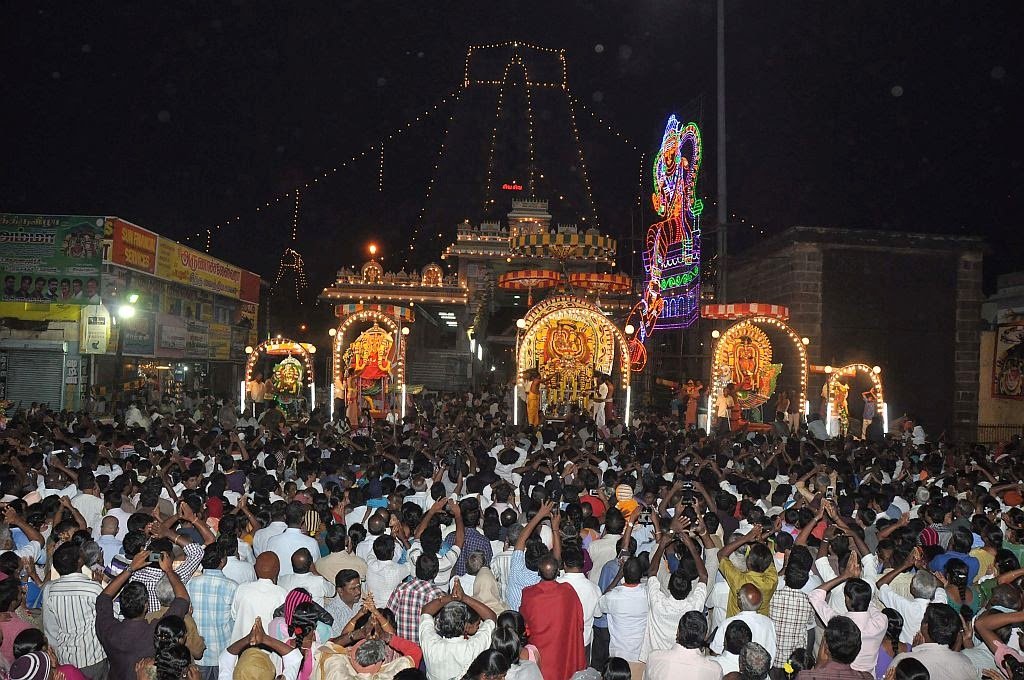
Panchamoorthies darshan front of Arunachaleswarar Temple
|
|
|
|



