
Durgai Ursavam - November 23, 2014
The Brahmostavam of Karthigai Deepam Festival at Tiruvannamalai is not
confined to the Temple alone but involves the whole town. The rituals
and ceremonies connected with it have endured for centuries. On the
first 3 days of the 17 day Festival, various functions occur beginning
on the first pre-Karthigai Deepam day at Durga Amman Temple,
Tiruvannamalai. The days after the 10 day Festival, include the God
Theepal on Ayyankulam Tank (opposite Arunagirinathar Temple), and Hill
rounding by the Gods to give darshan and blessings to those who live
around the Hill.
The first of the three days of functions pre-Karthigai Deepam are dedicated to Goddess Durga and start with Durga Ursavam.
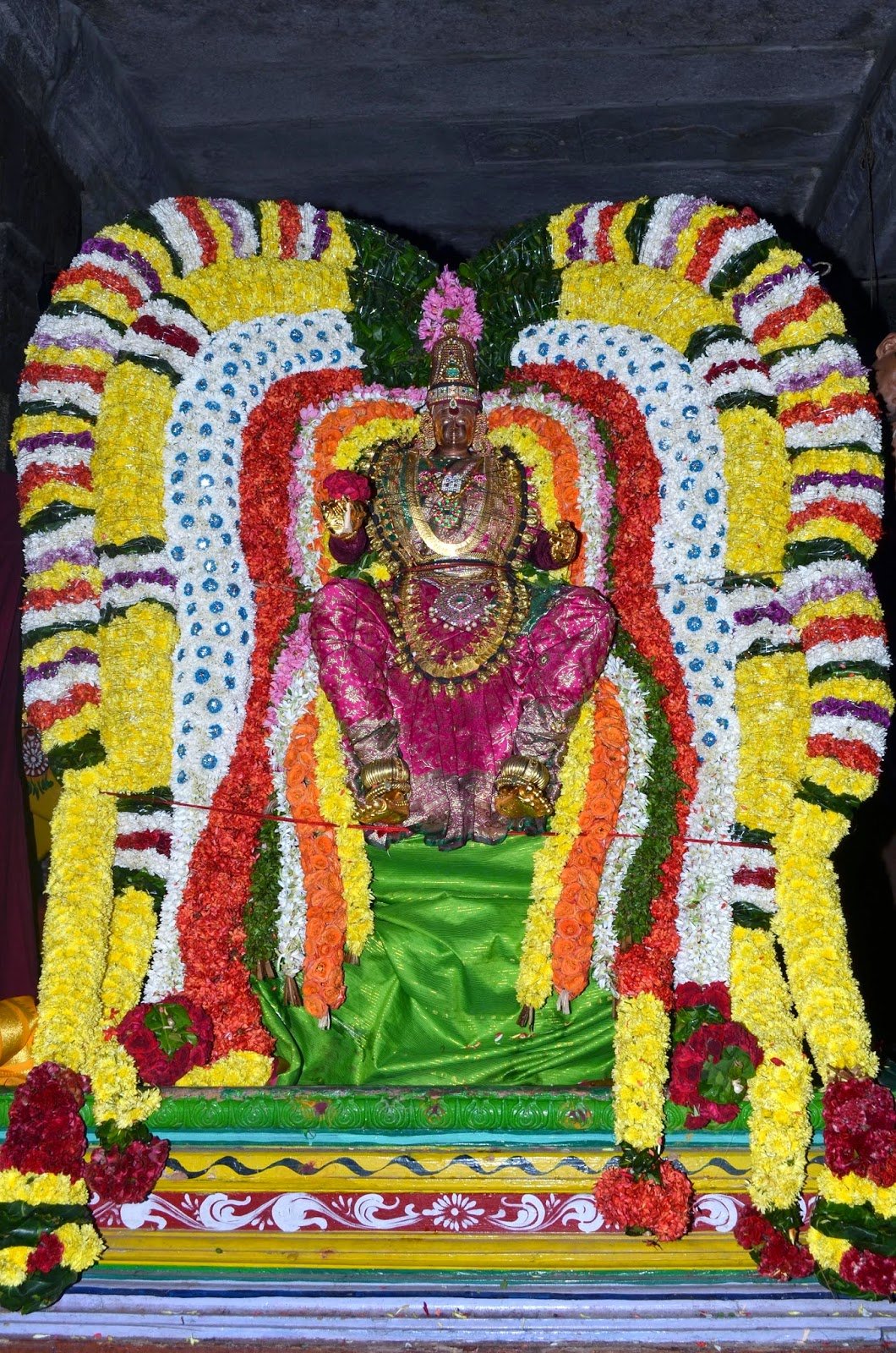
Goddess Durga Amman
|
|
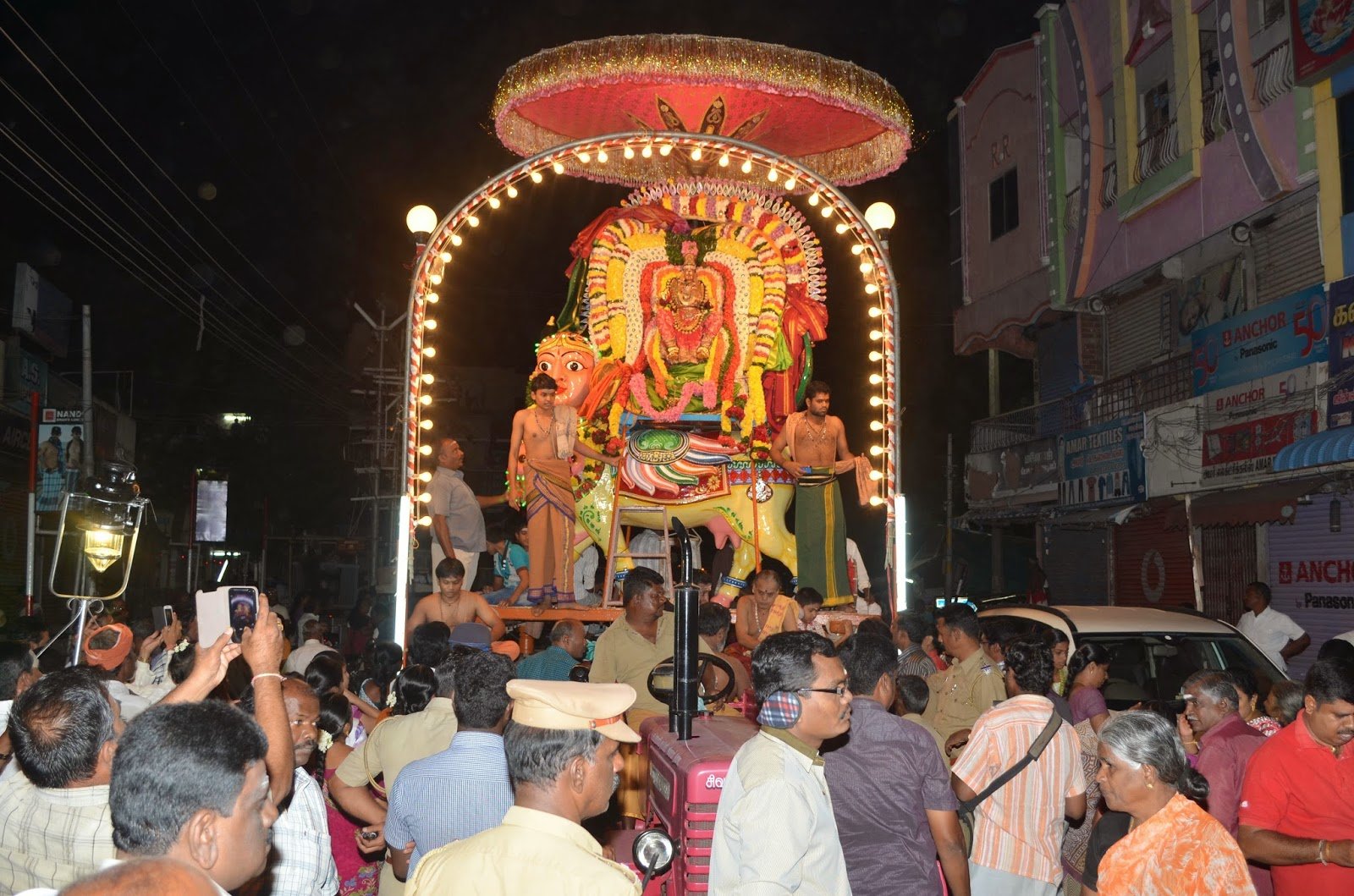
Goddess Durga on Kamadhenu Vahana
The reason for the unique connection with the Goddess at Durga Amman
Temple to the Karthigai Festival is believed to be because of the
Goddess and her fight with the demon Mahisha.
In the Mahishasura legend, before fighting with the demon, the Goddess
appointed four noble Bhairavis (celestial damsels) to keep watch on all
four sides of Arunagiri. Ordering, that:
"Admit only those who have come to worship Arunachala and are
tired, hungry and thirsty. Others should not enter. She then appointed
strong men to guard the boundaries of Arunachala and continued Her
penance at Her ashram."
[The Glory of Arunachala]
In accordance with the mythology of Arunachala, Durga is recognised as a
Guardian of Arunachala and thus a precursor of the Deepam Festival is
always a celebration of this aspect of the Goddess.
The Deepam itself which is lit on the night of Mahadeepam, (depending on
the advice of Priests consulting astrological texts) will remain alight
for a minimum of 7 days to a maximum of 13 days. This year the lighting
will take place on December 5, 2014.
The main Festival lasts for 10 days and begins with flag hoisting
(dhwajarohanam) marking the beginning of festivities. After this
ceremony, the image of Arunachaleswarar along with other deities are
installed in the Kalyana Mandapam to enable devotees to have darshan.
Processions occur both day and day inside the Temple and around the outside perimeter of Arunachaleswarar Kovil.
Pidari Ursavam, 2014 Karthigai Deepam Festival
The Pidari Amman Shrine is located in the Third Prakaram of
Arunachaleswarar Temple. In front of the Shrine a stone trishul
(trident) stands. In the evening of 25th November, 2014 Pidari Ursavam
was observed at the Shrine.
Goddess Pidari is Kali in a rural setting and regarded as being a
consort of Siva. Pidari is the ferocious aspect of Amman. The Mother
Goddess gives life but Kali takes life. Goddess Pidari is the feminine
form of Kala - time. Kali is the energy or the power of time. Her
blackness swallows all that exists and the emptiness of space is her
clothing, for when the Universe is dissolved, the power of time remains
without maya (veil).
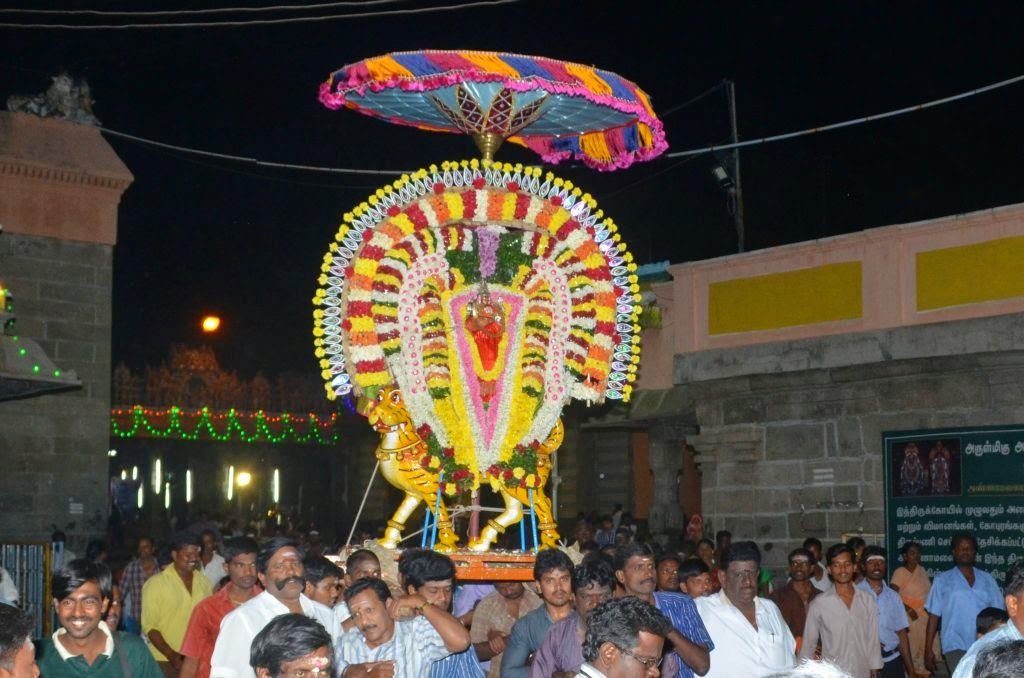
Procession to the Goddess Shrine
Kali's extension, Pidari and her worship; evolved as a fighter and
warrior and gained importance with the influence of Tantrism where she
is known as Kala Pidari. The Pidari Goddess, in line with Shakti
manifestations, emphasises fierce symbolism. At times Pidari is the sole
resident deity in a village. As devata, She is the all-in-all for the
village from simple prayers to Divine blessings. Otherwise she watches
over the main deity of a temple in her role as 'kaval deivam' while
taking her seat in a structure on the right hand side of a temple
entrance. She joins the 'kavaldeivam' or Protection Gods' similar to
that of Ayyanar, Muniandy, Karuppana Swamy or Veerabhadra, all of whom
are warrior-protection village gods.
Pidari shares Kali's attributes and is depicted holding a noose,
trident, skull cup and a pointed knife. The noose is sometimes replaced
by ankusha - the elephant goad. The damaru that she holds is
entwined by a snake, thus sharing Siva's characteristics. She has
flaming hair and three eyes. Sometimes her breasts are decorated with
snakes. She has a terrifying appearance with long incisor teeth to
frighten off evil spirits. Her sculptures are sometimes synonymous with
Goddess Mariamman and lime strung as a garland - 'elumichai malai' is her
favourite.
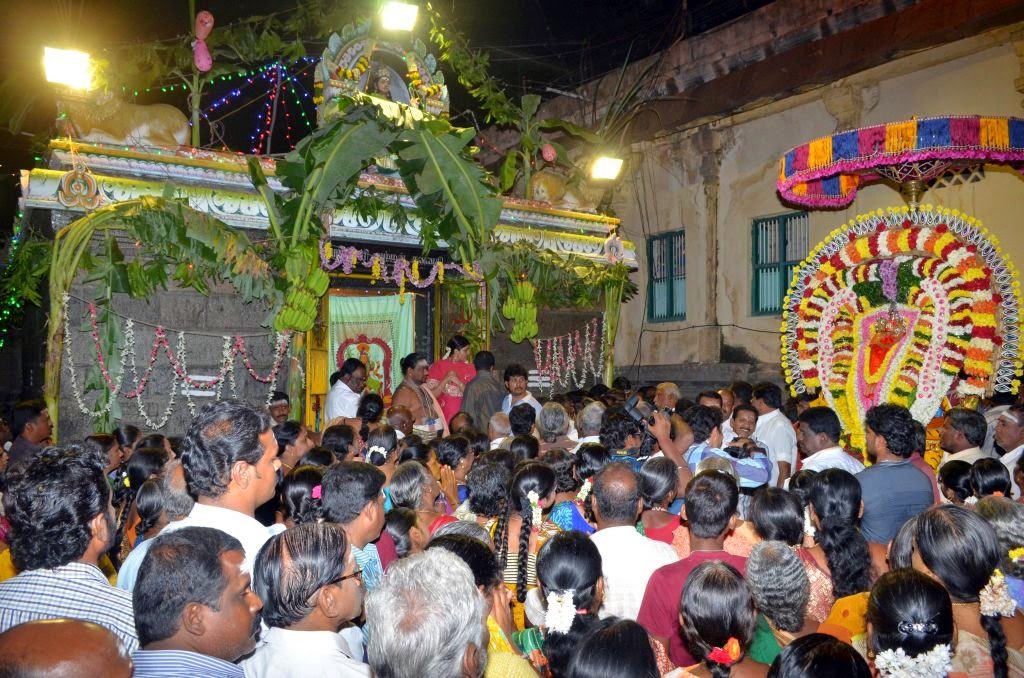
Pidari Shrine, Third Prakaram, Arunachaleswarar Temple
Goddess Pidari is also represented by a simple stone image called
'veerakkal' symbolising courage and venerating 'veerarghal' - the
warriors. Pidari is part of many Amman temples. In rural settings, it is
believed that Pidari is the combined form of Lord Shiva and Shakti.
'Adanghaa Pidari' is another Tamil description of Goddess Pidari.
'Adanghaa' means 'one that cannot be controlled' implying, Pidari, once
provoked does not subside her anger soon.
In the famous legend of Daksha's yajna in which Daksha ignores Lord
Siva. Dhakshayani attends the yagna and feels vexed to see that her
father had invited all the gods (including Vishnu and Brahma) but failed
to invite Lord Siva - thus insulting Him. For this, Dhakshayani
enters the yajna fires after cursing her father Daksha. Narada carries
the news to Lord Shiva and the Great Lord shakes the earth. Sweat from
his body falls down and Lord Veerabhadra and Pidari Badrakali emerge
from it and are ordered to destroy the yajna and kill Daksha. Which they
do but upon the intercession of the Devas and Gods (who beg for
Daksha's life) the head of a goat is attached to his body and he is
revived and thereafter begs forgiveness from Lord Shiva.
Vinayakar Ursavam, 2014 Karthigai Deepam Festival
There are three days previous to the beginning of the 10 day Karthigai
Deepam Festival. The first pre-day celebrates Durgai Utsavam, the second
day Pidari Utsavam and the third and final day observes Vinayakar and
Chandikeswarar Utsavam.
The panchamoorthies taken in procession throughout the celebratory
Karthigai Deepam Festival are: Vinayakar, Arunachaleswarar-Unnamulai,
Amman, Kartikeya and Chandikeswarar.
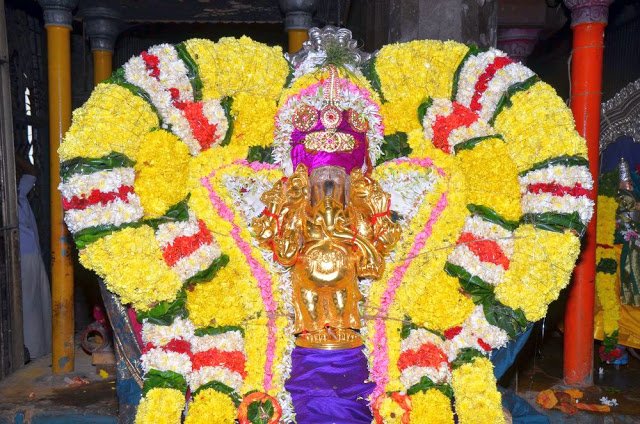
Vinayakar
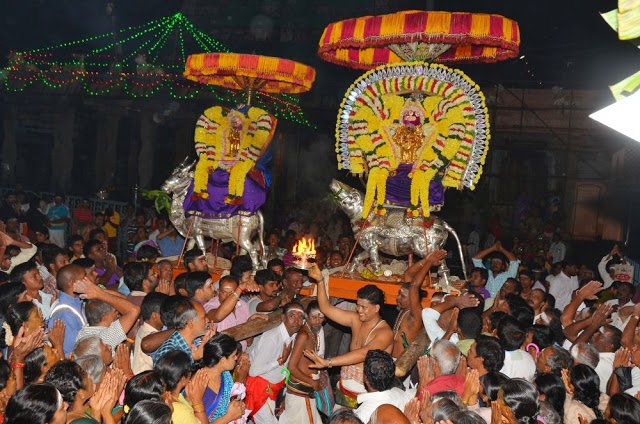
Vinayakar and Chandikeswarar Utsavam
|
|
|
|



