
Four Great Teachers
"There have been many 'intellectuals' even in India who have looked down
upon the path of Bhakti (devotion) as something inferior to Jnana
(wisdom). Their short-sightedness becomes at once apparent when we study
the lives of the great Four Teachers (Sambandar, Appar, Sundarar, and
Manikkavacakar) and realise that these great Jnanis, too, were great
Bhaktas who loved to visit Temples and sing the glories of the Lord.
The principal teachings of the four Saiva Samaya Acharyas is of love and
surrender to God; and of service to God and godly men. And it is only
through love, devotion, and service to God that one can obtain His
Grace. God is One and He is Shiva. Man must get over his bonds which
keep him in ignorance and obtain inseparable union with Shiva through
the Lord's Grace
|
|
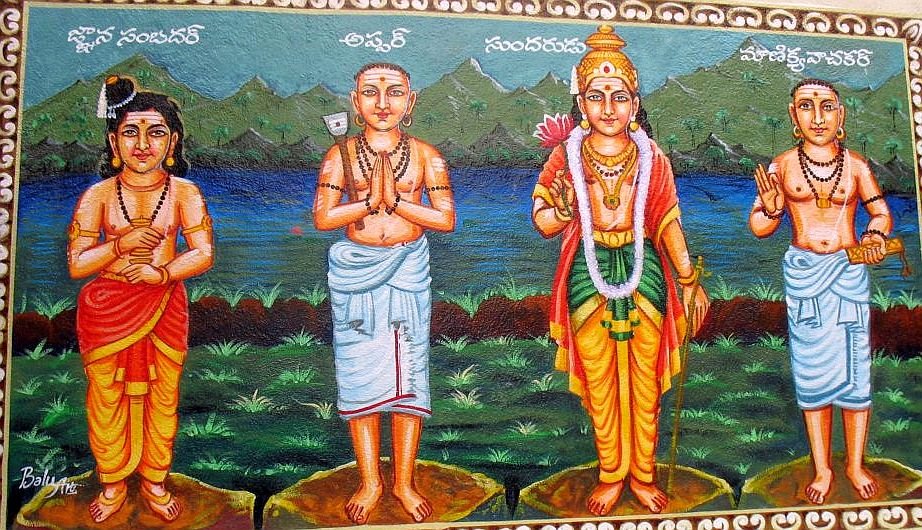
Left to Right: Thirujnana Sambandar, Thirunavukkarasar Swami,
Sundaramurthi Nayanar, Manikkavackar
[Extract by Venkatesananda]
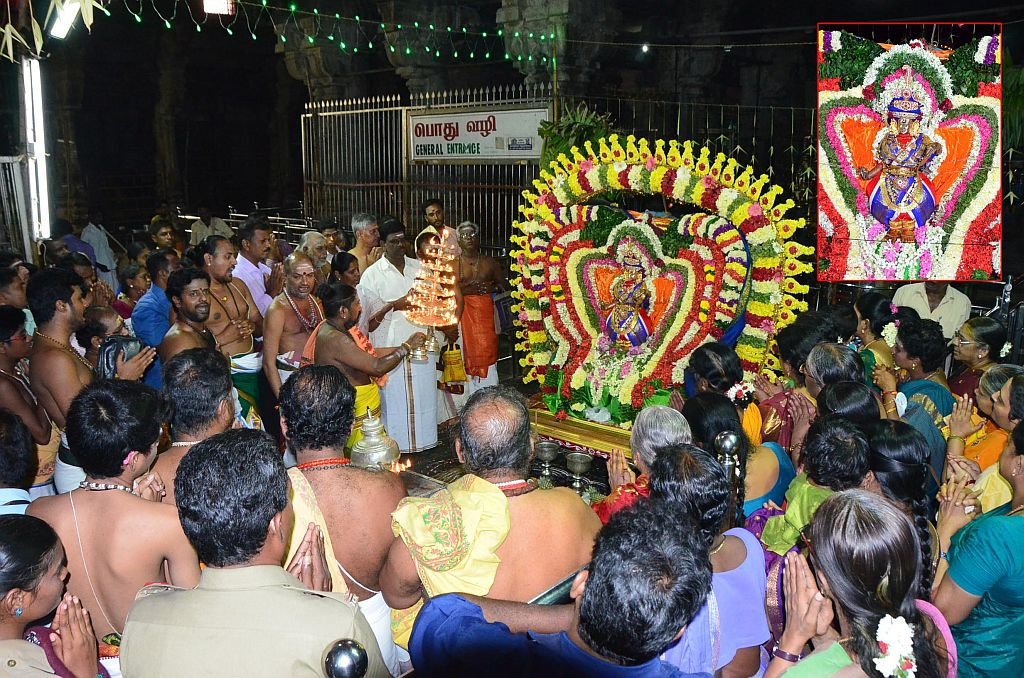
Sundaramurti Nayanar Utsavam, Big Temple
As well as individual ceremonies of worship and celebration for each of
the four great saints at Tiruvannamalai, the Saiva Samaya Acharyas are
also recognised during the yearly Deepam festivities at Arunachala. This
observance occurs during the 6th day of the 10-day Festival when murtis
of the Nalvar Samaya Acharyas and representations of all the Nayanars,
are brought out in procession around the maha veedhis of
Arunachaleswarar Temple.
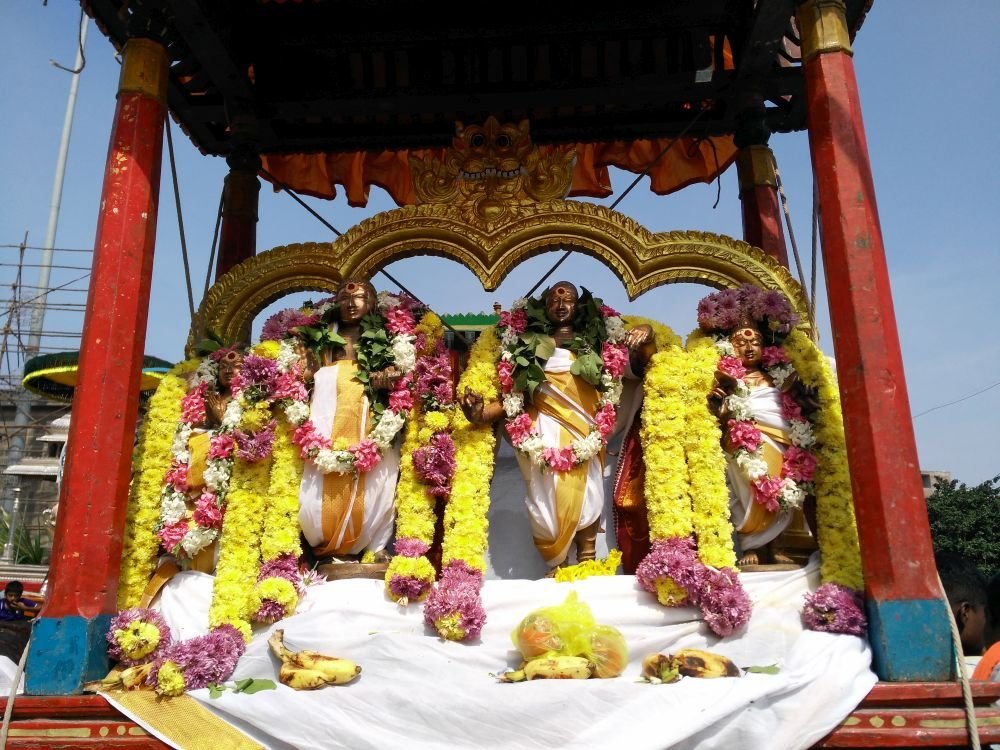
Saiva Samaya Acharyas carried in procession
6th day of Karthigai Deepam
These Kuravarkals of Saivism took birth in the world to show the path of
elevating oneself to the Supreme Shiva. There is a well known statement
that declares that these four great ones, (Jnanasambandhar, Appar,
Sundaramurti and Manikkavacakar) had differing relationships with Shiva:
Jnanasambandhar saw himself as the son of Shiva, Appar as his servant,
Sundaramurti as his friend, and Manikkavacakar as his beloved.
The Nalvars were the spearheads of a revolutionary movement in matters
religious and spiritual in the south. A decadence had set in, and
apostles of Buddhism and Jainism found the opportunity to seize peoples'
minds with their tenets and beliefs. Soon they made converts of the
kings of the land, after which the conversion of the people was but the
enforcement of a royal decree. People were torn and confused and these
four Great Saints came as the leaders of a spiritual renaissance in
Tamil Nadu, to restate the great truth - the perennial philosophy, and to
lead people towards Godhead.
It is customary to observe the day on which these Saints attained the
Lord's Feet, as a holy day. Given below are such days in respect of the
Four Great Saivite teachers, with their holy days, according to the
Tamil Calendar.
| Apparswami |
|
Chitrai Sadayam |
| Jnanasambandar |
|
Vaikhasi Moolam |
Manikkavacakar
|
|
Ani Makham |
| Sundaramurthi Swamigal |
|
Adi Swathi |
Tamil Nadu Spiritual Works
Spiritual works are divided into Thoththiram and Saaththiram, i.e.,
Hymns and Works on Doctrine respectively. Among the Thoththirams the
first in point of time and merit too is The Tiruvacakam. This and the
Thirukkovaiyaar by Manikkavacakar, are placed by scholars in the 3rd
century A.C. They top the list with 658 and 400 stanzas respectively,
and are followed by the first seven Thirumurais, the devotional works of
Thirujnana Sambandar, Thirunavukkarasar (both contemporaries in the 7th
century A.C) and that of Sundarar of early 9th century. These form the
bulk of the twelve Thirumurais and contain between them 8328 stanzas.
These saints visited between them more than 250 cities, towns, villages
and hamlets of what was then Tamil Nadu, i.e. the land lying between
Venkata Hills (near Tirupati which is now in Andhra Pradesh) in the
North, Cape Comorin in the South, the Arabian Sea in the west and the
Bay of Bengal in the East.
The Tenth Thirumurai, the Thirumandiram, a hand-book on Yoga, comprises
3000 stanzas. This work and the Tiruvacakam, form the fountain-head for
the doctrines of Caiva-Siddhantha. The 12th and last Thirumurai, the
Thiruththondar Puranam, more well known as the Periyapuranam of 400
stanzas is a hagiography of the best known saints of Tamil Nadu (up to
the date of its compilation).
(Extract from G. Vanmikanathan)
|
|
|
|



