
Thirujnana Sambandar Life
Sambandar Visit to Arunachala
Emissary at Tiruvoodal Festival
Thirujnana Sambandar Life
Thirujnana Sambandar was a Saiva poet-saint of Tamil Nadu who lived
around the 7th century. He is one of the most prominent of the
sixty-three Nayanars, Tamil Saiva bhakti saints who lived between the
sixth and the tenth centuries. Sambandar's hymns to Shiva were later
collected to form the first three volumes of the Tirumurai, the
religious canon of Tamil Saiva Siddhanta. He was a contemporary of
Appar, another Saiva saint.
Sambandar took birth in a Brahmin family in Sirkali in the district of
Tanjore which is also known by the name Brahmapuri. His parents were
Sivapada Hridayar and Bhagavathiar.
|
|
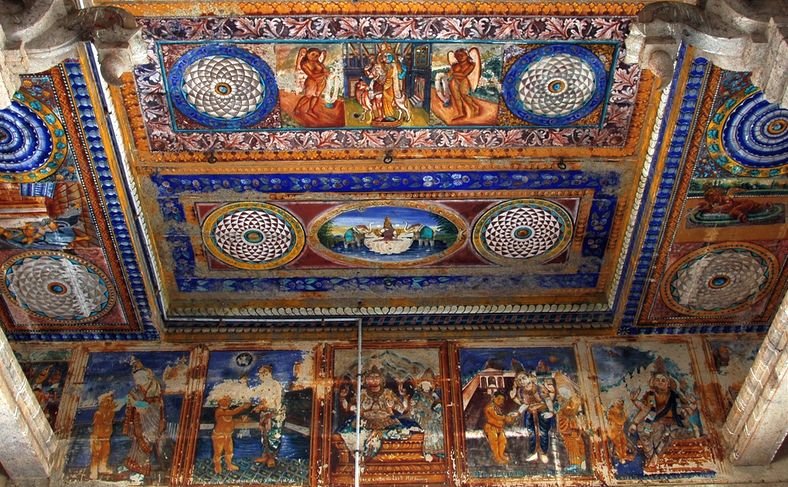
Brahmapureeswarar Temple, Sirkali fresco of Sambandhar's life
At that time apart from Saivism; Jainism and Buddhism were among the
popular faiths in South India. Even though the forces of Jainism were
very powerful, both Sivapada Hridayar and his wife as ardent devotees
of Lord Siva refused to give up Saivism and embrace Jainism.
Sivapada Hridayar prayed to the Lord for the boon of a son who would
re-establish Saivism. The Lord granted this boon, and soon a male child
was born. One day the parents took the child, who was then around three
years old, with them to the Temple tank and left him on its bank so they
could bathe. In response to the child's crying the Lord and Goddess
Parvati appeared before him. The Goddess fondled the child and suckled
him with her Milk of Wisdom. His father saw drops of milk on the child's
mouth and asked who had fed him, whereupon the boy pointed to the sky
and responded with the song Todudaya Seviyan, the first verse of the
Tevaram. From that moment the child was known as "Aludaiya Pillayar" or
one who enjoys the protection of the Lord: and also as "Tirujnana
Sambandar" as he attained divine wisdom through the grace of Lord Siva
and the Goddess Parvati.
From the moment he drank the Milk he began to compose and sing songs in
praise of Lord Siva; the collection of these songs are called Thevaram.
At his investiture with the sacred thread, at the age of seven, he is
said to have expounded the Vedas with great clarity. The ancient texts
say that Sambandar brought two people back to life by singing hymns to
them.
The child, accompanied by his father, went on pilgrimage to various
Temples throughout South India, where the boy would compose and sing
songs of praise to Lord Shiva. When Tiru Neelakanta Yazhpanar, an ardent
devotee of the Lord and an expert musician on the Veena met Sambandar.
Sambandar requested Yazhpanar to play. The music melted the heart of
Sambandar. Yazhpanar wanted to be always with Sambandar and to play
hymns in praise of the Lord. Sambandar went on pilgrimage to Chidambaran
where The very sight of the Lord entranced him. He had heard about the
greatness of the Brahmins of Tillai (Chidambaram). To him, they actually
appeared as Siva Ganas (celestial servants of Lord Siva).
Information about Sambandar comes mainly from the Periya Puranam, the
eleventh-century Tamil book on the Nayanars that forms the last volume
of the Tirumurai, along with the earlier Tiruttondartokai, poetry by
Sundarar and Nambiyandar Nambi's Tiru Tondar Tiruvandadi. The first
volumes of the Tirumurai contain three hundred and eighty-four poems of
Sambandar, all that survive out of a reputed more than 10,000 hymns.
Sambandhar says in one of his Padigams: "O foolish man, do not allow
days to pass. Serve Lord Siva who has a blue neck. Hear His praise.
Meditate on His form. Repeat always the Panchakshara. Live in the
company of devotees of Siva. Serve them. His name will remove all evils
and dangers . . . Worship Lord Siva, He will confer on you eternal bliss
and immortality".
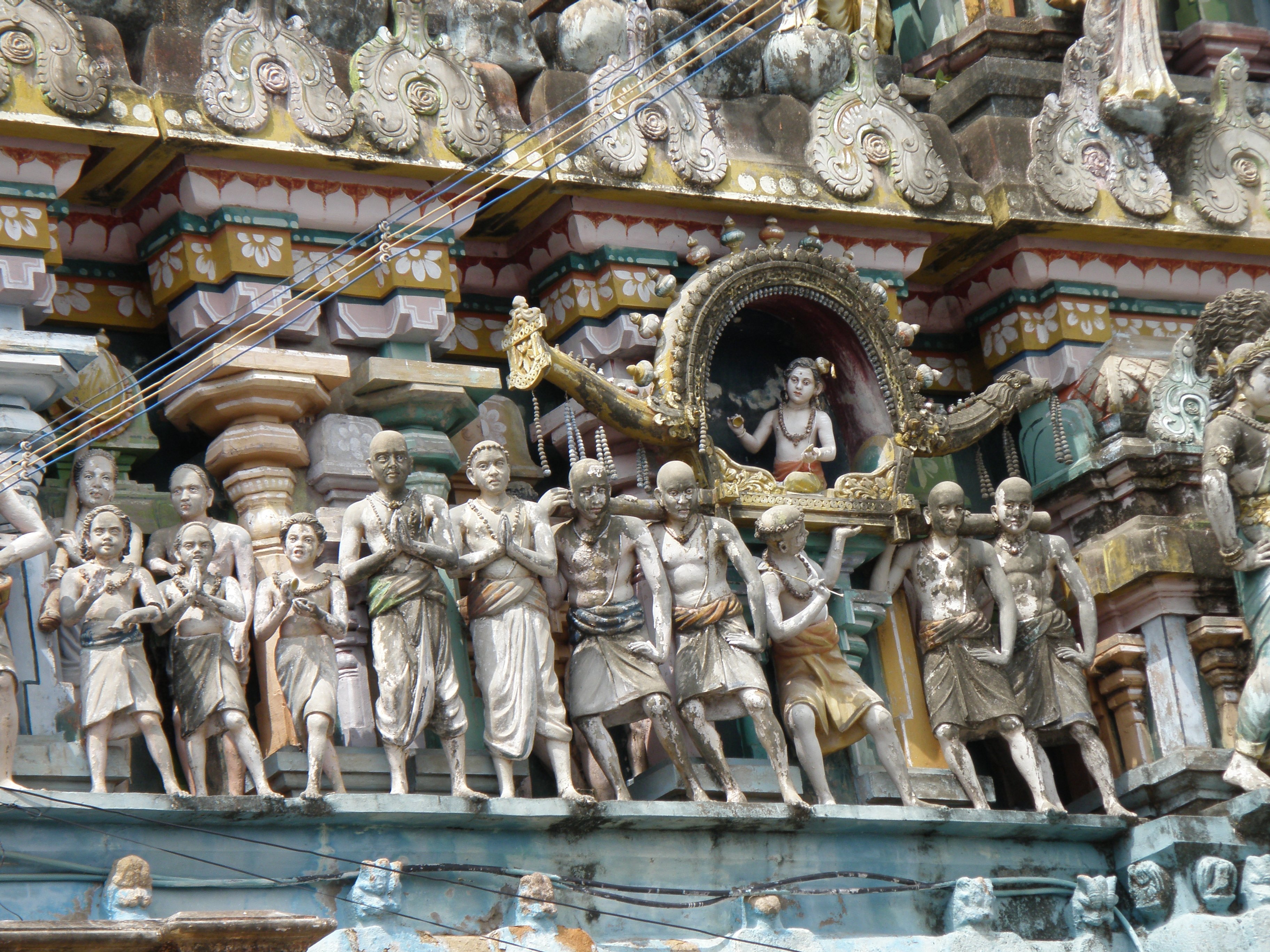
Appar helping to carry Sambandar's palanquin
One time when Appar Swamigal was at Tirupoonthurithi, Sambandar went to
meet him. Appar got mixed with the crowd and joined a group of devotees
carrying Sambandar's palanquin. When Sambandar enquired about Appar,
Appar responded from below: 'Here I am, carrying the palanquin, due to
the virtuous deeds of many past lives.' Sambandar jumped down and
embraced the great saint Appar.
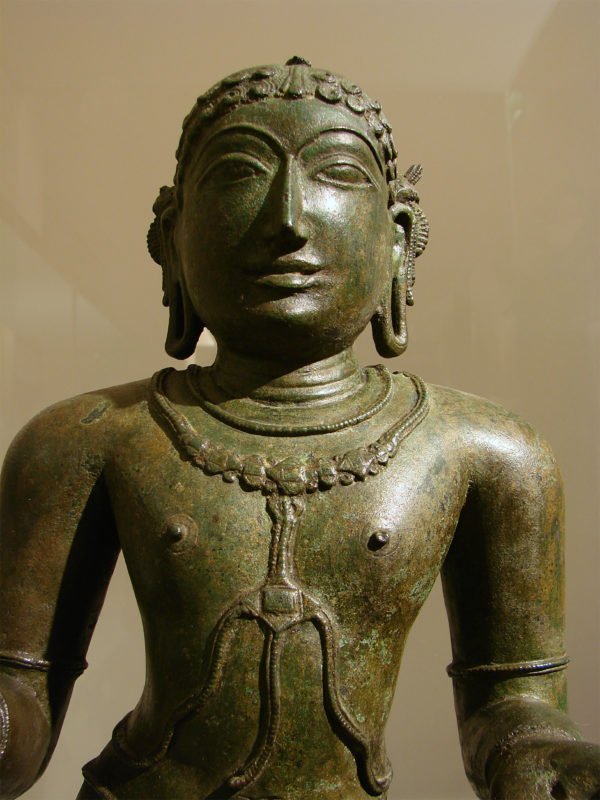
Thirujnana Sambandar Nayanar
After visting a number of shrines, Sambandar eventually returned to
Sirkalii. He had reached his sixteenth year. His father wanted to get
him married. The wedding was to take place at Nallur Perumanam. On the
appointed day, Sambandar reached Nallur Perumanam, went to the temple,
worshipped the Lord and got His blessings. The couple went into the
temple and Sambandar sang a Padigam praying for Liberation. The Lord
granted his wish and said: 'Oh Sambandar, you, your wife, and all those
who witnessed your marriage will merge in the Siva Jyoti and come to
Me.' At once, an effulgent Light emerged from the Lord. Before merging
in that Light, Sambandar sang a Padigam known as the Panchakshara
Padigam. Then all those who were there merged in the Light of Siva.
Sambandar Visit to Arunachala
In an English translation of the Arunachala Mahatmyam, Sri Thirujnana Sambandar's pilgrimage to Arunachala is recorded thus:-
Upamanyu said: When Tirujnanasambandha (one of the four great Tamil
saints) was staying at Tiruvarayaninallur (adjoining Tirukkoilur)
adoring the Lord there, some of his followers pointed out Arunachala
standing majestically at a distance. The child saint spontaneously
composed a hymn of ten stanzas beginning with the words: "Unnamulai
Umayalodum', meaning, the Lord who is accompanied by Uma known as
Unnamulai.
The child saint was looking for someone who would show him the way to
Arunachala and saw an old Brahmin gathering flowers. He was moved by the
sight of the old man and asked him respectfully, in a voice choked with
emotion, "where have you come from? What is your place? Why have you
come here?" The old man replied, "I have come from Arunachala. That is
where I live. I have come to gather flowers for the Lord." At this,
Jnana Sambandar asked him, "How far is Arunachala from here? Is it a
small wood or a big forest? Kindly lead me for I do not know the way."
The old man said, "Yonder is the Hill. It is not very far. I am old but I
come here everyday and return with flowers required for the morning
worship of the Lord. I shall take you there quickly by a good path"
Sambandar followed him along with his retinue. When they reached the
precincts of Arunachala the old Brahmin who had been leading them
suddenly disappeared. The Brahmin was none other than Arunachala leading
his child to His abode.
In accordance with the Lord's command, His bhutaganas appeared as
hunters and robbed Jnana Sambandar and his followers of their personal
possessions. The Saint thought: Alas! I cannot find the old Brahmin who
was leading the way, our only recourse now is to pray to the Lord who
grants wealth and joy. When he sang the praise of the Lord, the
extremely compassionate Arunachala appeared mounted on Nandi along with
His consort. When Sambandar saw the Lord, he sang melodious hymns
praising the Lord with great devotion and overflowing love.
The Lord with great affection and in a reverberating voice said: Child!
Because of my love for you I wanted you to come to Arunachala which is
my eternal abode. Hence I assumed the form of an old Brahmin and came to
the garden at Arayaninalloor in the guise of plucking flowers for the
Lord's puja. Upon my orders, bhutaganas took away your possessions. The
belongings of your followers shall be returned. A feast shall be set
before you and your followers so that your hunger may be appeased.
Sambandar and his followers got back what they had lost and a veritable
feast was set before them. The Lord bade the child Saint to come to His
temple. In ecstasy, Sambandar approached the Lord's Temple whose mighty
towers were visible from afar.
In every house the chanting of the Vedas could be heard. Great
hospitality was shown to the guests by the residents of the holy city of
Arunachala. In the streets around the temple of Arunachala; sounds
accompanying the celebration of the festival for the deities could be
heard, yagas were performed, deities were brought out of the temple on
procession accompanied by elephants, horses and chariots. Sambandar saw
tapasvis deeply absorbed in the bliss of Siva. The city of Arunachala
was flourishing; with scholars well versed in the Vedas and sastras and
bodies radiating with the glow of intense tapas, devotees with
Arunachala's name on their lips, wearing rudraksha and bodies smeared
with vibhutti, jnanis uncaring for the state of Brahma and yogis
immersed in their Heart in perfect bliss.
After passing the streets on either side of which stood many storied
buildings, Sambandar reached the Temple of the Lord. Sambandar entered
the Temple replete with courtyards and majestic walls. With profound
devotion and love for Arunachala he reached the sanctum sanctorum and
surrendered himself. He circumambulated the Lord and the Goddess
Apitakuchamba. He adored the Lord and paid his homage by praising Him
with a decad beginning with the word 'Poovar malarkondu'.
He resided in the vicinity of Lord Arunachala for a few more days
singing decads praising gloriously the Lord and the Hill of Arunachala.
Sambandar and his followers left Arunachala after seeking the Lord's
blessings and continued their journey.
Emissary at Tiruvoodal Festival
"Thiruvoodal Festival is celebrated in the month of Thai approximately
on January 16th during Pongal (which has to do with the movement of the
sun from the southern to the northern hemisphere). Legend has it that
the Lord in answer to a promise given to Parvati appears on this holy
day (Uttarayana) to dance on one foot. He says; 'On Uttarayana holy day,
I will do the dance when the sun rises.'
The word 'Thiru' signifies; deity, sacred, holy and wealth and the word
'Voodal' actually means 'tiff' or 'petty quarrel', and represents the
friction between the male and female in a love relationship which is
consciously exacerbated. The distinguishing mark of Voodal is that it
should arise and stay only for a brief period and not be prolonged as
its focus is the bliss when the Voodal is withdrawn.
To support the enactment of the 'tiff' between Shiva and the Goddess,
emissaries are employed by both to convey messages between the deities
and participate in 'brokering a deal' between the feuding couple. The
emissary used by Shiva on his behalf is Sundaramurthi Nayanar–a saint
feted as a great devotee of Lord Siva and one of the Tamil Samaya
Acharyas (four Tamil religious Teachers). His story is included in the
famous book entitled Periyapuranam. Saint Sambandhar is the other
emissary engaged to help conciliate the Divine couple."
To read more
|
|
|
|



