Life of Manikkavacakar
Manikkavacakar was one of the poets of the Hindu bhakti revival and his
work forms one volume of the Tirumurai - the key religious text of Tamil
Shaiva Siddhanta. His work is a poetic expression of the joy of
God-experience, the anguish of being separated from God.
This great saint who aided the spiritual and religious revival is
revered as one of the four Nalvars (lit.'The Four') of Shaiva Siddhanta
who took birth in the world to show the path of elevating oneself to
the Supreme Shiva. There is a well known statement that declares that
these four great ones, (Jnanasambandhar, Appar, Sundaramurti and
Manikkavacakar) had differing relationships with Shiva: Jnanasambandhar
saw himself as the son of Shiva, Appar as his servant, Sundaramurti as
his friend, and Manikkavacakar as his beloved.
Manikkavacakar (the name means, "words like jewels") was a Tamil poet
whose most famous composition was a book of Saiva hymns known as
Tiruvacakam. He was an Adi Shaiva Brahmin servitor who wore the top
tilted knot to denote his servitorship to Shiva. He was born in
Vadhavoor near Madurai on the banks of river Vaigai. The exact date of
his birth is subject to controversy. The oldest record of his life comes
from the Thiruvilaiyadal Puranam, a text that narrates the divine
events associated with Madurai Temple. Four chapters from this work,
fifty-eight to sixty-one, are devoted to the story of Manikkavacakar.
Manikkavacakar was born in a village called Vaadavur (Vaatapuri) in
Pandya Desha - and people called him Vaadavurar [man from Vaadavur]. He
read many religious books, absorbed the lessons therein, and
became noted for his devotion to Shiva and for his kindness and
compassion towards all living things. Having heard about him, the Pandya
king sent for him and made him his prime minister and conferred on him
the title of Thennavan Brahmarayan, i.e., 'Premier among Brahmins of the
South'. Though he performed the duties of minister with tact and
integrity, he had no desire for material involvement. His mind was
always absorbed in spiritual matters. Feeling convinced that for the
attainment of jnana the grace of a Guru was essential, he continued his
search for a spiritual master.
Once the Pandya king ordered the minister to purchase horses and bring
them to him. Vaadavurar felt that performing this mission would give him
an opportunity to search for his guru and as his mind was intensely
seeking a Guru, he visited numerous temples.
Having realised the spiritual maturity of Vaadavurar, Parameswara
assumed the form of a schoolteacher and for about a year taught poor
children in the village of Tirupperunturai seated on a street pial near
the temple awaiting the arrival of Vaadavurar. When he came, Iswara
assumed the shape of a Siddha Purusha [realised soul] with many
sannyasins around him and seated under a Kurundai tree within the
compound of the temple. Vaadavurar came to the temple, had darshan of
the Lord, and while performing pradakshina around the temple, saw the
Siddha Purusha. He was thrilled at the sight, tears welled up in his
eyes and his heart jumped with joy. Spontaneously his hands went to his
head in salutation and he fell down at the feet of the Guru like an
uprooted tree. He then arose and prayed that he, a humble being, might
be accepted as a disciple.
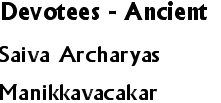
Vaadavurar taking blessing from guru
Having come down solely to bestow grace on him, Iswara, by his look,
immediately gave him jnana upadesa [initiation into true knowledge].
That upadesa took deep roots in Vaadavurar's heart, and gave him
indescribable happiness. With folded hands and joyful tears, he
performed pradakshina of the Guru, offered salutations, stripped himself
of his official dress and ornaments, placed them near the Guru and
stood before him dressed only in a kaupina. As he felt like singing in
praise of the Guru, he sang some devotional songs, which were like gems.
Iswara was pleased, and addressing him as 'Manikkavacakar' [meaning
'one whose speech is gems'] ordered him to remain there worshipping him.
Then he vanished.
Fully convinced that He who had blessed him was no other than Iswara,
Manikkavacakar was stricken with unbearable grief and fell on the ground
weeping and saying, 'Oh, my Lord! Why did you go away leaving me here?'
Sometime later, Manikkavacakar acted according to the injunctions of
Iswara; sent away his retinue, and instead of purchasing horses for the
king, spent all the money he had on the Temple.
The king immediately sent an order to Manikkavacakar to return. But how
could he go to the king without the horses? If he wanted to purchase
them - where was the money? Not knowing what to do, he prayed to Lord
Shiva for help. That night Lord Shiva appeared to him in a dream, gave
him a priceless gem and said, 'Give this to the king and tell him the
horses will come on the day of the Moola star in the month of Sravana'.
Startled by the vision he opened his eyes but the Lord was not there.
On the day of the Moola star, Iswara assumed the guise of a horseman,
transformed the jackals of the jungle into horses, and brought them to
the king.
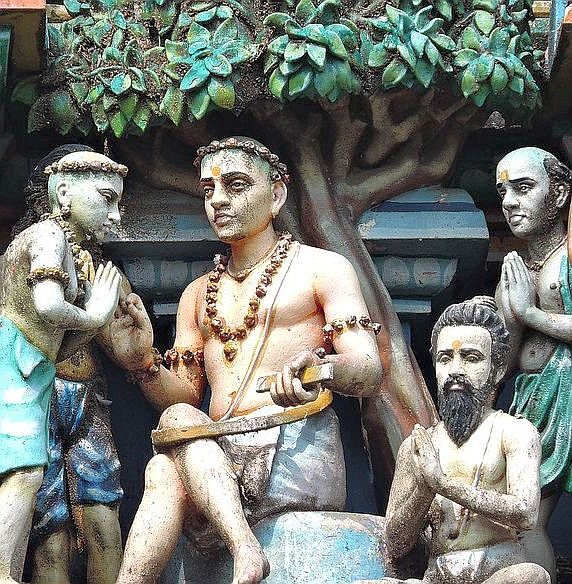
Lord in disguise delivering horses to King
The king was astonished and took delivery of the horses and had them
tied up at the same place where all his other horses were kept. The same
night the new horses changed into their real forms, killed the other
horses in the stables, created havoc in the city and fled. The king grew
angry, branded Manikkavacakar as a trickster and imprisoned him.
Again the Lord came to the rescue of his devotee, and made the River
Vaigai rise in flood and soon much of the area was under water. The king
ordered his people to send one man from each family to raise bunds to
contain the flood waters. One old woman, a seller of steamed rice rolls,
had no male member in her family nor could she hire anyone, as every
available man had been engaged already by others. The Lord in the guise
of a coolie came and offered to work for her provided she gave as wages
the crumbs fallen off the rolls she had cooked..
She agreed and the Lord in the guise of a coolie went to the work-spot
and busied himself with loafing about, dozing off on a sand bank or
playfully demolishing the work of others under the pretence of helping
them. The king arrived to inspect progress and found that the
portion allotted to the old woman's hired coolie remained undone. On
enquiry, his servants told him of the pranks of the coolie. The king
infuriated, called the coolie and said, 'Instead of doing the allotted
work, you are lying down and singing'. So saying, he hit the
coolie on the back with the cane he had in his hand. The blow recoiled
not only on the king but on all living beings and all suffered the pain
of the king's blow. The king immediately realised that the man he had
beaten was Parameswara in the guise of a coolie. The king was aghast.
Parameswara vanished and a voice from the sky said, 'O King!
Manikkavacakar is my beloved devotee. I myself did all this to show you
his greatness. Seek his protection.' The King went to Manikkavacakar and
requested he accept the rulership of the kingdom. The saint refused and
asked to be permitted to go to Perunturai. Both went to Madura to
worship the Lord. Manikkavacakar then left for Perunturai. The king
renounced everything soon after this and reached the Lord's Abode.
At Perunturai, Manikkavacakar sang highly inspiring songs and prayed
that he should see the Lord in the form of the Guru. On the way he
visited many shrines and by stages reached Chidambaram. He stayed in a
garden near the temple and sang the famous Tiruvacakam. The people of
Tillai heard the hymn and enjoyed its bliss
It is at Chidambaram that the Lord takes the Form, of Nataraja, the
divine dancer, for the welfare of the world. The object of His dance is
to free souls from the fetters of Maya. Inside the temple there is a
tank called Siva Jnana Ganga tank. In this tank Hiranyavarman, the son
of Manu, took his bath and was cured of leprosy. It is believed that
those who take a bath in this sacred tank and then worship Lord Nataraja
are purified of all sins.
The Buddhist Gurus declared they would go to Chidambaram and defeat the
Saivite in debate and convert the temple into a Buddhist shrine. So
saying the Buddhists left for Tillai accompanied by the King and his
mute daughter. The Buddhists opened the debate. Manikkavacakar explained
the principles of Saivism. The Buddhists could not offer
counter-arguments but continued to repeat their arguments!
Manikkavacakar prayed to the Lord for help and Devi Saraswathi withdrew
Her grace from the Buddhists - who became dumb and were defeated in
argument.
The Buddhist king understood Manikkavacakar's greatness and said: "You
have made my teacher and all his disciples dumb. If you can make my dumb
daughter speak, I and my subjects will embrace Saivism." Manikkavacakar
asked him to bring his daughter. He prayed to the Lord for His help and
then asked the girl to give proper answers to the questions on Lord
Siva. The dumb daughter not only began to speak but gave fitting answers
to the questions asked. All were wonder-struck at this miracle and on
recognising the superiority of Saivism - embraced it.
One day Lord Siva desired to hear Tiruvacakam from the lips of
Manikkavacakar and bestow Moksha on him. He went to Manikkavacakar in
the disguise of a Brahmin. Manikkavacakar welcomed the guest with
respect and enquired of his needs. Lord Siva in the guise of a Brahmin,
told Manikkavacakar: "I want to hear Tiruvacakam from you. I shall write
it down, so that I can learn it and with its help free myself from the
shackles of Samsara." Manikkavacakar recited the Tiruvacakam. The
Brahmin (Lord Siva) wrote it down on palm leaves. Then he suddenly
disappeared! At once Manikkavacakar knew that the Brahmin was the Lord
Himself.
Tiruvacakam
The Tiruvacakam is the celebrated collection of hymns by the Tamil
Saivite poet-saint Manikkavacakar. Together with the shorter poem
Tirukkovaiyar, it forms the eighth book of the Tamil Saivite canon
Tirumurai. Tiruvacakam contains 51 hymns comprising a total of 3,414
lines. The hymns range in length from eight to 400 lines and show a
significant variety of metrical forms, with 14 sub-varieties of meter.
The hymns are usually rhythmically recited or sung rather than read.
The work includes some unusual themes. Some have a woman in the role of
devotee to the Lord, singing songs appropriate for playing games or
doing village chores. One interesting poem is meant to be sung to awaken
the divinity in the temple in the morning (a common part of Indian
temple ritual). Because of its sacredness, Tiruvacakam has no
traditional commentaries attached to it.
Manikkavacakar's most important theme is the shadow of karma, which
hovers over all as a spectre. The poet calls to God to remove the bonds
of karma and free him. He also speaks of impurity that takes him on the
long road; when impurity has been removed, he becomes a slave to Lord
Shiva. Most importantly he asks for Shiva's grace to escape the hold of
the senses, which lead one to impurity and destruction. Manikkavacakar
was wary, as are many renunciants, of the pull of the unrestrained
senses.
"When He abode in state in Idaimaruthu and planted thereat the imprint of his Divine feet (on my head)"
Keerththithiruvahaval lines 75-76
The history of the great Manikkavacakar is told in Thiruvadhavur Puranam
and Thiruvilaiyadal Puranam. His compositions are Tiruvacakam and
Thirukkovaiyar. The day he immersed himself in the Supreme and became
one in Lord Shiva is Ani Magam Day.
Manikkavacakar's visit to Tiruvannamalai
Manikkavacakar had been specially commissioned by Shiva to tour the
Tamil region and sing songs in His praise. One of the places he visited
was Tiruvannamalai, which even in those days was a major Shaiva
pilgrimage centre. Manikkavacakar composed two of the Tiruvacakam poems,
'Thiruvempaavai' and 'Thiruvammaanai', on his visit to Tiruvannamalai.
There is a tradition in Tiruvannamalai that both poems were composed
while Manikkavacakar was doing pradakshina of Arunachala. A small temple
on the pradakshina road in the village of Adi Annamalai is supposed to
mark the spot where the two poems were composed and sung.
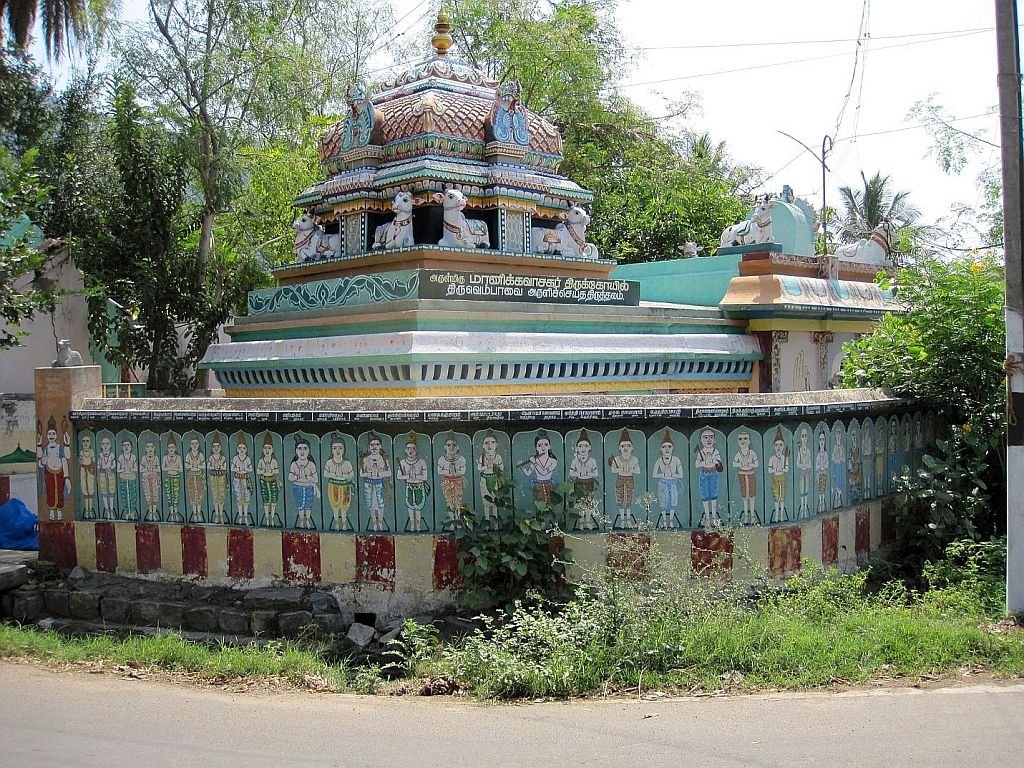
Manikkavackar Temple, Adi Annamalai
To read the Thiruvempaavai go to this link here
To read the Thiruvammaanai go to this link here
The Tiruvadavuradigal Puranam, a poetic retelling of Manikkavachakar's
life, includes the following verses that describe his visit:
After worshipping at that shrine [Tiru-Venney-Nallur],
with love in his heart he departed,
following the righteous path,
passing through the middle lands,
traversing tall forests and mountains,
where lions and fearsome elephants dwelt,
until he drew near to enduring Arunai's city.
When he saw the palaces and gopurams,
the strong walls, decorated with jewels and pearls,
the great gateways festooned with banners,
towering up in the midst
of a cool densely wooded grove,
in a forest of tall areca trees,
he joyfully made obeisance,
experiencing great bliss.
'You [Shiva] who abide in the form of a mountain
which appeared on that day as a column of flame
for the two to seek!
Blissful life which fills our hearts!'
Thus did he worship the Supreme Mountain Lord,
receiving His grace, before proceeding forth
to enter Arunai's prosperous city.
Leaving behind the groves, the city walls,
the streets decorated with many beautiful banners,
and the various shrines of the gods,
and taking the path which led to the holy presence,
he bowed down before the temple of the One
who wears in His locks a kondrai garland,
datura flowers, the moon and the snake,
and then did he perceive the form of Him
who on that day had enslaved him.
'Praise be to the dark-throated One
who swallowed the poison halahala
when Brahma, Vishnu and the rest of the gods,
crying out in distress, appealed to Him for protection!
Praise be to the Mountain of cool ambrosia,
mixed with the milk of green-hued Unnamulai,
which men and gods alike drink down
to cure the overpowering malady of their birth and death!
Praise be to the great ocean of grace of Him
who placed His feet upon my head,
the feet which tall Mal could not see,
though he burrowed deep into the earth
in the form of a powerful boar!
Praise be to the Mountain of burnished gold,
at whose side sits the slender
green-hued form of Unnamulai,
who is the earth's protectress!
Praise be to Him who granted His grace
to the victorious Durga,
when She worshipped Him and begged Him
to absolve Her from the sin
of killing the powerful buffalo-headed demon!
Praise be to the beauteous Lord Annamalai,
who came to me on that day and held me in His sway!'
Thus worshipping and praising the Lord
out of heart-felt love,
he dwelt there for some days.
It was the month of Margazhi,
when, in the ten days before the ardra asterism,
the beautiful maidens go from household to noble household
calling each other out in the early dawn,
just as the darkness is dispersing, and, banding together, go to bathe in the holy tank.
On observing their noble qualities he sang the immortal hymn
'Thiruvempaavai' which is composed as if sung by the maidens themselves.
Later, seeing them dance and sing
Thereafter Manikkavacakar moved from one place to another, singing and
composing devotional songs. Finally, he settled in Chidambaram. His
Tiruvacakam is placed near the idol of Shiva there. Several verses of
Tiruvacakam are also engraved in the walls of the Chidambaram temple.
Margazhi Month of Bhakti and Music
The Tamil Month of Margazhi is known as one of bhakti and music during
which there are recitations, chanting, singing and spiritual readings
conducted at Arunachaleswarar Temple and throughout Tamil Nadu. In
particular the music of Manikkavasagar's Thiruvempaavai is celebrated
during this month.
Listen to Tamil Nadu music maestro Ilaiyaraaja's rendition of the Tiruvacakam performed by the Philharmonic Orchestra.
"There is a festival in winter in which devotees go to their Shiva
temple very early in the morning to sing songs to Shiva in order to wake
him up. In 'Thiruvempaavai' young girls move from house to house,
waking up their friends, and encouraging them to come to the temple to
perform this rite. Though, ostensibly, it is merely a poem about young
girls encouraging each other to go and worship Shiva, their trips to the
temple are interpreted to be emblematic of the soul's journey towards
union with Shiva. It is thus a poem which encourages enthusiasm for the
ultimate pilgrimage that culminates in the experience of Shiva."
[G. Vanmikanathan]
 Ladies praying at Navagraha outside Mother's Shrine, Big Temple
 Ladies lighting Deepam outside Mother's Shrine
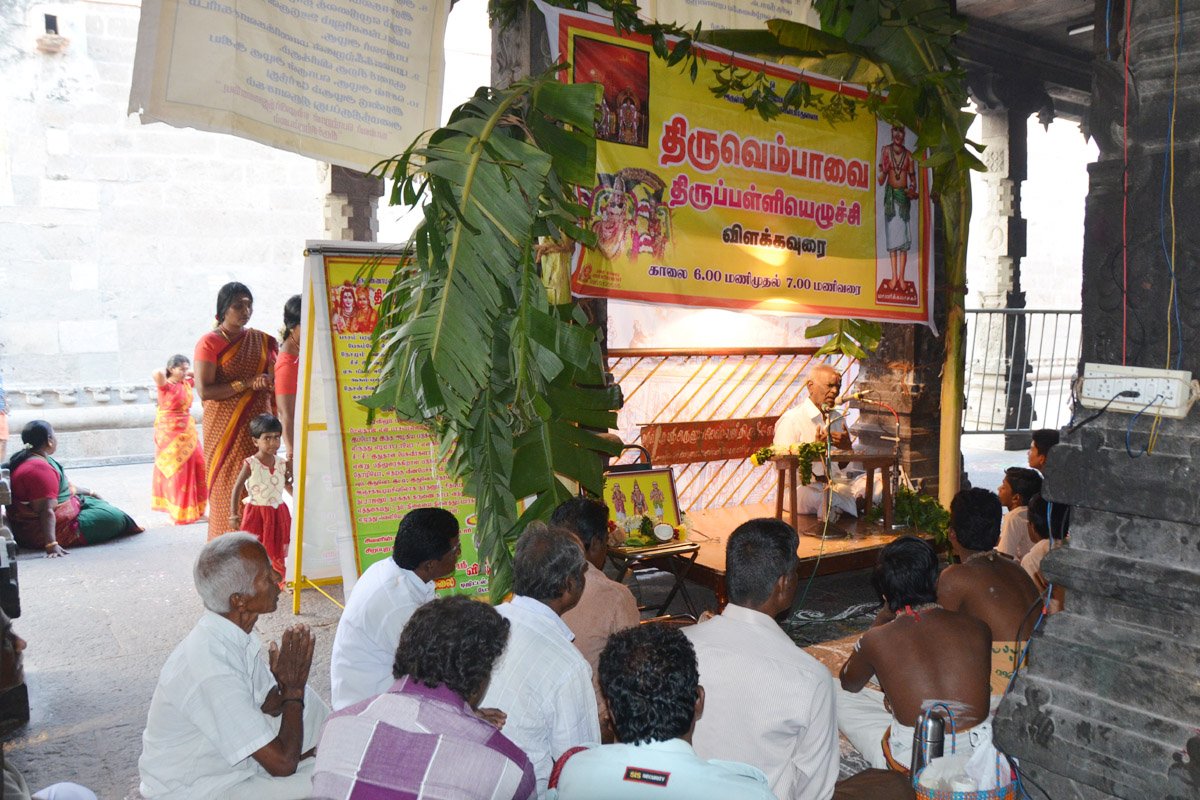 Pundit giving recitation at Big Temple compound
 Prayers and Recitations throughout Margazhi Month
Joyful Song of the Lord
Manikkavacakar led a life dedicated to Shiva worship and visited shrines
of Shiva throughout what is now Tamil Nadu. His devotional Tamil songs,
praising his Guru, Lord Siva and His Grace which changed his life from
worldly to divine were compiled into a single form and named as
Tiruvacakam.
There are many autobiographical remarks in the Tiruvacakam with
reference to the Guru-disciple relationship. This relationship turned
afterwards into that of lover and beloved - with Manikkavacakar as the
bride of Lord Siva and where he speaks of the stripping of his soul when
united to Siva.
"The Tiruvacakam relates an autobiographical story of the different
stages of Manikavacakar's spiritual life and experience which ultimately
enable him to attain bliss ineffable and eternal. It is a torrential
outflow of ardent religious feelings and emotions in rapturous songs and
melodies. The work may be regarded as a convenient handbook on mystical
theology."
[Ramachandra Deekshithar]
There is a common saying that "Those hearts melted not to Tiruvacakam
would melt to no other Vachakam". Tiruvacakam, particularly, the very
first decad 'The Civapuranam' is daily sung in Temples and homes
throughout Tamil Nadu.
Thiruvathirai Festival at Arunachaleswarar Temple
Thiruvathirai ('sacred big wave' which refers to the creation of the
Universe by Lord Siva) is yearly observed in Tamil Nadu Saivite temples.
The Festival takes place on the full moon night of the Tamil month
Margazhi (December - January) which is the longest night of the year.
Historical evidence show that the Festival has been observed on this day
for more than 1500 years and celebrates the cosmic dance of Lord Shiva
as is represented by the form of Nataraja. Arudhra (Thiruvathirai in
Tamil) signifies 'golden red flame' and Lord Shiva performs the dance
engulfed by His red-flamed light.
For the first nine days of the Festival the statue of Saint
Manikkavacakar is taken from its place near the Siva Sannidhi Shrine,
and brought out in procession around the Big Temple's maha veedhis (four
perimeter streets).
Manikkavacakar was a poet of the Hindu bhakti revival movement and his
work forms one volume of the Tirumurai, the key religious text of Tamil
Shaiva Siddhanta. His hymns are a poetic expression of the joy of
God-experience and the anguish of being separated from the Lord. This
great saint aided the spiritual and religious revival of Hinduism and is
revered as one of the four Nalvars of Shaivism who took birth in the
world to show the path of elevating oneself to the Supreme Shiva.
Manikkavacakar's hymns of the Tiruvacakam (particularly the hymn Thiruvempaavai) are chanted in temples.
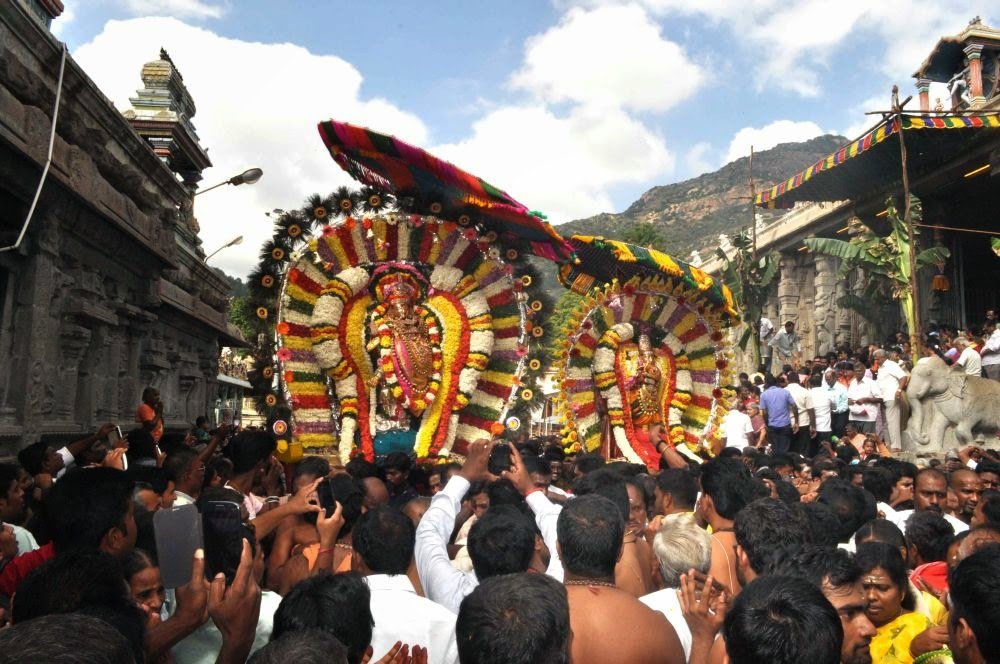 Gods exiting 1000 Pillar Hall
 Lord Nataraja to perform procession around Temple
On the very day of Thiruvathirai the idols of Nataraja (Lord Shiva) and
his consort Shivagami (Parvati) join Manikkavacakar in a procession
around Arunachaleswarar Temple. It is one of the major events in almost
all Shiva temples in Tamil Nadu.
|
|