"Every week throughout the year, one day is sacred to the Lord Shiva,
but once a year a day is set aside as Mahashivaratri - the Great
Festival of Shiva. It is a moveable festival, kept on the fourteenth day
of the dark fortnight of the lunar month of Phalguna.
Once celebrated on a vast scale throughout India, it now only sees peak
performance at two places, separated by a considerable distance as well
as a border. The best celebration to be witnessed is at the
Pashupatinath (Lord of Animal Life) Temple at Kathmandu, Nepal.

The other is celebrated on the Teleti, the sacred area at the base of
Mount Girnar in Saurashtra. Because politics have tended to separate
Nepal and India, this has encouraged Girnar to develop more and more.

The great cluster of seven peaks which suddenly push themselves up from
the extensive flat area below makes them a unique sight from a distance.
The journey to their peaks displays an even more wonderful sight. Two
Europeans who wrote much about India during the days of British rule,
described Girnar as "Not only the most wonderful sight in India, but in
the whole world."
A few days before Mahashivaratri, a vast number of sadhus make their way
to the secret spot and crowd the many ashrams on the Teleti for the
great midnight scene. It is here that one can see a large number of
naked saints, the very epitomes of the Nivritti Marga or Path of
Renunciation which they have chosen. The Naga sect come here in vast
numbers and this is one time and place where practically all sects meet
in concord. Nudity is here held in highest regard. Even sadhus who wear
langotis or small loin cloths, drop the curtain on this occasion; let
the microcosm be as the macrocosm.
In those happy blissful carefree days of ancient India, long before the
Vedic Aryans came to disturb the verdant scene, the Lord Shiva reigned
supreme with his consort, not only throughout the whole great
sub-continent of Jambudvipa, but in many distant places of the world. It
was here on this soil of India that men and women developed what was
probably the earliest true religion, culture and way of life. We know
from unquestionable proof that this Shiva-Shakti culture was flourishing
more than five thousand years ago (7000 BC) and can rightfully
conjecture that it must have had a history which began much earlier.
Traces of this very ancient cult can be found in every religion which
has appeared on the earth. Even today, in this ultra-modern age and
miraculously escaping Christian suppression or destruction, there are
still a vast number of the Phallic-Pashupati cults still existing in
Europe.
There is considerable opinion that the indigenous people of India prior
to the Aryan immigration were a dark-skinned people. If this is so it is
certainly strange that their God and Goddess were both described in
countless texts as white-skinned. The Dakshinamurti Upanishad, probably
itself a text rewritten from older oral traditions, describes Shiva as
"The Lord sitting cross legged whose hair is matted and adorned with the
shining crescent moon, whose body is white as milk and who has three
eyes." Here we have a description similar to the figures of the
Mohenjadaro and Harappa seals. This is also the prototype of the yogi
and the contemplative, but although a relative symbol and form, it was
also, to these early Indian Pagans, the living manifestation of the real
Shiva as Absolute whom Indus Valley inscriptions describe as "The
Supreme Being who exists by itself." These concepts still exist today.
To make relative comparisons, for clarity, Shiva assumes different
values according to the disciple. Shiva is not a name but a quality and
means Auspicious or the Auspicious One. To a few, Shiva is Paramatman,
Brahman, the Absolute, but many more prefer to see Shiva as a personal
God given to compassion for his worshippers, and the dispenser of both
spiritual and material blessings. Related to the Absolute concept is
Shiva as Yoganath, the Lord of Yoga, wherein he becomes teacher, path
and goal. As such he is the Adi Guru or Highest Guru of sannyasins who
have renounced the world to attain the Absolute.
In the vast pantheon of Indian gods, great and small, Shiva possesses a
mixture of the weird and wonderful and even brings a strange equipoise
and harmony to fantastic patterns and symbols.
Modern artists now dress Shiva in leopard skins and coloured clothes to
make the Absolute respectable. Most go so far as to hang a sacred
Brahmin thread on a God who flourished in India thousands of years
before a single Brahmin entered! Let us thank Shiva that Shiva can stand
all this and more. The texts which describe Shiva cannot be modernised
or overwashed with Christian respectability so easily. Let us examine
one of them.
Among the many priceless gems in the Bhagavatam, there are many cases
where the non-Vedic or Tantric deities have been changed into the name
of the Vaishnava God Vishnu. In many stories this was too easy, but some
texts are so detailed in their relationship with Shiva that a change
was not possible. One such story tells of the Sage Kasyapa who married
Diti, one of Daksha's daughters, and therefore the sister of Sati, the
wife of Shiva. It would appear that Kasyapa gave too much attention to
his strict disciplines and performance of sacrifices. Diti would be
neglected no longer and went to her husband and demanded he perform the
ancient ritual which gave women children.
Kasyapa saw the justice of the demand and promised to give her
satisfaction in the love duel, but that moment was not suitable and she
must wait a little for complete darkness. This was in accord with the
ancient traditional beliefs that Shiva roamed the earth at the three
sacred periods of sunrise, noon and sunset. It would be inauspicious if
the Lord spied two people copulating at the time when they should be
engaged in the rituals of worship. Kasyapa explains in a wonderful
passage, which throws much light on both Shiva and his qualities, as
well as aspects of life which did not meet with his approval.
"This is the sunset hour, when the Lord Shiva, riding on Nandi, the
sacred bull, moves about the world with his retinue. He, the Lord
Shankara, sees all with his three eyes. There is none like him in the
whole universe and He has no equal. Those who wish to break through the
veil of ignorance emulate His divine qualities. He who is the goal of
the righteous, is seen in that wild appearance which He has seen fit to
adopt, to teach the path of Self realization.
"Miserable creatures adorn the body with rich dresses and costume
although it is only fit to be food for dogs. Thus adorned and
embellished with flowers and cosmetics, they mistake the body to be the
real Self. Seeing Shiva completely naked, smeared with ashes, wearing a
necklace of skulls and having matter hair thick with dust, they laugh at
Reality -- Supreme Shiva -- not understanding that His purpose is to
teach them the useless nature of the body and treat it indifferently.
Shiva spurns the wealth and power which pitiful human beings expect as a
reward for religious devotion and piety. He alone is the cause of the
universe and Maya (delusion) is His slave. He is the Absolute, Perfect
Being and His ways are inscrutable."
The pre-Aryan people had the intelligence to realise that if you
projected the Absolute as a male figure, it could be represented as a
female figure also. People must have found creation more easily
understood in terms of cosmic copulation, a male and female principle
bringing things into being, as a yang-yin of Chinese thought. This was
easily understood for it was the natural process of their own lives.
They did not think of the plausibility of cosmic weavers and tailors and
so God and Goddess were both naked. They could not suspect that
anything created by the Divine was dirty or improper, but rather saw the
most fitting symbols of the God and Goddess in terms of penis and womb
(lingam and yoni; the yoni is the womb and not the external female
sexual organ). They saw the whole universe as a great womb in which
worlds were born and came to being.
When we muse on the vast world of philosophies, ideas and dreams, sacred
as well as insane, social, political and scientific, we see the
struggle of men to think and not build up ghosts which only vanish in
the dust. One day, perhaps, mankind will find that the oldest was really
the ultimate and in his search for immortality he must return to where
he started.
Now we can see that a Divine Guru, not only teaches us in terms of a
doctrine of practical instructions, but by the way he lives. Thus
millions of Indians have seen the manifest form of Shiva as their guide
on the path.
One of the early traditions and one of the world's most ancient, is
Shiva in the form of Dakshinamurti - the South-Facing Guru. In this
form, seated on a low platform, with one leg hanging down in front, he
communicated the Sanatana Dharma or Eternal Wisdom to the four Kumaras
who appeared early in creation. The Guru spoke no words but taught them
by the transmission of mind-to-mind, thus giving us an early example of
what was to become a popular concept in Zen. Its purpose was to show
that man can realise the Absolute when the human mind is in complete
equipoise with the Cosmic Mind.
There is a Hindu scripture called The Thousand Names of Shiva.
Dakshinamurti is one of them. Actually none of them are really names in
the sense that we generally use the word. They are all rather qualities
or descriptions. They are spread throughout India as names of temples or
sacred places. One of the oldest Upanishads refers to Shiva as
Kalagni-Rudra (Rudra the Lord of Fire and Time). Rudra has many meanings
and could by Ruddy or the Howler. Shiva as Rudra managed to work his
way into the most sacred of the Aryan Vedas, the Rig-Veda, though the
references are not too flattering. But that is of no matter. Enemies
will often, if not always, describe us more accurately than will our
friends. When Daksha crossed swords with Shiva, his son-in-law, we get a
much franker description of Shiva than might come from a respectable
devotee. This description is not only one which could also be applied to
the greater saints of India but might have real meaning to the dropout
of today. Here we quote briefly. The full story must come later.
Standing in the centre of the vast assembly of gods and men, Daksha
pointed his bony, ghee-soaked finger at Shiva, his son-in-law, and
uttered this terrible denunciation:
"Loo-ook at Him. A disgrace to this assembly and one who brings
discredit to the Gods. Is he not the laziest and most nonproductive one
who refuses to work or undertake duties? By him the righteous path of
Veda is tarnished. He has married my daughter in the presence of Agni,
Brahmins and relatives, yet is devoid of the respect he should show as
my son-in-law. He does not think of himself as my son and when he sees
me he does not salute me or inquire about my welfare. Instead, he
remains silent and closes his eyes like a monkey.
"Loo-ook at him! He has no modesty or sense of shame and comes here,
just as he walks about, completely naked and smeared with the ashes he
has taken from cremation grounds. His associates are lunatics, drunkards
and madmen. His very retinue are really ghosts, devils and spirits.
Lord indeed! he is only the lord of lazy servants who deny proper
service and responsibility to their masters. His decorations are evil
creatures and the necklace of human bones pollutes this place. His
matted hair is dusted with impurities from the cremation ground where he
likes to reside. Shiva! No, not Shiva -- Auspicious -- but
Inauspicious! I weep to think that I was tricked into giving my daughter
Sati to him in marriage. From henceforth, we will get no share in
sacrifices performed by me."
Shiva did not rate high in Daksha's popularity list, but Daksha should
be seen and understood as the symbol of the Vedic Brahmin ritualist who
wanted to present the Aryan purity and its religion, in spite of the
great merger which was taking place to bring about the fusion of Vedic
and Tantric cultures into one all-embracing way of life. While Daksha
denounced, Shiva remained silent.
Let us return to the Teleti of Girnar, the Lord of Mountains. Sadhus
throng the ashrams and roads. Some have erected little hits of sticks
and leaves by the roadsides. The climax takes place at midnight when the
sadhus take their bath and assemble to offer praise to the Lord Shiva.
It is the end of winter and still cool but they endure all in the
ecstasy of naked submission to the Absolute as Shiva.
The great concord of saints is not without its spectacles. Some of the
sadhus have taken vows never for a period of so many years to lie or sit
on the ground, even to sleep. They stand with their arms resting on a
flat piece of wood fixed on a pole, and this becomes their only support
to rest or sleep. By the side of the road, a tall sadhu leans against a
tree eating fruit. He is completely naked and his only possession, a
trisula or three-pointed spear, as high as himself, rests against one
shoulder.
Further along the road is another naked sadhu putting on a spectacular
show. He stands with his legs apart, sufficient to permit huge stones or
rocks which have been tied to his penis, to swing free. The weight of
the rocks must be enormous and the sadhu has no competitors. Nothing to
do with true spiritual life, but helpful in encouraging donations. Some
of these types stand on the points of nails fixed in small blocks of
wood. The performance starts with a challenge that he will stand on
these uncomfortable supports and remain completely immobile until ten
rupees have been donated. Usually he has an accomplice standing by and
if things go on too long he gives a signal and his friend terminates the
painful performance by promptly donating the remainder of the money.
Mahashivaratri is the cake and the showmanship is the icing sugar which
makes the festival more palatable.
Midnight on Mahashivaratri is no less bewitching than midnight festivals
in other lands. As the sadhus go to take their bath and manoeuvre their
way into the pool, from the vast concord of naked bodies we hear the
great mantra of the Lord:
"Hara Hara Mahadeva Shiva-Shambhu Kashi Vishvanatha Ganga!" (Hara is the
Great God, Shiva called Shambhu, Lord of the World, residing at Kashi
on the Ganges!)
Banares, now called Varanasi - the original name corrupted to Banares - also has its great celebrations of this festival.
Within the boundary of Varanasi is an area called Kashi which for
millennia has been regarded as the seat and city of Shiva-Kashinath.
Today it is the one great city of the world where you will see the most
religion and the least spirituality. But in spite of this defect, it
draws like a magnet and has a peculiar and mystic fascination of its
own. It is, perhaps, the most concentrated and visible aspect of modern
Hinduism that can be seen today. It has more sacred bathing ghats than
any other city and they stretch unending along the bank of the Ganges.
Kashi has the long-standing tradition that if you die there,
irrespective of what evil might have been done, you will go directly to
heaven. Hundreds, in old age, still go there for this purpose. Great
numbers of old Brahmins go to Kashi and become initiated as Dandi Swamis
- the Swamis who carry the staff. There they wear the ochre robe and
pass their days in prayer and gossip, to await that great moment when
they will be carried to the burning ground and wake up in heaven.
Only a Brahmin can be initiated as a Dandi Swami, and this is the only
qualification. They are not sannyasins, but take to a stage in life
called vanaprastha, something akin to a hermit, but one still observing
prayer and ritual. In the past, it was India's answer to the old age
pension. Most beg their food from the house of a Brahmin. Some
institutions have also been set up to give meals and people donate money
to the sect to purchase the wood for their ultimate disposal.
Women vanaprasthas are now very rare and generally cared for by
families, but the life is actually open to women just as much as men,
though they do not take initiation. The Dandi Swamis acknowledge Shiva
as the Supreme Lord, but as individuals their concepts are very
relative. The vanaprastha stage of life is not sectarian and can be
assumed by any man or woman of any caste and they can continue the
worship of deities of their own choice.
A lovely story is told which demonstrates the traditions of Kashi and
the eternal Ganges. Parvati, the Consort of Shiva, was playing the role
of a woman more than a Goddess and rebuking Shiva for his readiness to
grant boons and blessings too easily. She added her final feminine
thrust to say that if Shiva was in dire trouble, nobody would try to
help him.
Shiva took up the challenge and said they would arrange a text. He would
lie on the ground and pretend he was dead. The Goddess would then pose
as a distraught window. She would then tell anyone who passed that the
God of Kashi had granted her a special boon and if any stranger who was
pure in heart touched the body, her husband would come to life again and
she would be rescued from widowhood.
Many came by but most hurried on because Hindus had been taught that it
was inauspicious to touch a dead body and in this way they would lose
their chance to go to heaven. As the hours passed, the test brought no
success. Suddenly a man came along looking the very picture of dejection
and misery. He stopped to listen to Parvati's plea but sadly turned
away and said: "Good lady, your devotion to your husband should be
honoured, but I am unworthy to fulfil the task. I have wanted the world
too much and it has only brought me misery. My life has been too evil
for me to be able to serve you in this way."
Hanging his head, he turned to move on. Then, suddenly, he turned back. "Wait, good lady, there is a way."
The man rushed down to the Ganges and plunged in the water.
Hurrying back, he laid his wet hands on Shiva's head. Shiva stirred and
sat up, but before he could speak, the man rushed down to the river and
immersed himself a second time. Shiva laughed, but the Goddess put her
questions.
"Why, good man, did you first refuse but touched my husband after
bathing in the river?" The man laughed and replied: "Should it not be
known by all that any person who bathes in the Ganges at Kashi washes
off all taint of evil and becomes pure?" "But," asked the Goddess, "why
the second bath, if you had been made pure?"
"Did I not touch your husband's corpse and is that not a new impurity?"
This time, Parvati laughed with Shiva and the man suddenly realised who they were and threw himself at their feet.
Shiva said: "For this day's work, in which your faith and sincerity
excelled all other men, I will grant you a boon. Ask for whatever you
wish."
"Be careful," said the Goddess.
The man looked at the face of Shiva. "What boon can I ask, when I am
weary of the world, but the boon of your grace which will grant me
strength and confidence to tread your path to liberation? Grant me
this."
Shiva held up his hand, making the mudra of granting boons, and said:
"So shall it be and when you have cast off the last body you will shine
as an immortal among the stars."
Later, Parvati said to Shiva: "I never seem to be able to get the better
of you." Shiva turned to her and whispered: "You should take a bath in
the Ganges."
Mankind has gone a long way, up and down, down and up and now mostly
down. Ancient values, tempered in the forge of time, are being rejected
for new untried ideas. Happiness in worldly life is still the only real
criterion by which mankind can measure its life. Progress is not always
found with the latest innovations, concepts or ideas, and mankind may
soon have to learn that ancient Pagan ways of life and values have still
the most to offer. There is still some gem of real wonder in that old
Pagan life where men learned not only how to live but also how to die.
Those who can see Shiva and Shakti as undifferentiated union have no
need to think of "Gay Liberation" or "Women's Liberation" or any
concepts to establish sex equality. What Nature made, Nature will
preserve.
India has taught us the balance of life and the true pulsating rhythm by
which all things are accomplished. It is the most earnest and serious
way of life the world has ever known, yet does not have real meaning
until we can lampoon it and learn to laugh with it. This way of life,
thronged with cheats and hypocrites, contained the greatest man who ever
lived. The path which is over covered with the most rubbish and
superstitions, carries on its crest the highest wisdom of the Absolute.
When you enter the stream, think of the goal on the other shore and do
not waste words or tears lamenting on the water which is going past.
A word of warning, human creatures! If you love your world and its
frustrations, its empty promises, tears and anguish, its war, shattering
noise and disasters, its passions, pathos, pillories and pilfering, its
weary ways of unending toil and trouble, its devil dance which leads
you to the grave, then Beware and turn your eyes away from the Lord of
Yoga; flee from this Shiva and His Shakti, lest your delusions are
destroyed and you are led to liberation."
Mahashivaratri at Pashupatinath Temple
For more than a week before and after Mahashivaratri, the area
around Pashupatinath Temple is transformed into a mammoth fair of sorts,
with food stalls, pavement markets and clusters of temporary shelters
where life-styles and human activities of a mind-boggling variety can be
witnessed. Colorful costumes of the many different ethnic and tribal
pilgrims from India sporting intriguing headgear, ranging from turbans
to towels around the scalp; long flowing dresses, pantaloons and loin
cloths, along with the women's colorful sarees, all form a fascinating
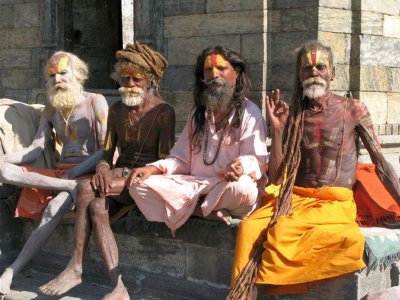
contrast to the many Sadhu-Babas and Yogis in their birthday suits.
People fill the roads - holy men, some half clad, some covered in ash
but entirely nude; pilgrims in their distinct and colorful tribal
costumes; vendors selling practically everything from vermilion powder,
Rudraksha beads, monkey nuts, to Coca Cola and snacks. Foreign tourists
also form part of this vast collection of humanity.
During Shivaratri, the temple of Pashupatinath, dedicated to Lord Shiva,
becomes all spruced up in anticipation of the arrival of Sadhus, Yogis
and other holy men as well as the hundreds of thousands of devout Hindu
pilgrims. All devout Hindus believe that a visit to the holy
Pashupatinath temple will absolve them of all past sins and the
preference to make this pilgrimage during the time of Shivaratri, and
assure them of a good human birth in their next life.

Hindu
sadhus burn cowdung cakes to perform some holy rituals in the revered
Pashupati area in Kathmandu. Hundreds of devotees from different parts
of Nepal and India have been coming to the area to celebrate Maha
Shivaratri festival that falls on February 23rd.
On the day of Mahashivaratri, people gather on the hillside across the
river from the Pashupatinath temple as well as around the vicinity of
the temple complex in groups around campfires and in makeshift shelters,
singing Bhajans, reciting Sanskrit verses, discussing various religious
topics while maintaining a fast and a vigil in anticipation of the
religious ceremonies. Marijuana smoking mendicants, many with long
matted tresses, dot the area, serene and trance-like, emulating Lord
Shiva himself, in their consumption of the sacred herb, either by
smoking it in clay chillum pipes, or by eating bhang.
At midnight Shivaratri festival officially begins with the priests
inside the main temple making offerings of the auspicious Pancha Amrit
to the Lingam of Lord Shiva. All day and throughout the night, devotees
in an almost never-ending stream, file through the gates of the main
temple to sprinkle milk, flowers, coins and rice offerings on the Lingam
of Lord Shiva to be followed by a ritualistic bath in the river every
few hours as dictated by the rituals.
At about six o'clock in the morning priests start the recitation of
sacred texts which can be heard for miles around being amplified through
loud-speakers strategically spread all over the Pashupatinath temple
complex. This chanting of prayers continues till mid-day followed by the
singing of Bhajans. The mammoth turnout of pilgrims is such, that
devotees and believers are still involved in the elaborate religious
activities many days after the actual night of fasting. As is inevitable
after a period of fasting, there is the ritual partaking of food and
sweetmeats following the festivities of Shivaratri. Naturally there are
vast numbers of food-stalls selling many varieties of food and sweets.
For the devout Hindus who come from far away to experience the
Shivaratri festivities and take a dip in the holy waters of the Bagmati
river, it is often a once-in-a-lifetime experience.
For non-Hindus, Shivaratri offers a fascinating insight into a very
important religious event as well an opportunity to see diverse
cultures, peoples and costumes with the most gawked at and photographed
being the Hindu holy men - the Sadhus and Yogis, smeared in ash, their
foreheads striated with many different and intriguing designs under many
different types of hair-do. Completely naked ascetics, with rings in
their genitals roam through the crowds, mindless of the stares and
glances and to the intense cold of the Himalayan winter, having mastered
their minds to withstand the heat, cold and inhibition of all types.
[William Forbes]
Shiva - The Mystic Night
We conceive God as glory, as creativity and as austerity. Vishnu
is glory and magnificence, Brahma is creativity force, and Shiva is
austerity and renunciation. You might have heard it said that God is the
embodiment of six attributes of which renunciation is one. You will be
wondering how God can renounce things. He is not a Sannyasin. He is not
an ascetic like a Vairagin or a Sadhu. What is He going to renounce? How
do you conceive Shiva as an austere Yogin or a renunciate? What does He
renounce? The all-pervading Almighty, what has He to give or abandon?
Here is the secret of what renunciation is! It is not renunciation of
anything, because there is nothing outside Him; renunciation does not
mean abandonment of object. If that had been the definition of
renunciation, that cannot apply to God. God does not renounce or abandon
any object, because all objects are a part of His Cosmic Body. Then how
do you represent God as an embodiment of Vairagya (dispassion)?
Bhagavan, who is endowed with 'Bhaga' or glories of a sixfold nature, is
also embodiment of Vairagya. Do you identify Him with a Sannyasin,
possessing nothing? No, never. God is the possessor of all things. Then,
how can you call Him a renunciate, a Sannyasin or a Vairagin? The
secret behind the concept or the consciousness of Vairagya, renunciation
is here, in the identification of this attribute with God. It is only
when we interpret things in terms of God that things become clear.
Otherwise, we get confused. We cannot know what goodness is, we cannot
know what evil is, we cannot know what virtue is, unless we refer all
these values of life to the concept of God in His Perfection. The only
standard of reference for us in all matters of life's values, is the
existence of God. So, the concept of renunciation, which has been very
much misused, also gets rectified, clarified and purified when it is
understood with reference to the existence of God whose special
manifestation, in this context, is known as Lord Shiva.
God does not renounce anything. Then, in that case what is renunciation
in this context? It is the freedom from the consciousness of
externality. This is called Vairagya. How can you abandon things? All
things are there in front of you, like trees in a forest or stones in
the jungle. There is nothing like abandonment of things, because they
are internally related to you. Nobody can renounce anything, because
everything in this world is connected to everything else. Then what is
Vairagya? Vairagya is not renunciation of any object; it is impossible.
Everything clings to you. But the idea that things are outside you,
makes you get attached to them. This false attachment is Raga, and its
absence is Viraga. The condition of Vi-raga is Vairagya. As God has no
consciousness of externality, because everything is embodied in Him,
there cannot be a greater renunciate than God. And in as much as this
Consciousness of God is the highest form of Wisdom, He is the repository
of Jnana.
In Hinduism, Lord Shiva is represented as an aspect of God, the
Almighty. He presents before us the ideal of supreme renunciation born
of Divine Realisation – not born of frustration, not born of an escapist
attitude, not born of defeatism, but born of an insight into the nature
of things, a clear understanding of the nature of life and the wisdom
of existence in its completeness. This is the source of Vairagya, or
renunciation. You do not want anything, not because you cannot get
things, but because you have realised the interconnectedness of things
and the unity of all purpose in consciousness. All desires get hushed,
sublimated and boiled down to the divine Being only when this
realisation comes. God does not possess things. Possession is a
relationship of one thing with another thing. But, God is
super-relative. That is why we call Him the Absolute – He is not
relative. Anything that is related to something else comes under the
category of relative. God is not related to anything else, because He is
All-comprehensive. And, thus, in His all-comprehensive Absoluteness,
which is height of wisdom conceivable, there is also the concomitant
character of freedom from the consciousness of externality, and
therefore, as a corollary, freedom from attachment to anything. Thus
Lord Shiva is the height of austerity, Master Yogin, portrayed as seated
in a lotus pose, as the king of all ascetics; not that He has the
desire for self-control, but He is what self-control is itself. He does
not practise self-control. Self-control itself is symbolised in the
personality of Lord Shiva. Such a wondrous concept of a glorious
majestic picture of the Almighty, as Lord Shiva, is before us for
adoration during Mahashivaratri.
We observe fast during the day and vigil during the night. The idea is
that we control the senses, which represent the outgoing tendency of our
mind, symbolised in fasting, and we also control the Tamasic inert
condition of sleep to which we are subject every day. When these two
tendencies in us are overcome, we transcend the conscious and the
unconscious levels of our personality and reach the superconscious
level. While the waking condition is the conscious level, sleep is the
unconscious level. Both are obstacles to God-realisation. We are shifted
from one condition to another. We are shunted, as it were, from waking
to sleep and from sleep to waking, every day. But the super-conscious is
not known to us. The symbology of fast and vigil on Shivaratri is
significant of self-control; Rajas and Tamas are subdued, and God is
glorified. The glorification of God and the control of the senses mean
one and the same thing, because it is only in God-consciousness that all
senses can be controlled. When you see God, the senses melt like butter
melting before fire. They cannot exist anymore. All the ornaments
become the solid mass of gold when they are heated to the boiling point.
Likewise, in the furnace of God-consciousness, the sense-energies melt
into a continuum of universality.
In the famous Rudra-Adhyaya or the Satarudriya of the Yajur Veda, we
have a majestic, universalised description of Lord Shiva, a chant which
we are accustomed to every day in the temple. Only those who know what
Sanskrit is, what the Vedas are and what worship is, can appreciate what
this Satarudriya chant also is. It is one of the most powerful prayers
ever conceived by the human mind. It is filled with a threefold meaning.
According to the culture of India, everything is threefold – objective,
subjective and universal. Everything in the world, from the smallest to
the biggest, has an objective character, a subjective character and an
universal character. Objectively you are something, subjectively you are
another thing and universally you are a third thing. It all depends
upon the point of view from which you interpret a particular thing,
person or object. When you objectively interpret a thing, it looks like
one thing; when you subjectively analyse it, it is another thing; and
from the universal point of view, it is a third something altogether.
Likewise, this Mantra, the Satarudriya of the Yajurveda, a hymn to Lord
Shiva, has an objective meaning, a subjective meaning and a divine,
supreme, supra-mental, universal meaning. Objectively, it is a prayer
for the control of the forces of nature. Subjectively, it is a prayer
for self-control and the rousing of the spiritual consciousness.
Universally, it is a surge of the soul towards God ¬realisation. It
has an Adhiyajnika, Adhibhautika, Adhidaivika and Adhyatmika meaning, as
we usually put it. It has a tremendous meaning. The Vedas, the Mantras
of the Vedas, are filled with such threefold or fourfold meaning. Hence
it is difficult to understand the full meaning of any Mantra of the
Veda. "Ananta vai vedah": Infinite is the meaning of the Vedas.
The meaning of the Vedas is infinite. It has no end at all. It is
mathematics; it is chemistry; it is physics; it is Ayurveda; it is
psychology; it is metaphysics; it is philosophy; it is spirituality; it
is meditation; it is love; it is ecstasy. You will find everything in
every Mantra of the Veda. All depends upon how you look upon it, how you
feel it. A person may be a father, he may be a brother, he may be a
son, he may be a friend, but all the while he is one and the same
person. Attitudes are different on account of the various relationships.
So the Rudra Adhyaya before us is a majestic prayer for world peace,
international peace, subjective peace, universal peace and
God-consciousness.
It is difficult to chant this Veda Mantra called the Satarudriya,
because it requires a training – as in music, for example. Everybody
cannot sing. It requires tremendous training for years together.
Likewise, the chanting of the Mantras of the Veda requires training for
years together, and not for a few days only. Just as one who does not
know how to sing will make a jarring noise and you will like to get up
and go away rather than listen to it, so also when you chant the Mantra
wrongly, the gods will get up and go away. They will not bear it any
more. Hence, it requires training. But once it is properly learnt, it
becomes a protection for you from catastrophes of every kind – physical,
psychological and what not. So, those who know may chant it, recite it
and take part in the recitation of it every day in the temple, at least
during the worship on Mahashivaratri.
Those who cannot do this because it is difficult, can chant the Mantra
'Om Namah Shivaya', the Panchakshara Mantra of Lord Shiva with Om
preceding it. It is a Kavacha, a kind of armour that you put on. This
armour will protect you from danger of every kind. It will protect you
and also all those whom you want to be protected. It will protect your
family; it will protect your country; it will protect the whole world.
It can cease wars and tensions of every kind, provided you offer the
prayers wholeheartedly from the bottom of your heart. Collective prayer
is very effective. If a hundred persons join together and pray, it will
have a greater effect than one person praying. Of course, if that single
person is very powerful, even one person's prayer is all right. But
where personalities have their own weaknesses and foibles, it is better
that people have congregational prayer. When all the minds are put
together they form a great energy. It surges forth into God.
So, during this period preceding Shivaratri, prayer is to be offered to
Lord Shiva as the Master of Yogin, as the incarnation of all virtues and
powers, as a facet of the Almighty Lord. The glory of Lord Shiva is
sung in the Shiva Purana, in the Yajur Veda Rudra Adhyaya, as I
mentioned, and in the Mahabharata. You will be wonderstruck at the force
with which Vyasa and other sages sing the glories of God – of Vishnu,
of Narayana, of Shiva, of Devi in the various Puranas and epics –
because these masterpieces have been written by those who had the vision
of God. Only one who has the vision of God can express with a soulful
force. Otherwise, it will be an empty sound without much significance
and thought. So, chant the Mantra 'Om Namah Shivaya' as many times as
possible every day, mentally or even verbally as is convenient, with
self¬control – which means to say, without any thought of
sense-object. If you chant the Mantra together with the thought of
sense-objects, then there is divided devotion. It is like dividing the
course of a river in two different directions so that the force of the
waters gets lessened. Suppose you have five sense-objects, and towards
all of them your senses are running, and you are thinking of God also at
the same time – then energy is divided, concentration becomes weak and
meditation is not successful. No meditation will become successful if
the senses are active, because the senses oppose the effort at
meditation. While meditation is the collective force of the mind
concentrating itself on God-consciousness, the senses, when they are
active, do the opposite of meditation and you become a tremendous
extrovert. You are connected to the objects of sense rather than the
universal concept which is God. God is unity, whereas sense objects are
multiplicity. They are the opposite of what you are aiming at in your
spiritual life.
With moderate behaviour in every manner in your spiritual life, you will
attain success. As the Bhagavadgita beautifully puts it, "Moderate in
your eating, moderate in your activity, moderate in your speech,
moderate in your sleep" – form the golden mean, the via-media, the
golden path. God is the harmony of all powers in the universe. Harmony
means the middle course – neither this extreme nor that extreme. You
cannot say whether it is or it is not. We do not know what it is. As
Buddha said, "'Nothing is', is one extreme; 'everything is', is another
extreme. God is in the middle. Truth is in the middle." So, the middle
path is the best path, which is the path of austerity with
understanding. This is the characteristic of the middle path. When there
is understanding without austerity, it is useless. When there is
austerity without understanding, that is also useless. There must be
austerity with understanding and understanding with austerity, knowledge
with self-control and self-control with knowledge; that is wisdom.
Knowledge with self-control is called wisdom, whereas knowledge without
self-control is mere dry intellectuality. That is of no use. And
austerity without understanding is a kind of foolishness. It will have
no proper result.
Lord Shiva is not merely an austere Being but also a repository of
Knowledge. All worshippers of knowledge also worship Lord Shiva, as He
is the God of all students, scholars and seekers of wisdom and
knowledge. Thus, Mahashivaratri is a very blessed God-sent opportunity
for us. So on this day, pray to Lord Shiva with all your heart, with all
your soul, fully trusting on the might of God, wanting nothing from the
objects of sense, and delighted within that the Kingdom of Heaven is at
hand. God is bound to come. The powers of the cosmos are everywhere and
they can be invoked at any time by us, provided we are strong enough in
our will and in the method of invocation. We are blessed because we
live in the Kingdom of God. We are blessed because we are seekers of
Truth. We are blessed, thrice blessed, four-times, five-times blessed
because we are seeking God who also seeks everything in this creation.
God seeks the world and the world seeks God. This is the mystery of
creation, the subtlety of the spiritual path and the glory of the
meditative life. Jnana and Vairagya combined is Lord Shiva, who is
worshipped on Mahashivaratri day.
Lord Shiva is easily pleased. He is called Asutosh. Asutosh means
'easily pleased'. He is not a difficult Person. You can quickly please
Lord Shiva. If you call Him, He will come. Sometimes He is also called
'Bhole Baba' – a very simple, not complicated Person. He comes to help
you, even unasked. He helped the Pandavas. The Pandava brothers were in
war with the Kauravas in the Mahabharata battle, and Lord Shiva helped
them without their knowing that the help was being offered. Lord Shiva
helped the Pandavas invisibly – and why would He not help us? He helps
all those who tread the righteous path. So let us tread the path of
righteousness and be recipients of Divine Grace.
We may look at the whole thing from another angle of vision. The
Sanskrit word 'Shivaratri' means 'the night of Shiva'. On this holy day
we are to fast during the day and keep vigil during the night. You may
be wondering why Shiva is connected with the night and not with the day –
otherwise we could observe vigil during daytime and fast during the
night. Instead of that, why has the whole thing been put topsy-turvy?
Shiva being connected with night has a highly spiritual and mystical
connotation. It is not that divinity as manifest in the form of Lord
Shiva has any special connection with the period we call night. If you
study deeply the Upanishads and such mystical texts of high spiritual
significance, you will realise that the Supreme Being, the Absolute, is
designated in its primordial condition as a Supreme Darkness due to
excess of light. This adjective or qualification 'due to excess of
light' must be added. It is darkness because of the excess of light.
When you look at the sun directly for a few minutes and then look
elsewhere, you will see only darkness. The sun has dazzled you to such
an extent that all else appears as darkness. It is said in the
Mahabharata that when Lord Sri Krishna showed the Cosmic Form in the
court of the Kauravas, everything was dark, as it were. The intensity of
the light was such that it looked like darkness to the eyes of man. In
one of the famous creation-hymns of the Rigveda we have a similar
reference made to the original condition of creation. There is the hymn
of the Veda called the Nasadiya Sukta, wherein it is said, "Tama asit
tamasa gudhamagre": Darkness there was; at first concealed in darkness.
According to us, light is perception of objects, and therefore
non-perception of objects is regarded by us as night, because knowledge
or consciousness unrelated to the perceptual process is unknown to the
human mind.
Generally, to know is to know an object; and if it is not to know an
object, it is not to know anything at all. For example, take the state
of deep sleep. Why do we fall asleep? Do you know the reason? What is
the cause for our going to sleep every night? Where is the necessity?
The necessity is psychological and, to some extent, highly metaphysical.
The senses cannot always continue perceiving objects, because
perception is a fatiguing process. The whole body, the whole nervous
system, the entire psychological apparatus becomes active in the process
of the perception of objects. And without our knowing what is
happening, the senses get tired. They cannot go on contemplating things
all twenty-four hours of the day. Why should they not be contemplating
objects of sense throughout the day, all twenty-four hours of the day?
The reason is that perception is an unnatural process from the point of
view of consciousness as such. Perception of an object is the alienation
of an aspect of our personality through the avenue of a particular
sense in respect of its object. All this is difficult for many to grasp.
This is a highly psychological secret. Consciousness is indivisible.
This is a simple fact. Many of you would have heard about it.
Consciousness is undivided; it is incapable of division into parts. So
it cannot be cut into two sections – subject and object. On the basis of
this fact there cannot be a division between the seer and the seen in
the process of perception. To make this clear, let us see what happens
in dream.
In dream we see objects like mountains, rivers, persons, etc. But they
are not there. Things which are not there become visible in dream. Now,
did the mountain you saw in dream exist? It did not. But did you see it?
Yes, you saw it. How did you see, when it was not there? Is it possible
to see a non-existent object? How can non-existent things be seen? It
is contradictory statement to say that non-existent things can be seen.
What do you see when things are not there? You will be wonderstruck!
What happens in dream is that there is an alienation of the mind into
the objects of perception; and the mind itself becomes the mountain
there. There is tension created due to the separation of a part of the
mind into the object and a part of it existing as the perceiving
subject. That is why we are restless in dream. We cannot be happy. It is
neither waking nor it is sleep. It is very difficult to be happy in
this condition because a tense situation of consciousness is created.
What happened in dream, the same happens to us in the waking condition
also. Just as the mind in dream divided itself into two sections – the
perceiving subject and the object that was seen – in the waking state
also, it divides itself into the subject and object. It is like a
divided personality. It is as if your own personality has been cut into
two halves, of which one half is the 'seer' and the other half is the
'seen'. It is as if one part of your personality gazes at another part
of your own personality. You are looking at your own self as if you are a
different person. You are objectifying yourself; you alienate yourself.
What can be more false and undesirable than this situation? It is a
mental sickness.
Now you are able to understand this situation in dream on account of the
comparison that you make between waking and dream. When you wake up,
you do not see the dream objects, and then you begin to analyse the
condition in which you were when you were dreaming. You say, when you
are awake, that you are in a world of reality, whereas in dream you were
in a world of unreality. How do you know that the world of dream was a
world of unreality? It is merely because you compare it with the waking
condition which you consider as real. How do you know that the world of
waking is real? You cannot say anything about this, because there is
nothing with which you can compare it, as you did in the case of the
dream. If you can know another standard of reference, higher than the
waking condition, you would have been able to make a judgement of it –
whether the waking condition is real or unreal, good or bad and so on.
When you are dreaming, you do not know that the objects are unreal. You
consider them as real and you take it for granted. The comparison
between the dream and the waking world is responsible for our judgement
of the unreality of the dream world. But with what will you compare the
waking world? There is at present nothing to compare it with, and
therefore you are in a condition which is self-sufficient,
self-complacent and incapable of rectification.
When you feel that you are perfectly right, nobody can teach you. Nobody
can set you right, because you think that you are right. The question
of teaching arises only when you feel that you are ignorant and you need
teaching. The waking world is only an indication as to what could be
happening or what is perhaps happening. You cannot know what is
happening actually, unless you transcend this condition, which you have
not done yet. But, by the conclusion that you can draw from an analysis
of the dream condition, you can conclude to some extent that in the
waking state also you are in a fool's paradise. What is the guarantee
that you will not wake up again from this waking world, into something
else? Just as in dream you did not know that you were dreaming, in this
waking also you do not know that you are in a state similar to dream.
You think that this world in waking is a hard fact and a solid reality,
just as you believed the world of dream also to be real. To the senses
an absence of perception is equal to darkness – the darkness that we
experience in deep sleep.
Let us come back to the subject of Shivaratri, the night of Shiva. When
you perceive an object, you call it waking. When you do not perceive it,
it is darkness. Now in the waking condition – the so-called waking
world – you see present before you a world of objects, as you are
intelligent. In dream also there is a sort of intelligence. But in deep
sleep there is no intelligence. What happens? The senses and the
intellect withdraw themselves into their source. There is no
perceptional activity, and so the absence of perception is equated to
the presence of darkness. The cosmic Primeval condition of the creative
will of God, before creation – a state appearing like darkness, or night
– is what we call the condition of Shiva. It is very important to
remember that the state of Shiva is the primordial condition of the
creative will of God, where there is no externality of perception, there
being nothing outside God; and so, for us, it is like darkness or
night. It is Shiva's night – Shivaratri. For Him it is not night. It is
all Light. Shiva is not sitting in darkness. The Creative Will of God is
Omniscience, Omnipotence, Omnipresence – all combined. Sometimes we
designate this condition as Isvara.
The Supreme Absolute, which is indeterminable, when it is associated
with the Creative Will with a tendency to create the Cosmos, is Isvara
in Vedantic parlance, and Shiva in Puranic terminology. This is the very
precise condition described in the Nasadiya Sukta of the Veda as Tamas
or darkness. This is, to repeat again, darkness due to the excess of the
Light of the divine Absolute. If you look at God, what will you see?
You will see nothing. The eyes cannot see Him because He is such
dazzling light. When the frequency of light gets intensified to a very
high level, light will not be seen by the eyes. When the frequency is
lowered and comes down to the level of the structure of the retina of
the eye, only then you can see light. There are various kinds of lights,
various intensities or frequencies, and the higher frequencies are
incapable of cognisance by the senses on account of their structural
deformity. So if you see God, you will see nothing.
As a matter of fact, we are seeing God even now. But we are not able to
recognise Him. The world that we see before us is God Himself. There is
no such thing as the world. The world does not exist. It is only a name
that we have given to the Supreme Being. Call the dog a bad name and
then hang it. Who asked you to call it a world? Why do you give such a
name? You yourself have given it a name and say, "Oh, this is the
world!" You can call it by another name. You are free to give any name
to it. Really there is no such thing as a world. It does not exist. The
world is only a name that you give to a distortion created in the
perception of your consciousness due to its isolation into the subject
and the object.
To come back to the analogy of dream again, the mountain that you saw in
dream was not a mountain; it was only consciousness. There was no
mountain. But it looked like a hard something in front of you, against
which you could hit your dream head. You see buildings in dream. It was
consciousness that projected itself into the hard substance of bricks
and buildings, mountains and rivers, persons and animals, etc., in
dream. The world of dream does not exist. You know it very well, and yet
it appears. What is it that appears? The consciousness itself projects
itself outwardly, in space and time created by itself, and then you call
it a world. Likewise, in the waking state also the Cosmic Consciousness
has projected itself into this world. The world is Cosmic
Consciousness. The Supreme Divinity Himself is revealed here in the form
of this world. As the dream world is nothing but consciousness, the
waking world also is nothing but consciousness, God. This is the essence
of the whole matter. So you are seeing God. I am right in saying that.
What you see in front of you is God only. It is not a building. There is
no such thing as a building. But you call it a building due to an error
of perception, due to ignorance and due to not being able to analyse
the situation in which you are involved. We are caught up in a mess, in a
paradox, in a confusion; and the confusion has entered us, entered into
the bones, as it were, into the very fibre of our being and made us the
fools that we are today. It is to awaken ourselves from this ignorance
and to come to a state of that supreme blessedness of the recognition of
God in this very world, that we practise Sadhana. The highest of
Sadhanas is meditation on God.
On Shivaratri, therefore, you are supposed to contemplate God as the
creator of the world, as the Supreme Being unknown to the Creative Will,
in that primordial condition of non-objectivity which is the darkness
of Shiva. In the Bhagavadgita there is a similar verse which has some
sort of a resemblance to this situation. "Ya nisa sarvabhutanam tasyam
jagarti samyami; yasyam jagrati bhutani sa nisa pasyato muneh": That
which is night to the ignorant, is day to the wise; and that which is
day to the wise, is night to the ignorant. The ignorant feel the world
as daylight and a brightly illumined objective something; and that does
not exist for a wise person. The wise see God in all His effulgence; and
that does not exist for the ignorant. While the wise see God, the
ignorant do not see Him; and while the ignorant see the world, the wise
do not see it. That is the meaning of this verse in the second chapter
of the Gita. When we see sunlight, the owl does not see it. That is the
difference. The owl cannot see the sun, but we can. So, we are owls,
because we do not see the self-effulgent sun – the Pure Consciousness.
And he who sees this sun – the Pure Consciousness, God – is the sage,
the illumined adept in Yoga.
Shivaratri is a blessed occasion for all to practise self-restraint,
self-control, contemplation, Svadhyaya, Japa and meditation, as much as
possible within our capacity. We have the whole of the night at our
disposal. We can do Japa or we can do the chanting of the Mantra, 'Om
Namah Shivaya'. We can also meditate. It is a period of Sadhana.
Functions like Mahashivaratri, Ramanavami, Janmashtami, Navaratri are
not functions in the sense of festoons and celebrations for the
satisfaction of the human mind. They are functions of the Spirit; they
are celebrations of the Spirit. In as much as we are unable to think of
God throughout the day, for all the 365 days of the year, such occasions
are created so that at least periodically we may recall to our memory
our original destiny, our Divine Abode. The glory of God is displayed
before us in the form of these spiritual occasions.
[Swami Krishnananda]
|
|
|
|