Each month there is day known as Sivaratri and once a
year there is Mahasivaratri (maha=great); The Great Night of Shiva. The
dates of these occasions correspond to the phases of the moon and it is
believed that the mind (which is adversely affected by the power of the
moon) is less susceptible to low, animalistic forces and thus more
tractable to the power of meditation and prayer.
It is for this reason that Mahasivaratri is believed to be the one
24-hour period in the year which is of the greatest benefit. It has been
stated in the scriptures that if a man fasts, stays awake and meditates
for the whole of Mahasivaratri, it will give him his best chance to
achieve mastery of the mind and attain liberation.
Mahashivaratri always falls on the fourteenth day of the dark fortnight
of Phalguna (February-March), and is dedicated to the worship of Lord
Shiva. On this day devotees sing Shiva bhajans, recite verses from
scriptures, offer prayers in the morning and evening, and some observe
fasting throughout the day. People visit Shiva Temples and in the case
of Arunachala, premier Shiva site of South India, circumbulation of
Arunachala Hill is observed by many.
| |
The name Shiva signifies a quality that means 'Auspicious' or 'The
Auspicious One'. To a few, Shiva is Paramatman, Brahman, the Absolute,
but many more prefer to see Shiva as a personal God given to compassion
for his worshippers, and the dispenser of both spiritual and material
blessings. Related to the Absolute concept is Shiva as Yoganath, the
Lord of Yoga, wherein he becomes teacher, path and goal. As such he is
the Adi Guru or Highest Guru of sannyasins who have renounced the world
to attain the Absolute.
One of the early traditions, is Shiva in the form of
Dakshinamurti; the South-Facing Guru. In this form, seated on a low
platform, with one leg hanging down in front, he communicated the
Sanatana Dharma or Eternal Wisdom to the four Kumaras who appeared early
in creation. The Guru spoke no words but taught them by the
transmission of mind-to-mind, and its purpose was to show that man can
realise the Absolute when the human mind is in complete equipoise with
the Cosmic Mind.
While almost all other festivals are celebrated during the day,
Mahashivaratri is celebrated at night, which stands for all that is
evil: injustice, ignorance, darkness, sin, violence, treachery,
falsehood, and misfortune. Mythology says that Shiva appeared to save
the world from Tamoguna (darkness and ignorance).
One legend extolling the glory of Mahashivaratri, is related in the Shiva Purana:-
"In ancient times, a Bheel (forest inhabitant) named Gurudruha trudged
through a forest to hunt deer. At night, without having sighted a single
animal, he climbed a Bilva (Aegle marmelos) tree on the banks of a
lake. Later at night, a doe arrived to drink water. Gurudruha aimed his
bow and arrow at her. While aiming, he unknowingly dropped some Bilva
leaves and his drinking water below on a Shivalingam that happened to be
under the tree. The deer then requested him to allow her to entrust her
fawns to her husband, after which she would return. After much haggling
he agreed.
While awaiting her return, he stayed awake by aimlessly plucking leaves
and dropping them below. Again they fell on the Shivalingam. Thus he
unknowingly performed its puja (worship) while remaining awake all
night. Finally the doe returned with her family, She informed him that
along with her, he'd have to kill her family too. As he aimed, some more
leaves fluttered down on the Shivalingam.
The collective punya (spiritual merit) accrued from the puja performed
unknowingly, eradicated all his sins. This purified his heart. Repenting
his flawed life of sin, he set the deer free. As he sat repenting, Lord
Shiva manifested in front of him and granted him a boon, "You shall be
born in a town known as Shrungver, as a man named Gruha. Lord Vishnu
will grace your home as Lord Rama and redeem you." (This event is
described in the Ramayana.) Shiva also blessed the deer, which attained a
better destiny."
Another Mahashivaratri legend traces the origin of this festival to the
churning of the Ocean of Milk by devas (gods) and asuras (demons). It is
said that when both gods and demons were churning the Ocean of Milk to
obtain amrita (water of immortal life), they came across many unusual
substances, including the deadly poison Kalakuta. As soon as they
touched the poison, it exploded into poisonous fumes that threatened to
envelope the entire Universe with darkness.
When the destruction of the Universe seemed inevitable, the gods ran for
assistance from Brahma and Vishnu, but neither was able to help. At
last they ran to Lord Shiva, who raised his trident and condensed the
fumes. In order to save the creation, Shiva swallowed the poison without
spilling a single drop. The poison left a dark blue mark on Shiva's
throat. The Gods praised and worshipped Shiva for saving the universe.
The Ocean of Milk represents the ideal world that is full of peace and
happiness for all human beings. Churning the Ocean of Milk signifies the
human activity in the world. The amrita symbolizes happiness and the
poison represents human greed and selfishness. Shiva symbolizes the
atman (self), and worship of Shiva denotes meditation and contemplation
by an individual on his or her own self.
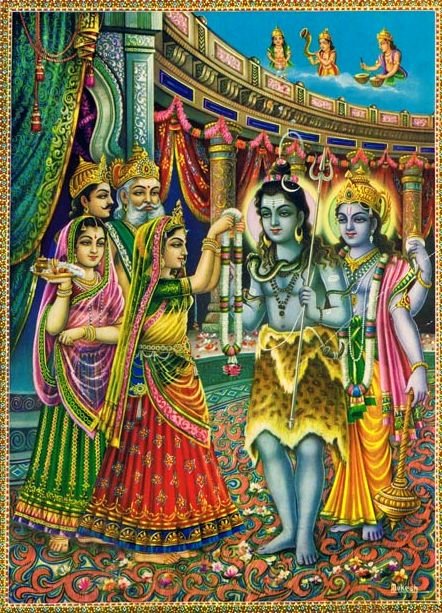
Other legends of Mahashivaratri extols that Lord Shiva and the Goddess Parvati were married on this day.
Another tradition believes that on the day of Mahashivaratri, all twelve Jyotirlingams of India manifested.
Our own Arunachala legend, proclaims that Mahashivaratri is the day Lord
Shiva appeared as a luminous Jyotirlingam before Brahma and Vishnu.
Dispute of Brahma and Vishnu
In the days of antiquity a controversy arose between Brahma and Vishnu
as to which of the two was greater. Brahma said to Vishnu, "I have
created the five elements and all the living beings with their endless
differences in form and sound. Therefore I am the Absolute God." Vishnu
said, "The whole universe is but an aspect of mine. Of what use is your
creation if I do not protect it? It is my thought-power that creates,
sustains and destroys the whole Universe. So I am the Absolute God".
Their dispute resulted in misery in the manifested world. Supreme Being
Parameshwara saw this and was filled with compassion. To settle the
discord and subdue their pride, Lord Shiva appeared before them in the
form of blazing column of light and a voice issued from it asking them
to seek its upper and lower limits and he who found either of these is
the superior one. Both gods stopped fighting and decided to explore the
ends. Brahma took the form of a swan and flew up to reach the top of the
column of light, whereas Vishnu became a boar and started burrowing
into the earth to find its base.
A thousand years passed as Vishnu dug deep into the nether worlds and
the journey seemed endless. With all this power he could not discover
the base and he got lost in meditation with the result that he
experienced the Supreme Light which dwells in the hearts of all. He soon
realised and recognised that his true strength was derived from this
Supreme Light, that is Lord Shiva. He prayed to Shiva seeking His pardon
and then returned to earth.
Brahman who flew up as a swan was mounting the sky and the higher he
soared, the column of light rose higher before him. He was growing
despondent and was about to return when he saw a fragrant flower called
Ketaki (screw-pine) falling towards the earth. On asking from where it
had come, the flower revealed that it had come from the crest of the
fire column that was none other than Shiva himself and that it had been
descending for thousands of four-fold Yugas. Brahma requested the flower
to say that both of them came down after seeing the crest and thus the
flower swore to Vishnu in the presence of the Column of Effulgence that
Brahma had reach the summit.
Splitting asunder the column of Light, Shiva appeared before the two
Gods. When the lotus-eyed Vishnu saw him, he danced with joy. The guilty
Brahma on seeing the Lord's true form was confused and frightened.
Mahadeva said, "The two of you need not be ashamed for having
transcended your limits. Hari (Vishnu) pondered deeply and became
enlightened. But Brahma has uttered falsehood and I now cut off his
fifth head for that perjury. Brahma shall not hereafter be installed in
any Temple. And this flower, which bore false witness, shall never again
find a place on my head and shall not be used for my worship."
After cursing Brahma and the screw-pine flower thus, Shiva turned to
Vishnu and said, "Child! Be composed, I am pleased with you. You are one
of my foremost devotees. You originated from me and are my sattwic
part. At the end of the kalpa you shall merge in me."
Brahma and Vishnu prayed to Shiva to abide there forever as a Tejo
Lingam. In answer to their heartfelt request, Parameshwara established
himself as the Arunachala Hill and also as a small Siva Lingam at the
eastern foot of the Hill for the welfare of the world and for those who
desire to worship Him and obtain illumination.
As a result of the dispute between Brahma and Vishnu the Lord declared
that henceforth the Screwpine flower (Thazhampoo, Ketaki, Screwpine)
which hitherto had adorned Shiva's head, would no longer be used in his
adoration. Thus, this flower is only used in worship of Lord Shiva one
time a year, and that is during third Kala Puja in the night of
Mahashivaratri.
On Maha Shivaratri, Lord Shiva is Lingodbhavamurti, the pillar of fire
that spans all, with no beginning and no end. On this day it is easy to
please Lord Shiva by fasting and prayer. The main prayer is usually
conducted during the night. Ever three hours the devotee worships Lord
Shiva in the form of a Shiva Lingam. the Lingam is bathed with milk,
ghee, honey, curd, rose water, etc. Lord Shiva is also greatly pleased
by the offering of Bilva leaves.
One also devotes time to chanting the Vedic Rudram, or the five-syllable
mantra of Shiva (Om Namah Shivaya) and to meditating on Him, by
remembering one's ultimate goal, which is God Realization, the purpose
of human birth. Ascending to the top of Mount Kailash within oneself,
and trying to experience the presence of God Shiva within as one's very
own self, and simultaneously as the Universal Self permeating the entire
universe, one draws closer to Lord Shiva on this night.
Thus the only way to achieve peace and happiness is by worshipping Shiva
at night, that is, by meditating on one's own self during the night
when the individual is free from the distractions of the physical world.
When the individual attains self-knowledge, he or she can live in the
world without being affected by anger, greed, and selfishness, the three
enemies of one's soul. Mahashivaratri symbolizes the worship of the
Atman within.
|
|
|
|