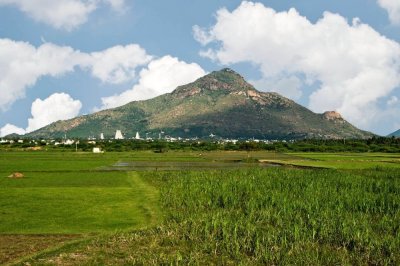
Arunachala is in the eastern ghats of North Arcot
District. It is an isolated hill, about fifty miles inland from the Bay
of Bengal and rises into a peak of 2268 feet above sea level. On this
hill there are many caves and hermitages near which are freshwater
springs and tanks. On the western slopes are forest areas, but the
eastern slopes, until recent years and the beginning of recent
reforestation programmes, were barren. From recorded history, this area
has been believed to be sacred. Other names of Arunachala are;
Arunagiri, Sonagiri, Sonasaila, Sudarsanagiri, Jothirlingam and
Tejolingam.
"By seeing Chidambaram, by being born, in Tiruvarur, by dying in
Kasi, or by merely thinking of Arunachala, one will surely attain
Liberation."
Geographically speaking, Tiruvannamalai is located at latitude 12°
15'N and longitude 79° 07'E. As to its geological history, a
contemporary U.S. geologist reported that:-
|
|
"Arunachala could have been thrown up by the earth under the stress
of some violent volcanic eruption in the dim ages before even the
coal-bearing strata were formed. This rocky mass of granite may be dated
back to the earliest epoch of the history of our planet's crust, that
epoch which long preceded the vast sedimentary formations in which
fossil records of plants and animals have been preserved. It existed
long before the gigantic saurians of the pre-historic world moved their
ungainly forms through the primeval forest that covered our early earth.
It was contemporaneous with the formation of the very crust of earth
itself. Arunachala was almost as hoary and as ancient as our planetary
home itself."
The earth is composed of five elements: earth (prithvi), water (appu), fire (tejo), air (vayu) and ether (akasa).
Ancients, having understood the essence of the five elements, have
caused temples to be erected for each element. They are known as the
sacred spots of the five elements. They are
Fire - tejo - Tiruvannamalai
Earth - prithvi - Thiruvarur, Kanchipuram
Water - appu - Thiruvanaikka (near Thiruchirapalli)
Air - vayu - Thirukkalathi
Ether - akasha - Chidambaram
Of the sthalas of five elements, Tiruvannamalai as the tejo sthala stands foremost in bestowing grace.
The hill is
referred to in the Puranas as the oldest hill on earth, and is regarded
as the heart of the earth owing to its great sanctity. The mountain in
this sthala is full of unequalled greatness. In the Krita Yuga, the Lord stood in the form of Fire (truth and wisdom). In the Treta Yuga, Arunachala was a mountain of precious gems (ratna). In the Dvapara Yuga it stood in the form of gold and now in Kaliyuga, Arunachala is manifest as a stone hill. We are still in the Kali Yuga (age of greed and conflicts) and according to belief, the yuga
will end with the incarnation of Kalki, the last Avatar of Vishnu, who
on his white horse, must destroy what is to be destroyed.
The town of Tiruvannamalai (derived from the word malai = mountain),
lies at the eastern foot of Arunachala. Within this town there is the 24
acre Arunachaleswarar Kovil, one of the largest Temples in India and
around 2,000 years old. The temple grew from a small sanctum-sanctorum housing a lingam to its present size, over the course of many centuries.
In earlier times, this place was part of a province called Thondaimandalam.
At that time the province extended between the north and south Pennar
rivers, with the Bay of Bengal in the east, to the present Mysore
province and Cuddapah in the west. These lands passed through the hands
of Kings and Emperors and later came under the influence of; Muslims,
Mahrattas, the French and from the 19th Century, the British.
There is
evidence that Aryan sages Agastya and Gautama and the scholar Tholkapyar
came to South India to gather information about Saivism. The idea of
Saivism being the supreme deity apparently originated in South India,
with Arunachala as the first representation of the Lingam.
It is said
that Gautama Rishi did his penance near this hill. It is believed that
he resided on a small hill called Pavalakunru, on the north eastern foot
of Arunachala hill.

Temple at Pavalakunru (modern times)
Similar sages came to this hallowed hill for tapas in ancient days. In the Arunachala Mahatma, as in some other Puranas, it is stated that somewhere near the peak of this hill abides a siddha purusha under a banyan tree. The place is said to be inaccessible. In Arunachaleswarar Kovil there is a mantap or seat dedicated to this siddha purusha, who is also called Arunagiri Yogi.

Mantap of Arunagiri Yogi at Big Temple
The great power of Arunachala's attraction has been affirmed by
countless sages, saints and other persons who have come to the foot of
the Mountain. The Hill evokes a tremendous power of radiance and by the
power of its 'energy field' emits a luminous aura, which is observable
during moonless nights. At this place, the conscious substance of the
Universe takes on the traits of union between Siva and Sakti with the
hill as centre in which all forces counterbalance.
Many saints
have sung songs in praise of Arunachala and its sanctity. Early Tamil
literature records the visit of Tirunavakkarasu and Tirugnanasambandar,
two saints who were contemporaries of the Pallava king Mohendra I (600
to 633 AD). Tirugnanasambandar was inspired by the sight of the hill
when he saw it from a town called Arianinallur, near Tirukkolilur
(twenty miles from Arunachala), and composed hymns in praise of it. He
visited Tiruvannamalai, stayed on the hill and worshipped it as a tejolingam.
The author
(Sekkalar Swami - 1088 AD) of literary works on the two saints says that
Tirunavakkarasu worshipped Siva on the top of the hill and obtained
enlightenment. Sunderamurti Swami refers to the worship of Annamalaiyar
in his work Tiruttogai, and Manikavachakar also sang Arunachala's
praises in his hymns. About the middle of the 13th century, Sidhopant, a
Maharatta saint and the father of Gnyanadeva, visited Arunachala. It is
also said that two other saints from Maharatta, Namdev (14th century)
and Samarthi Ramadasa (17th century) also visited this holy place.
Other ancient saints associated with Arunachala are Guhai Namasivaya, his disciple Guru Namasivaya, Virupaksha Deva and the great Murugan devotee and poet, Arunagirinathar. Another saint associated with Arunachala is Isanya Desikar whose tomb is located at Isanya mutt at the north eastern foot of the hill.
Two Yoginis
names Jatini Sanmukha Yogini and Ammani Ammal, are associated with the
hill. Ammani Ammal lived in the early part of the 17th century and
constructed the northern gopuram of Arunachaleswarar Kovil. It is said
that to construct this tower, she collected money by begging Apparently
she had a mysterious power of knowing the amount of money kept in any
box in any house she visited, out of which she claimed a part towards
the cost of the proposed construction. The tower Ammani Amman is named
after her.
In more recent
times, preeminent saints and sages connected with Arunachala have been;
Sri Seshadri Swamigal, Sri Ramana Maharshi, Kavyakanta Ganapati Sastri and Yogi Ramsuratkumar.
Shaktas regard this hill as Sri Chakra, a diagram of 43 triangle. Some consider that the form of the hill resembles the first half of the Sri Chakra which is called Meruprastana, the emblem of the Cosmos. In one of his Ashtakams, Adi Shankaracharya (who is believed to have visited Arunachala) calls the hill 'Meru' and says that siddha purushas are found here and also upon the Himalayas.
Some
Vaishnavites believe that the Hill represents the Chakra (Wheel of Time)
of Lord Vishnu.
"Giripradakshina or circumambulation of the Hill . . . . is
traditionally performed following the movement of the planets around the
unmoving sun, which means keeping the Hill always at one's right. The
eight cardinal points are marked by Shrines, Tanks and Mandapams, for
those edifices date from an earlier medieval period when the Vaishnava
faith was in the ascendant over the Saiva faith, and the Hill was then
regarded as the Wheel of Time in the hands of Mahavishnu, the Lord of
the Sun.' [1]
A vivid description of the glory of Arunachala and the bliss enjoyed by
the earnest devotees who worshipped here, is given in many of the Puranas, such as the Sivamaha Purana, Brahmanda Purana, Arunachala Mahatmyam and others, The most famous legend regarding the origin and sanctity of Arunachala and its manifestation as a Lingam at its eastern foot, over which has come into being the Arunachala temple, goes thus:
Lord Brahma,
the creator, and Lord Vishnu, the preserver each claimed superiority
over the other. Somewhat embarrassed that distinguished Gods of the
celestial realm should be engaged in such an altercation, Lord Siva, the
Lord of the Universe, appeared before them as a pillar of fire, known
as sthanu or lingodbhavamurti. In an effort to arbitrate
their discord, Lord Siva declared that, "Whosoever should find either
the beginning or the end of this light of mine shall be considered, now
and forever more, the superior of you two."
Upon hearing
this, Vishnu took the form of a boar and dug into the depths of the
Earth, seeking the beginning of the light. But he was to return
disappointed. Brahma became a swan and flew up, seeking the light's top.
He too was about to give up in despair when, by chance, he happened
upon a falling flower and embarked upon a conversation with it.
The flower which by name was a screw pine (pandanus odoratissimus),
started conversing with Brahma. Eventually the god convinced the flower
to support him in a lie to Siva, and that each be the other's witness
to the fact that they had found the end of the pillar of light.
Upon hearing
this lie Siva proclaimed that from henceforth Lord Brahma, would not be
deified in temples, and the screw pine would not be used in
worship. This has indeed come to pass as there are only two Brahma
temples (one in Pushkar near Ajmere and the other in Idar State in
Rajaputana) and the screw pine is only allowed in the worship of Siva one time a year during Mahashivaratri.[2]
Upon the
request of the gods Vishnu and Brahma, Siva established Himself as the
Arunachala Hill and also as a small Lingam at the eastern foot of the
hill so that all could worship both as emblems of Siva. Lord Siva in so
doing, admonished them thus:
"All jivas live, move and have their being in Me. I am latent in you
just as fire in wood, ghee in milk and so on. You cannot perceive such
latency with the aid of your senses, or by learning either from books or
from scholars, but you can know Me only by meditating on Me alone, I am
now here as the Arunachala hill and also as a lingam.
The moon gets
its light from the sun, even so other holy places will henceforth get
their sanctity from Arunachala. This is the only place where I have
taken this form for the benefit of those people who desire to worship Me
and obtain illumination. Arunachala is Omkara-swarupa or AUM itself. I
will appear on the top of this hill every year on the Karthikai day in
the form of a peace giving beacon. Those who see, that flame and
meditate on it will realise the 'Great Flame' or the 'Luminous Self' in
themselves."
The inner meaning of the legend of the pillar of light can be taken that Brahma represents intellect (buddhi), Vishnu represents ego (ahamkara)
and Siva represents Atman (Self). Ego and intellect realise the
futility of knowing Atman because the latter is beyond the senses and
transcends both ego and intellect. The ego and intellect, therefore,
surrender themselves completely to the Atman and obtain illumination
(Self-knowledge).
This myth has
given rise to two iconographic representations. One of them is
well-known: the lingodbhavamurti - Vishnu and Brahma in the
attitude of worshippers. The other representation is a later
development, specific to Tiruvannamalai, where Siva and Parvati are
figured on a stele covered with semi-circular incisions to represent the mountain; the rear face of the stele is a lingam, which is visible from the rear niche of the sanctuary. This representation is known locally as adi mudi,
the high and the low, after the same words in poems by Sambandar and
Sundarar, referring to the directions in which Brahma and Vishnu sought
the extremities of the pillar of fire.
Ramana
Maharshi came to this sthalam and never left; Seshadri Swamigal came to
this kshetra and remained; Sri Yogiramsuratkumar came and made it
his own; as did Mahatmas like Guhai Namasivaya, Guru Namasivaya,
Virupaksha and Isanya Desikar who came and lived at Arunachala. The
history of this sthalam says that five Jivan Muktas are always to be found living at Arunachala. Therefore, even today there are Jivan Muktas living here, though unseen and uncomprehended by us. How many Jivan Muktas must have lived here in the past? If all their samadhis exist in this place, one cannot through mere words extol the purity of this Holiest of all Holy places.
As a symbol of
the centre, the mountain, like all mystic centers, emanates a space
which is cardinalized in the same way as a mandala. The route of 14
kilometers around the mountain and centered on its vertical axis, is
oriented to the cardinal points by the distribution of shrines
consecrated to the eight lingas of the directions.
'It is said that the Gods do not come down from the Mountain. It is
man's task to climb towards Them. Overcome by compassion, Lord Siva has
made this progress possible by introducing the Giri Pradakshina, this
edifying ritual which aims at walking round the Holy Mountain with the
mind fixed on the immutable Centre.' [3]
Arunachala is the physical embodiment of Sat, the reality, and hence to have contact with it in any manner is Sat-sang.
Ramana Maharshi used to say that the benefits which can be gained by
meditation and various other forms of mind-control only after great
struggle and effort, will be effortlessly gained by those who go round
the Hill and that the power of Arunachala is such that even if one does
pradakshina (perform circumambulation of the 14 km pathway around
Arunachala) with no faith, it will still have its effect and surely
purify the mind.
Because Arunachala is the Fire of Knowledge (jnanagni) in the form of a Hill, the out-going tendencies (vasanas)
of the mind are automatically scorched when one goes round it. When
damp wood is brought close to a fire, it will gradually be dried, and at
a certain point it will itself catch fire. Similarly, when the mind
which is soaked with worldly tendencies goes round the Hill, the
tendencies will gradually dry up and at a certain point the mind will
become fit to be burnt by the fire of jnana. Ramana Maharshi said
of pradakshina to Kunju Swami: "This Hill is the storehouse of all
spiritual power. Going round It benefits you in all ways"
[1] Wheel of Time from Hill of Fire by Monica Bose
[2] The screwpine and worship
[3] Arunachala the Holy Hill by Skananda 1987
|
|
|
|



