By Eduardo Linder
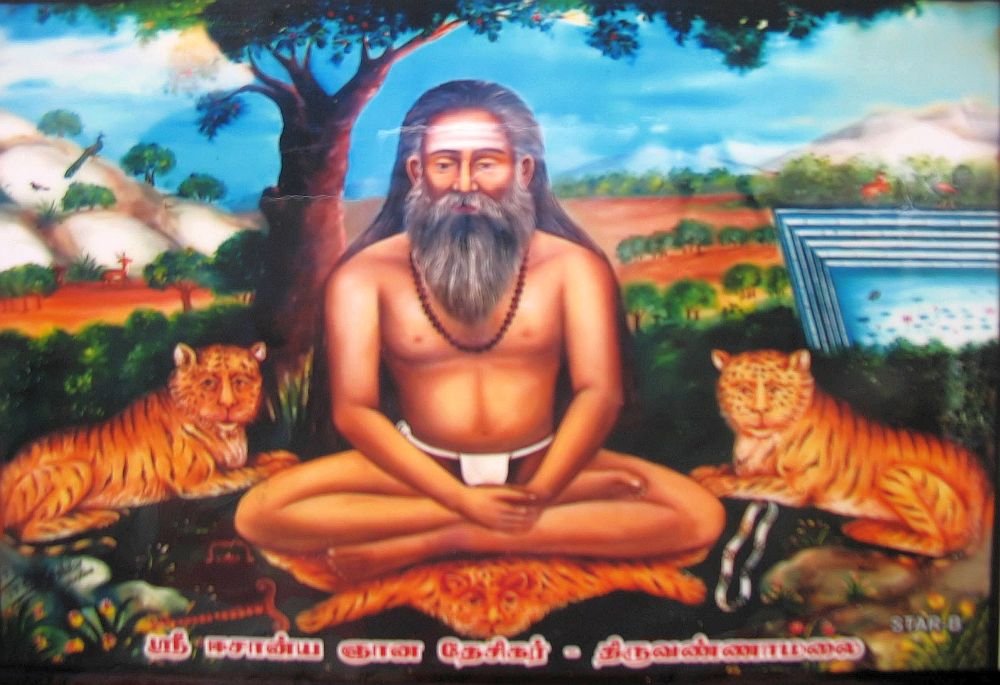
Isanya Desikar, whose math is located just outside Tiruvannamalai on the old pradakshina
road, was a distinguished yogi who, like many before and after him,
have felt the spiritual call of Arunachala. He came and settled at the
foot of the mountain quite late in his life, but nevertheless, by virtue
of his intense and personal relationship with Arunachaleswara, he can
still be regarded as one of the major saints of Arunachala.
He was born in
1750 in a small village called Rayavelur, which is located near the
River Palar in northern Tamil Nadu. His parents, Tiruneelakantha Desikar
and Uma Parvathi, belonged to the local farming community. Prior to
Isanya Desikar's birth his parents had been unable to produce a son for
many years. To solve this problem they had prayed to Lord Murugan at
Arunachala and had asked him to bless them with a son. When their
prayers were answered, the child was given the name of Kandappan, one of
the many names of Lord Murugan.
| | It soon became
clear that he was a precocious child both spiritually and
intellectually. When he was first sent to school, he astounded his
teachers by reciting the lessons before they had even been taught. Then,
while the other boys struggled to catch up, he would sit quietly in
meditation. His father gave him Siva diksha at the age of seven
and then bestowed the title of 'Desikar' on him. The title, which may
have been a hereditary one, entitled and empowered the son to carry out
the duties and functions of a guru.
Isanya Desikar (a
name he acquired much later in life) spent most of his childhood
uneventfully, mostly sitting in meditation in his family house. When he
reached the age of sixteen, his father decided it was time for him to
get married. While Tiruneelakantha was looking for a bride from amongst
his own relatives, Isanya Desikar, who had no inclination to get
married, appealed to his mother.
'I don't want to become a samsari. We have been
the slaves of Lord Siva since the days of our distant ancestors. My mind
longs to see all the holy places associated with Him. Instead of
marrying me off, give me permission to go on a pilgrimage.'
His mother granted his request and soon afterwards he set off on an extensive South India yatra. It seems he never went home again.
A major turning
point in his life occurred at Chidambaram. After he had visited the
temple there and had darshan of Lord Nataraja, he went to visit Sri Mouna Swami, a local saint who was reputed to be a siddha purusha. Mouna Swami lived on the northern bank of the Ayi tank in Chidambaram and appeared to be immersed in samadhi
for most of the time. Isanya Desikar felt an immediate attraction to
him, so much so that he decided to stay on in Chidambaram in the hope of
getting both initiation into sannyasa and upadesa (teachings) from him. For some time Isanya Desikar begged for his food and had darshan
of Mouna Swami twice a day, but the Swami himself appeared to pay
little attention to him. Feeling that the Swami was ignoring him because
he was not yet a mature enough devotee, Isanya Desikar decided that he
would try to compensate for this lack by giving Mouna Swami a display of
his earnestness. He took off all his clothes except for his loincloth
and went and stood before Mouna Swami during one of the heavy winter
rains. When Mouna Swami saw him standing there, undaunted by the heavy
rain and without the least trace of a shiver on his bare body, he took
the blanket that was covering his own body and wrapped it around the
shoulders of Isanya Desikar. Then, to Isanya Desikar's delight, he gave
him the desired initiation and upadesa and afterwards put him
into a state of deep meditation. To celebrate his acceptance, Isanya
Desikar composed a five-verse poem in praise of Mouna Swami. In the
first verse he extolled the greatness of his new teacher:
Ever-perfect one! You have manifested in the world as the one who is
steeped in the pure bliss of the experience of the expansive infinity
that has no attributes. [You have manifested] as the Self-realised
silence and as the embodiment of truth and grace to bring harmony among
various beliefs. I, keeping my head at the feet of your devotees, regard
you as the Lord himself who dances in space at Chidambaram and who is
worshipped by the three worlds...
In the fifth and final verse, Isanya Desikar acknowledges that he cannot
attain liberation through his own efforts or through his religious
knowledge. He therefore requests Mouna Swami to bestow his grace on him
and grant him absorption in the Self:
O Guru possessing Supreme Knowledge, known as the silent Guru living
on the banks of the Ayi tank, what is the use of studying the scriptures
and the many different arts? Of what avail is an extensive study of
Vedanta and Siddhanta, expounding their meaning, or following he ways of
various religions? It is easy to transcend samsara? Bless me with a
supremely blissful absorption in the Self, in which one can see the
emergence of your effulgent grace.
It is not recorded how long Isanya Desikar spent with Mouna Swami. It
may well have been several years because, when he finally decided to
leave Chidambaram to carry on with his pilgrimage, he had the long
matted hair of an ascetic yogi and the reputation for being a siddha, a yogi with great powers. His biographer [1]
reports that he travelled stark naked and carried only a few insignia
which marked him out as being a member of the South Indian order of siddha sannyasins.
After leaving
Chidambaram he wandered around for some time and met at least two famous
saints: a fellow siddha, Dakshinamurti Swami, who lived at Tiruvarur and a man called Ugandalinga Jnana Desikar, a Guru and a Brahmanishta
who lived in a village called Sikkal near Nagappattinam. When his
wanderlust had abated, he decided to settle down and undergo a long
period of solitary meditation. He soon found a suitable place - a large
uninhabited cave on a small hill. The nearest town was Vettavalam, which
is only a few miles from Tiruvannamalai, and the nearest village, a
settlement called Pakkam, supplied him with his few bodily needs. He
spent many years in this cave, apparently trying to immerse himself in
the state of nirvikalpa samadhi.
During his stay
there he was partially supported by a local farmer, Muthuswami Udaiyar.
This man visited the cave every day to offer milk from his cow. After
several years of devoted service Muthuswami Udaiyar's labours were
indirectly rewarded when he found a hoard of treasure while he was
digging the foundations of a house he was planning to build for himself.
His neighbours refused to believe that he had come across the treasure
accidentally. Instead, they decided that Isanya Desikar had used his
powers to manufacture gold coins so that he could pay Muthuswami Udaiyar
for his milk. The villagers who believed in this version of events went
en masse to Isanya Desikar's cave and, after singing his praises in
many ways, requested that he produce some gold coins for them as well.
Isanya Desikar realised that he would no longer be able to meditate
peacefully in an area where he had a reputation for manufacturing gold.
So, when the importuning crowds had dispersed, he quietly slipped away
and walked continuously until he reached Arunachala. He found a quiet
place on the banks of the Goraknath tank in the western part of
Tiruvannamalai and began to resume his meditation.
It was not long
before someone else came forward to support him. A local man, Arunachala
Chettiar, had become depressed because he had been unable to produce a
son even after many years of marriage. Many people had told him that his
luck would change if he could only receive the grace of a holy man. He
set out in search of such a person, encountered Isanya Desikar sitting
in samadhi by the side of the Goraknath tank, and began to serve him with great devotion.
Shortly afterwards, some siddhas,
who resided at Arunachala but who were invisible to ordinary men, came
to Isanya Desikar and escorted him to an uninhabited mountain cave.
Inside, there was a large mound of ripe fruits. The thought occurred to
him that if one of these fruits was given to Arunachala Chettiar, he
would beget a son.One of the siddhas read his mind and responded by saying, 'You may fulfil his desire accordingly'.The siddhas
escorted Isanya Desikar back to his place by the tank after first
giving him many of the fruits that he had seen in the cave. The fruit
that was given to Arunachala Chettiar produced the desired result.
Arunachala Chettiar was later given a bag of vibhuti by Isanya
Desikar. It became a family heirloom and several generations of his
family found they could overcome any worldly problems by worshipping
it.
Muthuswami
Udaiyar, the man who had served Isanya Desikar for many years while he
had been mediating near Vettavalam, had become very unhappy when his
holy man had suddenly and mysteriously disappeared without giving him
any explanation. However, he was not left in this state of dejection for
very long. One night, Lord Arunachaleswara himself appeared in one of
his dreams in the guise of Isanya Desikar and said, 'Dear son, don't
feel sad. I am staying at the north-eastern corner of Arunachala. You
can come and see me there.'
Then
Arunachaleswara appeared in his own divine form to Isanya Desikar and
told him, 'Dear son, I have asked a devotee to come to the north-eastern side of Arunachala to see you. Go there and meet him.'
As Isanya Desikar
was walking towards the appointed rendezvous he began to compose some of
the verses that were later known as Svanubhava Stotra Pamalai (Garland of Hymns of Self-Experience).
These eventually numbered 117, all of which were addressed to Lord
Arunachala. From the second verse onwards it becomes clear that in
discovering Arunachala he had found both his true Guru and his God.
2
O Arunachala! Your devotees, recognising you as the infinite reality
who is grace embodied in the form of fire, beyond the reach of Brahma
and Vishnu, sang in praise of your greatness. I, who have in a
miraculous way found you and adopted you as my Guru, may say many things
about you, but all I really know is that you are the great and adored
Lord Arunagiri. I am unable to say anything more.
In another of his verses he explains that it was Arunachala's power that
stilled his mind and enabled him to discern the real nature of the
mountain.
57
O Sat-chit-ananda, who stands as 'The Self is he', by the power of
the Guru's love I recognised you as God. I praise and bow to the
blissful form, vast as the sky. You made me silent; now grant me
liberation
The poem is a mixture of different metres and the mood of the verses
varies from self-deprecation to ecstasy. It may well be that they were
composed on many different occasions, for the author sometimes complains
about his faults and laments over his spiritual bondage, whereas at
other times he exalts in the liberation that the grace of the Lord has
granted him. Since it is traditional in Tamil literature for jnanis
to write verses in which they take a devotee's standpoint and claim to
be ignorant, deluded, suffering, etc., one cannot state authoritatively
that one verse was written during his sadhana and another after
his liberation. However, although the chronology of the verses will
always remain problematic, there seems to be little doubt that Isanya
Desikar eventually attained liberation through the redeeming grace of
Arunachala. In one verse, for example, he sings:
45
In my identity with the body I had the sense of 'I' and 'mine' in the
three states of waking, dream and sleep. By your gracious love this
sense has vanished like a dream. You made me turn to you, O Arunachala,
you who burn like a flame. You burnt away my Self-forgetfulness.
The style reveals a familiarity with some of the great works of the Tamil bhakti
tradition, but the style is distinctively his own. Also, it is
interesting to note that the language and philosophy of the verses are
uncompromisingly advaitic. Many of the great Arunachala saints
who have written about the mountain were Saiva in orientation and this
is clearly reflected in the language of their poetry. Isanya Desikar was
brought up and educated in the Saiva tradition but his verses show that
he felt more at home with the language and concepts of Vedanta:
81
Is there any truth apart from the Self? Great men live without the
illusory mind-screen, rooted in the reality of blissful no-thought.
Abiding in the Self, totally free, they are the wise ones, free from
karma.
He was enough of a Saiva to revere the mountain as Siva himself and its power of sakti, but none of the standard ideas of Siddhanta
can be found in his verses. When he talks of Siva, he is not conceiving
of him in a mythic or even an anthropomorphic form. He instead seems to
regard Siva as being simultaneously pure awareness, the energy that
created the manifest world, and the substance out of which the world was
created.
87
In the past, present and future, you, the form of grace, abide as the lofty Siva-bliss which is the one life in all life...
66
You are the Lord, the Guru, intelligence, the law, our goal. You are
absorbed in the Self and you abide as the Self which is everything, with
nothing separate from it. In a myriad ways you engage in sport in the
world of forms: I as you, you as I. O Supreme Infinite Siva! You shine
within the devout as the Self that is awareness.
Scattered throughout the verses there are occasional hints of the path
that Isanya Desikar himself followed. Believing that the best and
highest form of devotion to Arunachala could be practised by abiding in a
thought-free state, he directed his efforts towards cultivating an
inner silence.
58
If you think without thoughts of that eternally blissful One who
shines everywhere as the divine, as Sakti, as Siva - that bhakti itself
is mukti. Thus proclaim the scriptures...
72
Realising that all we have learned is but the work of God, and
knowing that we cannot know anything by ourselves, to be in silence is
the jnana that vouches freedom from rebirth. Speak not. See the unborn
Self as chit, as Siva. That seeing is illumination.
When
we left Isanya Desikar, he was walking toward the north-eastern corner
of the mountain to keep his appointment with the devotee who had kept
him supplied with milk for so many years. They soon found each other and
resumed their former relationship. Isanya Desikar then chose a spot
under a banyan tree on the southern side of the Isanya tank and was soon
spending most of his time immersed in samadhi. Muthuswami
Udaiyar often visited him there, and each time he came he would bring
food for Isanya Desikar and for any other devotees who happened to be
with him.
When no devotees
were near him, Isanya Desikar, who was then about sixty years of age,
liked to sit naked, absorbed in samadhi. On such occasions Lord
Arunachaleswara himself sometimes used to manifest in the form of a
tiger to guard him and prevent anyone from disturbing him. Isanya
Desikar knew what was happening. Each time he came out of samadhi,
he would fondly run his fingers through the fur of the tiger and
address him lovingly as 'Arunachala, my Lord'. Occasionally other tigers
from the forest would come along and help Arunachaleswara with his
guard duties. Isanya Desikar knew that the presence of the tigers would
intimidate other people, so whenever he saw that devotees were about to
visit him, he would send the tigers away by saying, 'My devotees may get
frightened if they see you. Please keep away.'
After some time
Isanya Desikar moved to a nearby flower garden and took up residence
there. Muthuswami Udaiyar, the man who had been feeding him for many
years, persuaded the owners of the flower garden to donate a small
portion of it so that Isanya Desikar could remain undisturbed there. The
owners agreed and handed over about a third of the flower garden. Sri
C. Subbiah, who wrote a biography of Isanya Desikar, states that from
the day he took up residence in the north-eastern corner of the flower
garden he became known to the world as 'Isanya Desikar', for isanya
in Tamil means 'north-east'. This may well be true but it seems just as
likely that he acquired his name either by sitting by the side of the
Isanya tank or merely by living for so many years on the north-eastern
side of the mountain.

As Isanya
Desikar's fame began to spread, he began to attract devotees and
disciples. One of them was a man called Pondy Arunachala Swamy who is
chiefly remembered for coming to a macabre end after going against his
Guru's wishes. He was brought up in Pondicherry, but after he came under
the influence of Isanya Desikar he took sannyasa and moved to
Tiruvannamalai. Since he had no family, his property was lying unclaimed
in Pondicherry. It should be remembered that as a sannyasin he had no
rights to it. Under Hindu law, the taking of sannyasa has the same legal implication as physical death. The sannyasin's
relatives take over his property, and if there are no relatives, his
former possessions become the property of the state.Pondy
Arunachala Swamy knew all this, so one day he suggested to Isanya
Desikar, 'Why don't I go back to Pondicherry dressed as a householder
and claim all my former property from the French government. Then I
could sell it all and give all the proceeds to you.'
Isanya Desikar
strongly disapproved of his disciple's plan, 'We don't want any money,'
he said, 'And furthermore, the sannyasin's robe, once donned, should never be removed. If you are still intent on going, I must warn you. You will not return!'
Pondy Arunachala
Swamy, who was aggrieved that the government had ended up with all his
property, ignored the warning and went to Pondicherry to carry out the
plan. He convinced the French government that he was the rightful owner
of his ancestral property, took possession of it and auctioned it off.
He converted the proceeds into gold, which he loaded on the back of a
bullock. His intention was to drive the bullock all the way to
Tiruvannamalai with the valuable cargo strapped to its back. However, at
the moment of his departure, when he struck the bullock with a stick to
make it start, the bullock, normally a very placid animal, turned on
him and gored him to death. The cargo then became the property of the
Pondicherry government, but instead of hiding it in their treasury, they
decided to use some of it to commemorate the strange and unfortunate
accident. They made a statue of Pondy Arunachala Swamy being gored by
the bullock and installed it on the western side of Karuvadaikuppam near
Muthialpet. The statue can still be seen there today.
A suitable epitaph
for Pondy Arunachala Swami can be found in one of Isanya Desikar's
verses to Arunachala:
48
Those who ceaselessly seek to find their treasure in gold do not find
anything in it. Not knowing themselves, they vainly talk about this and
that. Spiritual seekers realise that you alone are the treasure. You
are the world, the creation, the Lord, the Mother. They [the spiritual
seekers] know no one else by you, O Lord of Arunachala.
Isanya Desikar must have been one of the first Gurus in India to have a western devotee. His name was Ayton [2]
and he was the District Collector for the region that extended from
Tiruvannamalai to Vriddhachalam. He had heard about the greatness of
Isanya Desikar and approached him in the hope of getting a cure for a
chronic complaint.When Isanya Desikar saw him coming he issued his
standard warning to the tiger who had been keeping guard over him: 'Lord
Arunachala! A European is coming. He may get frightened on seeing you.
You had better stay away.' The tiger promptly withdrew.
Ayton came near
and prayed to Isanya Desikar to cure him of the tuberculosis from which
he had been suffering for many years. Isanya Desikar smiled and after a
brief pause spat on the ground. The moment he spat, Ayton was cured of
the disease. Ayton then spoke to the holy man with both trepidation and
devotion.'Swami, I have recently acquired a large amount of land, I
would like to offer your holiness as much as you need. It can be a
permanent endowment in your name.'
Isanya Desikar
smiled and asked tauntingly, 'Will your land yield crops even during a
drought?'Then, pointing his finger towards Arunachaleswara and
Apeetakuchamba, he added, 'Here is a householder with two children and a
large family. It is proper to give him any amount of land, but it is
not proper to gift it to me, a sannyasin.'
Ayton took leave
of him but returned on many occasions. He got into the habit of
addressing him reverentially and affectionately as 'Tata', which
means 'grandfather'. It is said that before he began any new project he
would always mediate on Isanya Desikar and invoke his blessing by
saying, 'Tata, please lead me in this work. It is your
work.' At the annual Deepam festival Ayton would take the lead in
dragging the huge temple chariot through the streets of Tiruvannamalai.
However, before moving the chariot for the first time he would pick up
one of the ropes and exclaim loudly: 'Tata, you hold the rope and
lead us!' The local people were all astounded that such a prominent
British official should have such devotion towards a naked sannyasin.
Ayton made it a
point always to attend and lead this annual festival, but one year he
found himself stranded by floods on the southern side of the River
Pennar just before the beginning of the festival. Knowing that he was
expected to be at Arunachala to start the chariot on its journey, he
called out to his mount: 'Horse, I must see Tata and I must also get the Deepam festival started. Think of Tata
and cross the river!' Without a moment's delay or hesitation, the horse
leaped into the raging torrent of water and effortlessly waded to the
other side. None of the other people who were stranded dared to follow
for they were all convinced that it would be suicidal to enter the
surging waters.
At the moment when Ayton put his faith in Tata
and leaped into the water, Isanya Desikar opened his eyes after a long
meditation and stretched out his hand in a southerly direction. When one
of his disciples asked what he was doing, he replied, 'If someone falls
into a river, should we not save him?'
Ayton arrived
safely and took Isanya Desikar's blessings to start the festival. When
the news of Ayton's spectacular river crossing and Isanya Desikar's role
in it spread among the Deepam crowds, many of them came to the
north-eastern side of the hill to see the man who had been responsible
for the miracle. The guardian tigers had to withdraw for several days
until the crowds subsided. Several of the new visitors turned out to be
mature seekers who were looking for guidance from a Guru. Isanya Desikar
accepted some as disciples, had a small thatched shed built to
accommodate them and gave instruction by writing a guide to liberation
entitled Jnana Kattalai.
In 1829, when
Isanya Desikar was seventy-nine years old, he realised that death would
soon come to him. He foresaw the time and date of his passing and wrote
the information on a palm leaf that he then concealed under his seat. On
the 26th day of the Tamil month of Margazhi he told his oldest disciple somewhat cryptically, 'Lord Nataraja is going to the thousand-pillared mantapam.
We too should go there.' Then he sat in meditation, facing north, with a
slight smile on his face. Muthuswami Udaiyar, realising that his master
was about to give up his body, asked him, 'What now will be the fate of
us devotees?'
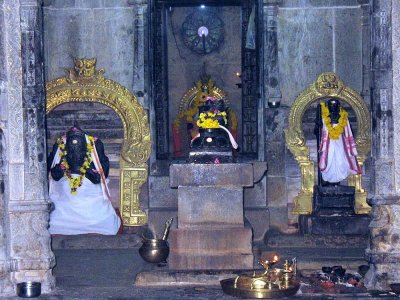
Isanya Desikar Samadhi, Tiruvannamalai
Isanya Desikar
replied, 'Has not your family already ripened as a bunch?' and promptly
abandoned his body. His devotees chose a samadhi site under a
bilva tree nearby because they recollected that Isanya Desikar had
occasionally stood there and gazed lovingly at the mountain. When the
palm leaf that predicted his death was found shortly after his burial,
the devotees had one last proof of their master's powers.
[Thanks to The Mountain Path]
[1]The information in this article has been gleaned from a Tamil work, The Life History of Tiruvannamalai Sri Isanya Jnana Desikar and his Garland of Hymns of Sri Annamalai
by C. Subbiah Swamigal. It was published in Madras in 1921 and seems to
be the only reliable source of information on the saint's life.
[2]The name Ayton has been selected as a
plausible British rendering of Tamil. The correct name may well have
been something phonetically similar such as Eton or Heighton.
|
|
|
|