By Swami Anvananda
Arunagirinathar is reknowned as one of Tiruvannamalai's most famous saints. He was a Murugan bhakta
who lived at the foot of Arunachala in the fourteenth century. Reliable
information about him is hard to come by for the earliest account of
his life was not published until the nineteenth century, about 500 years
after he died. This version, which has several variations, contains the
following principal elements.
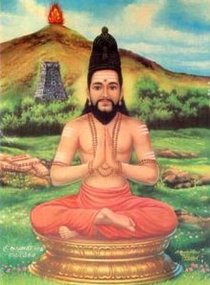
Arunagirinathar at Arunachala
|
|
Arunagirinathar was born in Tiruvannamalai and spent the greater part of
his life there. He was reputed to be the son of a courtesan called
Muttammai. As he grew up he found the company of courtesans so
attractive, he spent most of his time in their houses. When his mother
died, all the properties he inherited from her were squandered to pay
for his lust.
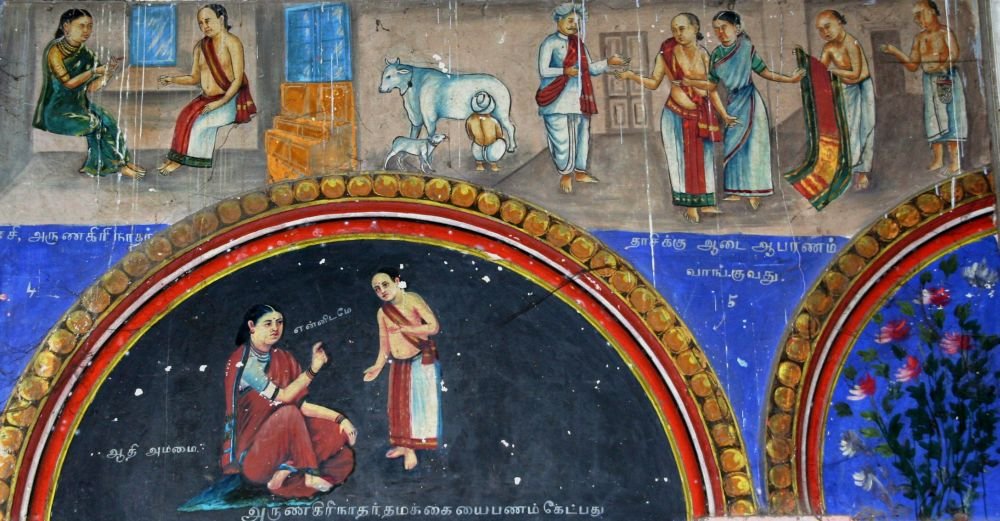
Arunagirinathar had a sister, Adi, who was very fond of him. Taking
advantage of her affection, Arunagirinathar persuaded her to part with
her jewels and all her other possessions so that he could continue to
indulge his appetite for the local courtesans. He continued with this
way of life for many years. As he became older, his body became diseased
and the better class of courtesan began to jeer at him and avoid his
company.
The major turning point in his life occurred when he had spent all his
sister's money. Not knowing that she was destitute, he approached her
again in the hope of getting another hand-out. His sister, who had
nothing left except the clothes she was wearing, told him that her funds
were exhausted. Since she still loved her brother, and since she still
wanted to be of assistance to him she offered him her own body, saying, 'If your lust is so insatiable, you can use my body for your sexual satisfaction'.
These words deeply affected and shamed Arunagirinathar. He mentally
reviewed the wasted years of his life and came to the conclusion that he
had been committing crimes against God. As his sense of shame deepened,
he decided to commit suicide by jumping off one of the gopurams
in the Arunachaleswara Temple. He climbed the tower, but before he was
able to jump, Lord Murugan manifested before him and held him back. In
some versions of the story, Arunagirinathar actually jumped and Murugan
had to catch him before he died on the paving stones below.
Murugan embraced him. Then, with his vel, (the spear that he always carries) he wrote a mantra on Arunagirinathar's tongue, gave him a japa mala
and commanded him to sing songs in praise of him. Arunagirinathar was
initially hesitant, claiming that he had no knowledge of Tamil prosody,
but when Murugan encouraged him by giving him the first line of a song,
Arunagirinathar found that he could effortlessly compose and sing the
remainder. Murugan disappeared, leaving Arunagirinathar a totally
transformed man. His diseases vanished and he became an ecstatic bhakta
whose devotion manifested as a stream of new songs, all in praise of
Murugan, his deliverer. He toured the town of Tiruvannamalai, composing
and singing songs as he went. Later on, he travelled throughout India,
still singing his songs, and visited many of the country's famous
pilgrimage centres. Traditional accounts say that he composed more than
16,000 songs in praise of Murugan. Most of them have been lost, but more
than 1,300 of the surviving ones have been collected together in a work
called Tiruppugazh (The Glory of God), which has now become one of the classics of Tamil devotional literature.
So much for the traditional account. If one turns from this to the
historical evidence and the biographical and cultural references in
Arunagirinathar's poetry, one is likely to conclude that this account,
though it contains a large germ of truth, has been greatly embellished
and sensationalised.
From one reference in the Tiruppugazh it is clear that Arunagirinathar came from a Hindu family whose ancestral deity was Murugan:
O Skanda [Murugan]! Glorious God of the hills!
Pray bestow your blessings, accepting the ardent worship of this humble son to you, my ancestral deity. [Tiruppugazh]
Though there is little doubt that the verses of the Tiruppugazh
were brought into existence by divine inspiration, a study of their
contents reveals that Arunagirinathar was a highly educated man. His
songs exhibit a familiarity with the Tevarams, the Tirukkural
and numerous other Tamil scriptural and philosophical works. His
compositions are also sprinkled with Sanskrit words and expressions
which indicate that he had studied the Itihasas, the Puranas, the Gita, the Upanishads, the Agamas and the Mantra and Tantra Sastras.
Some commentators feel that the vast erudition he shows in his
compositions indicates that he must have come from a family of brahmin
pandits. It is not therefore likely that he was the son of a courtesan,
for with such a background he would not have received a scholarly
education.
It was the lot of many learned men in Arunagirinathar's day to earn
their living by composing poems in praise of rich men. Arunagirinathar
himself admits that he took up this profession in order to be able to
afford the fees of the local prostitutes:
To me who seek the company of prostitutes all the time,
spending on them whatever little money I earn by bestowing lavish
praises on men who lack wisdom, who never pray to your holy feet, who
are dunces, who indulge in devilish activities and who have no sense of
gratitude - pray, Murugan, grant me moksha [from all this].
[Tiruppugazh]
One can deduce from this that he was already a reasonably competent poet
before his encounter with Murugan and that Murugan merely enhanced his
talent, enabling him to compose extempore verses that were both
devotional and literary masterpieces.
Some references in the Tiruppugazh show that he was a married man
and that his immoral behaviour outraged his family and made him the
laughing stock of everyone in town:
[I was] ridiculed and jeered at by my wife, by the people
of the town, by the women of the place, by my father and my relatives. I
was treated as a despicable person by the very people whom I have
loved. With everyone scolding me or indulging in loose talk about me, my
mind became confused and full of gloom. I thought within myself, 'Is it
for this that I strove to obtain this human body which is a treasure
indeed?' [Tiruppugazh]
This mention of his family seems to contradict the traditional story
that casts him as an orphan who frittered away his inheritance on
sensory indulgences.
Arunagirinathar was clearly aware that
his immoral behaviour was sinful in the sight of God. In one of his
verses he lamented:
'Will I ever get to know how to attain your holy feet
before becoming too old? I am wasting my youth by indulging in sinful
and sexual pleasures.' [Tiruppugazh]
His life took a change for the better when he came into contact with an unknown mahatma
who advised him to meditate on Lord Murugan. Arunagirinathar at first
ignored the advice, but after some time he began to meditate in the
manner prescribed by the mahatma. For several hours each day he
sat in front of an image of Murugan, but his mind, weakened by years of
dissipation, was unable to concentrate for any length of time.

Lord Murugan appearing before his devotee Arunagirinathar
In despair Arunagirinathar decided to end his life. It was at this
opportune moment that Lord Murugan appeared on a dancing peacock, halted
him in the act and took possession of him. There is no support in any
of Arunagirinathar's verses for the well-known story that his suicide
attempt was precipitated by his sister's offer of her body, nor is it
indicated anywhere that his chosen method of suicide was to jump off one
of the gopurams. However, the attempted suicide and the divine intervention that prevented it are clearly documented:
When I was about to shed life from my body, out of
compassion for me and to elevate me to a better and praiseworthy status,
you came upon the scene, dancing, accompanied by your celestial
devotees and showered grace on me. [Tiruppugazh]
In some of his other verses Arunagirinathar attempted to convey the joy that this first darshan brought to him and the transforming effect that it had on his mind:
The kadamba garland that he wore suffused me with its cloying
fragrance. My breath was held. His moon-like countenance and tender
smile caused such joy and ecstasy that my mind was lost. The moment he
looked at me a cool liquid light poured out from his long lotus eyes. It
filled my heart, tasting like nectar, and I was lost to him forever.
Overwhelmed by the experience, Arunagirinathar surrendered
wholeheartedly to Lord Murugan and resolved to keep an awareness of the
Lord's name continuously in his mind:
O mind of mine, it's good you decided to surrender. See
him on his peacock vahana. He has now taken charge of you. Doubt not,
there is no greater state. Dwell on his holy name always...
[Tiruppugazh]
After his dramatic conversion Arunagirinathar made extensive tours of
India, singing Murugan's praises and repeating his name. On many
occasions during his travels his devotion was rewarded when Murugan
appeared to him in the form of a vision. It is worth examining some of
these verses that he sang, for they give a revealing insight into his
spiritual state, his beliefs and the practices he enjoined on
others.
In the following verse he recalls how he transcended his dualistic
relationship with God and established himself in the supreme state of
Self. He utilised the term 'mauna' or 'silence' to convey the essence of this indescribable state:
It [mauna] has no length and breadth and its extent
cannot be comprehended by anyone. [It is] where everything becomes
clear. No longer engaged in outward puja, I experienced profound wisdom
and spread flowers of joyous love. Can I [now] worship that form of Siva
which is beyond the Vedas, beyond thought and speech, beyond conscious
self-effort and beyond, beyond all subtle desires? [Tiruppugazh]
Arunagirinathar never stated explicitly how long it took him to attain
this realisation; he merely said that it came about sometime after his
first encounter with Lord Murugan:
The appointed day of Yama's coming having passed by, the
desire to be always sporting with women having left me, having cut
asunder the troubles caused by the five senses, I began to sing the
glory of your lotus feet. I meditated upon you, O Lord of Tiruchendur
[Murugan], and having come to know you, wisdom dawned upon me. O Kanda, I
have known you, known you well. Going on the path of inner experience, I
attained the true knowledge, destroying the I-am-the-doer sense at its
root. [Afterwards], the ever-functioning mind was dead. Speech ceased to
be... [Tiruppugazh]
Although Arunagirinathar seems to have realised the Self fairly quickly,
probably because of his latent spiritual maturity, he recognised that
most devotees could only progress slowly, step by step. Like many other
teachers before and after him, he told such people that they should
first learn to quieten their minds:
Before I go down the steps of the bhakti ghat to bathe in
the sea of ananda, the restless waves of the mind, free of all silt,
must first subside.
To effect this subsidence Arunagirinathar recommended that devotees
should live a life of purity and follow traditional practices:
By engaging in charity, by observance of festivals, by
external worship of God; by the study of scriptures, by the control of
the senses, by purity of thought and action, by observance of dharma, by
adopting an attitude of compassion, and lastly, by rendering personal
service to the Guru, one soon attains purity of mind.
[Kandar-Alankaram]
When these practices mature, the grace of the Lord manifests in full measure and takes one to the goal:
Control your mind, give up anger, always perform charity,
remain in the sattvic state of repose, free from rajas and tamas. Jnana
Vel [the spear of jnana wielded by Murugan] of its own accord, without
seeking or effort, will [then] bestow its grace on you.
[Tiruppugazh]
Having been transformed by the grace of the Lord from a life of
debauchery to a state of Self-knowledge, Arunagirinathar could speak
with authority on the redeeming power of grace, the necessity of
surrender, and the effectiveness of meditating on the name and form of
the Lord. As a result of his own experiences Arunagirinathar clearly
felt that the path of devotion and surrender was the easiest and most
direct route to God. He therefore discouraged his listeners from
engaging in other practices, deeming them to be either
counter-productive or futile. For example, in several of his verses,
written from the standpoint of a devotee, he makes very blunt and
outspoken remarks about the uselessness of traditional yoga practices.
In other places he is equally negative about pandits and philosophers
who get bogged down in intellectual disputes about religion.
The practice of yoga to make the body steady by
controlling the breath, ...the awakening of the fire [kundalini] in the
solar plexus and the resulting preoccupation with such practices that
cause mental anxiety should be given up. I should strive to control the
five senses of the body by rooting out their mischief completely. I
should give up the sense of doership. I desire to attain the mauna state
where there is no feeling of insufficiency, the brahmic state of
non-differentiation and the house of moksha by surrendering at the lotus
feet of God Kumara [Murugan]. [Tiruppugazh]
I have had enough of the company of those persons
belonging to one or the other of the six religious faiths, shouting,
doubting, disputing, asserting and debating with each other about the
superiority of the tenets of their respective faiths. Also [I have had
enough] of those who have only taught themselves for the purpose of
engaging in such controversies or for the sole purpose of performing
ritualistic worship. Enough also of those who spend their times in
mantras and calculations concerning yantras and chakras, their layouts
with angles and junctions as found in Siva Tantras and Agamas. O Lord
Murugan! Grant me moksha without my having to meander by fruitless and
circuitous routes. [Tiruppugazh]
O yogis, by concentrating your two eyes on the tip of
your nose and by controlling your breath from the muladhara to the head
so that not even a single breath goes out of your body, you are trying
to get moksha. You have forgotten to follow the easier and simpler way.
If you concentrate your mind on Vallinayaka's [Murugan's] feet, it is
easy to get moksha. [Kandar-Alankaram]
I do not want to be a foolish yogi by practising the
control of respiration and consuming large quantities of herbs and
roots, hoping to preserve and protect this mortal body as long as one
wishes. Bless me, O Muruga, to avoid the ordeals of such disciplines
that produce a certain rigidity by mala maya [the contaminating power of
maya] and instead lead me to a daily life disciplined by jnana and
possessed of religious piety. Bless me further, O Lord, to become a
great yogi established in the reality of Siva, a state without
differentiation of the Self from the objects around. [Tiruppugazh]
After his extensive pilgrimages, encompassing at least
200 towns, Arunagirinathar finally returned, settled down in
Tiruvannamalai and spent the remainder of his life there. The
traditional story of his life includes several incidents that took place
during this period either in the Arunachaleswara Temple or nearby. In
the first of these stories Pravuda Devaraya, the local king, invited him
to appear in court because he had heard of Arunagirinathar's high
reputation as both a poet and a saint. Arunagirinathar, who had no
interest in the affairs of the world, ignored the invitation. Pravuda
Devaraya, who had a high regard for scholars and sadhus, then
came in person and requested that Arunagirinathar come for a visit to
the royal palace. Arunagirinathar, noticing that the king was a devout
man, accepted the invitation, went to the palace for a visit and had
several honours bestowed on him by the king.
In the court of this king there was a famous scholar, Sambandandan, who
had a tendency to boast both about his spiritual attainments and his
religious knowledge. He had managed to establish himself as a favourite
of the king, so when he heard about the reception accorded to
Arunagirinathar he felt that his position in court might be threatened.
His jealousy motivated him to hatch a plot against Arunagirinathar that
he hoped would belittle his new rival in the eyes of the king.
Sambandandan had done great tapas earlier in his life, so much so that
he had obtained a boon from Kali, his ishta devata (chosen
deity), that for a period of twelve years she would appear before him
whenever he summoned her. Knowing that he could call on Kali to appear
at any time, Sambandandan proposed to the king that he and
Arunagirinathar should have competition in which each would try to make
his chosen deity manifest in a form that would be visible to everyone.
Sambandandan not only persuaded the king to agree to the competition, he
also persuaded him to add a stipulation that the loser of the
competition should leave the kingdom and never return. Although the king
agreed to the rules of the competition, it seems that he did not pass
on the full details to Arunagirinathar. He merely told him that he had
organised a competition in which the two devotees would try to summon
their favourite deities. Arunagirinathar agreed to take part, saying
that if Lord Murugan could be persuaded to appear, he would give the
king darshan and bless him.
The competition was held in public in the Arunachaleswara Temple.
Sambandandan, full of confidence, undertook to manifest his God first.
To the accompaniment of great pomp and ceremony, he called on Kali to
appear, but for some reason she refused to manifest herself. In some
versions of the story it is said that the twelve-year period of the boon
had expired the previous day, so she was no longer under any obligation
to appear. Since Sambandandan was still able to communicate with her,
even though he could not make her appear, he got a promise from her that
she would hold Murugan tightly in her arms so that he would be unable
to manifest when Arunagirinathar called on him.
Arunagirinathar began his attempt by
singing a song. After praising Murugan at length in verse form, he
summoned him to appear:
...O Lord Murugan who resides in the heart of Pravuda
Devaraya in such a way as to make it dance with joy! O Lord of Lords!
Come dancing, O Lord, come dancing in such a way that when you dance,
everything dances... [Tiruppugazh]
In some versions of the story Murugan manifests immediately, but in
other accounts he fails to appear because he is being held tightly by
his mother, Kali. In the version in which Murugan is restrained,
Arunagirinathar devised a strategy to counter Kali's influence. He first
sang another song that was so entrancing, Kali unconsciously began to
loosen her grip on her son. When Arunagirinathar sensed that this was
happening, he sang a different song that summoned Murugan's vahana,
his peacock, to appear and dance before Murugan and Kali. The peacock
promptly appeared and danced in such an enticing way, Kali momentarily
forgot to hold on tightly to Murugan. At this crucial moment Murugan
leapt out of her arms, mounted his peacock and entered the physical
world through one of the pillars of a mantapam in the
Arunachaleswara Temple. A temple has since been built around this column
to commemorate this great event. The manifestation of Lord Murugan was
so dazzling, the light he emanated caused Pravuda Devaraya, the king, to
lose his eyesight.
This traditional story is so full of improbable events, it would be
tempting to dismiss the whole episode as quaint myth. However, the
central event of the story, the manifestation of Lord Murugan in public
in response to Arunagirinathar's pleas, finds some corroboration in two
verses from the Tiruppugazh:
In the midst of the assembly of your devotees who deserved your compassion... You came once in Tiruvannamalai...
O Victor on the peacock! You came to my help in
Tiruvannamalai in a way that people of the world can perceive and praise
your great compassion. [Tiruppugazh]
There is no mention of a competition in any of the verses, nor are the
activities of Sambandandan and Kali alluded to, but there seems to be
enough textual evidence to suggest that, prompted by Arunagirinathar,
Murugan appeared, mounted on a peacock, before a large assembly of
people, including the king, who had gathered there with the express
purpose of determining whether or not Arunagirinathar could make his
chosen deity appear.
The biographies of Arunagirinathar contain another story in which the
central event is a competition. A contemporary of Arunagirinathar, an
erudite scholar and staunch Vaishnava called Villiputhurar, was
responsible for translating the Mahabharata into Tamil verse.
This man was so confident that he was a better scholar than anyone else,
he toured around the country, challenging all the pandits he met to
engage in scholarly competition with him. It is doubtful whether many
people accepted his challenge because Villiputhurar made it a condition
of the competition that the loser should have his ears cut off. Hearing
of Arunagirinathar's fame as an extempore poet, he came to
Tiruvannamalai and challenged him to a poetry competition. Under the
rules of this contest, Arunagirinathar had to compose extempore verses
that Villiputhurar undertook to explain. If Arunagirinathar could
compose a verse that Villiputhurar could not ascertain the meaning of,
the latter would concede defeat and agree to have his ears cut off.
Arunagirinathar in return agreed that he would have his own ears cut off
if he failed to produce a verse that baffled Villiputhurar.
The competition began with
Arunagirinathar composing the verses of a poem that later became known
as Kandar Antadi.
Villiputhurar easily deciphered the meaning of the first fifty-three
verses, but could make no sense of verse fifty-four. It was a cunningly
designed verse, a masterpiece of alliterative prosody in which the
meaning was deeply buried inside a succession of apparently meaningless
syllables, all of which began with the sound of 't.' When
Arunagirinathar explained the meaning of the verse, Villiputhurar
admitted that he had been defeated. Arunagirinathar, who lacked the
vindictive streak that characterised Villliputhurar, allowed the latter
to keep his ears.
There is one other well-known story about Arunagirinathar that is so
incredible, almost nobody nowadays takes it seriously. After
Sambandandan, the man who had failed to make Kali appear, had lost his
competition with Arunagirinathar, he tried to get revenge by hatching
another plot. He went to the king, who had been blinded by the darshan of Murugan, and told him:
'If your highness can persuade Arunagirinathar to bring a
parijata flower from svargaloka [one of the heavenly worlds], a few
drops squeezed from the flower onto your eyes will restore your
eyesight.'
The king, eager to regain his vision, commissioned Arunagirinathar to do
the job. In order to reach the heavenly world, Arunagirinathar entered
the body of a parrot that had recently died and reanimated it. He left
his own body in one of the niches of a gopuram in the
Arunachaleswara Temple and flew off the collect the flower. After the
parrot had departed on its mission, Sambandandan, who had been watching
Arunagirinathar's movements, showed the lifeless body of the poet to
Pravuda Devaraya, announced that it was dead, and asked for permission
to cremate it. The king agreed and the body was quickly burned. Some
time later Arunagirinathar returned with the flower only to discover
that he no longer had a human body to return to. He went to the king in
his parrot body, restored his eyesight with the parijata flower
juice and explained what had happened. Realising that he had been
tricked, the king was struck with grief because he knew that it would
now be impossible for Arunagirinathar to resume a human form again.
Arunagirinathar, on the other hand, was untroubled by this bizarre turn
of events.

Kiligopuram, Arunachaleswarar Temple representing the life of Arunagirinathar
He happily spent the remainder of his life in the parrot's body and even
continued to compose poetry in praise of Lord Murugan. It is said that
he composed and sang his famous work Kandar Anubhuti and several
other poems while he was still occupying the parrot's body. If this
story were true, there ought to be some reference to his startling
physical transformation in his later works. The lack of any such
reference has convinced most people that the whole story is an
imaginative embroidery on the original, more documented, incident of
Murugan manifesting out of a pillar in the Arunachaleswara Temple.
If his life did not end in this improbable way, what finally did happen
to him? Sambandandan, Villiputhurar, Pravuda Devaraya and
Arunagirinathar were all people who left imprints on the historical
record. If one compares their dates and collates all the facts that are
known about them, it is possible to come to the conclusion that
Arunagirinathar lived about seventy-five years from around A.D. 1330 to
A.D. 1405 There is evidence in his poetry that he lived to such an age,
for in the following verse, which summarises the main events of his
life, he is clearly looking back on a very long and distinguished
career:
...By your precious gift to me of singing the songs so
beautifully named as Tiruppugazh, I have been blessed with the eternal
vision that knows no decay or diminution. [I have] also gained insight
into the truth enunciated in great writings, Sunk as I was in ignorance,
this heinous sinner, by the merit of singing Tiruppugazh, has crossed
the ocean of desire and reached a place indescribable by speech. It has
earned me great name and good fame, has made me traverse the seven
worlds, and now mere wishes of mine, once uttered, carry the weight of a
king's command, Leaving these aside, how can I forget you for the very
precious gift which has taken me beyond the ocean of sorrow, beyond the
three gunas, beyond all vasanas and freed me from rebirth forever...
[Tiruppugazh]
[With thanks to the Mountain Path].
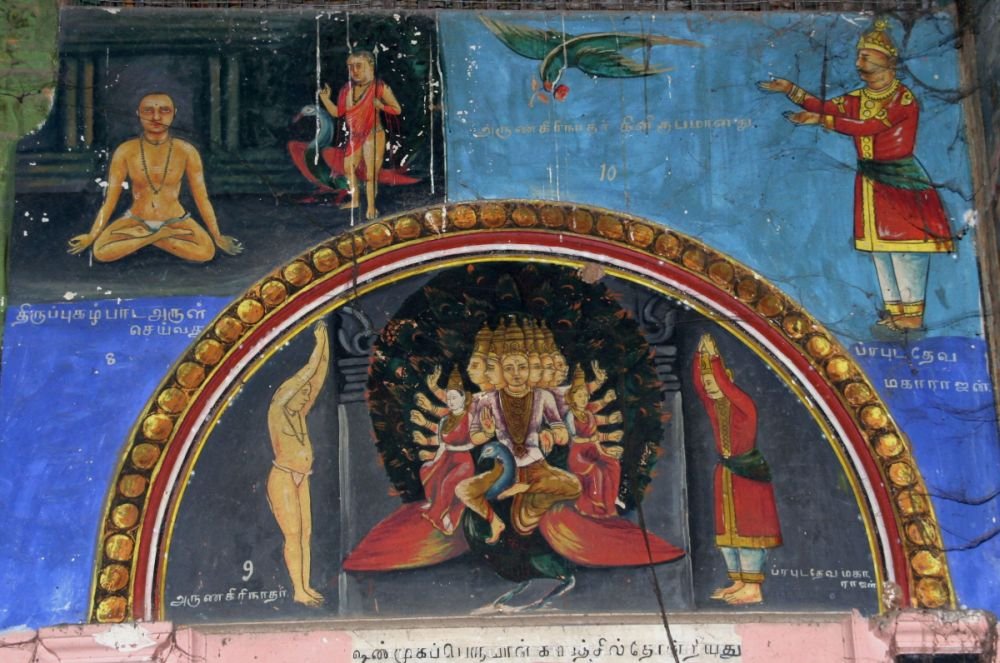
The below photographs are of paintings on the ceiling of the Mandapam
inside the Arunachaleswarar Temple compound. The paintings show
significant occurences in the life of Arunagirinathar.
The saint with his sister Adi trying to persuade her to support his life of debauchery

Arunagirinathar
meditating on Lord Murugan, the parrot with the parijta flower, and
Lord Murugan revealing himself out of a pillar at Arunachaleswarar
Temple
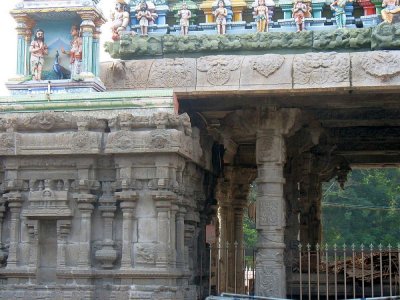
Statues
of Lord Murugan with Arunagirinathar standing on top of the pillar from
which the Lord appeared at the Arunachaleswarar Temple
|
|
|
|