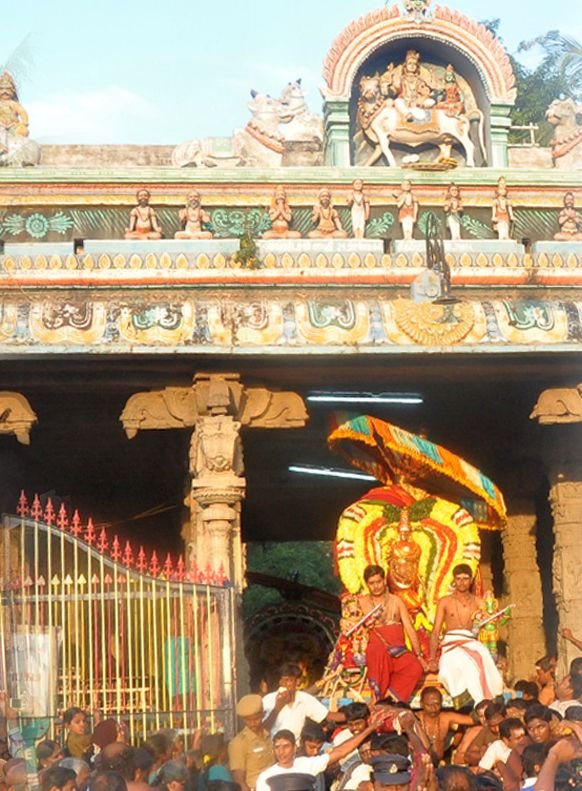
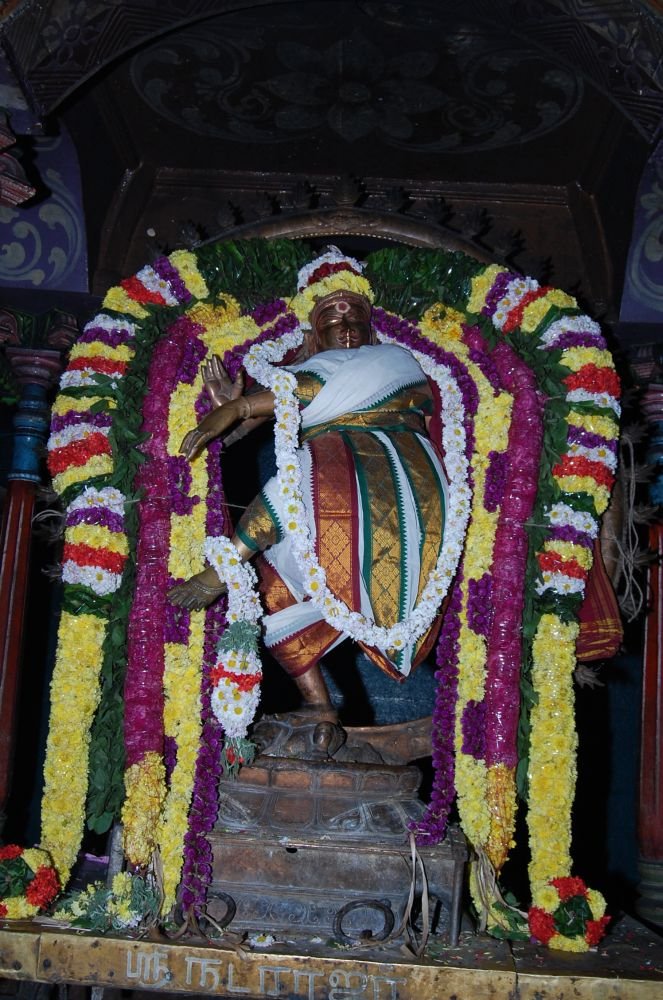
Thiruvoodal Festival is celebrated in the month of
Thai approximately on January 16th during Pongal (which has to do with
the movement of the sun from the southern to the northern hemisphere).
Legend has it that the Lord in answer to a promise given to Parvati
appears on this holy day (Uttarayana) to dance on one foot. He says; 'On
Uttarayana holy day, I will do the dance when the sun rises.'
The word 'Thiru' signifies; deity, sacred, holy and wealth and the word
'Voodal' actually means 'tiff' or 'petty quarrel', and represents the
friction between the male and female in a love relationship which is
consciously exacerbated. The distinguishing mark of Voodal is that it
should arise and stay only for a brief period and not be prolonged as
its focus is the bliss when the Voodal is withdrawn.
The poem Thirukkural says in the chapters dedicated to 'kama' which is
concentrated on the relationship between man and woman and the
establishment of household and children, that; 'The way to amplify bliss
through desire or relationship is through voodal. That ever present
bliss you can only see when the tension comes and is withdrawn. It is
like salt to food - beyond a certain limit it is lost completely.'
Thirukurral explains the tiff as 'creation of a tension, which when
released you have a bliss that is always present. It is the Voodal that
helps one focus upon that.'
| |
Thus Thiruvoodal is enacted by Shiva and Parvati to convey social truths
to their devotees. It takes place; inside the compound of
Arunachaleswarar Temple, on the streets delineating the perimeter of the
Temple, and on the girivalam pathway itself; by iconic representations
of Shiva and Parvati. Thiruvoodal Festival is regarded in such high
esteem that one of the perimeter roads has earned the special name
Thiruvoodal Street by this convention.
From the early hours Abishekam is performed at the Temple to start the
procession by 5 a.m. At which time an iconic representation of the Lord
(and Parvati) is carried by attendants on a palanquin with a huge
sunshade.
The palanquin first visits the Kodi Kampathu Nandi and
gives darshan as Viratswarupa and afterwards separates into three parts
representing; Brahma, Siva and Vishnu before leaving the compound of
Arunachaleswarar.
After Blessing the Nandhis en route the Holy Couple of Periya Nayakar
(Protagonist Of the Universe) and His Consort find their way out through
the thitti vaasal - a small entry at the east of the Temple compound,
instead of leaving through the main Temple gate known as the Raja
Gopuram.
On blessing the Sun at the thitti vaasal the procession goes
around the temple perimeter thrice. During which the actual staging of
the Divine Quarrel is re-enacted on the streets; the first time as
Brahma, second as Vishnu and the third round as Rudra.
To support the enactment of the 'tiff' between Shiva and the Goddess,
emissaries are employed by both to convey messages between the deities
and participate in 'brokering a deal' between the feuding couple. The
emissary used by Shiva on his behalf is Sundaramurthi Nayanar - a saint
feted as a great devotee of Lord Siva and one of the Tamil Samaya
Acharyas (four Tamil religious Teachers). His story is included in the
famous book entitled Periapuranam. Saint Sambandhar is the other
emissary engaged to help conciliate the Divine couple.
A Tamil Poem "Thirukkutraala Voodal" narrates how Devi and Swami sing
mockingly against each other's courting. Thiruvalluvar has stressed in
his verses the fact that such play between the couple enhances love and
affection between spouses especially in making love which is described
as the supreme form of "understanding" each other.
Parvati complains about Shiva in the presence of Saint Sundarar. She
talks of her unhappiness about the unkempt ways of Shiva; about his
matted hair and having the Goddess Ganga in his disheveled locks, about
his naked body smeared with ashes, his reclusive nature and his way of
wandering about in cremation yards, His liking for wearing bones and
dried skin, the carrying of a skull and his other strange behaviour. The
Goddess also complains of Lord Shiva appearing in the minimal clothing
of a Kaupina (loincloth) in front of the Rishi's wives to whom he gives
mouna darshan. Parvati also criticises that she is unable to get her
Lord to work as he is immersed in meditation most of the time.
Saint Sundarar is nonplussed and does not know what to do. Shiva, for
his part, knowing full well that Parvati is more concerned with 'this
and now' while he dwells purely in the eternal, pleads with her to
reconcile. Parvati is implacable and stops talking to Shiva. She enters
the temple without him.
In order to placate her and as night is approaching, Shiva agrees to
circumambulate Arunachala. During his circumambulation, he meets Bhringi
Rishi and grants him liberation. The Lord loses all his Jewels during
his hill round.
When Lord Shiva completes his pradakshina he returns to Arunachaleswarar
Temple early the next morning. He wishes to have reunion with his
consort. This part of the Festival is known as Maruvoodal. The point of
the Maruvoodal myth is to show the world that even a Celestial Couple
has differences between them. But in the end there should only be
reunion, even at the cost of a loss in finances which is represented by
the loss of the jewels the night previously.
Returning to his residence, Shiva knocks at the door but it has been bolted by Parvati. Lord Shiva asks,
'Oh my darling why have you locked the door?'
'Sir after we came to an understanding still you went without me. And
see now look you have lost everything there is no ornament or clothes.
Not, only that but you went and gave darshan to all kinds of people. So,
I am now requesting you must establish your manliness to me and
retrieve everything that is lost and give the special one-legged dance.'
Shiva starts the dance, Parvati forgets everything and opens the door.
The various sagas concerning the Gods which are used to create the
scenario of the 'petty quarrel' that needs resolution include:
Story of Ganga
Goddess Parvati is happy watching the one-legged dance of Lord Shiva,
but on noticing Goddess Ganga in the matted locks of her Lord, Parvati
becomes recalcitrant and withdrawn. Shiva asks his emissary Sundarar to;
'Please go and tell her the reason. My dear friend Sundaram, I do not do
anything for my own self-interest; Bhagavati did intense tapas to bring
down the river of the Gods, the Ganga, in order to pacify the souls of
the thousand ancestors that had been burnt by the look of Kapala Rishi.
Because Bhagavati did tapas, the Ganga was brought down, I had nothing
to do with it and when the water came down it was so forceful, everyone
said it had to be stopped or it would destroy the earth. So, what was
meant to be the medicine is turning out to be another story. So they
asked me to do this thing, so please explain this to Parvati. Tell her
that all the creatures of the world, her creatures would have been
destroyed unless I had helped negate the power of the water cascading
unto the Earth.'
Mohini and the Sages
Because the Rishis of Dwaraka got too proud in that they had technology
that could yield anything and attain all fruits, they started to believe
that there was no need for any divine person as they had the use of;
'yagna' technology. In addition they had wives of unquestionable
chastity.
Shiva informs Sundarar to convey to Parvati that;
'To show the Rishis, that they are born of you (i.e. Parvati) and me and
are our progeny and shouldn't think that power is coming to them on its
own. If their activities bear fruits it is because we have laid down
the laws for it.
To show this, I ordained that the enchantingly beautiful Mohini (a
manifestation of Lord Vishnu) appeared to the Rishis, who were
completely ensared by her, as too were the rishis' wives to my own Form
as an mouna ascetic. I did this to the reduce the ego of these rishis
and also grace their wives by affording them darshan of my mouna ascetic
manifestation.
Shiva's ascetic manifestation
Shiva says in the course of the Thiruvoodal;
'Don't put your trust into anything, everything is reduced to bone - all
is reduced to ashes. So this is the symbol of the final residue. So,
that is the reason I am found with this skull, no other reason.'
Sage Bringi
In order to give darshan and blessings to the Sage Bringi, Shiva sets
off to perform circumambulation of Arunachala, and thus enrages Parvati
who is angry with the sage for his refusal to worship her. Parvati's
anger, creates maya (Maya Swarupa), and from that maya emerge thieves
who strip Shiva of his ornaments and clothes, whilst he is performing
pradakshina. This stripping of Shiva is actually yearly enacted at the
same spot (during Voodal Festival) upon the idol that is being carried
around the Hill.
Shiva explains to Parvati (through his emissary Sundarar) that, to
satisfy the desire of devotees, he has taken a vow to appear in the form
in which he is worshipped. In accordance with that vow he has given
darshan to Bringi. He further tells his emissary Sundarar to convey to
Parvati;
'My darling you know Shakti can never be separated from Shiva in just
the way the mud pot can never be separated from the mud. You can't say,
"Give the pot without all that other stuff!" You cannot have the form
just like that. You know it my dear, that Shiva-Shakti can never be
separated, so in accordance with the understanding of devotees, I am
appearing in this form.'
'Sundarar please explain to Parvati so that she will reduce this tiff.'
Story of Bringi's maya
"Sage Bringi considered that Shiva's Grace is the ultimate source for
existence. He was an ardent votary of Lord Shiva to the exclusion of any
deity in the worship including Parvati! He refused to worship Shakti, a
woman. Even during his daily worship, he would circumambulate only the
Lord ignoring Mother Shakti, with a flashing spark of arrogance.
The divine couple wanted to enlighten the sage and hence assumed a
unique form sharing his body with Parvati. The couple took the form of
Ardhanarishvara and stood unified inseparable to every atom. Even then
the egoistic sage took the form of a bee (Bringa is Sanskrit for Bee and
the sage came to be called Bringi because he once became a bee) and
tried to pierce through the body of the Lord so that he could go around
only the Shiva part.
In every human body the static force of Shiva constitutes the bone and
the skin, and the dynamic force of Shakti triggers the blood and flesh.
Goddess Shakti, being the power as the name indicates, pulled out her
energy from Bringi's body. Now he was a mere skeleton and was even
unable to stand. The Lord pacified Parvati and gave the sage one more
leg to stand. The sage soon realized his folly and understood that life
becomes dynamic only by the blending of both grace and force which are
not contradictory but complementary to each other."
|
|
|
|