Sacred architecture (also known as religious
architecture) is a religious architectural practice concerned with the
design and construction of places of worship and/or sacred or
intentional space, such as churches, mosques, stupas, synagogues, and
Temples. Many cultures devoted considerable resources to their sacred
architecture and places of worship. Religious and sacred spaces are
amongst the most impressive and permanent monolithic buildings created
by humanity.
Sacred, religious and holy structures often evolved over centuries and
were the largest buildings in the world, prior to the modern skyscraper.
While the various styles employed in sacred architecture sometimes
reflected trends in other structures, these styles also remained unique
from the contemporary architecture used in other structures.
Sacred geometry, iconography and the use of sophisticated semiotics such
as signs, symbols and religious motifs are endemic to sacred
architecture. Entering into a religious building can be taken as a
metaphor for entering into a spiritual relationship with the indwelling
Self.
| |
Indian architecture is related to the history and religions of the time
periods as well as to the geography and geology of the Indian
subcontinent. India was crisscrossed by trading routes of merchants from
as far away as Siraf and China as well as weathering invasions by
foreigners, resulting in multiple influences of foreign elements on
native styles. The diversity of Indian culture is represented in its
architecture. Indian architecture comprises a blend of ancient and
varied native traditions, with building types, forms and technologies
from West, Central Asia, and Europe.
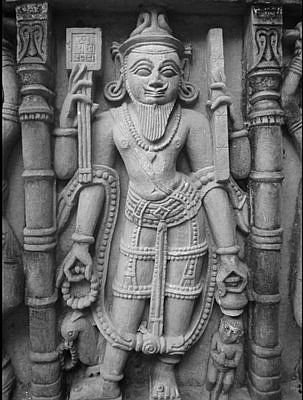
Hindu Temple architecture is based on Sthapatya Veda and many other
ancient religious texts like the Brihat Samhita, Vastu Shastra and
Shilpa Shastras in accordance to the design principles and guidelines
believed to have been laid by the divine architect Vishvakarma.
Divine Architect Vishvakarma
Hindu Temple architecture which evolved over a period of more than 2000
years conforms to strict religious models that incorporate elements of
astronomy and sacred geometry. In Hindu belief, the Temple represents
the macrocosm of the Universe as well as the microcosm of inner space.
While the underlying form of Hindu Temple architecture follows strict
traditions, considerable variation occurs with the often intense
decorative embellishments and ornamentation.
A basic Hindu Temple consists of an inner sanctum, the garbhagriha or
womb-chamber, a congregation hall, and possibly an antechamber and
porch. The Hindu Temple represents Mount Meru, the axis of the Universe.
There are strict rules which describe the themes and sculptures on the
outer walls of the Temple buildings.
The two primary styles that have developed are the Nagara style of
Northern India and the Dravida style of Southern India. A prominent
difference between the two styles are the elaborate gateways employed in
the South. They are also easily distinguishable by the shape and
decoration of their śikharas. The Nagara style is beehive-shaped while
the Dravida style is pyramid-shaped.
Śikharas - Mountain Peaks
Śikharas
Śikhara, a Sanskrit word translating literally to "mountain peak",
refers to the rising tower in the Hindu Temple architecture of North
India. Like mountains these structures are larger at the bottom than at
the top. They were built of stone and brick and were capped with a
bulb-shaped top called an amalaka. The Śikhara over the sanctum
sanctorum where the presiding deity is enshrined is the most prominent
and visible part of a Hindu Temple of North India.
In south India, the equivalent term for "Śikhara" is "Vimanam". These
are not to be confused with the elaborate gateway-towers of south Indian
Temples, called "Gopurams", which are perhaps the most prominent
features of those Temples.
Vimana is a term for the tower above the Garbhagriha or Sanctum
sanctorum in a Hindu Temple. A typical Hindu Temple in Dravidian style
may have multiple gopurams, typically constructed into multiple walls in
tiers around the main shrine. The Temple's walls are typically square
with the outermost wall having four gopuras, one each on every side,
situated exactly in the centre of each wall. The sanctum sanctorum and
its towering roof (the central deity's shrine) are also called the
Vimana. Generally, these do not assume as much significance as the outer
gopurams, with the exception of a few Temples where the sanctum
sanctorum's roofs are as famous as the Temple complex itself. The
structure of Vimana are generally believed to be the docking zone for
celestial vehicles in which gods travel.
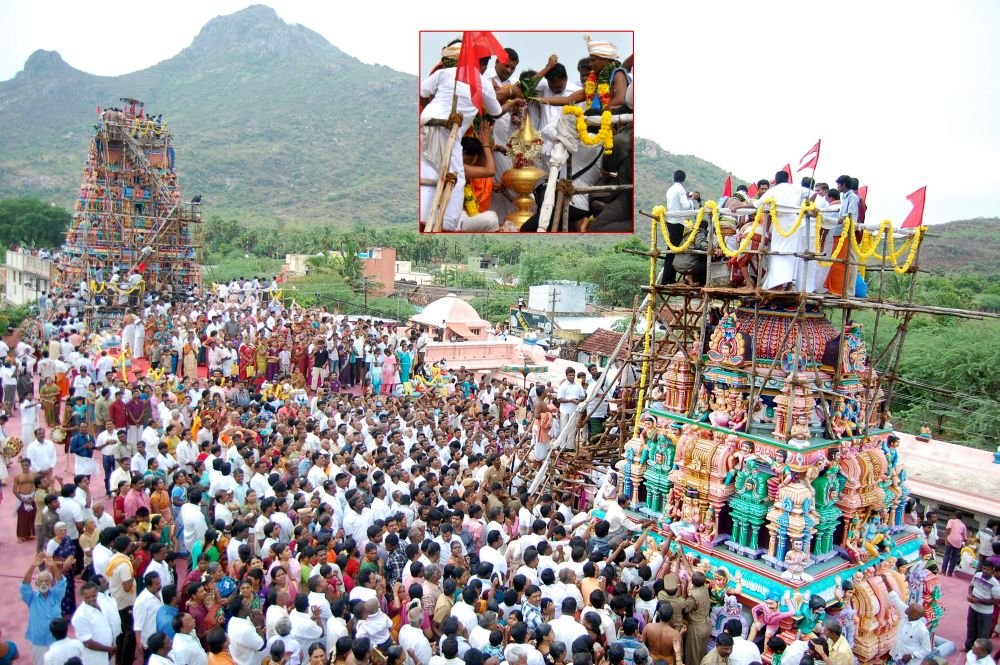
The photo below was taken during the recent Kumbhabhiskheam at
Adiannamalai. The photograph shows the ceremony in which Divine Power is
transferred back to the deities by performing an abhishekam (salutary
bathing) to the Vigrahas and Vimanas (pinnacles) on the roof with the
sanctified holy waters from the kalasas accompanied by Vedic chanting
and special rites. On that day at the designated auspicious time, when
the Kumbha is bathed with the charged and sanctified holy waters
contained in the sacrificial pots, consecrated and sanctified pranic
powers trickle down a silver wire and enter the Deity installed inside
the Sanctum Sanctorum of the Temple.
Anointing the Vimana
It is not only the mountain Arunachala which is a significant factor in
the spirituality connected with this site but also the presence of
Arunachaleswarar Temple. The construction of the Temple and its
situation magnifies the energies of its surroundings as it was built in
strict observance of the sacred geometry of mathematical repetition in
natural patterns.
|
|
|
|