'Water which rises up from the sea, rains on earth
and finds its way back to the sea, defying all obstacles. So too the
embodied ego arising in you and bound by action, is destined to reach
you, O Arunachala, thou hill on earth, Ocean of bliss'. [1]
Neither the Self nor one's body is in need of Liberation. In between
rises the ego freely aware at one level and tied to the body at another.
The body is innocent and efficient. Within limits, it adapts to a
varying environment; it grows and when hurt, heals itself. The ego, when
conscious of its Source, remains subdued. The ego, when not so,
destroys the body and the environment without usefully destroying
itself. Vichara then is egology; the ego in quest of its source. Ecology
is the natural consequence of this. It is the art of living happily and
in harmony with all life on earth.
Lord Arunachala, the Hill, declares this same truth:
|
|
'He who thinks of me, gazes at me or resides in my
precincts is granted Liberation without Diksha or drudgery. Though fiery
in form, I stand as a hill of contracted energy, so that mortal life
may be sustained. Many are the enjoyments secreted in me and which flow
out for the joy of all'. [2]
Even on a physical level, the
hill, any hill, symbolises height or potential energy, and is the basis
for retention and efficient distribution of life-giving water to the
levels below. The sage, the Egologist, is the perfect Ecologist. He has
minimal needs, infinite patience; he conserves the environment and
promotes the welfare of all. One need not wait for 'sagehood' to
understand and thus respect Ecology. The demands of hunger and thirst of
the body are uncomplicated. It is the ego which dictates its own
peculiar 'tastes', of food and drink, often to the detriment of the
body's dynamic balance. Tied as we are to the body's simple needs, we
are in deep and continuing debt to Mother Earth who meets our needs.
Earth is Gaia, a
living self-regulating being, swimming in the cosmic environment. The
Universe is now being seen as a self-organising principle. Who sees
this? Man! Using his self-aware intelligence. Alas! He views his
self-aware intelligence as a useful but chance product of material
evolution. To him, the universe is self-organising but not 'self-aware'
as he is. Can a son annul the parents' marriage because he could not be
there to register it! Even if our self-awareness were a product of
evolution, it is the subservient 'neuron' of Self-aware Cosmic Being!
On the screen of
Awareness the Seer and the Seen arise. From the Seen, the Seer-ego
constructs models of evolution of the Seen. The universe of Seen is as
real as the Seer-ego that declares residence in it. For the ego-hero of
this 'movie', paradigms of biological and cosmic evolutions are factual,
real and themselves evolving. The ego's discovery of the living cell,
the embodied gene, has enabled the view that all of life is but a
commune. Worm, bacterium, bird or beast, we are all but vast communities
of cells 'swimming' in Earth-environment, multiplying and competing for
Earth's nutrients. Earth too is a giant 'cell' swimming in the ocean of
the Sun's energy. Green forest covers is the sole means by which Mother
Earth traps this energy, this Prana, and distributes it to all life.
Soil is Earth's epidermis. Deprived of a minimum skin-cover, Mother
Earth, like a man severely burnt, can heal no more. Her forest clothing
prevents soil-loss.
'The forest is a
society of living things, the greatest of which is the tree. Its value
depends upon its permanence, its capacity to renew itself, to store
water, provide Nature's most valuable ground cover, and build up to a
great height, stores of one of the most adaptable of raw materials:
wood. As long as a soil is covered with forest, its humus is maintained.
In the forest the processes of decay and growth always balance one
another. The forest manures itself and with the help of earthworms and
other animals distributes this manure through the upper layers of the
soil. Everything is done by nature quietly and efficiently. No
artificial fertilizers, no selective weed-killers, no pesticides and no
machinery are needed in the household of the natural forest. In that
vast evergreen forest Nature works in perfect rhythm... A teeming life
goes on in the forest without any of the problems that confront mankind
in similar circumstances.
There
are not dust-bins to empty, no water-borne sewage, no town-clerks or
city councillors or armies of officials, with more and more rates to
pay, no ever growing burden of debt. The forest solves its own
sanitation problems by direct action while man evades them. In its
economy it perfectly combines, Capitalism, Communism and Society Credit
and instead of building up debt it stores up real wealth - the wealth of
the woods." [3]
The forest is a
vital factor in the formation of rain. A forested hill is Nature's
sponge that soaks in all the rain water. The green canopy breaks the
fall of the rain drops; the ground cover absorbs much water; the soil
well aerated by the searching roots and worms, absorbs the excess water.
This water is pumped up by the living roots to the leaves, thus
enabling the soil to retain even more water. The excess begins to flow
downhill, but the standing trees break the speed and minimize erosion of
soil and nutrient. The hill is the source of rivers and springs that
sustain life in the plains below. The greater the wooded cover, the
greater is the 'sponge-effect' and the more perennial are the streams,
springs, tanks and wells.
The Arunachala Ashtaka
(attributed to Adi Sankara) declares the Arunachala Hill to be of the
form of Sri Chakra, thus linking its spiritual and earthly significance.
The Arunachala Puranam devotes a whole chapter to describing the tanks
and springs surrounding the Hill. The major Tirthas were in the eight
cardinal directions, with minor ones in between. Charged by underground
springs, these Tirthas were also the catchment area for the many streams
from the water-sheds of the broad-based hill. Sri, Seyar, Punya and
Sona were rivers flowing respectively to the North, North-west, West and
South of the Hill. The presence of forest cover ensured the stability
of these water-systems. The Purana also speaks of the residents of
Arunachala taking pride and initiative in maintain the wealth given
gratis by the thickly forested Hill. The Hill was not home to the
recluse alone. Even, 'boar, bear, parrot, deer and elephants converge in
hordes upon this Hill of streams'. [4]
Resplendent even
today as the spiritual Hill attracting aspirants from far and wide, the
barren physical hill faithfully mirrors modern man's neglect of Nature's
fundamental role. Indiscriminate felling and burning of the hill had
led to serious erosion. The bared rocks bear testimony to trends afar:
man's lop-sided pursuits and extravagance often disrupting the integral
web of Nature on which he is actually dependent.
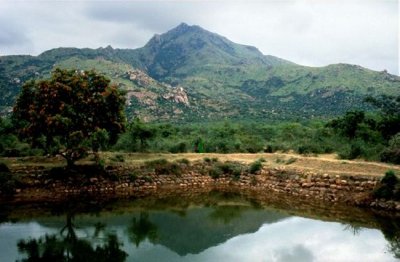
All is not lost. Every clod of earth is 'alive' and precious. When
protected, bare rock and soil spring to green life. If Arunachala
represents the convergence of all spiritual disciplines, He is also the
radiator of earthly prosperity. Let us clothe Him in green splendour and
thus usher in the green of the planet too!
[1] Sri Ramana's Arunachala Ashtakam (v. 8)
[2] Arunachala Mahatmayam
[3] My Life, My Trees by Richard St. Barbe Baker
[4] Jnana Sambandhar's Annamalai Thevarram
By J.Jayaraman
|
|
|
|