CENTRAL SHRINE

Click To View Photos of Structures
Arunachaleswarar Temple Interactive
| |
Sri Sambanda Vinayagar Shrine
The Sambanda Vinayagar Shrine is located south of the Flagstaff and Bali
Peeta. It is told that Vinayagar killed a demon and smeared his body
with the demon's blood - hence this Vinayagar appears red and is thus
called Sennira Vinayagar (Red Vinayagar). The large idol, which is in
sitting pose, is considered to be one of the biggest images of Ganapati
in Tamil Nadu.
Sri Sambanda Vinayagar Shrine
At this place can be found an inscription dated 1340 A.D. of the region
of Veera Vallala Deva. From this epigraphy we learn that one Sambandan
lived in Tiruvannamalai and was President of a popular Mutt. It was he
that built the shrine for Vinayagar; hence it is called Sambandan
Vinayagar.
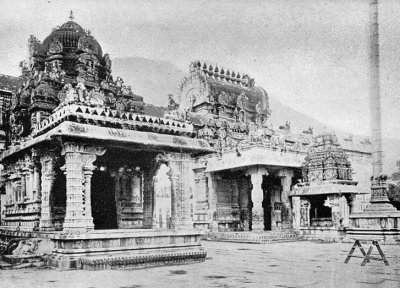
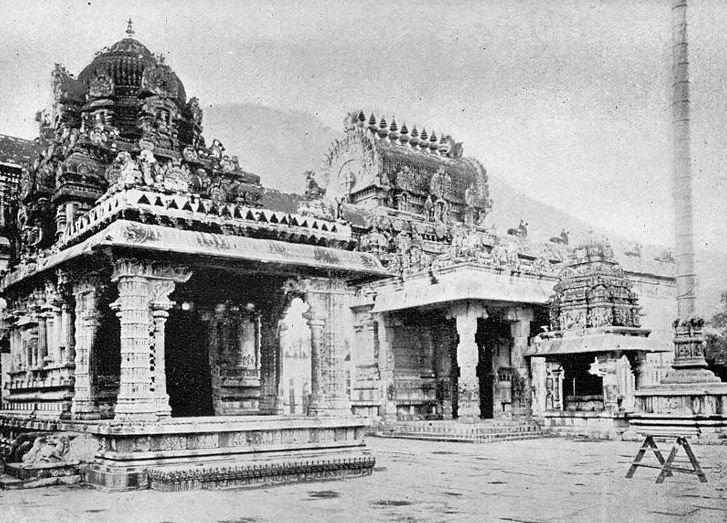
Sri Sambanda Vinayagar Shrine 1913
The above photograph of 1913 shows the Vinayagar Shrine separate from
the Central Shrine. In this photograph the Kodi Kampathu Nandi (3rd
Temple Nandi) was in its own mandapam with Vimana. Subsequently this
outside area was remodelled and covered with roofing.
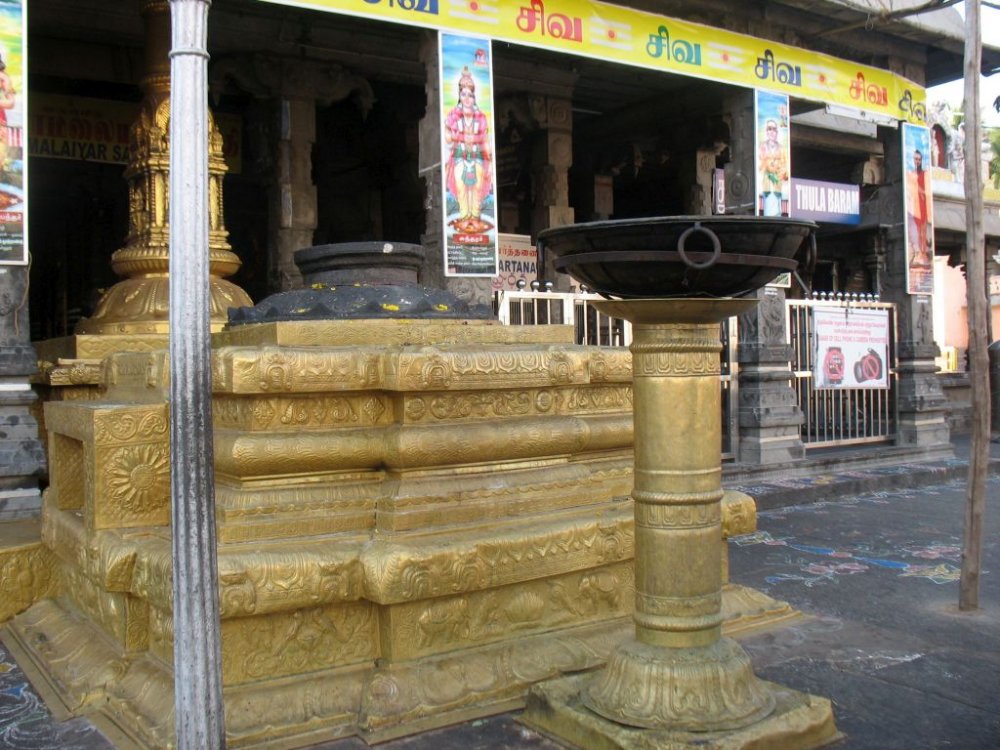
Dhwaja Stambh (Flagstaff)
Next to the Dhwaja Stambh is a large sacrificial altar (Bali Peeta) and
Kodi Kampathu Nandi (third Nandi of the Temple from east to west) facing
the Garbagriha. This Nandi no longer is set in its own Mandapam with
Vimana.
Kodi Kampathu Nandi
The Dhwaja Stambh which is fashioned in teak and covered with gold was
installed at this Shrine in time for the 2002 Arunachaleswarar
Mahakumbhabhiskeham. To read about that function go to this link here.

Flagstaff and Balipeetam
A small Gopuram called the "Rishi Gopura" is situated next to the
flagstaff. This Gopura was originally the gateway to the Temple at an
earlier time. In a niche in the wall of the entrance on one side is a
small image of Lord Ganesha and on the other side an image of Lord
Subramanya. Nearby is a large statue of Adikara Nandi and those of the
Dwarapalakas (Temple gatekeepers).
Subramanya Shrine
Right to the Flagstaff at the entrance to the second prakaram is a
shrine dedicated to Lord Subramanya. This shrine is also supposed to
have been built around the same time as the Sri Sambanda Vinayagar
Shrine i.e. the 13th century.
SECOND PRAKARAM
Saint Sivaprakasa Swamigal in his Thiruveedhi Ula has called
Arunachaleswarar Temple a poem wrought by seers. This great
Arunachaleswarar Temple is spread over 25 acres and has like all other
Temples, garbagrihas, maha mandapams, prakarams, Gopurams and sacred
tanks.
The Siva Temple is the outcome of a millennium of building and
extension. The original enclosure containing the main shrine was
enlarged eastwards, and gained the name of "second enclosure". What is
now known, as the "first enclosure" is in fact the platform around the
shrine. This is a theoretical enclosure for ritual purpose, the
enclosure being considered as the inner circle of Siva's Divine Court,
where the sub-shrine of Chandikeshvara (one who maintains accounts),
receives the leftovers from Siva's puja, is located.
The second enclosure, originally without a roof but covered in the
nineteenth century, is entered through a gateway know as the Rishi
Gopura. It is believed that the entrance used to be on the southern
side, but the Nattukottai Chettiars (renowned religious philanthropists)
raised a wall of the prakaram and covered it with stone roofing and
shifted the entrance from the southern side to the eastern side in line
with other entrances. Around the perimeter of this prakaram there are
several details, either free-standing or in small shrines.
Entering the second prakaram one crosses a threshold with two large
doors, on other side of which are two large bells which are rung during
the time of arati. Walking around this prakaram are a large number of
idols. Some of these Shrine and images are not original - for rich Temples
frequently undergo renovations. Thus the original tenth-century "Seven
Mothers" have been replaced by more modern representations; and
Jyeshtha, the Goddess of misfortune, also an ancient statue, now stands
near a shop in the town of Tiruvannamalai, ousted from the Temple in
favour of Gajalakshmi, as has happened in many other Temples in Tamil
Nadu.
The statues currently in the second prakaram of Arunachaleswarar Temple
include; Asta Lingas (similar to those on the girivalam roadway), the
four great Nalwars: Appar, Sundarar, Sambandar and Manikkavacakar, the four sons of
Brahma, the 63 Nayanars (Saivite saints), an idol of Ayappan and the
Sthala Vinayagar which was erected by Sembiyan Mahadevi the Queen of
Kandaraitha Chola and dates from the 10th Century. Before functions and
Festivals celebrated at Arunachaleswarar Temple, puja is first done to
this aspect of Lord Ganesha.
Next to the Sthala Vinayagar at the back of the prakaram, are the
Periyaudar Uttsavars, Ardhanarishvara, Venugopal Shrine, Lingams,
Gajalakshmi and Lord Murugan with Valli. There is an interesting story
attached to the Venugopal Shrine. It seems the statues of Krishna and
His two wives was originally in a small Vaisnava Village of Agraharam
near Samudram Eri located some two miles south of Arunachaleswarar
Temple. Legend has it that the people of Agraharam, during certain
festivals, carried the Utsava Moorthies from their village Shrine to
Tirukoilur (a Vaisnava centre with a large Vishnu temple), about 20
miles away.
The Vaisnava inhabitants of Agraharam were very devoted to their
Vaisnava God and whenever Saiva idols from Arunachaleswarar Temple
passed during circumambulation of Arunachala, the incensed Vaisnava
villagers would attack the procession. Repeated complaints of this
disturbance were made to the King (probably Kulottunga I). It is said
that the King himself visited the area to satisfy himself of the
complaint.
Once satisfied of the situation, the King ordered that during a
particular festival all the villagers should go in procession to
Tirukoilur. When they had gone, he had the images of Venugopal and his
Devis removed from the Village Shrine, brought to Arunachaleswarar
Temple and thereupon installed at the back of the Siva Sannidhi.
On the Northern verandah are the Utsava-Murthis of the 63 Saiva saints, a
shrine of Bhairava (aspect of Siva) and the Vaikunta Vail.
Vaikunta Vail
The doorway known as the Vaikunta Vail, (the Gates of Heaven) opens to
the third prakaram and opposite to the Devi's Shrine. Vaikunta Ekadasi
(Ekadasi is synonymous with fasting and abstinence) is an auspicious day
dedicated to Lord Vishnu. It occurs in the month of Margashirsha
(between December and January). In Tamil Nadu the festival is known as
Mukkoti Ekadasi or Sorgavasal Thirappu.
On this day, the Vaikunta Dwaram or the Swarga Vaasal, 'The Gates of
Heaven' are believed to be kept open. The area encircling the
Arunachaleswarar Sanctum is referred to as Swarga Vaasal and devotees
throng to gain entry into the Temple, to seek the Lord. To find out the
significance of Vaikunta Vail at Arunachaleswarar Temple go to this link
here.
Vaikunta Vail
Adjacent to this doorway is the retiring room for Sri Arunachala and
every night a ceremony of taking the Lord to that room for rest is
observed. To read a narrative about this ceremony go to this link here.
Next to the doorway is the tank that supplies water for worship in the
Central Shrine and thereafter a Nataraja Shrine, where the image of the
Dancing Lord is made of brass. It is said that below the site where
Nataraja is installed, an underground cellar was found from which many
valuable articles were recovered and handed over to Temple authorities.
There is a similar story of a cellar in the Kili Gopura from which
jewellery was recovered and given to the Temple.
FIRST PRAKARAM
The first prakaram encloses the Sanctum Sanctorum, Ardha Mandapam and the Maha Mandapam.
CENTRAL SHRINE
The Central shrine is enclosed by a high wall right round. The eastern
third is an extension built later than the western two-thirds of the
wall. There are many inscriptions on the wall. The western two-thirds of
the wall may have been built in the later half of the 9th century by
Aditya I or early in the 10th century by Parantaka I. The eastern
extension was perhaps built by Uttama Chola. The second door one passes
through on the way to the interior, is referred to as the Uttama Chola
door. The first door and the Gopura on top of it is referred to as Vena
Odeyan's door and Gopura.
On the left of the second door, there is a panel containing figures
representing King Uttama Chola and his Queen. On the door frame, is a
figure of the Thambiran, a contemporary of Uttama Chola. This and the
second door is believed to have been built in the second half of the
10th century A.D. The first door and the small Gopura on top may have
been added by Vena Odeyan in 1230 A.D.
On entering the quadrangle, which is covered by a stone roofing there is
a Bali Peeta and a Nandi. This fourth Nandi is known as Ratha Vilaku
Nandi and is smaller than the previous three.
Ratha Vilaku Nandi
In front of the fourth Nandi (Ratha Vilaku Nandi), on a raised platform,
are the Maha Mandapam and the central shrine. The platform is wide
enough around the shrine for circumambulation. Along the walls of the
enclosure there is a raised verandah all round. The roof is supported by
colonnades of stone pillars in two rows. The pathway between these two
raised portions is also for circumambulating the central shrine.
Maha Mandapam
This is also known as the Eastern Great Hall. In front of the central
shrine and over the steps is a platform. The central shrine itself
consists of a large and a small room. The large room, which is the
eastern portion, is called the Maha Mandapam. It has two doors, one on
the east, the other in the west. The western door opens into a passage
running from north to south, which separates this room from the Sanctum
Sanctorum.
Surya is installed in the north-eastern direction facing Arunachala. It
is thought that the reason that Lord Surya is positioned so close to the
Central Shrine at Arunachaleswarar Temple is because during Karthigai
Deepam, Surya as representative of the Sun and Light, has a particular
connection with the mythology of the Festival. To find out more about
the connection with Surya to Arunachala go to this link here.
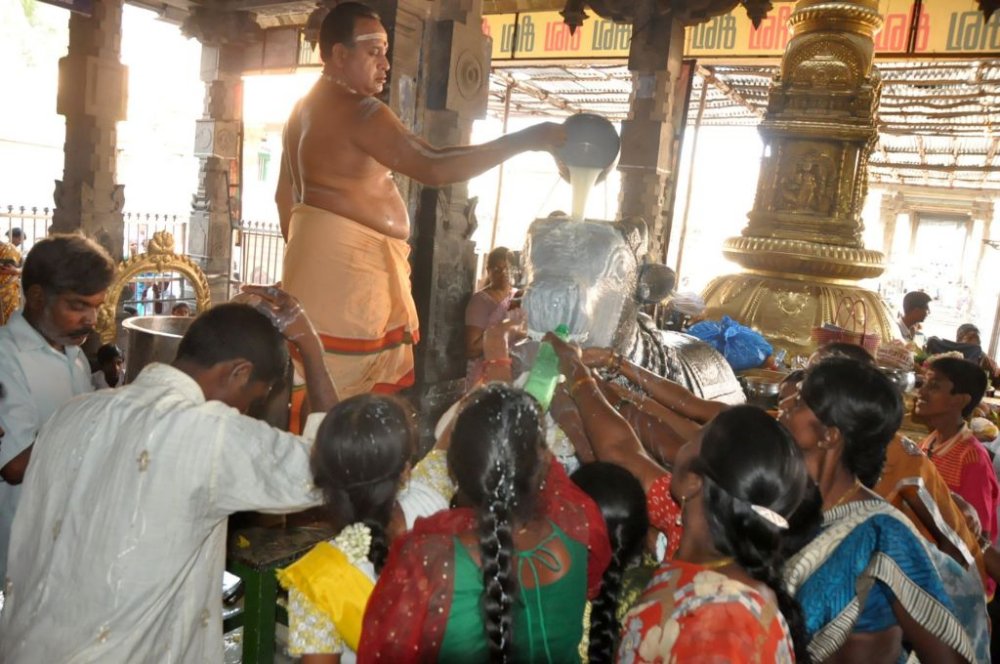
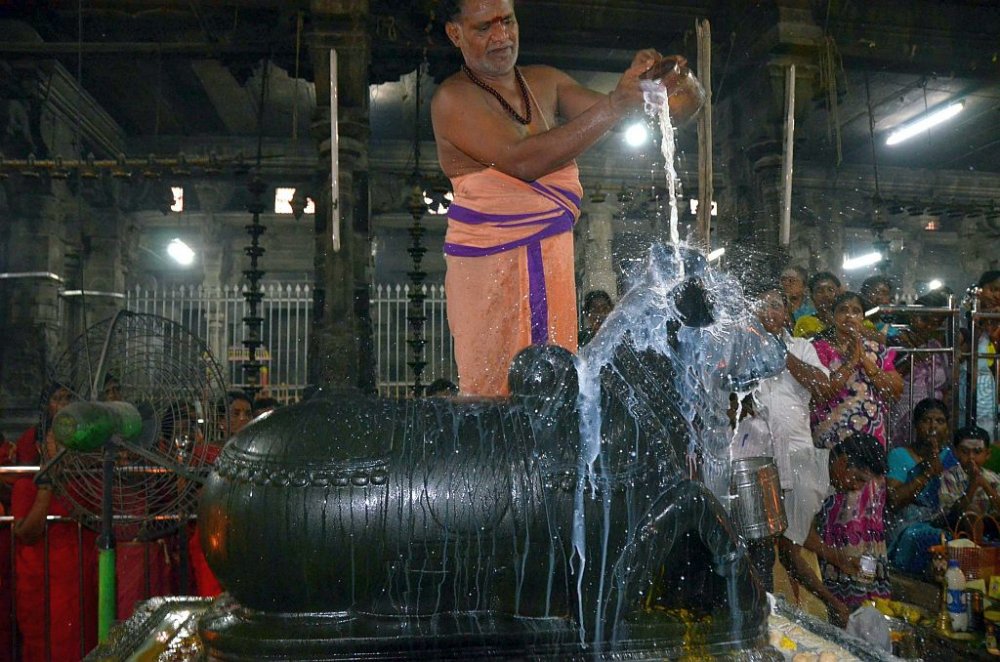
In the centre of this mandapam is the Pradosha Nandi, the first Nandi of
the Temple - as is so with the other four Nandis, abhishekam is
performed to Pradosha Nandi during bi-monthly Pradoshams. On the base of
the Garbhagriha are found epigraphs of Vijayalaya and Parantaka I; but
the base of the Mahamantap is completely hidden by the platform which is
believed to have been built quite recently by the Chettiars. The thick
lime-wash in many places has obliterated inscriptions. In this hall
there are some inscriptions on the walls. In the passage, between this
hall and the Garbhagriha on the western wall of the Mahamantap - on the
left is the figure of a man with a beard and on the right there is a
figure of a clean-shaven man.
The first prakaram goes all around the inner shrine. On the outside wall
of the inner shrine there are the following murtis: Ganapati and
Dakshinamurti to the south, Lingodbhavamurti in the west with Brahma and
Durga in the north. To read about the Lingodbhavamurti abhishekam
performed during Mahasivaratri, go to this link here.
After Goddess Durga, there is a small shrine dedicated to Chandikeswara.
The statue dates from the mid 19th Century. There are two Dwarapalakas
(Celestial Gate Keepers) guarding entrance to the Central Shrine - they
have matted hear, wear crowns and carry dandham sticks as weapons.
The main shrine, made up of a cella and a vestibule, bears tenth-century
inscriptions on its base, but above there has been extensive
remodelling. The Sanctum Sanctorum or Garbhagriha has only one door to
the east, opposite the door of the Mahamantap. These two structures are
estimated to be over 1350 years old. On entering the Garbhagriha one
finds it has two divisions, the eastern portion is for accommodating
devotees to perform Puja through the agency of Gurukals while the
western hall contains the Lingam representing 'Aroopa Nishkala
Arunachala.' This ancient Lingam has been worshipped by devotees for
over 2000 years.
Garbagriha
In the ante chamber of the Lord, there is to the left Vallabha Ganapathy
and next a small silver canopy covering the Chakra of Annamalaiyar - a
representation of Mount Meru made out of the five precious metals
(panchalohas) with an imprint of Lord Siva's footprints on top. It is
this Chakra that is taken to the retiring Chamber at night to meet with
Goddess Ambal Iccha Shakti who arrives from the Inner Shrine of
Unnamulai Amman where she is permanently housed during the daytime.
The Shrine of Arunachala marks the centre of the Temple. It is square
and access is from the east. At the centre the Annamalaiyar Lingam is
enthroned on a circular platform (Aavudayaar). The bottom portion of the
Linga where it meets the Aavudayaar is encircled by a gold band.
There is a small aberration on the Lingam, which has an origin connected
to its original discovery. This aberration is in the form of a slight
depression believed to be due from contact with a utensil such as a
pick-axe when the Lingam was originally unearthed. As a result of
centuries of abhishekams performed on the Linga, the Linga appears
different in this spot than elsewhere.
Renovation and Gilding of the Temple
Renovation work was done in the Garbagriha by Aditya Chola III in 750
A.D. and Parandkaka Chola I in the 10th Century A.D. In 1216 during the
reign of a Banachief named Ponparapinan Magadesan (also known as
Vanakovaraiyan), the central Shrine of the Arunachaleswarar Temple was
gilded. The chieftain also gave three villages to the Temple, and
donated 96 cows and 3 bulls for the purpose of burning three perpetual
lamps (Nanda Villakku) to the Lord.
|
|
|
|