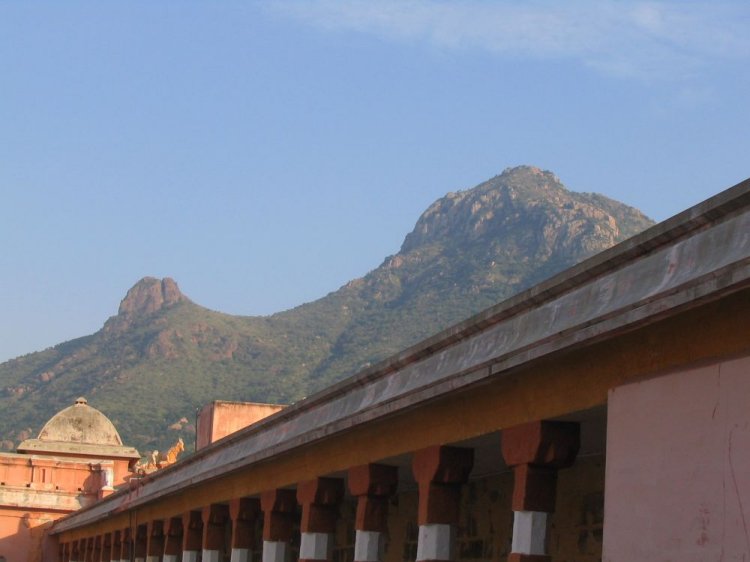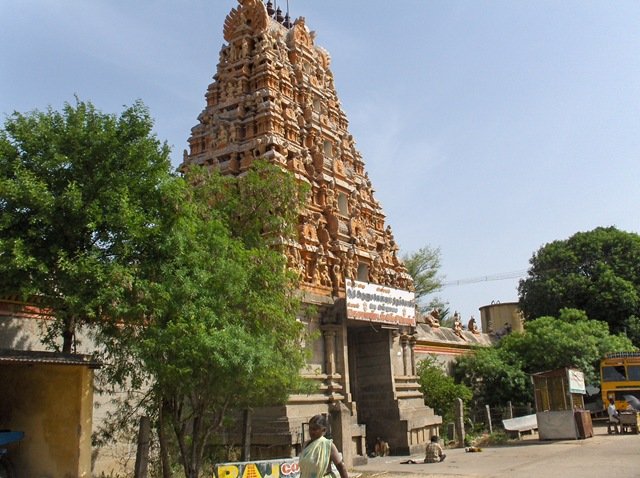
The name of this Temple, Adi Annamalai means 'first'
or 'ancient' Annamalai (Arunachaleswarar). Its size is small and it
around an acre in size -- compared with the 25 acre size of
Arunachaleswarar Temple on the southeast side of the Hill.
The legend of Adi Annamalai recounts that Brahma, after His dispute with
Vishnu about the fiery column, made a lingam and went to the northwest
side of the Hill to establish the Temple of Adi Arunachaleswarar (at the
village of Adi Annamalai) to worship Shiva.
| | |
Dispute of Brahma and Vishnu
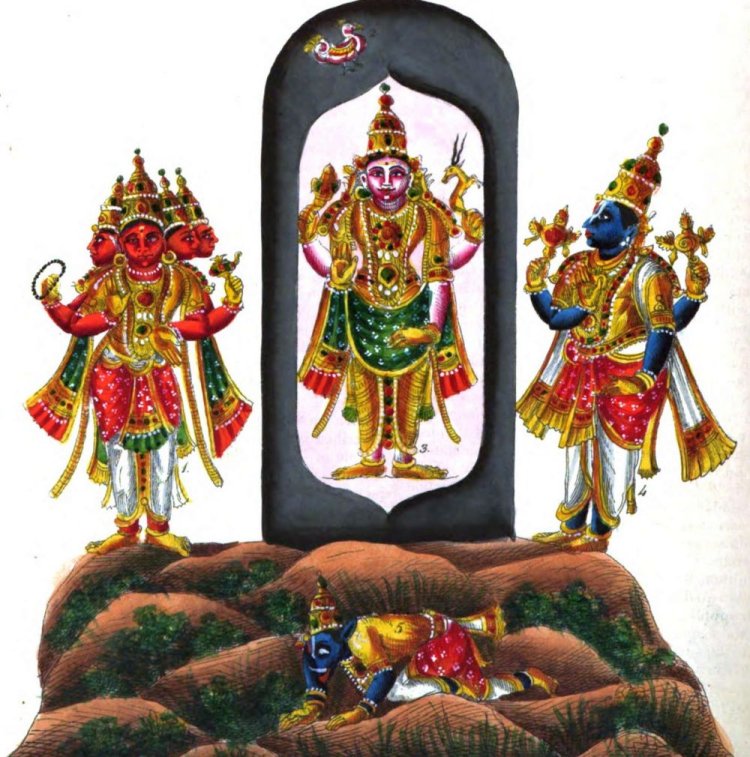
In the days of antiquity a controversy arose between Brahma and Vishnu
as to which of the two was greater. Brahma said to Vishnu, "I have
created the five elements and all the living beings with their endless
differences in form and sound. Therefore I am the Absolute God." Vishnu
said, "The whole universe is but an aspect of mine. Of what use is your
creation if I do not protect it? It is my thought-power that creates,
sustains and destroys the whole Universe. So I am the Absolute God"
Their dispute resulted in misery in the manifested world. Supreme Being
Parameshwara saw this and was filled with compassion. To settle the
discord and subdue their pride, Lord Shiva appeared before them in the
form of blazing column of light and a voice issued from it asking them
to seek its upper and lower limits and he who found either of these is
the superior one. Both gods stopped fighting and decided to explore the
ends. Brahma took the form of a swan and flew up to reach the top of the
column of light, whereas Vishnu became a boar and started burrowing
into the earth to find its base.
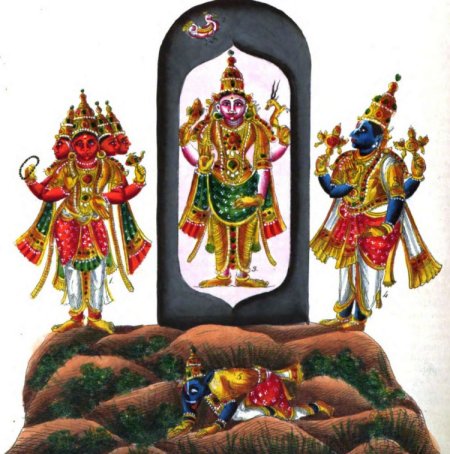
A thousand years passed as Vishnu dug deep into the nether worlds and
the journey seemed endless. With all this power he could not discover
the base and he got lost in meditation with the result that he
experienced the Supreme Light which dwells in the hearts of all. He soon
realised and recognised that his true strength was derived from this
Supreme Light, that is Lord Shiva. He prayed to Shiva seeking His pardon
and then returned to earth. Brahman who flew up as a swan was mounting
the sky and the higher he soared, the column of light rose higher before
him. He was growing despondent and was about to return when he saw a
fragrant flower called Ketaki (screw-pine) falling towards the earth. On
asking from where it had come, the flower revealed that it had come
from the crest of the fire column that was none other than Shiva himself
and that it had been descending for thousands of four-fold Yugas.
Brahma requested the flower to say that both of them came down after
seeing the crest and thus the flower swore to Vishnu in the presence of
the Column of Effulgence that Brahma had reach the summit.
Splitting asunder the column of Light, Shiva appeared before the two
Gods. When the lotus-eyed Vishnu saw him, he danced with joy. The guilty
Brahma on seeing the Lord's true form was confused and frightened.
Mahadeva said, "The two of you need not be ashamed for having
transcended your limits. Hari (Vishnu) pondered deeply and became
enlightened. But Brahma has uttered falsehood and I now cut off his
fifth head for that perjury. Brahma shall not hereafter be installed in
any Temple. And this flower, which bore false witness, shall never again
find a place on my head and shall not be used for my worship." After
cursing Brahma and the screw-pine flower thus, Shiva turned to Vishnu
and said, "Child! Be composed, I am pleased with you. You are one of my
foremost devotees. You originated from me and are my sattwic part. At
the end of the kalpa you shall merge in me."
Brahma and Vishnu prayed to Shiva to abide there forever as a Tejo
Lingam. In answer to their heartfelt request, Parameshwara established
himself as the Arunachala Hill and also as a small Siva Lingam at the
eastern foot of the Hill for the welfare of the world and for those who
desire to worship Him and obtain illumination.
[Abridged - The Glory of Arunachala]
It was after the establishment of the Temple at Adi Annamalai that Lord
Siva then manifested himself as Swayambhu Linga (Self Created) on the
southeast side of the Hill. The Temple housing this sacred Linga is
known as the Arunachaleswarar Temple.
According to legend Brahma got enamoured of Tillottama, his own daughter
(i.e. one of his own creations) and in his mood of infatuation went
after her in the form of a dove. When she took refuge in Siva, the Lord
confronted Brahma in the form of a Hunter and dispelled his delusion.
There is even today on the slopes of Arunachala, a Temple to the Lord as
Hunter, known as Vediyappan Koil, being called wrongly nowadays as
Kannapar Koil. To get himself absolved of the sin committed, Brahma
installed and worshipped a Linga of Lord Arunachaleswarar. This is also
called Adi Annamalai.
In the Arunachala Puranam (Tamil), Brahma says to his son Sanaka, "To
remove the unabating Karmas I installed and worshipped a Linga of Lord
Arunachala, who is called Ani Annamalai (Ani = Beautiful)".
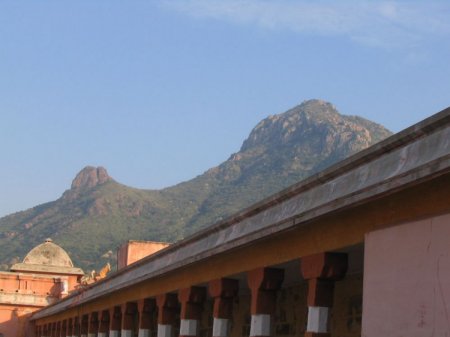
It is reported that the vision of Arunachala from this Temple is known
as Siva Yoga Muka Darshan and the great Siddha Thirumoolar saw this
aspect. Bhagavan Sri Ramana Maharshi who used to camp at Adi Annamalai
for up to 2-3 nights while performing Giri Valam was reported to have
said that while at the Temple he heard the celestial recital of 'Sama
Veda'.
Adi Annamalai Temple Contemporary
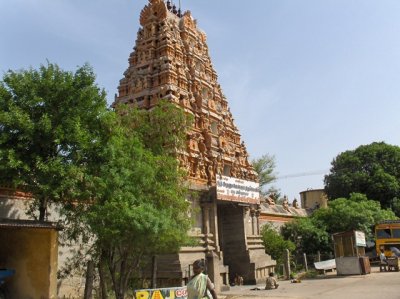
In spite of its illustrious history and position as one of the foremost
Temples at Arunachala, the Adi Annamalai Temple was sadly neglected in
the 20th Century. The last time Adi Annamalai Temple was renovated was
during the years 1903-1918 when work was financed by a group of Chettiar
devotees. A subsequent Kumbabhishekam was celebrated in 1967; but the
puja was neither proper nor performed in the correct way. Since that
time no substantial renovation or maintenance work occurred at the
Adiannamalai Temple.
Swami Ramananda (well known in this area) would meditate at Adi
Annamalai Temple from between 1988-1992 for up to 4 hours a day. While
at the Temple he couldn't fail but notice that the Temple was in a bad
condition; there was only meagre lighting as the entire electrical
wiring was in a damaged state in addition the Temple was full of bats
and had a very bad smell. Even though, the Adi Annamalai Temple falls
under the aegis of The Hindu Religious and Charitable Endowments, at
that time, it was not properly maintained. As a result of the near
electrocution of an innocent visitor, Swami Ramananda became inspired to
take action. He discovered that the necessary electrical work for the
Temple would cost Rs.75,000/-, so went about utilising contacts to raise
the amount. Within 6 months money was raised and the work of installing
new electrical wiring throughout the Temple completed.
At the electrical inauguration, The Temple Board Deputy Commissioner
coincidentally visited Adi Annamalai and while there spoke to Swami
saying, "Swami you should now do the full renovation of this Temple and
also arrange a subsequent Maha Kumbabhishekam". Swami was perplexed as
he had raised Rs.115,000/- for the electrical work and attendant
ceremonies but soon discovered that the estimate for a full Temple
renovation and lavish Maha Kumbabhishekam would come to 30 Lakhs -- and
there was only Rs.25,000 remaining from the electrical work collection.
However after prayful meditation, Swami became convinced that he had the
Grace and Blessings of Sri Ramana Maharshi to undertake the work, so
went about raising funds and overseeing all renovation and rebuilding
work at Adi Annamalai Temple. Ganesha Puja was performed on January
26th, 1993 and in February 7th, 1994 Temple work officially started. The
work that was to be undertaken included: new electrical wiring,
rebuilding crumbling stucco idols at all Temple Towers, new flooring,
roof tiled with brick tiles, rooms renovated including all doors and the
Temple palanquins (for procession of idols) were to be repaired and
painted. The entire work took over two years to complete and cost
approximately the 30 Lakhs that was originally estimated (i.e.
U.S.$75,500).
Previously few pilgrims visited Adi Annamalai Temple, however nowadays
during Poornima (when 5 Lakhs visit Tiruvannamalai) about 50,000
pilgrims come to take darshan at Adi Annamalai Temple.
The month of Maargazhi (December-January) is considered the pre-dawn
hour of the gods (Brahma Muhurtha). Saint Manickavachakar sang his
immortal 'Thiruvembavai' at Adi Annamalai. This song of bridal mysticism
is sung all over Tamil Nadu every morning of Maargazhi month. There is a
Temple and pond dedicated to this saint at Adi Annamalai.
Vision of Sri Ramana Maharshi
Describing a vision Bhagavan Sri Ramana once said: 'I was wandering
about aimlessly when I found at one place a big cave. When I entered the
cave, I saw a number of waterfalls, beautiful gardens with tanks and
well laid paths shining with bright lights and everything about it was
very pleasing. As I walked more into the cave I saw a Siddha Purusha
(realised person) seated like Dakshinamoorthy under a tree on the banks
of tank. Around him, a number of saints were seated. He was answering to
their deep questions. That placed appeared to me familiar. That is all.
I opened my eyes. Subsequently after some time when I saw Arunachala
Purnanam in Sanskrit, I found the following slokas where Lord Siva
says:-
"Here I always abide as the Siddha and I am worshipped by devas.
In the interior of my Heart is transcendental glory with all the luxuries of the World.
My effulgent form in its mellowed appearance is known as the Aruna Hill.
Meditating on this mighty Linga of mine one should do pradakshina (go
around it) slowly."
In these two slokas that cave and that Siddha Purusha have been
described and so I was surprised that what appeared in a trance was to
be found in that book. So I wrote their translation in Tamil: 'Angiyuru
Vayumoli Mangugiri yaga' Its meaning is 'though you are in the form of
Fire, you have kept away the Fire and have taken the shape of a Hill
mainly to shower your blessings on the people. You are always living
here in the form of a Siddha'.
The cave that appeared to me is in you with all the luxuries of the
world. Not long after this vision the Temple renovation work at Adi
Annamalai started (1903-1918). The workers accidentally uncovered a
passage in a covered pit on the eastern part of the Temple. When
devotees reported about this to me, I visited the place and was
surprised to find that it was this very passage that I saw in the
vision. Then I thought, that which is in the Purana appears to be true
and that the tunnel is the way to places I have seen. I asked them not
to investigate further but to close and seal the entrance."
"Recently (i.e. c.1949), when the temple in Adi Annamalai was renovated,
it was reported that in the sanctum sanctorum of the temple, a large
tunnel was found, and when people tried to find out its extent they saw
that it was extending to the very centre of the Hill. As they could not
go in very far, they came back. I therefore thought that that which had
occurred to me that which is in the Purana appear to be true, and that
the tunnel was the way to the place I had seen.
It is reported that Siddha Purushas come from the cave inside to the
Temple through the tunnel night after night and go back after
worshipping Ishwara. Why so far? Recently something like that was seen
even here. I was going on to the Hill as usual when, as I was getting
near the steps over there, a big city appeared before me. There were
huge buildings of several varieties; well-laid thoroughfares; good
lighting; and it appeared to be a great city. At one place, a meeting
was being held; Chadwick was with me. He was even saying, 'Bhagavan, all
this is so self-evident. Who will believe if we say this is all a
dream!" Everything appeared as if it was actually happening . . . "
[Letters of Sri Ramanasramam' by Suri Nagamma]
Birds nesting at Adi Annamalai Temple
When entering the Temple Compound of Adi Annamalai during bird nesting
season, you will often be met with clouds of parrots and doves on
fly-past. And looking up you will spot the occasional sleepy looking owl
standing sentry at the doorway of its nest.
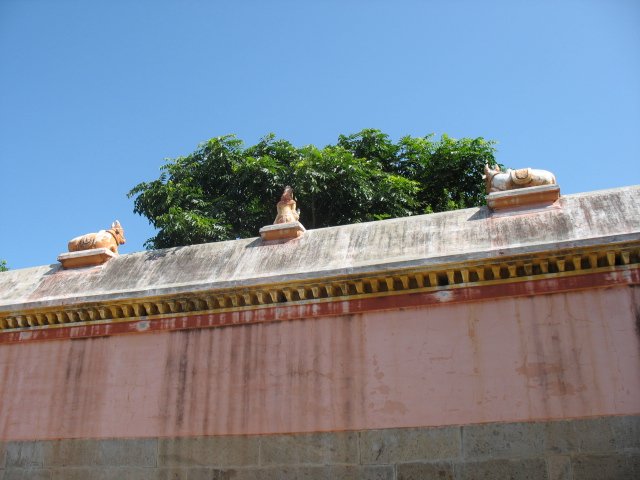
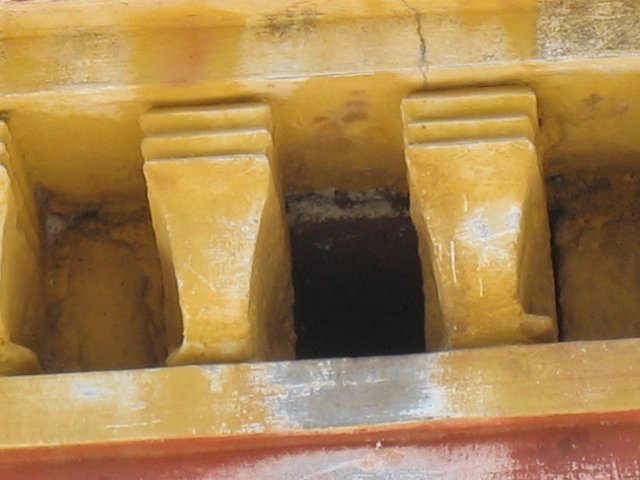
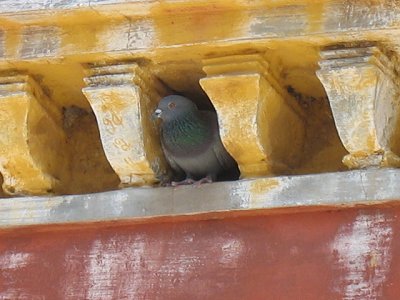
With careful attention to detail during renovation of Adi Annamalai
Temple, the little openings at the top of the compound walls surrounding
the Temple were preserved so they could continue to remain as nesting
places for: parrots, doves, pigeons, sparrows, owls and bats.
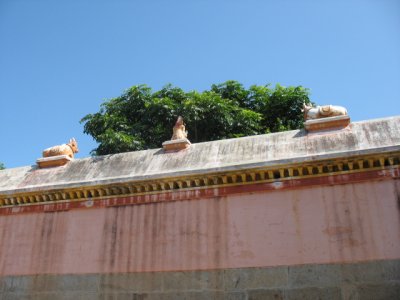
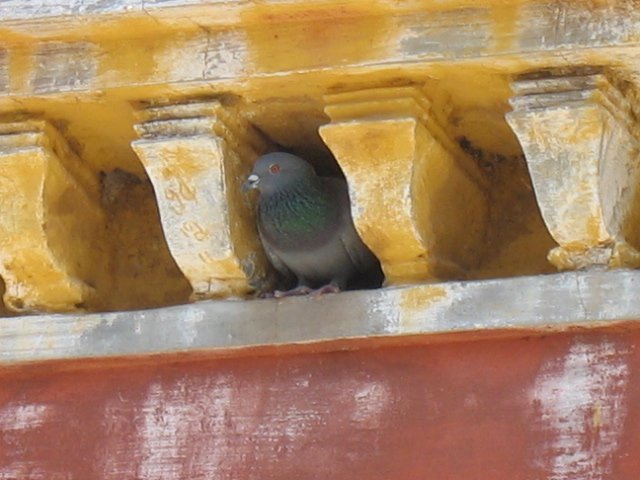
In the below photograph a very nice little nook which opens up inside
the compound wall to provide a secure nesting place for lots of the
local birdlife, safe from the usual local predators such as, monkeys,
cats and squirrels - in fact the perfect home!
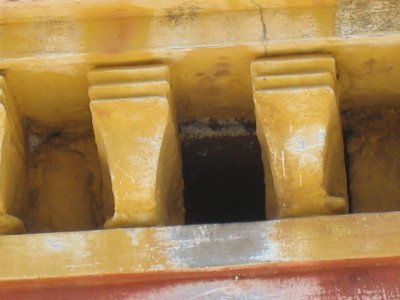
And what better bird to have in one of the safe homes than the Emerald Dove, the State bird of Tamil Nadu.
|
|
|
|