

The Indian subcontinent under the control of the
Mughul Empire lost its territory with the death of Emperor
Aurangzeb in 1707. The death resulted in the splitting up the
Empire between viceroys and local rulers with bitter fighting amongst
them. In the 1740s and 1750s French and British colonial companies
became more active in local conflicts, and by the Third Carnatic War
(1757-1763), the British gained Bombay, Madras and Calcutta - and emerged
the largest among the colonial powers. British holdings at Madras were
strongly influenced by treaties with the Nawab of Carnatic (Muhammed Ali
Khan Wallajah), whose territory surrounded Madras. The other major
powers in the east were the Nizam of Hyderabad with control of Mysore
coming into the hands of Hyder Ali, the Muslim military leader, in
1761.
All of the powers intrigued against one another, and sought to
collaborate with British and French colonial companies in order to gain
either direct control of territory, or revenues from territory in
exchange for financial and military support. Since European military
training was significantly better than local armies, small numbers of
disciplined European or European-trained forces could defeat larger
Indian armies composed mainly of poorly trained infantry and cavalry.
|
|
Tiruvannamalai lay at a strategic crossroad; connecting sacred centres
of pilgrimage and military routes. Inscriptions show that the city
developed around the temple and the area was an urban centre from the
time of the Vijayanagara Empire (which substantially pre-dates colonial
times). As the Mughal Empire came to an end, the Nawab of the Carnatic
lost control of Tiruvannamalai - and confused chaos ensued after 1753.
Subsequently, there were periods of both Hindu and Muslim stewardship of
Arunachaleswarar Temple; with Muraru Raya, Krishna Raya, Mrithis Ali
Khan, and Burkat Ullakhan besieging the temple in succession.
The Battle of Tiruvannamalai and the Battle of Chengam were two
successful battles fought by the Madras Army in the Carnatic. The allied
forces of Hyder Ali was defeated by the British Army under Colonel
Smith in Chengam on 3rd September 1767. A second battle, that lasted for
two days, the Battle of Tiruvannamalai took place on 25th September
1767 between the troops of East India Company and troops of Hyder Ali.
The allied forces of the English army was led by Colonel Smith. The
Nawab's army lost 4,000 men and 64 guns in the battle.
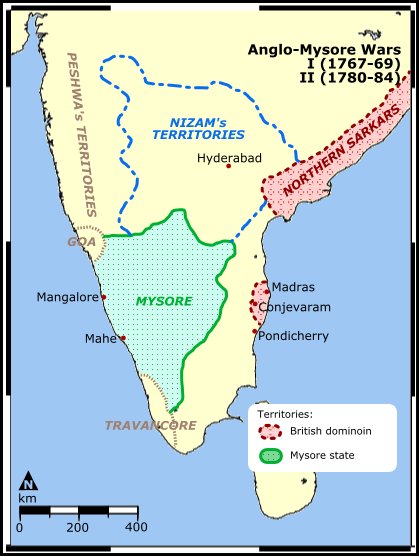
India in 18th Century
After a lengthy tussle, Tipu Sultan captured Tiruvannamalai and then
then gathered his army and came close to capturing Madras. A Peace
Treaty was signed with the British during April 1769 returning the
situation to pre-war days. The treaty also laid terms for mutual aid and
the end of a defensive alliance.
(Tipu Sultan was born on November 20, 1750, to military officer Hyder
Ali of the Kingdom of Mysore and his wife, Fatima Fakhr-un-Nisa. They
named him Fath Ali but also called him Tipu Sultan after a local Muslim
saint, Tipu Mastan Aulia).
In 1790 Tipu Sultan re-captured Tiruvannamalai over-riding the Treaty of
Mangalore (1784 A.D.) in which he and the English agreed to mutual
restoration of conquests and exchange of prisoners. Tipu Sultan attacked
Thiagadurga Fort (30 miles south of Tiruvannamalai). The whole
population of the surrounding region took refuge in the fort. Activated
by the news from Thiagadurga and fearing attack, the people of
Tiruvannamalai collected arms and men to defend themselves till British
reinforcements arrived. When Tipu Sultan attacked Tiruvannamalai, its
inhabitants put up a brave resistance but were compelled to surrender.
Tipu Sultan, it is said, occupied the hillock of Pavala Kundru after
destroying the small shrine that was there. His solders, it seems, were
cruel to the people of the town but strangely the Temple of Sri
Arunachala was left untouched, barring a single cannon shot that was
fired at it. The missile seems to have hit a part of the northern wall
causing minimal damage. After camping there for some weeks, Tipu Sultan
and his army left Tiruvannamalai.
If you mentally delete the recent construction between the Pavala Kundru
Hillock and Arunachaleswarar Temple, one can visualise an invading Tipu
Sultan army camped on the Hillock with army and canons, raining shots
upon the outside of the northern wall of the Arunachaleswarar Temple
compound.
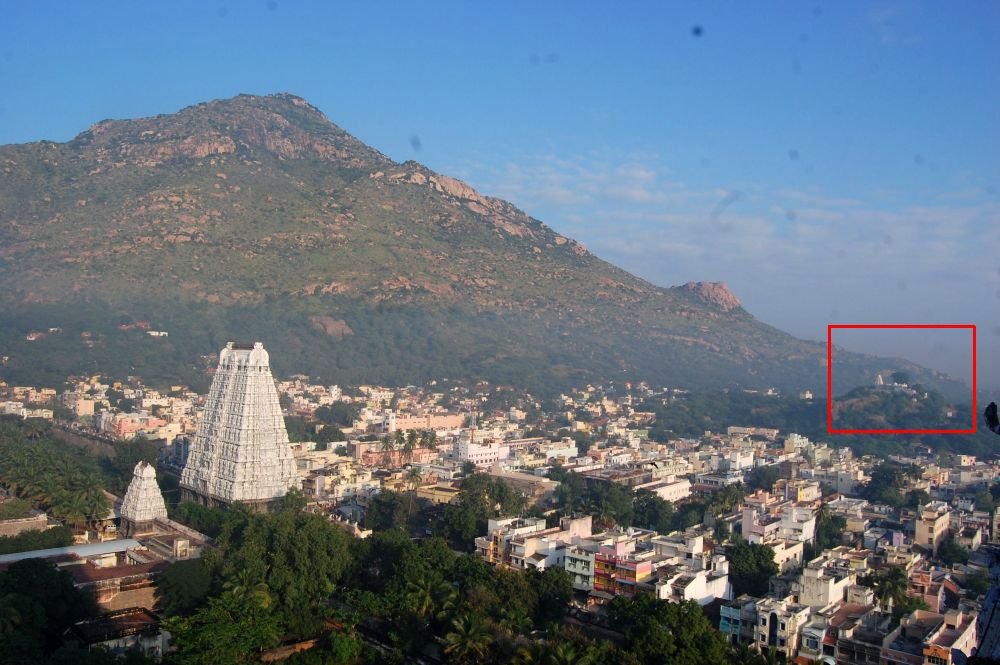
Pavala Kundru outlined in red. Amman Ammani,
North Gopuram on left side of photo
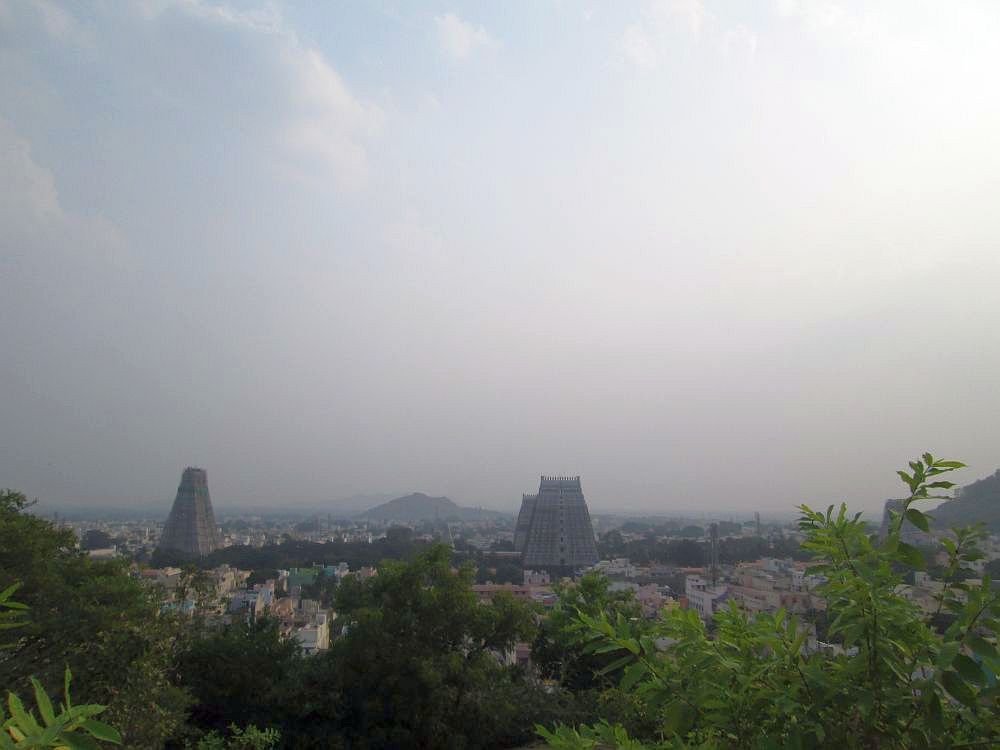
View of North Wall of Arunachaleswarar Temple
from Pavala Kundru
A gun belonging to Tipu Sultan was found buried near the hillock where
he had camped. It was taken and placed in a museum in Madras. Ramana
Maharshi said that whatever Temple might have existed on or about Pavala
Kundru seemed to have disappeared probably on account of Tipu Sultan's
invasion. The present Temple was probably built only a hundred and fifty
years ago.
Historical Military Synopsis:
Between 1753 and 1791 Tiruvannamalai was besieged on ten separate
occasions and was six times taken, thrice by assault. The temple and the
town adjoining it were on several occasions the scene of severe
fighting, the marks of cannon balls being visible on the temple walls to
this day. In 1753 it was besieged by Murtiz Ali Khan and Morari Row and
very gallantly defended by Barkat Ulla Khan on behalf of the Nawab of
the Carnatic. In 1757 the garrison abandoned the place on the approach
of a French army under Soupires, but in August of the following year it
was recaptured by Krishna Row, the Killadar of Tiagar. A month later,
however, a strong detachment under Saubinet attacked and captured it
after three assaults when the garrison was put to the sword. In 1760 it
was taken by Captain Stephen Smith, and in August of the same year was
attacked by Mysore troops which, after two unsuccessful assaults,
withdrew to Tiagar. On the outbreak of the First Mysore War allied
forces of Hyderabad and Mysore invaded the Carnatic by the Chengam Pass.
A desperate fight took place on 3rd September 1767, near Chengam, 16
miles from Tiruvannamalai, when some 6,000 men under Colonel Smith
totally routed the invading army. A second battle was fought at
Tiruvannamalai which lasted two days and resulted in the allies losing
4,000 men and 64 guns. In 1790, after being repulsed from Tiagar, Tippu
captured Tiruvannamalai.
[Extract from narrative compiled by Southern Indian Railways 1900]
|
|
|
|



