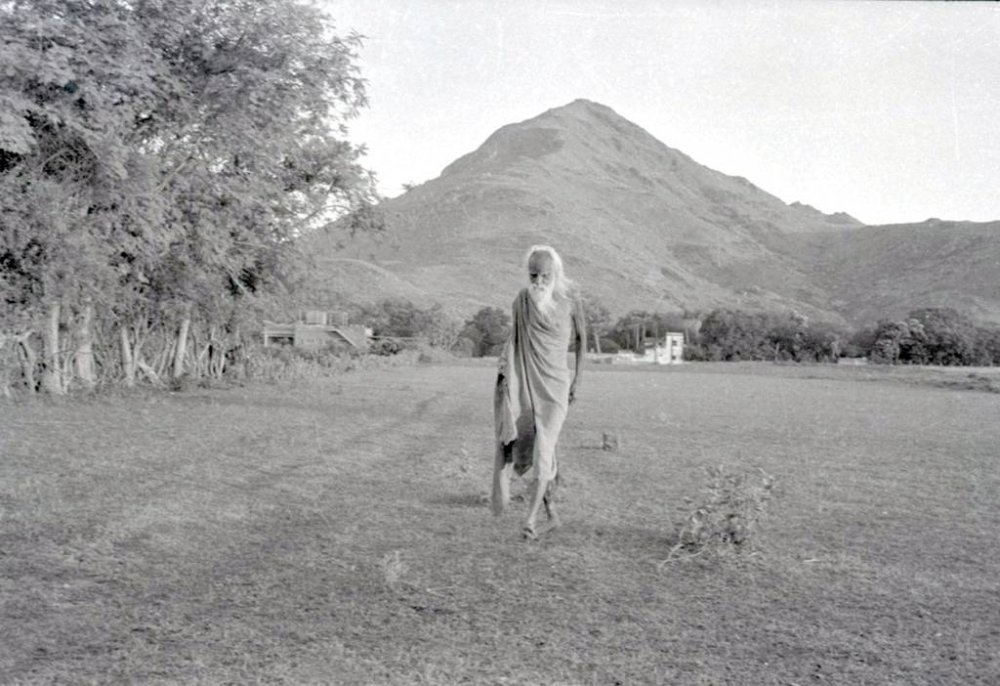
Early in the morning on Deepam Day, 7th December 2003,
a little-known devotee left his physical body in Tiruvannamalai, where
he had lived for more than 54 years in the supreme state of atma-jnana
bestowed upon him by the Grace of Sri Bhagavan.
The reason that he
was so little-known, even among fellow devotees, can only be attributed
to the divine Will of Sri Bhagavan, which can never be fathomed or
explained by our limited human intellects. If at all any semblance of
individual will could be attributed to this self-effacing devotee, he
appeared to have chosen to live in such circumstances as would shield
him from all but the barest minimum of public attention. Those who knew
him respected that seeming choice and avoided publicising him in any
way. But now that the human form has been cast off, I believe it is not
inappropriate that I share with fellow devotees a little of what I know
about him.
The devotee I am
writing about was in his former life named Ramaswami, but for more than
40 years past he has been known as Sri Tinnai Swami, because he lived on
and seldom moved away from the tinnai (masonry bench) in the verandah
of the house of the family of the last Sri C.P. Nathan, who gave him
food and shelter and attended to his few physical needs.
|
|
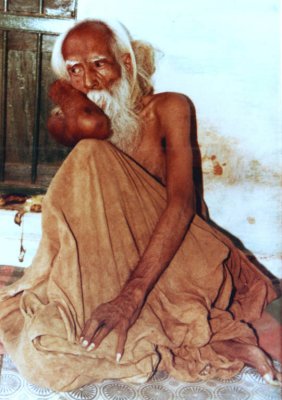
Sri Tinnai Swami was born in Coimbatore on the 12th
December 1912, in a family of lawyers and doctors belonging to the small
Telugu Brahmin community of that town. As a young man he was employed
for many years as a biochemist in Madras Medical College, during which
time he married and had four sons. Until his mid-thirties there was no
indication in his outward life of the great inner and outer
transformation that was to happen later.
In the mid-1940's
he came to Tiruvannamalai on three occasions to have darshan of Sri
Bhagavan, each time staying for just a brief while, but these first
three visits appear to have caused an immediate change in his outward
life. The first hint of an outward change in his life occurred later,
possibly sometime around the end of 1948. At that time an opportunity
had arisen in his department for a biochemist to be selected to go to
America for higher studies or research, and at first he was the
candidate selected. Soon, however, his selection was reversed, and a
junior colleague was selected in his place. Knowing that this change had
happened unjustly through some political influence, he resigned his job
in Madras Medical College as a matter of principle Before seeking
another job, he told his wife that he would take this opportunity to
spend some more time in Sri Bhagavan's Presence.
Thus he came to
Tiruvannamalai for the fourth time, and soon he wrote to his wife saying
that he planned to stay longer, and would bring her and their children
there after the forthcoming kumbhabishekam of Matrubhuteswara Temple, at
which time he hoped to find suitable accommodation for them.
Accordingly his family soon joined him and stayed with him in
Tiruvannamalai until about July of that year. By that time his wife was
about to give birth to their fourth son, so he sent her and their
children to stay with his father-in-law in Kolar. Before she left, he
told her that he intended to soon go to Pondicherry, where a suitable
job vacancy was available.
During those months
that he lived with his family in Tiruvannamalai, he spent most of his
time either in Sri Bhagavan's presence or doing giripradakshina, and he
also appears to have formed a close friendship with Sri Muruganar. One
incident that occurred at that time gives a clue to the inner change
that was taking place within him. One day he came home unusually late
for lunch, so his mother asked him, "Have you been to see Swami?"
(referring to Sri Bhagavan as Swami). "What is the use of merely seeing
Swami?" he replied, "We must become Swami".
After his family
had left, he one day approached Sri Bhagavan and asked permission to
leave for Pondicherry to apply for a job, to which Sri Bhagavan replied,
'Iru'. Iru is a Tamil word that literally means 'Be', but in such a
context it would normally be taken to mean 'Stay' or 'Wait'. Though it
was unusual for Sri Bhagavan to tell someone to stay when they asked
permission to leave, most devotees who were present at that time
probably took little notice of it. However, one of those present was Sri
Muruganar, and he was able to understand the great power of that single
word uttered by Sri Bhagavan and the profound impact it had upon Sri
Tinnai Swami.
Sri Tinnai Swami
obeyed both the colloquial and the literal meaning of the word 'iru'
uttered by Sri Bhagavan. From that moment, he never left Tiruvannamalai,
and he also remained fixed firmly in the eternal state of
Self-abidance. As Sri Sadhu Om once commented, "Lord Murugan bestowed
jnana upon Arunagiriyar and Bhagavan bestowed jnana upon Tinnai Swami by
uttering just one word, 'Iru"."
Sri Tinnai Swami's
inward transformation was reflected in a complete transformation in his
outward life. From that day on his outward behaviour was changed
radically. He seldom spoke, and when he did his words were usually
enigmatic, often allegorical, and at times even appeared quite
meaningless. He neglected his appearance, allowing his hair to grow long
and matted, and he lived by begging his food, usually just one meal a
day, and sometimes not even that. He was known sometimes to remain so
absorbed in his inward state that for several days he did not stir
outwardly even to eat or fulfill any other bodily function.
Since they had heard nothing from him for some time, his family became
worried, so his brother-in-law came to Tiruvannamalai to find out what
had happened to him. When he finally found him and discovered that he
had changed so completely, and when he showed no sign of response when
requested to come home, his brother-in-law concluded that he had become
mad.
His wife, however,
refused to believe this, and asked her father to take her to see him.
Finally they came, shortly after Sri Bhagavan's mahanirvana, but their
pleas to him to come home were of no avail. Seeing this, his wife said
to her father, "If he wishes to live like this, I do not wish to stand
in his way. But as his wife I have the right and duty to serve him. So
please allow me to remain here to take care of him."
Her father
therefore rented a cottage in the compound of Kittu Aiyar, the Ashram
priest, for her to stay in with her two younger sons, while the elder
sons would remain with him in Kolar, where they were going to school.
When his wife and father-in-law requested Sri Tinnai Swami to accept her
service, he consented and lived for a while in an adjacent hut. During
that time he would spend most of his time in deep Self-absorption, from
which he would rise only to accept food or to do giripradakshina.
After some time,
however, his father-in-law asked Tinnai Swami's wife to return to Kolar
to be with her elder sons, and though at first she declined, she agreed
after Sri Tinnai Swami told her to go, saying her duty was to look after
her sons. Over the course of the next fifty years or so, she visited
Tiruvannamalai on many occasions, sometimes for just a few days, and
sometimes for several weeks. Whenever she came, she did whatever she
could to serve Sri Tinnai Swami, though generally there was little
anyone could do for him except to offer him food. Sometimes he would
accept her service, and at other times he would not, and when he did not
she usually understood it to mean that he did not want her to remain
there, so she would return home.
After she returned
with her father to Kolar, Sri Tinnai Swami returned to live in
Virupaksha cave. As had become usual, he spent most of his time there in
Self-absorption, and would on most days gets up only once to go for
giri-pradakshina and to beg his meal on the way.
At first he would
beg from houses anywhere in the town, but gradually he restricted
himself to begging from just a few houses in Sri Ramana Nagar. As time
went on, he slowly stopped begging from other houses, and came on most
days to the house of Sri C.P. Nathan to eat his only meal. Finally one
day in the late 1950s, when he came to their house as usual, he said to
Mrs. C.P. Nathan, "Amma, it is raining outside. May I take shelter
here?" She replied, "Swami, this is your house. You are welcome to stay
here." He therefore sat on the tinnai in their verandah, and remained
there.
That day was
actually a very hot sunny day in the Tamil month Purattasi
(September-October), and there was no sign of any rain. After a short
while, however, a small black cloud appeared, and a few drops of rain
fell. Nevertheless, it appears that what he really meant when he said,
"It is raining outside", was that living in a public place like
Virupaksha cave, he was exposed to all sorts of unwanted attention. That
is, because from his outward appearance and behaviour it was clear even
to worldly-minded people that he was no ordinary sadhu, he naturally
attracted public attention and adulation which he wished to avoid.

At that time, C.P. Nathan was living with his family in a rented house,
but because he had recently been disabled by a paralytic stroke, he knew
that he would be unable to continue paying the rent, and was therefore
in need of some other accommodation. When Mrs. C.P. Nathan informed this
difficulty to Sri Tinnai Swami, he pointed to a nearby piece of vacant
land and said, "Why should you worry? Your house is built there". Soon
after that, it became known that that plot of vacant land belonged to
David McIver, and that he was ready to sell it for the nominal price he
had paid for it some 15-20 years earlier. But though they could afford
to buy the plot, C.P. Nathan and his wife had no idea how they could
afford to build a house on it. When they told this to Sri Tinnai Swami,
he said, "Three sadhus will build your house for you". Later, with money
lent by some friends, and with the help of three sadhus, Sri Sadhu Om,
Swami Sankarananda of Desur Ramanananda Mathalayam, and Swami
Krishnananda, a small house was built for them, with a coconut leaf
verandah and tinnai for Sri Tinnai Swami to live on.
For more than 40
years Sri Tinnai Swami lived on that tinnai, and only on a very few
occasions did he ever leave that compound. In the 20 years I lived in
Tiruvannamalai, from 1976 to 1996, he left the compound on only one
occasion, in the lat 70's, when for some unknown reason he went and
crouched for three or four days in the open ground between the compound
and Arunachala.
During my early years in Tiruvannamalai, he left his tinnai only
to crouch on the floor to eat food, or to visit the outdoor latrine, or
occasionally to sit on the outdoor tinnai facing Arunachala, or very
rarely to walk to the front gate. Other than this, he remained reclining
quietly on this tinnai. Before I came to Tiruvannamalai, on a few
occasions he walked to Pali Tirtham (the tank beside Sri Ramanasramam)
to dip himself briefly, and returned in his wet clothes, which he
allowed to dry on his body. And while I was there, he once went to the
well behind the house and poured a few buckets of water over himself.
Except on these few occasions, he never took bath, but his body did not
give off any unpleasant odour.
From the day that
Sri Bhagavan told him, "Iru", Sri Tinnai Swami remained completely
indifferent to all forms of physical discomfort and inconvenience. Apart
from shelter, a small amount of food each day, and occasionally fresh
clothing to replace what he had been wearing continuously for a
considerable period of time, often till it was threadbare or quite
ragged, he generally did not accept any form of service. His hair always
grew long and matted, and his finger and toenails also grew long,
thickened and curled, and it was only in the later years of his life,
when the nails growing back into his flesh caused bleeding and obviously
very painful wounds (which were sometimes invaded by the small red
variety of ants, whose bite stings sharply), that he finally acceded to
our repeated requests to allow us to cut his nails.
There are many
remarkable incidents in his life that I have witnessed or heard that I
could relate, including some minor miracles that devotees attribute to
him, but the most remarkable thing about his outward life was the fact
that he lived silently in one place for so many years, unmoved by and
unconcerned with whatever was or was not happening around him. It was
not that he did not know what was happening - from occasional words he
uttered it was clear that he knew many things, including things which he
had no means of knowing through the usual channel of the five senses -
but he was simply unaffected and untouched by anything.
During the many
years that he lived on their tinnai, C.P. Nathan, and his family were
blessed with the good fortune of providing him with the little food,
clothing and shelter that his body required, and in the early years in
spite of their then state of poverty they performed such service not
only to him but also to Sri Sadhu Om and other sadhus and devotees of
Sri Bhagavan. Sometimes they even had to sell their cooking vessels in
order to purchase provisions to feed visiting devotees. All of us who
had the good fortune to know Sri Tinnai Swami will be very grateful in
particular to Mrs. C.P. Nathan, who in spite of many hardship serviced
him with great devotion in every way she could especially providing him
food, as she did till the end in spite of her advanced age and physical
weakness.
Towards the end of
1985, Sri Tinnai Swami lost his eyesight, apparently due to cataract,
but he never allowed any doctor to check his eyes. After this his few
physical activities became even less. He ate food from a plate placed on
a table beside his tinnai, continuing to recline even as he ate, and he
got off his tinnai only to answer the calls of nature in a bowl placed
beside it. Other than that, he remained unaffected by and totally
unconcerned with the failing strength and health of his body. His state
remained unshakable as ever.
Finally, a few days
before his 91st birthday, he left his body as quietly as he had lived
in it, in the early hours of the morning when everyone in the compound
was asleep. His holy remains were found reclining peacefully as ever,
and were interred with due respect and devotion in the manner
traditional for a sadhu that afternoon, a few hours before the holy
Deepam was lit on Arunachala, beside the samadhi shrine of Sri Sadhu Om,
close to the tinnai where he has lived for so many years.
His ever-devoted wife, Smt Jayalakshmi, and his four sons all survive him.
In the eyes of the
world, which attached importance only to doing, overlooking the true
importance of mere being, there might appear to be little greatness in
the extraordinary life of Sri Tinnai Swami. He did not speak, write or
teach anything, nor did he perform any other "useful" function. But
whether we are able to recognise it or not, his mere being was a great
blessing bestowed upon the whole world by Sri Bhagavan, the effect of
which cannot be known or measured by our finite intellects. As Sri
Bhagavan says in verse 303 of Guru Vachaka Kovai:
"They (the wise) say that the ucchistha (the leftover of food)
consumed by God is the supreme purifier that removes all sin. Take to
heart that the life of sat-achara (abidance in the state of being) lived
by a jnani in this material world is itself that ucchistha."
That is, the mere existence of a jivanmukta, whose physical form
continues to live in this world after God has consumed his ego, is
itself the sacred ucchistha that purifies the world of all evil. When
this supreme good is done by his mere being, what need is there for the
jnani to do anything - whether to speak, write, teach or perform any
other kind of "good deed"?
[By Michael James]
|
|
|
|