
History and Legend
The geographical coordinates of Parvathamalai are 12°26'11"N latitude
and 78°58'19"E longitude. Parvathamalai 20 kms from Polur and 35 kms
from Tiruvannamalai, is part of the Javadi Hills and accessible through
Kadaladi village or Thenmadhimangalam. Parvatham means mountain and
Parvatha Malai as it is called, connotes 'Hill of Hills' or 'Queen of
Hills'. Parvathamalai presents eight different shapes from eight
directions around the hill.

Parvathamalai - Ashram and Temple on summit
| |
"Naviram Hill (Nanviramalai) is described in 'Malaipadukadam' a Sangam
poetic work in Pattuppattu anthology. Over two thousand years ago the
Javadi hill-range, an extension of the Eastern Ghats comprising
modern-day Tiruvannamalai and Vellore Districts of Tamil Nadu, was known
as Palkunrakkottam.
Thondai Nadu, a historical region situated in the northern part of Tamil
Nadu, was divided into 24 districts or 'Kottams.' Palkunrakkottam was
one among the 24 kottams. Palkunrakkottam means the 'land surrounded by
hillocks'.
The Javadi hill range extends 50 miles (80 km) wide and 20 miles (32 km)
long and lies at 2350 - 3500 feet above sea level. Most scholars believe
Naviram Hill, situated at Thenmadhimangalam, is the same hill that is
now known as Parvathamalai."
"Know the greatness of the God who resides in Naviram who ate poison, who causes the earth surrounded with water to tremble!"
[81-84 Malaipadukadam]
"Nannan showers unspoiled wealth like the rain showers on Naviram Mountain, the Lord of the country surrounded by mountains)."
[579 Malaipadukadam]

Nannan's (son of Nannan) fort
Before the top of the hill there are ruins of an abandoned fort,
believed to have been constructed by King Nannan (son of Nannan).

Part of the abandoned fort
"Palkunrakkottam was ruled by King Nannan (son of Nannan) Lord of
Cheyaru Valley and Velir Chieftain of Chenkamma. The 'Malaipadukadam'
names Naviram Hill as Nannan's Hill. The poet Perunkausikanar addresses a
group of Kuttar and advises them to seek the patronage of King Nannan
(son of Nannan) whose territory includes Naviram Hill."
[abridged from narrative by R. Muthusamy]
At the summit of the Hill is the Mouna Guruswamy Ashram and more
importantly a very powerful Temple at which resides the Siva aspect in
the form of Lord Mallikarjuna (i.e. White Jasmine) and the Shakthi
aspect in the form of Parvatha Rani, Parvathammal, Sri Brahmarambika and
Sri Akilandesvari Amman.
The presiding deity of Parvathamalai Temple in Sanskrit is known as
'Kalakanteshvarah' - 'the god whose neck is dark blue.' Parvathamalai is
also known as Kandhamalai, Mallikarjunamalai, Naviramalai, Parvathagiri,
Sanjeevigiri, Thenkailayam and Trisulagiri.
The summit Temple has sannidhis for Lord Shiva, Amman Bramarambigai, Sri
Ganapathy, Sri Valli Devasena Subramaniyar, Bairavar and Agasthiyar.
The Temple which is open 24 hours a day is not protected by doors or a
compound wall and has no presiding priest - leaving devotees free to
perform their own puja.
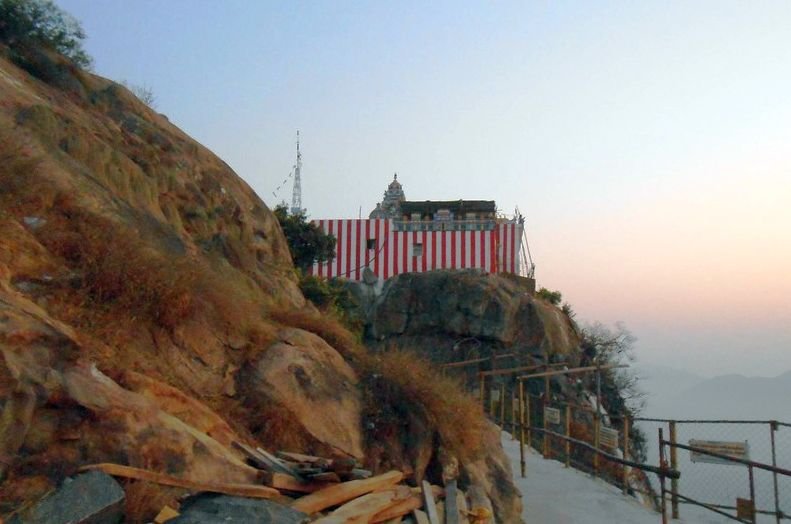
Parvathamalai Temple
A Temple at this site is believed to have existed for the last 2000
years although it is not known exactly when the current Temple was
constructed at the top of Parvathamalai. It is said that 2000 years ago
great yogis (Siddhars) constructed a Temple at the top of this hill for
meditation. The 'Malaipadukadam' states King Nannan around 200 A.D. used
to frequently visit a Temple (at this site) to worship Lord Siva and
the Goddess.
One of the legends associated with Parvathamalai, states that when Lord
Hanuman carried Sanjeevini hill to revive Lakshmana a piece of
Sanjeevenimalai fell at this spot. For this reason this particular area
is famous for various herbs and shrubs which can cure the deadliest
disease. It is not just herbs that can cure disease but it is thought
that the breeze alone from the Hill wafting through the plants and
shrubbery is enough to affect cure of sickness.

Lord Hanuman carrying Sanjeevini Hill
Another legend associated with this sacred site recounts that when Lord
Siva returned from the Himalayas to South India, He stepped on
Parvathamalai on His way to Arunachala.
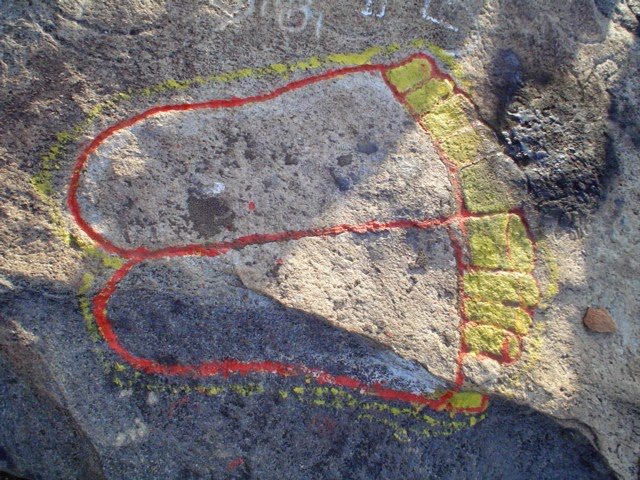
Representation of Lord Siva's Feet near Summit
The history of Parvathamalai is interconnected with that of the famed
Sri Mallikarjunar Temple at Srisailam, Andhra Pradesh. The encompassing
legend goes so:
Sage Siladha performed severe penance seeking a boon from Lord Siva to
have children. Two sons were born to him, Nandi and Parvathan. Sanakadhi
Rishi called on the sage and said that Nandi would live on earth only
for a short while. As a result of this prophecy Siladha fell into grief.
Nandi assured his father by saying that he would win over death by his
penance on Lord Siva.

Mallikarjunar Temple Srisailam
Pleased with Nandi's penance, Lord Siva appeared and made the young
child His vahana (vehicle) and passed the order that devotees should
come to Him only after attaining admittance from Nandi. Nandi's place of
penance at the foot of the hills at Sri Mallikarjunar Temple at
Srisailam is also known as 'Nandiyal'. His brother Parvathan also
performed penance on Lord Siva and became the hill - Parvatha Hill; i.e.
'Parvathamalai'. As Parvathamalai is equivalent to Sri Sailam Hill, the
name of Iraivan becomes Sri Mallikarjunar and Iraivi is now as Sri
Brahmarambika.
This sacred place approximately 25 kms from Arunachala is infused with
Arunachala's radiating spiritual power. Sri Shankaracharya of
Kanchipuram saw the hill in the shape of a Siva Lingam. Increasingly as
the fame of Parvathamalai spreads, many devotees and pilgrims visit and
climb the hill to worship at the Temple on the summit in order that they
may attain bliss and enlightenment. One of the unique features of the
Temple on Parvathamalai is that all who enter the inner shrine (sanctum
sanctorum) are allowed to perform their own puja to Lord Siva, the
Goddess, Sri Ganesha and Lord Murugan. The busiest times at
Parvathamalai are the days of full moon, no moon and new moon.

Lord Mallikarjunar
It is reputed that there are Siddhars who have made this Hill their home
and who keep their presence a secret only choosing to reveal themselves
to a few devotees of the Divine. It is believed that these Siddhars
visit the Temple on the top of Parvathamalai at midnight to worship the
presiding deities. Although no person is able to see these beings in
physical bodies, Villagers around Parvathamalai say they can clearly
hear the sound of ringing bells, blowing conches and beating drums
exactly at midnight when these other-worldly pujas are performed by
Siddhars. Devas and spiritual beings from other lokas are also believed
to worship on the Hill every night.
"Siddhars have spoken volumes about Pancha Nathana Nataraja. They say
that this deity is such a rarity in the Universe that even the Devas
would give anything just for the chance of worshipping him. They say
that on the Nataraja Abisheka days which occur in certain Tamil months
(Chitra, Aani, Aavani, Purattaasi, Margazhi and Maasi), the Devas
perform their worship to this deity in subtle form. This kind of worship
is similar to the sookshma worship done by the Devas at the peak of the
Arunachala Hill and on Parvathamalai Hill."
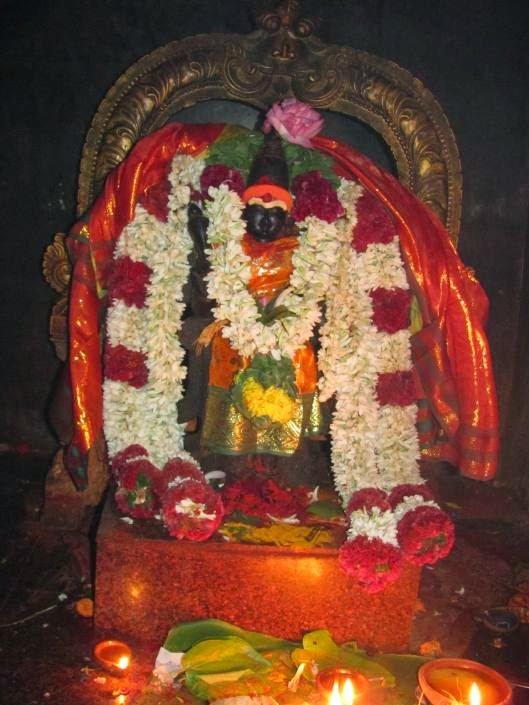
Sri Brahmarambika
It is reported by devotees that at night many paranormal activities
occur on Parvathamalai. In this regard its possible to experience both
Jyoti Darsanam at night and also to imbibe an almost other-worldly
intoxicating scent of flowers. The Goddess idol at the Temple has a
dazzling smile and Divine light can often be seen on her face and
cheeks. When the devotee walks away from Goddess Brahmarambika in the
sanctum sanctorum, the size of the deity instead of diminishing, appears
to increase in size as if the Goddess has stepped forward and is
approaching the devotee.
This place is filled with stories of miracles witnessed in one form or
another. Devotees often report seeing images of both snake and trishulam
when lighting camphor in front of Lord Siva. Some devotees have seen a
nine foot King Cobra visiting the Sanctum Sanctorum and others have
reported sight of three eagles (believed to be siddhars) circling the
top of Parvathamalai.
Saints of Parvathamalai
There is a legend at Parvathamalai associated with the two saints Guru
Namasivayar and Guhai Namasivayar - who were to later reside on caves on
Arunachala Hill. It is reputed that during their time on
Parvathamalai, Guhai Namasivayar and Guru Namasivayar
accidentally cooked and ate an unknown herbal leaf (believed to be
'Karunochi - Siddha Medicine') and thereby gained eternal youth.
Thavathiru Veera Vairakiya Moorthy Swamigal
Thavathiru Veera Vairakiya Moorthy Swamigal is believed to have lived
for many years on Parvathamalai engaged in sadhana dedicated to Lord
Siva. The following legend appears in a well known book written in
Tamil - but only now appears in English.
The legend goes thus:
To the northern side of Tiruvannamalai there is a place which has the
sacred blessing of Lord Siva and which used to be known as Trisula
Paaruvatham. Today this sacred place is called Parvathamalai. It is an
ancient Hill which has a beautiful Temple of Lord Mallikarajuna Iswara
located on its summit. This sacred Temple is believed to have originated
over 2,000 years ago. The Hill is surrounded by forests and mountains
and is known as Thirumoolaarenyam.
A number of Siddhars and Maharshis have performed Thaavam at this place.
A famous Rishi known as Mirukaandu Muni, lived on this Hill and with
his power of thaavam a river originated nearby called Mirukaanda River
which now flows all through the forest. Agathiyar Maharshi and Kaanuvar
Rishi have performed thapas and stayed for sometime at this sacred
place. Even today a number of Siddhars and Rishis are believed to reside
at Trisula Paaruvatham. The Universal Guru, Aathi Sivalinga - Chariya
Peruman Gurupeetam is at that spot even now.

Parvathamalai through Mist
Thavathiru Guru Veera Vairakiya Moorthy Swamigal was the sixth
Gurumoothy of the Gurupeetam. He was well versed in the agamas and in
all manner of spiritual books. He performed Siva Linga pooja each
morning, noon and evening for many years.
During his lifetime a Mughal (Muslim) king named Naavab Baadhumsha
interrupted a Tiruvannamalai Temple programme during Festival time while
a Panchamoorthy procession was going on. It is customary for saints to
walk at the back of a Panchamoorthy procession: Neadumaran Devar,
Jollyganda Devar, Paanapathera Devar, Veerupatchi Devar and Arunachalam
were on a palanquin at the back of this procession. The Mughal king
watching the procession viewed the saints at the back and asked that if
the procession was for the five Gods on their vahanas how could it be
acceptable that these saints should be coming on a palanquin at the back
of them? This king felt that such an act was entirely improper.
People around the king told him that these five saints were very great
and by power of their tapas were able to eliminate any problem or
difficulty that might arise. On hearing this the king became enraged and
cut a cow (which was nearby) into two halves. He told all around that
he challenged the saints that if they were truly in possession of Divine
power that they would be able to make the cow come back to life. The
king announced that if the saints were to fail that he would destroy
Arunachaleswarar Temple in retribution. The five saints tried all manner
of puja, mantras and invocations to heal the cow and bring it back to
life - but they failed with every attempt.
After sometime they heard a voice emanating from the sky informing them
to go to Veera Vairakiya Moorthy Swamigal as he alone could return the
cow to life. The five saints set off on the 25 km distance to Trisula
Paaruvatham (Parvathamalai) to see the saint and to inform him about the
king's challenge and to request him to come and return the cow to life.

Metal Padukas
When the five saints reached the Guru Peetam, Veera Vairakiya Moorthy
Swamigal was in Siva Yogam. Two tigers (who were manifestations of God
Siva and Goddess Parvati) were sitting on either side and the saints
were unable to reach him. After Swamigal completed his yoga, the two
tigers left the place and the five saints talked with Swamigal and
informed him about the challenge of the King.
On hearing the challenge Swamigal requested that the five saints should
worship the Siva Lingam murthy at the Lord Mallikarajuna Iswara Temple
on top of Trisula Paaruvatham (Parvathamalai) and then informed the
saints to make arrangements for a powerful and special puja. He gave
explicit instructions that they should prepare a homam (burning
sacrifice) long enough to fully stretch to Tiruvannamalai. It was his
intention and tapas to walk through the 25 km long, burning homam whilst
wearing scorching hot metal padukas. The five saints made the
arrangements as outlined and Swamigal started his way towards
Tiruvannamalai. As Swamigal reached the direction of Esanya Lingam
(northeast of Arunachala) the two halves of the cow came together and
joined up.
Swamigal arrived at the Big Temple and after worshipping Lord
Arunachala, sprinkled holy water from his kamandalu onto the cow and the
creature immediately returned to life. The hitherto distressed calf
became happy and jumped towards its mother to have milk. The king was
shocked to see such happenings and fell to the ground, worshipping
Swamigal in remorse for his actions. The king most eager to see the full
extent of the spiritual powers of the saint, requested Swamigal to
bring to life a stone bull (Nandi) in the Temple. Swamigal said that it
would happen and recited the Linga mantra. As he was chanting the Nandi
came to life, stood up and made a loud sound and then sat back down and
became stone again.
The king felt great remorse for his treatment of Veera Vairakiya Moorthy
Swamigal and apologised most earnestly for everything that had
transpired. He then went with the Swami to the Gurupeetam on Trisula
Paaruvatham, stayed some time performing service of the Saint and then
returned to Tiruvannamalai.
Veera Vairakiya Moorthy Swamigal continued at Trisula Paaruvatham all
the while performing Siva Linga pooja and in this way helped develop
Siva bhakti amongst the people of the area. He himself merged in the
feet of his Lord Siva.
|
|
|
|



