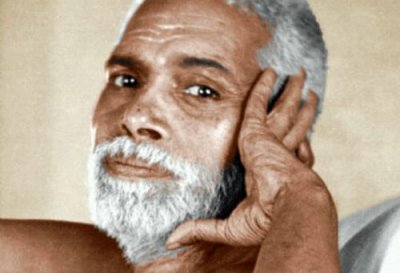
Teachings of Ramana Maharshi
There is no greater mystery than this, that being the reality yourself,
you seek to gain reality. You think there is something binding your
reality and that something must be destroyed before the reality is
freed. This is ridiculous. A day will dawn when you will laugh at all
your efforts. What is there to realize? The real is always as it is. You
have realized the unreal, in other words, you regard the unreal as that
which is real. Give up this attitude and you will attain wisdom. There
is nothing new nor anything you do not already have which needs to be
gained. The feeling that you have not yet realized is the sole
obstruction to realization. In fact, you are already free. If it were
not so, the realization would be new. If it has not existed so far, it
must take place hereafter. What comes will also go, what can be gained
can also be lost. If realization is not eternal it is not worth having.
Therefore what you seek is not that which must happen afresh. It is only
that which is eternal, but not now known due to obstruction. Remove the
obstruction. That which is eternal is not known to be so because of
ignorance. Ignorance is the obstruction. Get over the ignorance and all
will be well. The ignorance is identical with the 'I-thought'. Find its
source and it will vanish. Then the Self alone will shine as it always
has, in the stillness of being.
People often ask how the mind is controlled. I say to them, 'Show me the
mind and then you will know what to do.' The fact is that the mind is
only a bundle of thoughts. How can you extinguish it by the thought of
doing so, or by a desire? Your thoughts and desires are part and parcel
of the mind. The mind is simply fattened by new thoughts rising up.
Therefore it is foolish to attempt to kill the mind by means of the
mind. The only way of doing it is to find its source and hold on to it.
The mind will then fade away of its own accord. In deep sleep you are
entirely free from thoughts, because the 'I-thought' is absent. The
moment the 'I-thought' rises on waking, all other thoughts rush forth
spontaneously. The wisest thing for one to do is therefore to catch hold
of this leading thought, the 'I-thought', and dissect it - who and what
it is - giving thereby no chance to other thoughts to distract
you. Therein lies the true value of self-inquiry and its efficacy in
mind control. All that you need do is to find out the origin of the
'I-thought' and abide there. Your efforts can extend only thus far. Then
the beyond will take care of itself.
It is with the inward-going mind that you eliminate the outward-going
mind. You do not set about saying there is a mind and I'm going to kill
it, but you seek the source of the mind. Then you will find that the
mind does not exist at all. The mind, turned outwards, results in
thoughts and objects. Turned inwards, it becomes itself the Self. To ask
the mind to kill the mind is like making the thief the policeman. He
will go with you and pretend to catch the thief, but nothing will be
gained. So you must turn inward and see from where the mind rises and
then it will cease to exist. Whenever you are disturbed by thoughts you
need merely withdraw within to the Self. This is not concentration or
destruction of the mind but withdrawal into the Self. The degree of the
absence of thoughts is the measure of your progress towards
Self-realization. But Self-realization itself does not admit of
progress, it is ever the same. The Self remains always in realization.
The obstacles are thoughts. Progress is measured by the degree of
removal of the obstacles to understanding that the Self is always
realized. So thoughts must be checked by seeking to whom they arise. Go
to their source and they will not arise.
The truth of yourself alone is worthy to be scrutinized and known.
Taking it as the target of your attention, you should keenly seek to
know it in your spiritual heart. This knowledge of yourself will be
revealed only to the consciousness which is silent, clear and free from
the activity of the agitated and suffering mind. Know that the
consciousness which always shines in the heart as the formless Self, the
true 'I', and which is known by your being still without thinking about
anything as existent or non-existent, alone is the perfect reality.
Your duty is to be, and not to be this or that. 'I am that I am' sums up
the whole truth. The method is summed up in the words 'Be still'. What
does stillness mean? It means destroy yourself. Because any form or
shape is the cause of trouble. Give up the notion that 'I am so and so'.
All that is required to realize the Self is to be still. What can be
easier than that? Association with a realized master pushes the mind
inward. He is also in the heart of the seeker and so he draws the
latter's inward-bent mind into the heart. Satsang will make the mind
sink into the heart. Satsang means association with truth. Truth is the
Self. Since the Self is not now understood to be truth, the one reality,
the company of the sage who has thus understood it is sought. That is
satsang. Introversion results and truth is revealed. In all the three
worlds there is no boat like satsang to carry one safely across the
ocean of birth and death.
When unity in the heart is replaced by a variety of perceived phenomena,
it is called the outgoing mind. When you enter the inner stillness of
being, the heart-going mind is called the resting mind. When one daily
practices more and more abiding in the heart, the mind will become
extremely pure due to the removal of its defects, and the practice will
become so easy that the purified mind will plunge into the heart as soon
as the inquiry is commenced. Be what you are. All that is necessary is
to lose the ego. That which is, is always there. Even now you are that.
You are not apart from it. The thought, 'I have not realized', the
expectation to become realized, and the desire of getting anything, are
all the workings of the ego. You have fallen into snares of the ego. Be
yourself! See who you are, drop your mind into the cave of the heart and
remain as the Self, free from birth and death, free from all comings
and goings.
Man is always the Self and yet he does not know it. Instead he confounds
it with the non-Self, the body, etc. Such confusion is due to
ignorance. If ignorance is wiped out, the confusion will cease to exist
and the true knowledge will be unfolded. By remaining in contact with
realized sages the man gradually loses the ignorance until its removal
is complete. The eternal Self is thus revealed. When the mind is weak,
grace is necessary. Serving a realized being will bring forth the grace.
There is however nothing new to get. Just as a weak man comes under the
control of a stronger one, the weak mind of a man comes under control
easily in the presence of a strong-minded wise person. Every plane of
worldly existence has its own illusion, which can be destroyed only by
another illusion on the same plane. For example, a man takes a full meal
and goes to sleep. He dreams of being hungry in spite of the food he
has in his stomach.
To satisfy the dream hunger, he has to take dream food. A wound in dream
requires dream treatment. A great king once dreamt that he was ill but
was too poor to call a doctor. Although he had fabulous wealth in the
waking state, it was of no use to him in the dream state. Similarly, the
illusion of ignorance can be destroyed only by the illusion of the
master's grace.
Liberation is ever present and bondage ever absent. That which is, is
only grace; there is nothing else; but as long as the dream prevails,
the master must be sought and served to evoke the grace.
Association with the wise, satsang, and service of them is required of
the disciple. As very few can hold satsang with the unmanifested truth
of being, the absolute existence; most have to begin with association
with the manifested truth, that is, the embodied guru. Association with
sages should be made because thoughts are so persistent. The sage has
already overcome the mind and remains in peace. Being in his proximity
helps to bring about this condition; otherwise there is no meaning in
seeking his company. Serve the guru selflessly with a full heart.
Service to the guru is primarily abidance in the Self, but it also
includes making the guru's body comfortable, looking after his place of
abode, and serving all mankind by seeing all as God. It is the spiritual
contact which is important. If the disciple finds the guru internally,
then the guru will always be with him no matter where he goes. In the
proximity of a great master, the negative tendencies cease to be active,
the mind becomes still and samadhi results. Thus the disciple gains
true knowledge and right experience in the presence of the master. To
remain unshaken in this peaceful state, further efforts are necessary.
Eventually the disciple will know it to be his real being and will thus
be liberated even while alive.
God is said to reside in the heart in the same way as you are said to
reside in your body. Yet heart is not a place. Some place must be named
as the dwelling of God for those who mistake their bodies as themselves
and who comprehend only relative knowledge. The fact is neither God nor
you occupy any space. You are bodiless and spaceless in deep sleep, yet
in the waking state and in dream you appear to be the opposite. Whatever
the dream, the only thing that has value and is worth doing with regard
to dream is to wake up. When you wake up, do you say that the
experiences of the dream were real, although within the dream everyone
there would have tried to convince you of it? No. Similarly, when you
wake up to the Self these experiences of the world will be unreal, like
in a dream, although others in that state will try to convince you that
they are real. In truth, you are ever in the peace of deep sleep. Being
aware of this peace while in the waking state is samadhi. The unwise
cannot remain long in that state because his ego pushes him out of it.
For the wise, although he has scotched it, the ego continues to rise
again and again due to the karma with which his body has taken birth.
So, for both the wise and the unwise, the ego springs up, but with this
difference: Whereas the sage enjoys the transcendental experience,
keeping his attention always fixed on his source, the unwise is
completely ignorant of it. For the wise, the ego is not harmful, being a
mere skeleton of its normal self, like a burnt up rope. By constantly
fixing his attention on his source, the heart, the ego of the wise gets
dissolved like a salt doll which has fallen into the ocean. To the wise
it is immaterial whether the world appears or not. In either case, his
attention is directed towards the Self. He sees nothing separate from
the Self. He is the Self. He always remains as the Self. That is all.
Sri Ramana Maharshi Life and Teachings
Searching the Source of 'I' Thought
Question: This 'I'-thought rises from me. But I do not know the Self.
Ramana Maharshi: All these are only mental concepts. You are
now identifying yourself with a wrong 'I', which is the 'I'-thought.
This 'I'-thought rises and sinks, whereas the true significance of 'I'
is beyond both. There cannot be a break in your being. You who slept are
also now awake. There is no unhappiness in your deep sleep whereas it
exists now. What is it that has happened now so that this difference is
experienced ? There was no 'I'-thought in your sleep, whereas it is
present now. The true 'I' is not apparent and the false 'I' is parading
itself. This false 'I' is the obstacle to your right knowledge. Find out
from where this false 'I' arises. Then it will disappear. You will then
be only what you are, that is, absolute being.
Question: How to do it? I have not succeeded so far.
Ramana Maharshi: Search for the source of the 'I'-thought.
That is all that one has to do. The Universe exists on account of the
'I'-thought. If that ends there is an end to misery also. The false 'I'
will end only when its source is sought.
Again people often ask how the mind is controlled. I say to them, 'Show
me the mind and then you will know what to do.' The fact is that the
mind is only a bundle of thoughts. How can you extinguish it by the
thought of doing so or by a desire? Your thoughts and desires are part
and parcel of the mind. The mind is simply fattened by new thoughts
rising up. Therefore it is foolish to attempt to kill the mind by means
of the mind.
The only way of doing it is to find its source and hold on to it. The
mind will then fade away of its own accord. Yoga teaches chitta vritti
nirodha [control of the activities of the mind]. But I say atma vichara
[self-inquiry]. This is the practical way. Chitta vritti nirodha is
brought about in sleep, swoon, or by starvation. As soon as the cause is
withdrawn there is a recrudescence of thoughts. Of what use is it then?
In the state of stupor there is peace and no misery. But misery recurs
when the stupor is removed. So nirodha [control] is useless and cannot
be of lasting benefit.
How then can the benefit be made lasting? It is by finding the cause of
misery. Misery is due to the perception of objects. If they are not
there, there will be no contingent thoughts and so misery is wiped off.
'How will objects cease to be?' is the next question. The srutis
[scriptures] and the sages say that the objects are only mental
creations. They have no substantive being.
Investigate the matter and ascertain the truth of the statement. The
result will be the conclusion that the objective world is in the
subjective consciousness. The Self is thus the only reality which
permeates and also envelops the world. Since there is no duality, no
thoughts will arise to disturb your peace. This is realization of the
Self. The Self is eternal and so also is realization.
Abhyasa [spiritual practice] consists in withdrawal within the Self
every time you are disturbed by thought. It is not concentration or
destruction of the mind but withdrawal into the Self.
Why do I never remember that I am the Self ?
Ramana Maharshi: People speak of memory and oblivion of the
fullness of the Self. Oblivion and memory are only thought-forms. They
will alternate so long as there are thoughts. But reality lies beyond
these. Memory or oblivion must be dependent on something.
That something must be foreign to the Self as well, otherwise there
would not be oblivion. That upon which memory and oblivion depend is the
idea of the individual self. When one looks for it, this individual 'I'
is not found because it is not real. Hence this 'I' is synonymous with
illusion or ignorance (maya, avidya or ajnana]. To know that there never
was ignorance is the goal of all the spiritual teachings. Ignorance
must be of one who is aware. Awareness is jnana. Jnana is eternal and
natural, ajnana is unnatural and unreal.
Question: Having heard this truth, why does not one remain content?
Ramana Maharshi: Because samskaras [innate mental
tendencies] have not been destroyed. Unless the samskaras cease to
exist, there will always be doubt and confusion. All efforts are
directed to destroying doubt and confusion. To do so their roots must be
cut. Their roots are the samskaras. These are rendered ineffective by
practice as prescribed by the Guru.
The Guru leaves it to the seeker to do this much so that he might
himself find out that there is no ignorance. Hearing the truth [sravana]
is the first stage. If the understanding is not firm one has to
practise reflection [manana] and uninterrupted contemplation
[nididhyasana] on it. These two processes scorch the seeds of samskaras
so that they are rendered ineffective.
Some extraordinary people get unshakable jnana after hearing the truth
only once. These are the advanced seekers. Beginners take longer to gain
it.
Question: How did ignorance (avidya] arise at all?
Ramana Maharshi: Ignorance never arose. It has no real being. That which is, is only vidya [knowledge].
Question: Why then do I not realize it?
Ramana Maharshi: Because of the samskaras. However, find out
who does not realize and what he does not realize. Then it will be
clear that there is no avidya.
Self Inquiry Meditation Method
Question: You say one can realize the Self by a search for it. What is the character of this search?
Ramana Maharshi: You are the mind or think that you are the
mind. The mind is nothing but thoughts. Now behind every particular
thought there is a general thought, which is the 'I', that is yourself.
Let us call this 'I' the first thought. Stick to this 'I'-thought and
Question it to find out what it is. When this Question takes strong hold
on you, you cannot think of other thoughts.
Question: When I do this and cling to my self, that is, the
'I'-thought, other thoughts come and go, but I say to myself 'Who am I
?' and there is no answer forthcoming. To be in this condition is the
practice. Is it so?
Ramana Maharshi: This is a mistake that people often make.
What happens when you make a serious quest for the Self is that the
'I'-thought disappears and something else from the depths takes hold of
you and that is not the 'I' which commenced the quest.
Question: What is this something else?
Ramana Maharshi: That is the real Self, the import of 'I'. It is not the ego. It is the Supreme Being itself.
Question: But you have often said that one must reject other
thoughts when one begins the quest but the thoughts are endless. If one
thought is rejected, another comes and there seems to be no end at all.
Ramana Maharshi: I do not say that you must go on rejecting
thoughts. Cling to yourself, that is, to the 'I'-thought. When your
interest keeps you to that single idea, other thoughts will
automatically get rejected and they will vanish.
Question: And so rejection of thoughts is not necessary?
Ramana Maharshi: No. It may be necessary for a time or for
some. You fancy that there is no end if one goes on rejecting every
thought when it rises. It is not true, there is an end. If you are
vigilant and make a stern effort to reject every thought when it rises
you will soon find that you are going deeper and deeper into your own
inner self. At that level it is not necessary to make an effort to
reject thoughts.
Question: Then it is possible to be without effort, without strain.
Ramana Maharshi: Not only that, it is impossible for you to make an effort beyond a certain extent.
Question: I want to be further enlightened. Should I try to make no effort at all?
Ramana Maharshi: Here it is impossible for you to be
without effort. When you go deeper, it is impossible for you to make any
effort. If the mind becomes introverted through enquiry into the
source of aham-vritti, the vasanas become extinct. The light of the Self
falls on the vasanas and produces the phenomenon of reflection we call
the mind. Thus, when the vasanas become extinct the mind also
disappears, being absorbed into the light of the one reality, the Heart.
This is the sum and substance of all that an aspirant needs to know.
What is imperatively required of him is an earnest and one pointed
enquiry into the source of the aham-vritti.
Question: How should a beginner start this practice?
Ramana Maharshi: The mind will subside only by means
of the enquiry 'Who am I?' The thought 'Who am I?', destroying all other
thoughts, will itself finally be destroyed like the stick used for
stirring the funeral pyre. If other thoughts rise one should, without
attempting to complete them, enquire 'To whom did they rise?' What does
it matter however many thoughts rise? At the very moment that each
thought rises, if one vigilantly enquires 'To whom did this rise?', it
will be known 'To me'. If one then enquires 'Who am I?', the mind will
turn back to its source [the Self] and the thought which had risen will
also subside. By repeatedly practising thus, the power of the mind to
abide in its source increases.
Although tendencies towards sense-objects [vishaya vasanas], which have
been recurring down the ages, rise in countless numbers like the waves
of the ocean, they will all perish as meditation on one's nature becomes
more and more intense. Without giving room even to the doubting
thought, 'Is it possible to destroy all these tendencies [vasanas] and
to remain as Self alone?', one should persistently cling fast to
self-attention.
As long as there are tendencies towards sense-objects in the mind, the
enquiry 'Who am I ?' is necessary. As and when thoughts rise, one should
annihilate all of them through enquiry then and there in their very
place of origin. Not attending to what-is-other [anya] is non-attachment
[vairagya] or desirelessness [nirasa]. Not leaving Self is knowledge
[jnana]. In truth, these two [desirelessness and knowledge] are one and
the same. Just as a pearl-diver, tying a stone to his waist, dives into
the sea and takes the pearl lying at the bottom, so everyone, diving
deep within himself with non-attachment, can attain the pearl of Self.
If one resorts uninterruptedly to remembrance of one's real nature
[swarupasmarana] until one attains Self, that alone will be sufficient.
Enquiring 'Who am I that is in bondage?' and knowing one's real nature
[swarupa] alone is liberation. Always keeping the mind fixed in Self
alone is called 'self-enquiry', whereas meditation [dhyana] is thinking
oneself to be the absolute [Brahman], which is
existence-consciousness-bliss [sat-chit-ananda].
Question: The yogis say that one must renounce this world and go off into secluded jungles if one wishes to find the truth.
Ramana Maharshi: The life of action need not be
renounced. If you meditate for an hour or two every day you can then
carry on with your duties. If you meditate in the right manner then the
current of mind induced will continue to flow even in the midst of your
work. It is as though there were two ways of expressing the same idea;
the same line which you take in meditation will be expressed in your
activities.
Question: What will be the result of doing that?
Ramana Maharshi: As you go on you will find that your
attitude towards people, events and objects gradually changes. Your
actions will tend to follow your meditations of their own accord.
Question: Then you do not agree with the yogis?
Ramana Maharshi: A man should surrender the personal
selfishness which binds him to this world. Giving up the false self is
the true renunciation.
Question: How is it possible to become selfless while leading a life of worldly activity?
Ramana Maharshi: There is no conflict between work and wisdom.
Question: Do you mean that one can continue all the
old activities in one's profession, for instance, and at the same time
get enlightenment ?
Ramana Maharshi: Why not? But in that case one will
not think that it is the old personality which is doing the work,
because one's consciousness will gradually become transferred until it
is centered in that which is beyond the little self.
Question: If a person is engaged in work, there will be little time left for him to meditate.
Ramana Maharshi: Setting apart time for meditation is
only for the merest spiritual novices. A man who is advancing will
begin to enjoy the deeper beatitude whether he is at work or not. While
his hands are in society, he keeps his head cool in solitude.
Question: Then you do not teach the way of yoga?
Ramana Maharshi: The yogi tries to drive his mind to
the goal, as a cowherd drives a bull with a stick, but on this path the
seeker coaxes the bull by holding out a handful of grass.
Question: How is that done?
Ramana Maharshi: You have to ask yourself the Question 'Who
am I ?' This investigation will lead in the end to the discovery of
something within you which is behind the mind. Solve that great problem
and you will solve all other problems.
Question: Why is concentration ineffective?
Ramana Maharshi: To ask the mind to kill the mind is
like making the thief the policeman. He will go with you and pretend to
catch the thief, but nothing will be gained. So you must turn inward and
see from where the mind rises and then it will cease to exist.
Question: In turning the mind inwards, are we not still employing the mind?
Ramana Maharshi: Of course we are employing the mind.
It is well known and admitted that only with the help of the mind can
the mind be killed. But instead of setting about saying there is a mind,
and I want to kill it, you begin to seek the source of the mind, and
you find the mind does not exist at all. The mind, turned outwards,
results in thoughts and objects. Turned inwards, it becomes itself the
Self.
Question: How can I tell if I am making progress with my enquiry?
Ramana Maharshi: The degree of the absence of
thoughts is the measure of your progress towards Self-realization. But
Self-realization itself does not admit of progress, it is ever the same.
The Self remains always in realization. The obstacles are thoughts.
Progress is measured by the degree of removal of the obstacles to
understanding that the Self is always realized. So thoughts must be
checked by seeking to whom they arise. So you go to their source, where
they do not arise.
Question: Doubts are always arising. Hence my Question.
Ramana Maharshi: A doubt arises and is cleared. Another
arises and that is cleared, making way for yet another; and so it goes
on. So there is no possibility of clearing away all doubts. See to whom
the doubts arise. Go to their source and abide in it. Then they cease to
arise. That is how doubts are to be cleared.
"Who am I" Meditation
Question: Should I go on asking 'Who am I?' without
answering? Who asks whom? Which bhavana [attitude] should be in the mind
at the time of enquiry? What is 'I', the Self or the ego?
Ramana Maharshi: In the enquiry 'Who am I?', 'I' is the
ego. The Question really means, what is the source or origin of this
ego? You need not have any bhavana [attitude] in the mind. All that is
required is that you must give up the bhavana that you are the body, of
such and such a description, with such and such a name, etc. There is no
need to have a bhavana about your real nature. It exists as it always
does. It is real and no bhavana.
Question: But is it not funny that the 'I' should be
searching for the 'I'? Does not the enquiry 'Who am I?' turn out in the
end to be an empty formula? Or, am I to put the Question to myself
endlessly, repeating it like some mantra?
Ramana Maharshi: Self-enquiry is certainly not an empty
formula and it is more than the repetition of any mantra. If the enquiry
'Who am I?' were a mere mental Questioning, it would not be of much
value. The very purpose of self-enquiry is to focus the entire mind at
its source. It is not, therefore, a case of one 'I' searching for
another 'I'. Much less is self-enquiry an empty formula, for it involves
an intense activity of the entire mind to keep it steadily poised in
pure Self-awareness.
Question: When I think 'Who am I?', the answer comes
'I am not this mortal body but I am chaitanya, atma (consciousness, the
Self ).' And suddenly another Question arises, 'Why has atma come into
maya [illusion]?' or in other words, 'Why has God created this world?'
Ramana Maharshi: To enquire 'Who am I ?' really
means trying to find out the source of the ego or the 'I'-thought. You
are not to think of other thoughts, such as 'I am not this body'.
Seeking the source of 'I' serves as a means of getting rid of all other
thoughts. We should not give scope to other thoughts, such as you
mention, but must keep the attention fixed on finding out the source of
the 'I' - thought by asking, as each thought arises, to whom the thought
arises. If the answer is 'I get the thought' continue the enquiry by
asking 'Who is this "I" and what is its source?'
Question: Am I to keep on repeating 'Who am I?' so as to make a mantra of it?
Ramana Maharshi: No. 'Who am I ?' is not a mantra. It
means that you must find out where in you arises the 'I'-thought which
is the source of all other thoughts.
Question: Shall I meditate on 'I am Brahman' (aham Brahmasmi]?
Ramana Maharshi: The text is not meant for
thinking 'I am Brahman'. Aham ['I'] is known to everyone. Brahman abides
as aham in every one. Find out the 'I'. The 'I' is already Brahman. You
need not think so. Simply find out the 'I'.
Question: I am aware of the 'I'. Yet my troubles are not ended.
Ramana Maharshi: This 'I'-thought is not pure. It is
contaminated with the association of the body and senses. See to whom
the trouble is. It is to the 'I'-thought. Hold it. Then the other
thoughts vanish.
Question: Is soham (the affirmation 'I am he') the same as 'Who am I?'
Ramana Maharshi: Aham ['I'] alone is common to them. One
is soham. The other is koham [Who am I?]. They are different. Why
should we go on saying soham? One must find out the real 'I'. In the
Question 'Who am I?', 'I' refers to the ego. Trying to trace it and find
its source, we see it has no separate existence but merges in the real
'I'.
You see the difficulty. Vichara is different in method from the
meditation sivoham or soham ['I am Siva' or 'I am he']. I rather lay
stress upon Self-knowledge, for you are first concerned with yourself
before you proceed to know the world and its Lord. The soham meditation
or 'I am Brahman' meditation is more or less a mental thought. But the
quest for the Self I speak of is a direct method, indeed superior to the
other meditation. The moment you start looking for the self and go
deeper and deeper, the real Self is waiting there to take you in. Then
whatever is done is done by something else and you have no hand in it.
In this process, all doubts and discussions are automatically given up
just as one who sleeps forgets, for the time being, all his cares.
The Ribhu Gita
Sri Ramana often said that one should read and study the Ribhu Gita
regularly. He once remarked that in the Ribhu Gita it is said: "That
idea 'I am not the body, I am not the mind, I am Brahman, I am
everything' is to be repeated again and again until this become the
natural state." Ramana also said that such repetitions were a powerful
aid to Self-enquiry.
The Ribhu Gita is a spiritual text extensively used by Bhagavan Sri
Ramana Maharshi. It was one of the first books he read after
self-realization after he came to Arunachala and one whose message
clearly accorded with what he had realized within himself. During his
life it was recited at Ramanasramam and it is still read at Ramanasramam
today. Ramana's use and recommendation of this text has brought it into
much wider visibility among those interested in his teachings and
Advaita Vedanta. According to Annamalai Swami, "Bhagavan often said that
we should read and study the Ribhu Gita regularly. In the Ribhu Gita it
is said, 'That bhavana "I am not the body, I am not the mind, I am
Brahman, I am everything" is to be repeated again and again until this
becomes the natural state.'
The origins of the Ribhu Gita are uncertain. It is contained within the
Sivarahasya, an ancient Sanskrit epic devoted to Siva. It has been
compared to the better-known Bhagavad Gita, contained within the epic
Mahabharata. Similar dialogues between Ribhu and Nidagha on the Self and
Brahman are also found within the traditional 108 Upanishads, so it
appears that the origin of the Ribhu Gita dates from the Upanishadic
period, generally thought to be about 600 BC. The Ribhu Gita exists in
two forms, the traditional Sanskrit version, and a Tamil version
rendered in the late 1800s by Bhikshu Sastrigal, also known as Ulagantha
Swamigal. The Tamil version follows the Sanskrit original in essential
contents. It was rearranged by Ulagantha Swamigal and placed in
eight-line verses of great beauty. The Tamil version was the one
primarily used by Sri Ramana. Both the Sanskrit and Tamil versions have
now been translated into English in complete translations. This was done
by Dr. H. Ramamoorthy, a Sanskrit and Tamil scholar, and Nome, a
spiritual teacher in the United States.
The Ribhu Gita is a book that is best read aloud, a few verses per
sitting. It is in an ancient form designed to be chanted, and the way it
is written is most conducive to reading aloud, even if reading to
oneself. One can use this text with the Self-inquiry of Sri Ramana
Maharshi, "Who am I?" The text inspires the removal of
misidentifications attributed to the Self and be used to gain a firm
experiential conviction as to the reality of one's own Being. By tracing
one's identity to the Self, one gains the ability to abide as That
which is self-evident. It is the One that can never be conceived or
perceived. This is revealed by the reading of and meditation upon the
text.
|