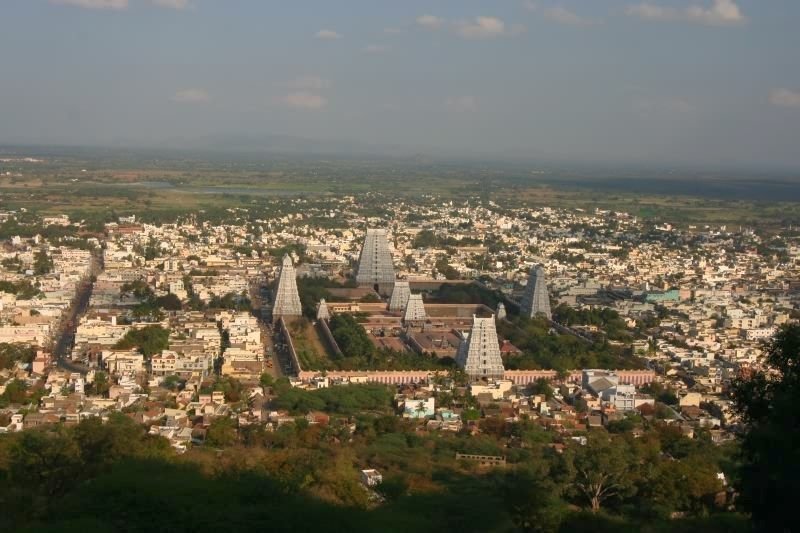
Temples in
Tamil Nadu are universally
famous for their architectural
beauty and height of their
Temple Towers, heights which
are intended to be and are
usually seen from kilometres
around, from streets and lanes
of the cities where they are
situated, from the suburbs
thereto, and from a ring of
villages and hamlets, in a
circle of several kilometres
diameter round the site of the
Temple.

Arunachaleswarar
Temple, Tiruvannamalai
|
|
The ground plans of Temples in
Tamil Nadu, is not left to the
vagaries of an architect or
benefactor, but is governed by
rules laid down in the Agamas
- scriptures parallel to the
four Vedas.
In the Sivapuranam of
Manikkavacakar's
Keerththithiruvahaval, he
sings:
"Hallowed be the feet of
Him who never departs from
my heart even for as long as
it takes to wink."
"You took my body as Your
abode," and
"My mind itself You took as
Your Temple."
To saints and the pious, the
abode of God is his own body,
his mind, his heart. This
faith has been extended to the
ground plan of the Temples of
the great sages who wrote the
Agamas. The human body has,
according to the seers and
savants, seven centres, seven
seats or seven stations
(chakras), one of which is the
normal habitat of a latent
spiritual force conceived as a
coiled serpent called the
Kundalini, and which, with
spiritual awakening, uncoils
itself and rises, passing
through the various stations,
to the topmost station, the
sahasrara.
These stations
are called:
1. Muladhara
2. Svadhisthana
3. Manipura
4. Anahata
5. Vishuddi
6. Ajna
7. Sahasrara
The sites of these seven
correspond to the sites of the
sacral plexus, the prostate
gland, the navel, the heart, the
larynx, the pituitary gland and
the pineal gland respectively.
The ground plan of a Temple
closely follows the ground plan
of a human body with these seven
sites. The diagram shows the
correspondence. The Tamilian,
therefore, when he worships God
externally in a Temple, worships
Him actually as enshrined in his
own body.
There is usually a tank in the
outer precincts of the Temple,
where the worshipper washes his
feet, hands, and face, and wears
the sacred ash on his forehead,
and other parts of his body -
sixteen places altogether in the
prescribed manner. These places
are the vertex, the forehead,
the chest, the navel, the two
knees, the two shoulders, the
two elbows, the two wrists, the
two sides of the thorax, back,
and nape of the neck. Such
wearing of the sacred ash
corresponds to donning an armour
with its several pieces such as
the helmet; visor, breast-plate,
cost of mail, epaulets,
elbow-pieces, wrist-guards,
knee-covers, neck-plate and so
on. Hence Manikkavacakar exhorts
the devotees to 'don the armour
of sacred ash.' This external
ablution stands for an internal
ablution, purifying the heart
and mind.
The Temple has usually five
prakarams i.e. courtyards
separated by high walls and
inter-connected by entrances,
four in number, on the East,
West, North and South in the
outermost wall, and only one on
each of the other walls, usually
on the eastern section thereof.
These five courtyards represent
the five sheaths of the human
body; the annamaya kosa (food
sheath), the pranamaya kosa
(breath sheath), the manomaya
kosa (mind sheath), the
vignaamaya kosa (intellect
sheath) and the anandamaya kosa
(bliss sheath).
The devotee crosses these
entrances to the innermost
court. This crossing represents
the control of the five senses.
At the flag post, he assumes a
firmness of faith, a
resoluteness of purpose, the
purpose of worshipping God with
one-pointed mind. At the
sacrificial altar, he sacrifices
his anava malam, the taint
of ignorance. He proceeds now to
worship God in the sanctum
sanctorum where the ever-burning
light represents the eternal
Effulgence.
Key to the Diagram
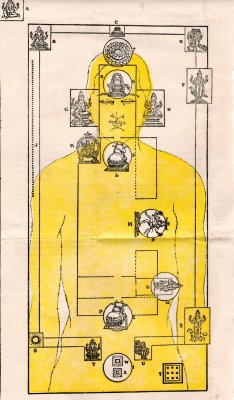
It will be seen that there are
seven white circles in the picture
of the human body. They are
numbered 1 to 7 beginning from the
foot of the diagram. They are the
six adharams or stations and the
thousand-petalled lotus. These
are:-
1. Muladhara
2. Svadhisthana
3. Manipura
4. Anahata
5. Vishuddi
6. Ajna
7. Sahasrara
The images have been designated
by capital letters. The key is
as follows:-
A. Shenbaga Vinayakar
B. Kanni Vinayakar
C. Iyyanaar
D. Aarrumukam
E. Shiva
F. Saneeswarar
G. Dakshinaamoorththi
H. Chandikeswarar
K. Utsavar
L. Vaahana-nandhi
M. Nataraajar
N. Ambikai
P. Athikaaranandhi
R. Vairavar
S. Sun
T. Ambala-Vinaayakar
U. Ambala-Shanmukar
W. Sacrificial Altar
X. Flag Staff
Y. Navagraham or the nine
planets
[Sri Ilanji A. Chokkalingam in
Aalayangalin Utporul Vilakkam]
To order a copy of this Book:
Alayangalin Utporul Vilakkam
Part 1 and Part 2
Please get in touch with Subbu
Email Address: yemsubbu@gmail.com
The South India Saiva Siddhantha
Works Publishing Society Ltd.,
522 TTK Road, Alwarpet, Chennai 18
(044) 32418129
|
|
|
|