The Lingams have the dominant Navagraha of the God to whom they are
associated. It is believed that placating a specific Lingam will bring
various benefits that are associated with the respective Navagraha.
As well as the Asta Lingams, there are two additional Lingams on the
girivalam roadway which according to the oral tradition of the region
are part of what is considered the "Dasa Lingams" (10 lingams) of
Arunachala.
Those two additional Lingams are Surya Lingam and Chandra Lingam.
Lord Surya
Surya, the Sun, is God incarnate in solar form, a glorious, shining
golden orb visible every day. He is Astamurthi, one of the eight forms
of Shiva. The Sun alone is the pivot of the entire Universe, the
dispeller of darkness, and root cause of the three worlds. He is the
deity of great brilliance and is considered the Supreme Soul. There are
many names of Lord Surya and each name refers to a particular quality of
consciousness - Aditya, Savita, Surya, Mihira, Arka, Prabhakara,
Martanda, Bhaskara, Bhanu, Chitrabhanu, Divakara and Ravi.
Surya is the chief of the Navagrahas and is often depicted riding a
chariot harnessed by seven horses which represent seven solar rays,
seven chakras of the body and seven days of the week.
Surya's sons, Shani and Yama are responsible for the judgment of human
life. Shani provides the results of one's deeds during life through
appropriate punishments and rewards while Yama grants the results of
one's deeds after death.
In Vedic astrology Surya is considered a malefic on account of His hot,
dry nature. Surya represents soul, will-power, fame, the eyes, general
vitality, courage, kingship, father, authority figures, benevolence,
generosity, grandeur, dignity and friendliness.
Surya has the following associations:
Animals: Deer, Tiger, Lion
Bird: Goose
Gem: Ruby
Metals: Copper and Gold
Direction: East
Food: Wheat
Sign: Leo
Day: Sunday
In Tantra yoga, Surya, the planetary deity of the Sun, represents the
Universal male principal, while Chandra, the Moon, represents the
Universal female or shakti principle. Surya is also associated with
Agni, the god of fire.
Lord Surya Arunachala Mythology
Fire or Agni is the fourth element of the Panchabhutas. The essential
character of Fire is to generate heat and according to Hindu Mythology,
Agni is one of the Eight Guardians that guard our Universe known as
Asta-dik-palakas.
In Indian mythology there are mentions of various types of fires. The
four important ones are fire of the earth, fire of the sky, fire of the
stomach (can mean hunger or digestive power) and the fire we commonly
use.
There is a wealth of mythology attached to Arunachala connected to its
association with fire and what is related to fire i.e. light and the
sun.
One such legend is in which Lord Surya estranged from his wife Chayadevi visits Arunachaleswarar Temple to propitiate the Lord.
The legend goes like this:
Named Gnayiru after the Sun God, the village (which is on the way to
Chennai) has numerous legends, one of which is connected with
Tiruvannamalai. The God Surya (who was estranged from his wife
Chayadevi) came to propitiate the Lord at Arunachaleswarar Temple. While
circumambulating the shrine he saw a light which fell on him by way of
blessings and then moved away. Intrigued, he followed the light till it
reached the village of Gnayiru where it fell on a Linga and vanished.
Surya was pleased for receiving the God Shiva's (Lord Pushparatheshwara)
Blessings in this way. Surya then returned to his wife.

Pushparatheshwara Temple
Since the Sun God is said to have bathed in a pond in the Temple
vicinity, it became known as Surya Theertham - there is also a Surya
Shrine inside the Temple. People visit Pushparatheshwara Temple in the
hope that they will be cured of eye-related disorders and ailments,
relief of pains and also in order that the Lord may shower prosperity on
them.
Another legend explaining the history of Pushparatheshwara Temple tells
of a king and ardent devotee of Shiva, who during his travels went
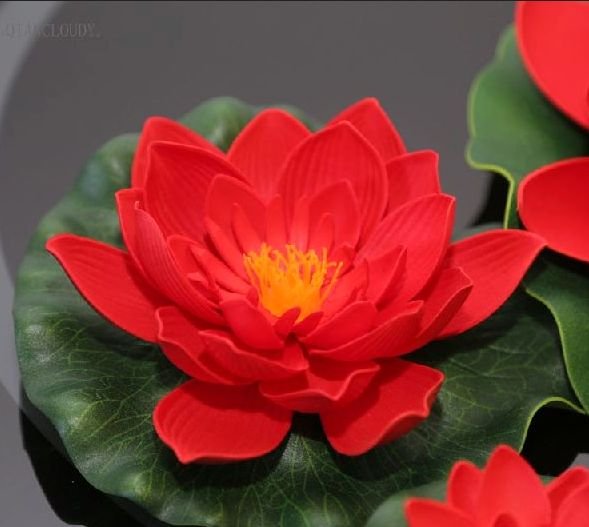
looking for red lotuses to propitiate the God. The king found a pond of red lotuses in
the village of Gnayiru and struck by the beauty of one of the flowers
went into the pond to pluck it.
But the closer he got to the flower the farther it moved away.
Frustrated with his attempts to pluck it, he threw his sword at the
flower. The sword found its mark on a Shiva Linga which was being
guarded by the lotus. Blood started spurting from the Linga and the
whole pond turned red. There was a blinding light and noise. Witnessing
this spectacle, the king turned blind. His horse ran amuck.
The king repented his action and prayed to Lord Shiva, who returned his
eyesight and instructed the king to build a Temple on the bank of the
lotus pond.
A different story tells that Surya (the Sun) cursed by Lord Brahma,
comes to Earth looking for a place to pray to Lord Siva. He chanced upon
a beautiful pond, filled with huge lotuses, some of which even had
1,000 petals. Fascinated, Surya ventured into the water to offer his
prayers. Touched by Surya's devotion, Lord Siva appeared as a Lingam on
one of the lotuses and cured him. Filled with joy and gratitude Surya
built a temple for the Lingam, in Gnayiru (Sun) Village.
It is said that the village used to be home of Kanva Maharishi. At the
Temple there is also an altar for Sangili Nachiyar, the wife of Tamil
saint-poet Sundarar. Sage Agastiyar (author of Aditya Hridaya Stotram)
is reputed to have stayed at Sri Pushparatheswarar Temple.
The Skanda Purana, Part III is replete with mythology referencing the significance of Lord Surya (the sun) at Arunachala.
Sun God at Arunachala
On the advice of Brahma, Bhaskara (i.e. the Sun-God) who is a mass of
refulgence but who was harassed by Asuras, devoutly worshipped the Lord
of Arunachala.
After plunging into the sanctifying pure Tirtha created by Brahma, he circumambulated Arunachala, the Lord himself.
After gaining victory over all the Daityas and (the privilege of)
circumambulating Meru, he gained supreme refulgence that destroys the
brilliance of enemies.
[Skanda Purana (P), Chapter 6, Verses 32-34].
Aditya whose shape was formed by Tvastr blazed with brilliance. The Lord
of Planets attempted to cross Sonadri. The horses of his chariot lost
their power and became tired. Due to the refulgence of Sonadri he became
devoid of glory. Even with all the attempted motion of the possessor of
cluster of rays (i.e. Sun), he became unable to go to the heaven. On
the advice of Brahma he propitiated Arunachala. When the Lord was
pleased, he obtained the path of the sky and splendid horses.
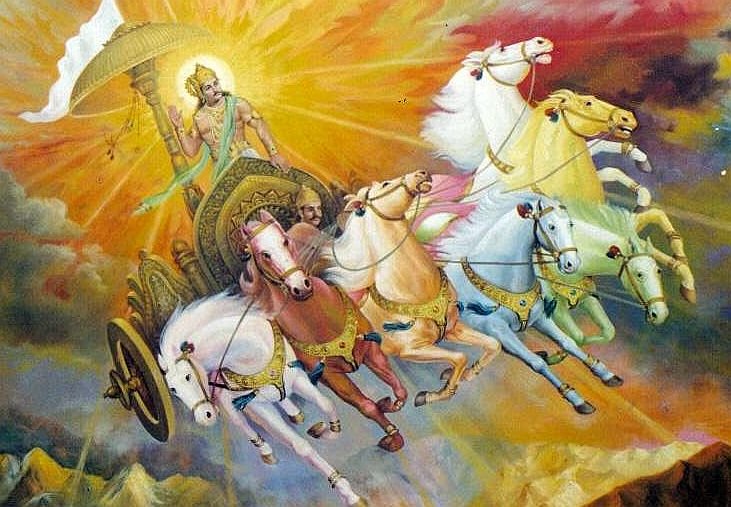
Ever since then the Sun never crosses the mountain named Sona but goes circumambulating him.
[Skanda Purana (P), Chapter 6, Verses 45-49a]
Sun God's Charioteer
When he obstructed the flow of water at the time of the gift of the
earth by Bali (to Vamana), Bhargava (i.e. Sukra) lost his eye on being
pricked with the top of Darbha grass held by Vishnu (i.e. Vamana). He
went to Sonachala and performed a very difficult penance. With his soul
purified, he regained his eye.
He (i.e. Aruna, Garuda's brother) was stationed on the mountain named
Bhaskara. By serving the Lord of Arunachala, he became the charioteer of
the Sun-God.
[Skanda Purana (P), Chapter 6, Verses 51b-53]
Circumambulation of Arunachala
One who circumambulates on Sunday becomes liberated. Piercing through the solar disc, he shall go to Siva's city.
[Skanda Purana (P), Chapter 9, Verses 57b-64a]
One shall attain innumerable benefits by circumambulating Sonagiri on
equinoctial days, days on which the Sun takes another transit, the
transit from one Zodiac to another, on Vyatipata days and other Parvan
days [Skanda Purana (U), Chapter 24, Verse 51]
Holy Rites for Special Attainments
If anyone worships the Lord of Sonadri on a Sunday with red lotuses, he will surely acquire great imperial magnificence.
[Skanda Purana (U), Chapter 7, Verse 1]
During the Solar and Lunar eclipses a devotee should piously bathe the
Lord with Pancantra repeating the five-syllable Mantra of Sonanatha.
During the two Ayanas (i.e. transits of the Sun) the deity should be
bathed with Pancagavya. The rite of bathing with Gavya shall be
performed along with the recitation of the six-syllabled Mantra During
the two equinoxes the bathing rite of the Lord of Arunachala should be
devoutly performed with milk repeating Pranava (Om).
[Skanda Purana (U), Chapter 7, Verses 32-34]
Sri Siva said:
Ether, wind, fire, water, earth, the sun, the moon and Puman (man i.e.
Hotr) - these are my physical forms, and through these the Universe
consisting of mobile and immobile beings shines.
[Skanda Purana (U), Chapter 24, Verse 39]
Parvati's Devotion to Arunachaleswara
She herself installed a Linga of Sankara. Parvati worshipped it in accordance with the injunction laid down in the Agamas.
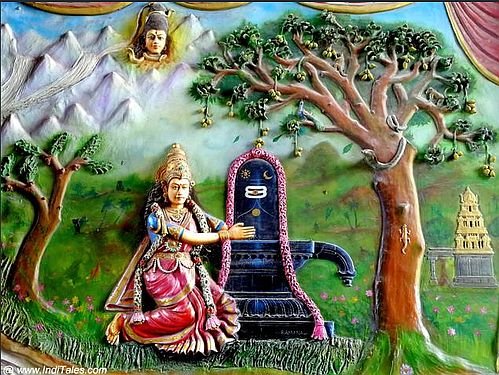
Parvati worships Lingam
She propitiated the Sun-god by offering seat, making idols and reciting
Mula Mantras. She performed the various ancillary rites. In the
different quarters she worshipped (the attendants) the chiefs of whom
were Dandin and Pingala, Saktis beginning with Dipta, the planets
beginning with the Moon in the different quarters. She showed the mystic
gestures of Dhenus (cows) etc. The Nirmalya (remnants of the worship)
was dedicated to the fierce splendour (of the Sun). She then offered the
foodstuffs prepared
. . . . Assuming the lotus-posture in her heart she worshipped Jnana
(knowledge), Dharma (Virtue) and others in due serial order. She
assigned Vama and other Saktis (power-deities) on the petals (of the
heart-lotus). The Sun and god Brahma were posted at the tip of the Petal
. . .
[Skanda Purana (U), Chapter 18, Verses 59-67]
Lord Surya Narrative - Deity of Sun and Light
Surya and Savitri are two names by which the Sun is commonly addressed
in Vedic hymns. Sometimes one name is used exclusively, sometimes they
are used interchangeably, and sometimes they are used as though they
represented quite distinct objects. It is supposed that Savitri refers
to the sun when invisible; whilst Surya refers to him when it is visible
to the worshippers.
Although the hymns in which Surya is addressed are not very numerous,
his worship was most common in the olden time, and has continued to the
present. It is to him that the Gayatri, the most sacred text of the
Vedas, is addressed at his rising by every devout Brahman. Simple in its
phraseology, this short verse is supposed to exert magical powers. It
is as follows:
Let us meditate on that excellent glory of the divine Vivifier;
May he enlighten (or stimulate) our understandings."
As a specimen of the language employed in some of the later writings in
reference to this verse, read the following few lines from the "Skanda
Purana".
"Nothing in the Vedas is superior to the Gayatri. No invocation is
equal to the Gayatri; as no city is equal to Kasi (Benares). The Gayatri
is the mother of the Vedas, and of Brahmans. By repeating it a man is
saved. By the power of the Gayatri the Kshetriya (Warrior caste)
Vishvamitra became a Brahmarsi (Brahman Saint), and even obtained such
power as to be able to create a new world. What is there indeed that
cannot be effected by the Gayatri? For the Gayatri is Vishnu, Brahma,
and Siva, and the three Vedas."
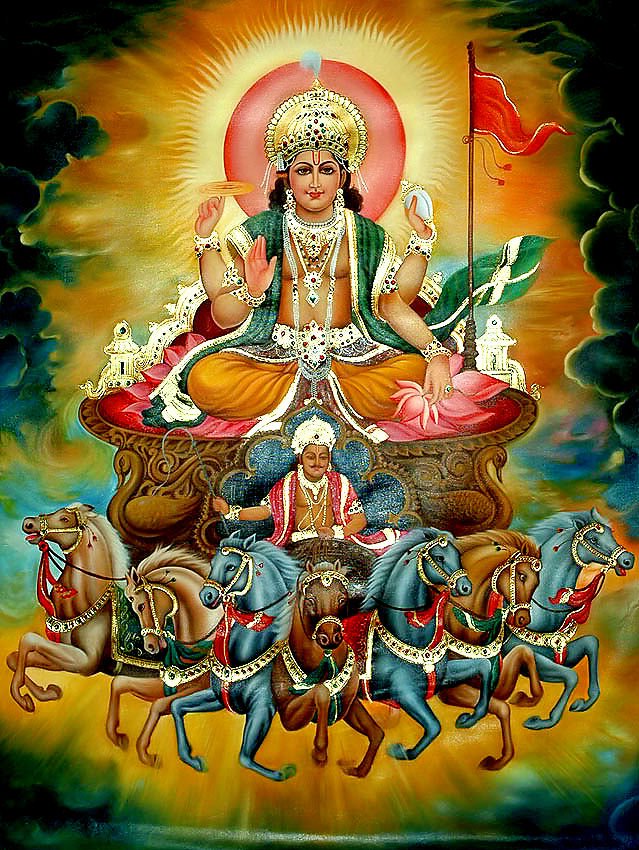
Lord Surya
The following translation of hymns from the RigVeda gives examples of addresses used to Surya:
"Behold the rays of Dawn, like heralds, lead on high
The Sun, that men may see the great all-knowing god.
The stars slink off like thieves, in company with Night,
Before the all-seeing eye, whose beams reveal his presence,
Gleaming like brilliant flames, to nation after nation.
With speed, beyond the ken of mortals, thou, O Sun
Dost ever travel on, conspicuous to all.
Thou dost create the light, and with it dost illume
The universe entire; thou risest in the sight
Of all the race of men, and all the host of heaven.
Light-giving Varuna! thy piercing glance dost scan!
In quick succession, all this stirring, active world,
And penetrateth too the broad ethereal space.
Measuring our days and nights, and spying out all creatures.
Surya with naming locks, clear-sighted god of day,
Thy seven ruddy mares bear on thy rushing car.
With these, thy self-yoked steeds, seven daughters of thy chariot
Onward thou dost advance. To thy refulgent orb
Beyond this lower gloom, and upward to the light
Would we ascend, O Sun! thou god among the gods."
Surya is regarded as a son of Aditi; at other times he is said to be a
son of Dyaus. Ushas (the Dawn) is called his wife, though in another
passage he is said to be produced by the Dawn. Some texts state that he
is the Vivifier of all things; whilst others state that he was formed
and made to shine by Indra, Soma, Agni, and others.
From the character ascribed to Savitri in some hymns, it seems more
natural to regard him as the sun shining in his strength, and Surya as
the sun when rising and setting. Savitri is golden-eyed, golden-handed,
golden-tongued. He rides in a chariot drawn by radiant, white-footed
steeds. He illuminates the earth; his golden arms stretched out to
bless, infusing energy into all creatures, reach to the utmost ends of
heaven. He is leader and king in heaven; the other gods follow him, and
he it is who gives them immortality. He is prayed to for deliverance
from sin, and to conduct the souls of the departed to the abode of the
righteous.
In the Puranic Age, Surya sustains quite a different character. He is
there called the son of Kasyapa and Aditi. He is described as a dark-red
man, with three eyes and four arms: in two hands are water-lilies; with
one he is bestowing a blessing, with the other he is encouraging his
worshippers. He sits upon a red lotus, and rays of glory issue from his
body. In addition to the daily worship that is offered him by Brahmans
in the repetition of the Gayatri, he is worshipped once a year by
Hindus, generally on the first Sunday in the month of Magh; and in
seasons of sickness it is no uncommon thing for some Hindus to employ a
Brahman to repeat verses in his honour, in the hope that thus
propitiated he will effect their recovery.
In the "Vishnu Purana" we find the following account of Surya. He
married Sangna, the daughter of Visvakarma; who, after bearing him three
children, was so oppressed with his brightness and glory that she was
compelled to leave him. Before her departure, she arranged with Chhaya
(Shadow) to take her place. For years Surya did not notice the change of
wife.
But one day, in a fit of anger, Chhaya pronounced a curse upon Yama
(Death), a child of Sangna's, which immediately took effect. As Surya
knew that no mother's curse could destroy her offspring, he looked into
the matter and discovered that this wife had forsaken him, leaving this
other woman in her place. Through the power of meditation, Surya found
Sangna in a forest in the form of a mare; and, in order that he might
again enjoy her society, he changed himself into a horse. After a few
years, growing tired of this arrangement, they returned in proper form
to their own dwelling. But in order that his presence might be bearable
to his wife, his father-in-law Visvakarma, who was the architect of the
gods, ground the Sun upon a stone, and by this means reduced his
brightness by one-eighth. The part thus ground from Surya produced the
discus of Vishnu, trident of Siva, lance of Kartikeya (the god of war),
and the weapons of Kubera (the god of riches).
The "Bhavishya Purana" says: "Because there is none greater than he
(i.e., Surya), nor has been, nor will be, therefore he is celebrated as
the supreme soul in all the Vedas." Again, "That which is the sun, and
thus called light or effulgent power, is adorable, and must be
worshipped by those who dread successive births and deaths, and who
eagerly desire beatitude." In the "Brahma Purana" there is a passage
in which the sun is alluded to under twelve names, with epithets
peculiar to each, as though they were twelve distinct sun-deities:
"The first form of the sun is Indra, the lord of the gods, and the
destroyer of their enemies; the second, Dhata, the creator of all
things; the third, Parjanya, residing in the clouds, and showering rain
on the earth from its beams; the fourth, Twasta, who dwells in all
corporeal forms; the fifth, Pushan, who gives nutriment to all beings;
the sixth, Aryama, who brings sacrifices to a successful conclusion; the
seventh derives his name from alms-giving, and delights mendicants with
gifts; the eighth is called Vivasvan, who ensures digestion; the ninth,
Vishnu, who constantly manifests himself for the destruction of the
enemies of the gods; the tenth, Ansuman, who preserves the vital organs
in a sound state; the eleventh, Varuna, who, residing in the waters,
vivifies the Universe; and the twelfth, Mitra, who dwells in the orb of
the moon, for the benefit of the three worlds. These are the twelve
splendours of the sun, the supreme spirit, who through them pervades the
universe, and irradiates the inmost souls of men."
Surya is said to have Aruna (Rosy), the Dawn, the son of Kasyapa and Kadru, as his charioteer.
According to the Ramayana, Sugriva [the king of the monkey-host which
assisted Rama in his great expedition to regain Sita (his wife)], was a
son of Surya by a monkey. In the Mahabharata, the hero Kama also was the
son of this deity; and when he was in the form of a horse, he became
father of the Asvins, and communicated the white Yajur-Veda.
When speaking of the planets, Surya is noticed again under the name of
Ravi. Among the many names and epithets by which this deity is known,
the following are the most common:-
Dinakara, "The Maker of the day."
Bhaskara, "The Creator of light"
Vivaswat, "The Radiant one."
Mihira, "He who waters the earth;" i.e., he draws up the moisture from the seas so that the clouds are formed.
Grahapati, "The Lord of the stars."
Karmasakshi, "The witness of (men's) works."
Martanda, " A descendant of Mritanda.
|
|