The Bet
By Anton P. Chekhov
| |
1.
It was a dark autumn night. The old banker was pacing from corner to
corner of his study, recalling to his mind the party he gave in the
autumn fifteen years before. There were many clever people at the party
and much interesting conversation. They talked among other things of
capital punishment. The guests, among them not a few scholars and
journalists, for the most part disapproved of capital punishment. They
found it obsolete as a means of punishment, unfitted to a Christian
State and immoral. Some of them thought that capital punishment should
be replaced universally by life-imprisonment.
"I don't agree with you," said the host. "I myself have experienced
neither capital punishment nor life-imprisonment, but if one may judge a
priori, then in my opinion capital punishment is more moral and more
humane than imprisonment. Execution kills instantly, life-imprisonment
kills by degrees. Who is the more humane executioner, one who kills you
in a few seconds or one who draws the life out of you incessantly, for
years?"
"They're both equally immoral," remarked one of the guests, "because
their purpose is the same, to take away life. The State is not God. It
has no right to take away that which it cannot give back, if it should
so desire."
Among the company was a lawyer, a young man of about twenty-five. On being asked his opinion, he said:
"Capital punishment and life-imprisonment are equally immoral; but if I
were offered the choice between them, I would certainly choose the
second. It's better to live somehow than not to live at all."
There ensued a lively discussion. The banker who was then younger and
more nervous suddenly lost his temper, banged his fist on the table, and
turning to the young lawyer, cried out:
"It's a lie. I bet you two millions you wouldn't stick in a cell even for five years."
"If you mean it seriously," replied the lawyer, "then I bet I'll stay not five but fifteen."
"Fifteen! Done!" cried the banker. "Gentlemen, I stake two millions."
"Agreed. You stake two millions, I my freedom," said the lawyer.
So this wild, ridiculous bet came to pass. The banker, who at that time
had too many millions to count, spoiled and capricious, was beside
himself with rapture. During supper he said to the lawyer jokingly:
"Come to your senses, young roan, before it's too late. Two millions are
nothing to me, but you stand to lose three or four of the best years of
your life. I say three or four, because you'll never stick it out any
longer. Don't forget either, you unhappy man, that voluntary is much
heavier than enforced imprisonment. The idea that you have the right to
free yourself at any moment will poison the whole of your life in the
cell. I pity you."
And now the banker, pacing from corner to corner, recalled all this and asked himself:
"Why did I make this bet? What's the good? The lawyer loses fifteen
years of his life and I throw away two millions. Will it convince people
that capital punishment is worse or better than imprisonment for life?
No, no! all stuff and rubbish. On my part, it was the caprice of a
well-fed man; on the lawyer's pure greed of gold."
He recollected further what happened after the evening party. It was
decided that the lawyer must undergo his imprisonment under the
strictest observation, in a garden wing of the banker's house. It was
agreed that during the period he would be deprived of the right to cross
the threshold, to see living people, to hear human voices, and to
receive letters and newspapers. He was permitted to have a musical
instrument, to read books, to write letters, to drink wine and smoke
tobacco. By the agreement he could communicate, but only in silence,
with the outside world through a little window specially constructed for
this purpose. Everything necessary, books, music, wine, he could
receive in any quantity by sending a note through the window. The
agreement provided for all the minutest details, which made the
confinement strictly solitary, and it obliged the lawyer to remain
exactly fifteen years from twelve o'clock of November 14th, 1870, to
twelve o'clock of November 14th, 1885. The least attempt on his part to
violate the conditions, to escape if only for two minutes before the
time freed the banker from the obligation to pay him the two millions.
During the first year of imprisonment, the lawyer, as far as it was
possible to judge from his short notes, suffered terribly from
loneliness and boredom. From his wing day and night came the sound of
the piano. He rejected wine and tobacco. "Wine," he wrote, "excites
desires, and desires are the chief foes of a prisoner; besides, nothing
is more boring than to drink good wine alone," and tobacco spoils the
air in his room. During the first year the lawyer was sent books of a
light character; novels with a complicated love interest, stories of
crime and fantasy, comedies, and so on.
In the second year the piano was heard no longer and the lawyer asked
only for classics. In the fifth year, music was heard again, and the
prisoner asked for wine. Those who watched him said that during the
whole of that year he was only eating, drinking, and lying on his bed.
He yawned often and talked angrily to himself. Books he did not read.
Sometimes at nights he would sit down to write. He would write for a
long time and tear it all up in the morning. More than once he was heard
to weep.
In the second half of the sixth year, the prisoner began zealously to
study languages, philosophy, and history. He fell on these subjects so
hungrily that the banker hardly had time to get books enough for him. In
the space of four years about six hundred volumes were bought at his
request. It was while that passion lasted that the banker received the
following letter from the prisoner: "My dear gaoler, I am writing these
lines in six languages. Show them to experts. Let them read them. If
they do not find one single mistake, I beg you to give orders to have a
gun fired off in the garden. By the noise I shall know that my efforts
have not been in vain. The geniuses of all ages and countries speak in
different languages; but in them all burns the same flame. Oh, if you
knew my heavenly happiness now that I can understand them!" The
prisoner's desire was fulfilled. Two shots were fired in the garden by
the banker's order.
Later on, after the tenth year, the lawyer sat immovable before his
table and read only the New Testament. The banker found it strange that a
man who in four years had mastered six hundred erudite volumes, should
have spent nearly a year in reading one book, easy to understand and by
no means thick. The New Testament was then replaced by the history of
religions and theology.
During the last two years of his confinement the prisoner read an
extraordinary amount, quite haphazard. Now he would apply himself to the
natural sciences, then he would read Byron or Shakespeare. Notes used
to come from him in which he asked to be sent at the same time a book on
chemistry, a text-book of medicine, a novel, and some treatise on
philosophy or theology. He read as though he were swimming in the sea
among broken pieces of wreckage, and in his desire to save his life was
eagerly grasping one piece after another.
2.
The banker recalled all this, and thought:
"To-morrow at twelve o'clock he receives his freedom. Under the
agreement, I shall have to pay him two millions. If I pay, it's all over
with me. I am ruined for ever."
Fifteen years before he had too many millions to count, but now he was
afraid to ask himself which he had more of, money or debts. Gambling on
the Stock-Exchange, risky speculation, and the recklessness of which he
could not rid himself even in old age, had gradually brought his
business to decay; and the fearless, self-confident, proud man of
business had become an ordinary banker, trembling at every rise and fall
in the market.
"That cursed bet," murmured the old man clutching his head in despair...
"Why didn't the man die? He's only forty years old. He will take away my
last farthing, marry, enjoy life, gamble on the Exchange, and I will
look on like an envious beggar and hear the same words from him every
day: 'I'm obliged to you for the happiness of my life. Let me help you.'
No, it's too much! The only escape from bankruptcy and disgrace - is that
the man should die."
The clock had just struck three. The banker was listening. In the house
every one was asleep, and one could hear only the frozen trees whining
outside the windows. Trying to make no sound, he took out of his safe
the key of the door which had not been opened for fifteen years, put on
his overcoat, and went out of the house. The garden was dark and cold.
It was raining. A damp, penetrating wind howled in the garden and gave
the trees no rest. Though he strained his eyes, the banker could see
neither the ground, nor the white statues, nor the garden wing, nor the
trees. Approaching the garden wing, he called the watchman twice. There
was no answer. Evidently the watchman had taken shelter from the bad
weather and was now asleep somewhere in the kitchen or the greenhouse.
"If I have the courage to fulfil my intention," thought the old man, "the suspicion will fall on the watchman first of all."
In the darkness he groped for the steps and the door and entered the
hall of the garden-wing, then poked his way into a narrow passage and
struck a match. Not a soul was there. Some one's bed, with no bedclothes
on it, stood there, and an iron stove loomed dark in the corner. The
seals on the door that led into the prisoner's room were unbroken.
When the match went out, the old man, trembling from agitation, peeped into the little window.
In the prisoner's room a candle was burning dimly. The prisoner himself
sat by the table. Only his back, the hair on his head and his hands were
visible. Open books were strewn about on the table, the two chairs, and
on the carpet near the table.
Five minutes passed and the prisoner never once stirred. Fifteen years'
confinement had taught him to sit motionless. The banker tapped on the
window with his finger, but the prisoner made no movement in reply. Then
the banker cautiously tore the seals from the door and put the key into
the lock. The rusty lock gave a hoarse groan and the door creaked. The
banker expected instantly to hear a cry of surprise and the sound of
steps. Three minutes passed and it was as quiet inside as it had been
before. He made up his mind to enter.
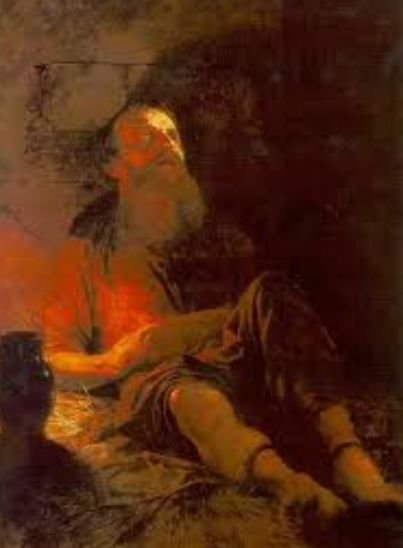
Before the table sat a man, unlike an ordinary human being. It was a
skeleton, with tight-drawn skin, with long curly hair like a woman's,
and a shaggy beard. The colour of his face was yellow, of an earthy
shade; the cheeks were sunken, the back long and narrow, and the hand
upon which he leaned his hairy head was so lean and skinny that it was
painful to look upon. His hair was already silvering with grey, and no
one who glanced at the senile emaciation of the face would have believed
that he was only forty years old. On the table, before his bended head,
lay a sheet of paper on which something was written in a tiny hand.
"Poor devil," thought the banker, "he's asleep and probably seeing
millions in his dreams. I have only to take and throw this half-dead
thing on the bed, smother him a moment with the pillow, and the most
careful examination will find no trace of unnatural death. But, first,
let us read what he has written here."
The banker took the sheet from the table and read:
"To-morrow at twelve o'clock midnight, I shall obtain my freedom and the
right to mix with people. But before I leave this room and see the sun I
think it necessary to say a few words to you. On my own clear
conscience and before God who sees me I declare to you that I despise
freedom, life, health, and all that your books call the blessings of the
world.
"For fifteen years I have diligently studied earthly life. True, I saw
neither the earth nor the people, but in your books I drank fragrant
wine, sang songs, hunted deer and wild boar in the forests, loved women...
And beautiful women, like clouds ethereal, created by the magic of your
poets' genius, visited me by night and whispered to me wonderful tales,
which made my head drunken. In your books I climbed the summits of
Elbruz and Mont Blanc and saw from there how the sun rose in the
morning, and in the evening suffused the sky, the ocean and lie mountain
ridges with a purple gold. I saw from there how above me lightnings
glimmered cleaving the clouds; I saw green forests, fields, rivers,
lakes, cities; I heard sirens singing, and the playing of the pipes of
Pan; I touched the wings of beautiful devils who came flying to me to
speak of God... In your books I cast myself into bottomless abysses,
worked miracles, burned cities to the ground, preached new religions,
conquered whole countries...
"Your books gave me wisdom. All that unwearying human thought created in
the centuries is compressed to a little lump in my skull. I know that I
am cleverer than you all.
"And I despise your books, despise all worldly blessings and wisdom.
Everything is void, frail, visionary and delusive as a mirage. Though
you be proud and wise and beautiful, yet will death wipe you from the
face of the earth like the mice underground; and your posterity, your
history, and the immortality of your men of genius will be as frozen
slag, burnt down together with the terrestrial globe.
"You are mad, and gone the wrong way. You take falsehood for truth and
ugliness for beauty. You would marvel if suddenly apple and orange trees
should bear frogs and lizards instead of fruit, and if roses should
begin to breathe the odour of a sweating horse. So do I marvel at you,
who have bartered heaven for earth. I do not want to understand you.
"That I may show you in deed my contempt for that by which you live, I
waive the two millions of which I once dreamed as of paradise, and which
I now despise. That I may deprive myself of my right to them, I shall
come out from here five minutes before the stipulated term, and thus
shall violate the agreement."
When he had read, the banker put the sheet on the table, kissed the head
of the strange man, and began to weep. He went out of the wing. Never
at any other time, not even after his terrible losses on the Exchange,
had he felt such contempt for himself as now. Coming home, he lay down
on his bed, but agitation and tears kept him a long time from sleeping...
The next morning the poor watchman came running to him and told him that
they had seen the man who lived in the wing climb through the window
into the garden. He had gone to the gate and disappeared. The banker
instantly went with his servants to the wing and established the escape
of his prisoner. To avoid unnecessary rumours he took the paper with the
renunciation from the table and, on his return, locked it in his safe.
|
|
|
|