Brunton: "What exactly is this Self of which you speak? If what you say is true there must be another Self in man."
Bhagavan: "Can a man be possessed of two identities, two selfs? To
understand this matter it is first necessary for a man to analyze
himself. Because it has long been his habit to think what others think,
he has never faced his 'I' himself. He has for too long identified with
the body and the brain. Therefore, I tell you to pursue the enquiry,
'Who am I?' You asked me to describe the true Self to you. What can be
said? It is that out of which the sense of the personal 'I' arises and
into which it will have to disappear."
Brunton: "Disappear? How can one lose the feeling of one's personality?"
Bhagavan: "The first and foremost of all thoughts, the primeval thought
of every man is the thought 'I'. It is only after the birth of this
thought that any other thoughts can arise at all. It is only after the
first personal pronoun has arisen in the mind that the second personal
pronoun 'you' can make its appearance. If you can mentally follow the
'I' thread until it leads you back to its source you will discover that
just as it is the first thought to appear so it is the last to
disappear. This is a matter which can be experienced."
Brunton: "You mean that it is possible to conduct such a mental investigation into one's self?"
Bhagavan: "Certainly it is possible to go inwards until the last
thought 'I' gradually vanishes." Another time, Brunton asks, "What path
do you advise? We need your grace."
Bhagavan: "Be still, do not think, and know that 'I AM'."
Brunton: "Should I meditate with eyes open or closed?
Bhagavan: "You can meditate with eyes open or shut whichever
suits you best. It differs with different people. Seeing is when the
mind looks through the eyes, but if it is not looking because it is
focused within, it does not see even if the eyes are open. It is the
same with sounds. If you pay attention to them you will hear them, but
if you persistently focus only on the Self within you will not hear
them. So too with the postures. Postures are immaterial for this path of
wisdom. Posture really means steadfast location in the Self. It is
internal. The best posture is to be in the Self."
Brunton: "Should we make effort?"
Bhagavan: "No one succeeds without effort. Mind control is not one's birthright. The successful few owe their success to perseverance.
When attention is directed towards objects and intellect, the mind is
aware only of these things. That is our present state of suffering. But,
when we attend to the Self within, we become conscious of it alone. It
is therefore all a matter of attention."
Brunton: "How should we meditate?"
Bhagavan: "All you need to learn is to close your eyes and turn inwards. That which you seek is inside yourself."
Brunton: "Is the thought 'I am God' helpful?"
Bhagavan: "'I AM' is God and not thinking. Realize 'I AM' and do
not think 'I AM'. Know it and do not think it. 'I AM THAT I AM' means
that one must abide as 'I'. One is always the 'I' alone and nothing
else."
At that time a pet squirrel was awaiting an opportunity to run out from
Bhagavan's sofa. Bhagavan caught it and said "All wish to run out and
rush out. There is no limit to going out. Happiness lies within and not
without."
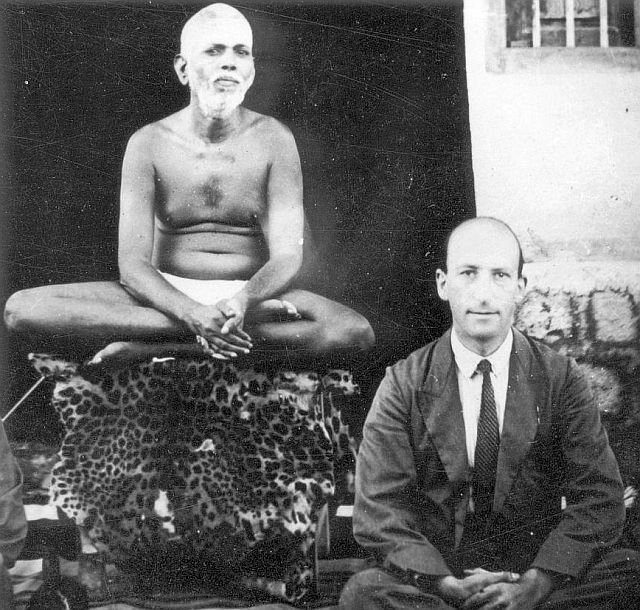
Paul Brunton with Ramana Maharshi
Maharshi on the True Self
Brunton: "Then you do not teach the way of Yoga?"
Maharshi: "The Yogi tries to drive his mind to
the goal, as a cowherd drives a bull with a stick, but on this path the
seeker coaxes the bull by holding out a handful of grass!"
Brunton: "How is that done?"
Maharshi: "You have to ask yourself the
question, Who am I? This investigation will lead in the end to the
discovery of something within you which is behind the mind. Solve that
great problem, and you will solve all other problems thereby."
"Will it be clearer if it is put in this way? All human beings are ever
wanting happiness, untainted with sorrow. They want to grasp a happiness
which will not come to an end. The instinct is a true one. But have you
ever been struck by the fact that they love their own selves most?"
"Now relate that to the fact that they are ever desirous of attaining
happiness through one means or another, through drink or through
religions, and you are provided with a clue to true real nature of man."
"Man's real nature is happiness. Happiness is inborn in the true self.
His search for happiness is an unconscious search for his true self. The
true self is imperishable; therefore, when a man finds it, he finds a
happiness which does not come to an end."
Brunton: "But the world is so unhappy?"
Maharshi: "Yes, but that is because the world
is ignorant of its true self. All men, without exception, are
consciously or unconsciously seeking for it."
Brunton: "Even the wicked, the brutal and the criminal?" I ask.
Maharshi: "Even they sin because they are
trying to find the self's happiness in every sin which they commit. This
striving is instinctive in man, but they do not know that they are
really seeking their true selves, and so they try these wicked ways
first as a means to happiness. Of course, they are wrong ways, for a
man's acts are reflected back to him."
Brunton: "What exactly is this self of which you speak? If what you say is true, then there must be another self in man."
Maharshi: "Can a man be possessed of two
identities, two selves?" he makes answer. "To understand this matter it
is first necessary for a man to analyse himself. Because it has long
been his habit to think as others think, he has never faced his 'I' in
the true manner. He has not a correct picture of himself he has too long
identified himself with the body and the brain. Therefore, I tell you
to pursue this enquiry, Who am I?"
"You ask me to describe this true self to you. What can be said? It is
That out of which the sense of the personal 'I' arises, and into which
it shall have to disappear."
Brunton: "Disappear?" I echo back. "How can one lose the feeling of one's personality?"
Maharshi: "The first and foremost of all
thoughts, the primeval thought in the mind of every man, is the thought
'I'. It is only after the birth of this thought that any other thoughts
can arise at all. It is only after the first personal pronoun 'I' has
arisen in the mind, that the second personal pronoun 'You' can make its
appearance. If you could mentally follow the 'I' thread until it leads
you back to its source, you would discover that, just as it is the first
thought to appear, so is it the last to disappear. This is a matter which can be experienced."
Brunton: "You mean that it is perfectly possible to conduct such a mental investigation into oneself?"
Maharshi: "Assuredly! It is possible to go inwards until the last thought 'I' gradually vanishes."
Brunton: "What is left?" I query. "Will a man then become quite unconscious, or will he become an idiot?"
Maharshi: "Not so! On the contrary, he will
attain that consciousness which is immortal, and he will become truly
wise, when he has awakened to his true self, which is the real nature of
man."
Brunton: "But surely the sense of 'I' must also pertain to that?" I persist.
Maharshi: "The sense of 'I' pertains to the
person, the body and brain," replies the Maharishee calmly. "When a man
knows his true self for the first time, something else arises from the
depths of his being and takes possession of him. That something is
behind the mind; it is infinite, divine, eternal. Some people call it
the kingdom of heaven, others call it the soul, still others name it
Nirvana, and we Hindus call it Liberation; you may give it what name you
wish. When this happens a man has not really lost himself; rather, he
has found himself."
"Unless and until a man embarks upon this quest of the true self, doubt
and uncertainty will follow his footsteps throughout his life. The
greatest kings and statesmen try to rule others, when in their heart of
hearts they know that they cannot rule themselves. Yet the greatest
power is at the command of the man who has penetrated to his inmost
depth. There are men of giant intellects who spend their lives gathering
knowledge about many things. Ask these men if they have solved the
mystery of man, if they have conquered themselves, and they will hang
their heads in shame. What is the use of knowing about everything else
when you do not yet know who you are? Men avoid this enquiry into the
true self, but what else is there so worthy to be undertaken?"
Brunton: "That is such a difficult, a superhuman task," I comment.
Maharshi: "The question of its possibility is a
matter of one's own experience. The difficulty is less real than you
think."
"The realisation of truth is the same for both Indians and
Europeans. Admittedly the way to it may be harder for those who are
engrossed in wordly life, but even then one can and must conquer. The
current induced during meditation can be kept up by habit, by practising
to do so. The one can perform his work and activities in that very
current itself; there will be no break. Thus, too, there will be no
difference between meditation and external activities. If you meditate
on this question, Who am I-if you begin to perceive that neither the
body nor the brain nor the desires are really you, then the very
attitude of enquiry will eventually draw the answer to you out of the
depths of your own being; it will come to you of its own accord as a
deep realization."
"Know the real self and then the truth will shine forth
within your heart like sunshine. The mind will become untroubled and
real happiness will flood it, for happiness and the true self are identical. You will have no more doubts once you attain this self-awareness."
Pursue the enquiry 'Who am I?" relentlessly
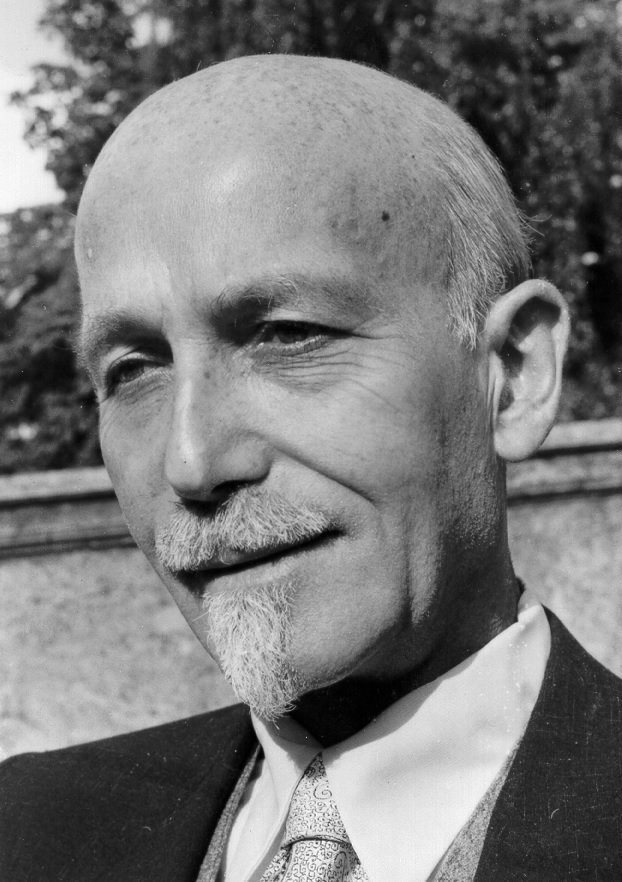
Brunton in later life
My meditations take the line he had indicated during my first visit,
when he had tantalized me by the vagueness which seemed to surround many
of his answers. I have begun to look into my own self.
Who am I?
Am I this body of flesh, blood and bone?
Am I the mind, the thoughts and the feelings which distinguish me from every other person?
One has hitherto naturally and unquestioningly accepted the affirmative
answers to these questions, but the Maharishee has warned me not to take
them for granted. Yet he has refused to formulate a systematic
teaching. The gist of his message is:
"Pursue the enquiry 'Who am I?" relentlessly. Analyse your entire
personality. Try to find out where the I-thought begins. Go on with your
meditations. Keep turning your attention within. One day the wheel of
thought will slow down and an intuition will mysteriously arise. Follow
that intuition, let your thinking stop, and it will eventually lead you
to the goal."
[Compilation from the teachings of Paul Brunton]
|
|