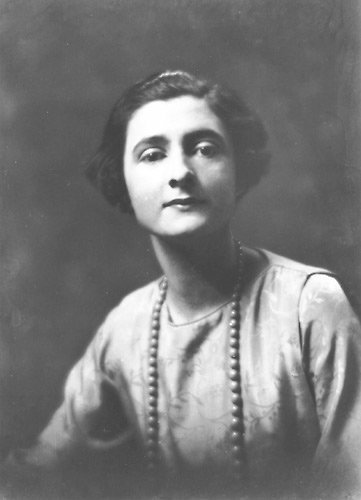
She had been described as "a woman of courtly manners, impeccable
decorative taste and great personal elegance... a woman with a
passionate and intense devotion to the art of living... and endowed with
a high spirit, energy, eclectic curiosity and a varied interest in the
arts."
In 1938, she met Hindu dancer Ram Gopal in Hollywood. They immediately
established a rapport and became close lifelong friends. In November
1938 they travelled to India to meet Ramana Maharishi and spent several
days at Tiruvannamalai. The below extract from her memoirs is about that
stay:-
Memoirs of Mercedes de Acosta
The book, "A Search in Secret India" by Paul Brunton had a profound
influence on me. In it I learned for the first time about Ramana
Maharshi, a great Indian saint and sage. It was as though some emanation
of this saint was projected out of the book to me. For days and nights
after reading about him I could not think of anything else. I became, as
it were, possessed by him. I could not even talk of anything else.
Nothing could distract me from the idea that I must go and meet this
saint. From this time on, although I ceased to speak too much about it,
the whole direction of my life turned toward India and away from
Hollywood. I felt that I would surely go there, although there was
nothing at this time to indicate that I would. Nevertheless, I felt I
would meet the Maharshi and that this meeting would be the greatest
experience of my life.
I had very little money, far too little to risk going
to India, but something pushed me towards it. I went to the steamship
company and booked myself one of the cheapest cabins on an Indian ship,
the S. S. Victoria, sailing from Genoa to Bombay toward the beginning of
October. In the meantime I flew to Dublin to see my sister.
In Madras I hired a car, and so anxious was I to arrive in
Tiruvannamalai that I did not go to bed and instead travelled through
the night, arriving about seven o'clock in the morning after driving
almost eleven hours. I was very tired as I got out of the car in a small
square in front of Arunachaleswarar Temple. The driver explained he
could take me no farther. I turned toward the hill of Arunachala and
hurried in the hot sun along the dust-covered road to the abode about
two miles from town to where the Sage dwelt. As I ran those two miles,
deeply within myself I knew that I was running toward the greatest
experience of my life.
When, dazed and filled with emotion, I first entered the hall, I did not
quite know what to do. Coming from strong sunlight into the somewhat
darkened hall, it was, at first, difficult to see; nevertheless, I
perceived Bhagavan at once, sitting in the Buddha posture on his couch
in the corner. At the same moment I felt overcome by some strong power
in the hall, as if an invisible wind was pushing violently against me.
For a moment I felt dizzy. Then I recovered myself.
I was able to look around the hall, but my gaze was drawn to Bhagavan,
who was sitting absolutely straight in the Buddha posture looking
directly in front of him. His eyes did not blink or in any way move.
Because they seemed so full of light I had the impression they were
gray. I learned later that they were brown, although there have been
various opinions as to the colour of his eyes. His body was naked except
for a loincloth. I discovered soon after, that this and his staff were
absolutely his only possessions. His body seemed firm and as if tanned
by the sun, although I found that the only exercise he ever took was a
twenty-minute walk every afternoon at five o'clock when he walked on the
hill and sometimes greeted yogis who came to prostrate themselves at
his feet.
He was a strict vegetarian, but he only ate what was placed before him
and he never expressed a desire for any kind of food. As he sat there he
seemed like a statue, and yet something extraordinary emanated from
him. I had a feeling that on some invisible level I was receiving
spiritual shocks from him, although his gaze was not directed toward me.
He did not seem to be looking at anything, and yet I felt he could see
and was conscious of the whole world.
After I had been sitting several hours in the hall listening to the
mantras of the Indians and the incessant droning of flies, and lost in a
sort of inner world . . . I moved near Bhagavan, sitting at his
feet and facing him. Not long after this Bhagavan opened his eyes. He
moved his head and looked directly down at me, his eyes looking into
mine. It would be impossible to describe this moment and I am not going
to attempt it. I can only say that at this second I felt my inner being
raised to a new level - as if, suddenly, my state of consciousness was
lifted to a much higher degree. Perhaps in this split second I was no
longer my human self but the Self. Then Bhagavan smiled at me. It seemed
to me that I had never before known what a smile was. I said, "I have
come a long way to see you."
"Tell me, whom shall I follow - what shall I follow? I have been
trying to find this out for years by seeking in religions, in
philosophies, in teachings." Again there was silence. After a few
minutes, which seemed to me a long time, he spoke.
"You are not telling the truth. You are just using words
- just talking. You know perfectly well whom to follow. Why do you need
me to confirm it?"
"You mean I should follow my inner self?" I asked.
"I don't know anything about your inner self. You should follow the Self. There is nothing or no one else to follow."
I asked again, "What about religions, teachers, gurus?"
"If they can help in the quest of the Self. But can they
help? Can religion, which teaches you to look outside yourself, which
promises a heaven and a reward outside yourself, can this help you? It
is only by diving deep into the spiritual Heart that one can find the
Self." He placed his right hand on his right breast and continued, "Here
lies the Heart, the dynamic, spiritual Heart. It is called Hridaya and
is located on the right side of the chest and is clearly visible to the
inner eye of an adept on the spiritual path. Through meditation you can
learn to find the Self in the cave of this Heart."
He said, "Find the Self in the real Heart."
Bhagavan pointed out to me that the real Self is timeless.
"But," he said, "in spite of ignorance, no man takes seriously the fact
of death. He may see death around him, but he still does not believe
that he will die. He believes, or rather, feels, in some strange way
that death is not for him. Only when the body is threatened does he fall
a victim to the fear of death. Every man believes himself to be
eternal, and this is actually the truth. This truth asserts itself in
spite of man's ignorant belief that the body is the Self."
I asked him how to pray for other people. He answered, "If you are
abiding within the Self, there are no other people. You and I are the
same. When I pray for you I pray for myself and when I pray for myself I
pray for you. Real prayer is to abide within the Self.
This is the meaning of Tat Twam Asi - That Thou Art. There can be no
separation in the Self. There is no need for prayer for yourself or any
person other than to abide within the Self."
I said, "Bhagavan, you say that I am to take up the search for the
Self by Atma Vichara, asking myself the question Who Am I? May I ask
who are you?" Bhagavan answered, "When you know the Self, the 'I' 'You'
'He' and 'She' disappear. They merge together in pure Consciousness."
I sat in the hall with Bhagavan three days and three nights.
Sometimes he spoke to me; other times he was silent and I did not
interrupt his silence. Often he was in samadhi. I wanted to stay on
there with him but finally he told me that I should go back to America.
He said, "There will be what will be called a 'war', but which, in
reality, will be a great world revolution. Every country and every
person will be touched by it. You must return to America. Your destiny
is not in India at this time." Before leaving the ashram, Bhagavan gave
me some verses he had selected from the Yoga Vasishta. He said they
contained the essence for the path of a pure life:-
Verses from the Yoga Vasishta
"Steady in the state of fullness, which shines when all desires
are given up, and peaceful in the state of freedom in life, act
playfully in the world, O Raghava!
Inwardly free from all desires, dispassionate and detached, but
outwardly active in all directions, act playfully in the world, O
Raghava!
Free from egoism, with mind detached as in sleep, pure like the sky, ever untainted, act playfully in the world, O Raghava!
Conducting yourself nobly with kindly tenderness, outwardly
conforming to conventions, but inwardly renouncing all, act playfully in
the world, O Raghava!
Quite unattached at heart but for all appearance acting as with
attachment, inwardly cool but outwardly full of fervour, act playfully
in the world, O Raghava!"
Ramana Maharshi's answers to questions
Through correspondence with a devotee at Tiruvannamalai, I was able
to put questions to Bhagavan and received the Maharshi's answers:-
Question: Why have we no memory of past lives?
Bhagavan: Memory is a faculty of the mind and
part of the illusion. Why do you want to remember other lives that are
also illusions? If you abide within the Self, there is no past or future
and not even a present since the Self is out of time - timeless.
Question: Are the world, the mind, ego and the body all the same thing?
Bhagavan: Yes. They are one and the same
thing. The mind and the ego are one thing, but there is no word to
explain this. You see, the world cannot exist without the mind, the mind
cannot exist without what we call the ego (itself, really) and the ego
cannot exist without a body.
Question: Does one who has realized the Self lose the sense of "I"?
Bhagavan: Absolutely.
Question: Then to you there is no difference
between yourself and myself, that man over there, my servant - are all
the same?
Bhagavan: All are the same, including those monkeys.
Question: But the monkeys are not people. Are they not different?
Bhagavan: They are exactly the same as people. All creatures are the same in One Consciousness.
Question: Do we lose our individuality when we merge into the Self?
Bhagavan: There is no individuality in the Self. The Self is One - Supreme.
Question: Then individuality and identity are lost?
Bhagavan: You don't retain them in deep sleep, do you?
Question: But we retain them from one birth to another, don't we?
Bhagavan: Oh, yes. The "I" thought (the ego) will
recur again, only each time you identify with it a different body and
different surroundings around the body. The effects of past acts (karma)
will continue to control the new body just as they did the old one. It
is karma that has given you this particular body and placed it in a
particular family, race, sex, surroundings and so forth.
"It is better just to meditate and have no thought. Let the mind rest
quietly on the Self in the cave of the Spiritual Heart. Soon this will
become natural and then there will be no need for questions. Do not
imagine that this means being inactive. Silence is the only real
activity."
Abridged Extract from Mercedes de Acosta Memoirs
[Source: Internet Library Archive]
|
|
|
|