
Annamalai Swami Life and Talks
Annamalai Swami Life with Ramana Maharshi
Annamalai Swami came to Bhagavan in 1928. After a brief spell working as
Bhagavan's attendant, he was given the responsibility of supervising
all building projects in the ashram. Between 1928 and 1938, working
directly under Bhagavan, he supervised the construction of the cowshed,
the Veda Patasala, the dining room, the storeroom, the old office block
(now used as the book-packing room), the dispensary and the large
revetment on the north side of the ashram
| |
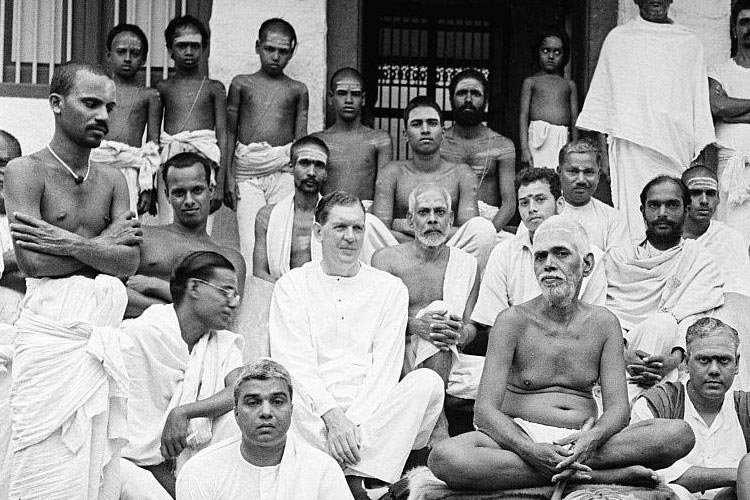
Annamalai standing at left of photo with arms crossed
In 1938 an experience he had with Bhagavan changed the course of his life:
"I went to Bhagavan's bathroom to help him with his morning bath.
Madhava Swami and I gave him the usual oil bath and massage. When the
bath was over, Madhava Swami asked a question: 'Bhagavan, the people who
take ganja lehiyam [an ayurvedic medicine whose principal ingredient is
cannabis] experience some kind of ananda. What is the nature of this
ananda? Is it the same ananda the scriptures speak of?'
Bhagavan replied, 'Eating this ganja is a very bad habit'. Then,
laughing loudly, he came over to me, hugged me and called out, 'Ananda!
Ananda! This is how these ganja-taking people behave!'
It was not a brief hug. Madhava Swami told me later
that he held me tightly for about two minutes. After the first few
seconds I completely lost all awareness of my body and the world.
Initially, there was a feeling of happiness and bliss, but this soon
gave way to a state in which there were no feelings and no experiences. I
did not lose consciousness, I just ceased to be aware of anything that
was going on around me. I remained in this state for about fifteen
minutes. When I recovered my usual world-consciousness, I was standing
alone in the bathroom. Madhava Swami and Bhagavan had long since
departed for breakfast. I had not seen them open the door and leave, nor
had I heard the breakfast bell.
This experience completely changed my life. As soon as I recovered
normal consciousness I knew that my working life at Sri Ramanasramam had
come to an end. I knew that henceforth I would be living outside the
ashram and spending most of my time in meditation." [Annamalai Swami
continued to help with ashram works whenever Bhagavan asked him to].
Bhagavan approved of his decision to leave, and. within a few hours of
having had the experience Annamalai Swami had established himself in
Palakottu, the sadhu colony which adjoined the ashram. Bhagavan
encouraged him to build a house there and even helped him by advising on
its design and construction. Annamalai Swami has lived there ever
since. In fact, he did not leave Tiruvannamalai, even for a single day,
since 1938.
Bhagavan told him to lead a quiet, reclusive life, and to meditate continuously on the Self. Taking this to be his Guru's upadesa,
he spent the succeeding years trying to stabilise in the experience of
the Self, a brief glimpse of which had been given him by Bhagavan during
their encounter in the bathroom. After many years of arduous and
unremitting effort, he says that he was able to stabilise himself in
Self-awareness to such an extent that the experience became continuous
and effortless.
In the last years of Annamalai Swami's life, many devotees started to
visit him, seeking spiritual guidance. Though he did not encourage
visitors, he was, health permitting, happy to see people who wanted to
talk about Bhagavan's teaching or the practice of meditation. The below
exchanges were recorded in 1987.
Talks with Annamalai Swami, 1987
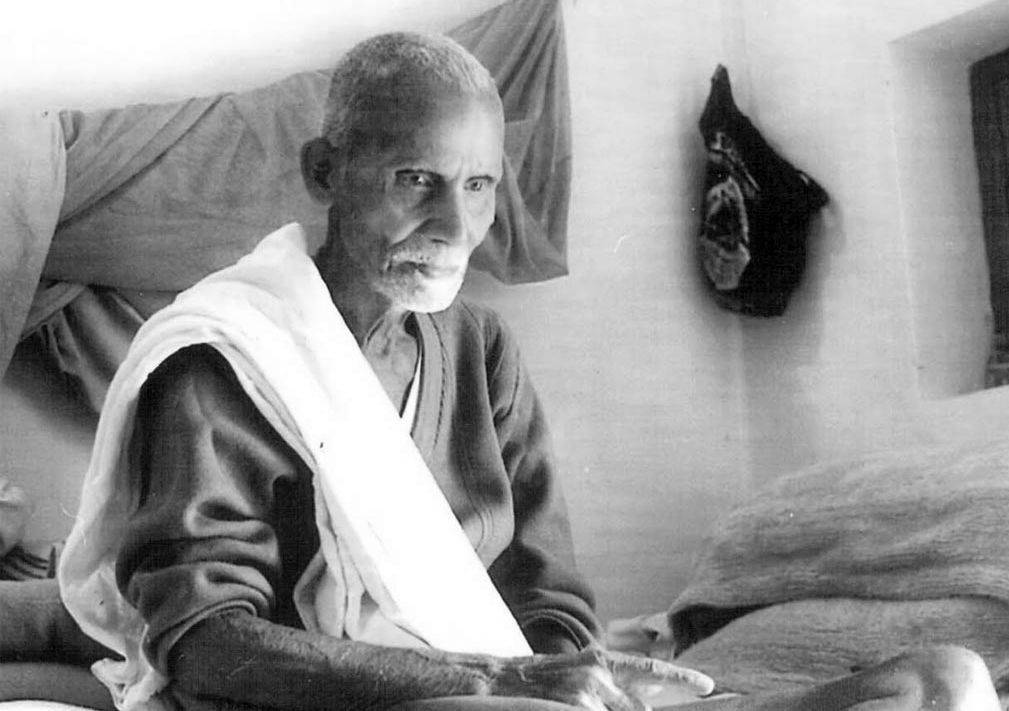
Giving talks at his Ashram
Question: What is the easiest way to be free of 'the little self'?
Annamalai Swami: Stop identifying with it. If you can convince yourself, 'This little self is not really me', it will just disappear.
Question: But how to do this?
Annamalai Swami: The 'little self' is something which only
appears to be real. If you understand that it has no real existence it
will disappear, leaving behind it the experience of the real and only
Self. Understand that it has no real existence and it will stop
troubling you.
Consciousness is universal. There is no limitation or 'little self' in
it. It is only when we identify ourselves with and limit ourselves to
the body and the mind that this false self is born. If, through enquiry,
you go to the source of this 'little self', you find that it dissolves
into nothingness.
Question: But I am very accustomed to feel 'I am this little
self'. I cannot break this habit merely by thinking 'I am not this
little self'.
Annamalai Swami: This 'little self' will only give way to the
real Self if you meditate constantly. You cannot wish it away with a few
stray thoughts. Try to remember the analogy of the rope which looks
like a snake in twilight. If you see the rope as a snake, the real
nature of the rope is hidden from you. If you only see the rope, the
snake is not there. Not only that, you know that there never was a snake
there. When you have that clear and correct perception that the snake
never at any time existed, the question of how to kill the snake
disappears. Apply this analogy to the 'little self' that you are
worrying about. If you can understand that this 'little self' never at
any time had any existence outside your imagination, you will not be
concerned about ways and means of getting rid of it.
Question: It is all very clear but I feel that I need some help. I am not sure that I can generate this understanding by myself.
Annamalai Swami: The desire for assistance is part of your
problem. Don't make the mistake of imagining that there is some goal to
be reached or attained. If you think like this you will start looking
for methods to practise and people to help you. This just perpetuates
the problem you are trying to end. Instead, cultivate the strong
awareness, 'I am the Self. I am That. I am Brahman. I am
everything.' You don't need any methods to get rid of the wrong ideas
you have about yourself. All you have to do is stop believing them. The
best way to do this is to replace them with ideas which more accurately
reflect the real state of affairs. If you think and meditate, 'I am the
Self', it will do you a lot more good than thinking, 'I am the little
self. How can I get rid of this little self?'
The Self is always attained, it is always realised. It is not something that you have to seek, reach or discover. Your vasanas
and all the wrong ideas you have about yourself are blocking and hiding
the experience of the real Self. If you don't identify with the wrong
ideas, your Self-nature will not be hidden from you.
You said that you needed help. If your desire to gain a proper
understanding of your real nature is intense enough, help will
automatically come. If you want to generate an awareness of your real
nature, you will be immeasurably helped by having contact with a jnani. The power and grace which a jnani
radiates quietens the mind and automatically eliminates the wrong ideas
you have about yourself. You can make progress by having satsang
of a realised Guru and by constant spiritual practice. But the Guru
cannot do everything for you. If you want to give up the limiting habits
of many lifetimes, you must practise constantly.
Most people take the appearance of the snake in the rope to be reality.
Acting on their misperceptions, they think up many different ways of
killing the snake. But they can never succeed in getting rid of the
snake until they first give up the idea that there really is a snake
there. People who want to kill or control the mind have the same
problem: they imagine that there is a mind which needs to be controlled
and then take drastic steps to beat it into submission. If, instead,
they generate the understanding that there is no such thing as mind, all
their problems would come to an end. You must generate the conviction,
'I am the all-pervasive consciousness in which all bodies and minds in
the world are appearing and disappearing. I am that consciousness which
remains unchanged and unaffected by these appearances and
disappearances.' Stabilise yourself in that conviction. That is all you
need to do.
Bhagavan sometimes told a story about a man who wanted to bury his
shadow in a pit. He dug the pit and stood in such a position that his
shadow was on the bottom of it. The man then tried to bury it by
covering it with earth. Each time he threw some soil in the hole, the
shadow appeared on top of it. Of course, he never succeeded in burying
the shadow. Many people behave like this when they meditate. They take
the mind to be real, try to fight it and kill it, and always fail. These
fights against the mind are all mental activities which strengthen the
mind instead of weakening it. If you want to get rid of the mind, all
you have to do is understand that it is 'not me'. Cultivate the
awareness 'I am the immanent consciousness'. When that understanding
becomes firm, the non-existent mind will not trouble you.
Question: I don't think that repeating 'I am not the mind, I am
consciousness' will ever convince me that I am not the mind. It will
just be another thought going on within the mind. If I could experience,
even for a moment, what it is like to be without the mind, the
conviction would automatically come. I think that one second of
experiencing consciousness as it really is would be more convincing than
several years of mental repetitions.
Annamalai Swami: Every time you go to sleep you have the
experience of being without a mind. You cannot deny that you exist while
you are asleep and you cannot deny that your mind is not functioning
while you are in dreamless sleep. This daily experience should convince
you that it is possible to continue your existence without a mind. Of
course, you do not have the experience of full consciousness while you
are asleep, but if you think about what happens during this state you
should come to understand that your existence, the continuity of your
being, is in no way dependent on your mind or your identification with
it. When the mind reappears every morning you instantly jump to the
conclusion, 'This is the real me.' If you reflect on this for some time
you will see how absurd it is. If what you really are only exists when
the mind is present, you have to accept that you didn't exist while you
were asleep. No one will accept such an absurd conclusion. If you
analyse your alternating states you will discover that it is your direct
experience that you exist whether you are awake or asleep. You will
also discover that the mind only becomes active while you are waking or
dreaming. From these simple daily experiences it should be easy to
understand that the mind is something that comes and goes. Your
existence is not wiped out each time the mind ceases to function. I am
not telling you some abstruse philosophical theory. I am telling you
something that you can validate by direct experience in any twenty-four
hour period of your life.
Take these facts, which you can discover by directly experiencing them,
and investigate them a little more. When the mind appears every morning,
don't jump to the usual conclusion, 'This is me. These thoughts are
mine.' Instead, watch these thoughts come and go without identifying
with them in any way. If you can resist the impulse to claim each and
every thought as your own, you will come to a startling conclusion: you
will discover that you are the consciousness in which the thoughts
appear and disappear. You will discover that this thing called 'mind'
only exists when thoughts are allowed to run free. Like the snake which
appears in the rope, you will discover that the mind is only an illusion
which appears through ignorance or misperception.
You want some experience that will convince you that what I am saying is
true. You can have that experience if you give up your life-long habit
of inventing an 'I' which claims all thoughts as 'mine'. Be conscious of
yourself as consciousness alone, watch all the thoughts come and go.
Come to the conclusion, by direct experience, that you are really
consciousness itself, not its ephemeral contents.
Clouds come and go in the sky, but the appearance and disappearance of
the clouds don't affect the sky. Your real nature is like the sky, like
space. Just remain like the sky and let thought-clouds come and go. If
you cultivate this attitude of indifference towards the mind, gradually
you will detach yourself from it.
Question: Bhagavan said that repeating 'I am the Self' is an aid to enquiry, but it does not constitute the enquiry itself.
Annamalai Swami: The meditation, 'I am not the body or the mind, I
am the immanent Self' is a great aid for as long as one is not able to
do self-enquiry properly or constantly. Bhagavan said, 'Keeping the mind
in the Heart is self-enquiry'. If you cannot do this by asking 'Who am
I?' or by taking the 'I'-thought back to its source, then meditation on
the awareness 'I am the all-pervasive Self' is a great aid.
Bhagavan often said that we should read and study the Ribhu Gita regularly. In the Ribhu Gita it is said, "That bhavana" I am not the body, I am not the mind, I am Brahman,
I am everything" is to be repeated again and again until this becomes
the natural state'. Bhagavan sat with us every day while we chanted
extracts from the Ribhu Gita which affirmed the reality of the
Self. It is true that he said that these repetitions are only an aid to
self-enquiry, but they are a very powerful aid.
By practising this way the mind becomes more and more attuned with the
reality, when the mind has become purified by this practice, it is
easier to take it back to its source and keep it there. When one is able
to abide in the Self directly, one doesn't need aids like this. But if
this is not possible, these practices can definitely help one.
Question: What is the correct way to pursue self-enquiry?
Annamalai Swami: Bhagavan has said, 'When thoughts arise, stop
them from developing by enquiring "To whom is this thought coming?" as
soon as the thought appears. What does it matter if many thoughts keep
coming up? Enquire into their origin or find out who has the thoughts
and sooner or later the flow of thoughts will stop.' This is how
self-enquiry should be practised.
When Bhagavan spoke like this he sometimes used the analogy of a
besieged fort. If one systematically closes off all entrances to such a
fort and then picks off the occupants one by one as they try to come
out, sooner or later the fort will be empty. Bhagavan said that we
should apply these same tactics to the mind. How to go about doing this?
Seal off the entrances and exits to the mind by not reacting to rising
thoughts or sense impressions. Don't let new ideas, judgements, likes,
dislikes, etc. enter the mind, and don't let rising thoughts flourish
and distract your attention. When you have sealed off the mind in this
way, challenge each emerging thought as it appears by asking, 'Where
have you come from?' or 'Who is the person who is having this thought?'
If you can do this continuously, with full attention, new thoughts will
appear momentarily and then disappear. If you can maintain the siege for
long enough, a time will come when no more thoughts arise; or if they
do, they will only be fleeting, undistracting images on the periphery of
consciousness. In that thought-free state you will begin to experience
yourself as consciousness, not as mind or body.
However, if you relax your vigilance, even for a few seconds, and allow
new thoughts to escape and develop unchallenged, the siege will be
lifted and the mind will regain some or all of its former strength.
In a real fort the occupants need a continuous supply of food and water
to hold out during a siege. When the supplies run out, the occupants
must surrender or die. In the fort of the mind, the occupants, which are
thoughts, need a thinker to pay attention to them and indulge in them.
If the thinker withholds his attention from rising thoughts, or
challenges them before they have a chance to develop, the thoughts will
all die of starvation. You must challenge them by repeatedly asking,
'Who am I? Who is this person who is having these thoughts?' If the
challenge is to be effective you must make it before the rising thought
has had a chance to develop into a stream of thoughts.
Mind is only a collection of thoughts and the thinker who thinks them.
The thinker is the 'I'-thought, the primal thought which rises from the
Self before all others and says, 'I am this body'. When you have
eradicated all thoughts except for the thinker himself by ceaseless
enquiry or by refusing to give them any attention, the 'I'-thought sinks
into the Heart and surrenders, leaving behind it only an awareness of
consciousness. This surrender will only take place when the 'I'-thought
has ceased to identify with rising thoughts. While there are still stray
thoughts which attract you or evade your attention, the 'I'-thought
will always be directing its attention outwards rather than inwards. The
purpose of self-enquiry is to make the 'I'-thought move inwards,
towards the Self. This will happen automatically as soon as you cease to
be interested in any of your thoughts.
Question: Many people find self-enquiry very difficult. Even most
of Bhagavan's devotees seem to follow a bhakti path. If one cannot do
enquiry successfully, should one first purify the mind with japa?
Annamalai Swami: No. If you have some interest in the path
of self-enquiry, you should follow it even if you feel that you are not
very good at it. If you want to do self-enquiry effectively and properly
you should stick to that method alone. Other methods may be good in
their own right, but they are not good as preparations for self-enquiry.
If you are serious about becoming a good violin player, you take
lessons from a good teacher and practise as much as you can. If you
encounter some difficulties, you don't switch to the clarinet for a few
months. You stay with your chosen instrument and you keep practising
until you get it right. The best preparation for self-enquiry is
self-enquiry.
Question: Going back to your advice to think 'I am the Self': we
are accustomed to make distinctions between things. You say, 'Meditate
that you are the Self'. If I try to generate this feeling, 'I am the
Self, it will not be the real thing; it will just be another idea in the
mind. Can thinking about this idea really help me?
Annamalai Swami: When I say, 'Meditate on the Self, I am asking
you to be the Self, not think about it. Be aware of what remains when
thoughts stop. Be aware of the consciousness that is the origin of all
your thoughts. Be that consciousness. Feel that that is what you really
are. If you do this, you are meditating on the Self. But if you cannot
stabilise in that consciousness because your vasanas are too
strong and too active, it is beneficial to hold on to the thought 'I am
the Self'. If you meditate in this way, you are not cooperating with
your vasanas, the ones that are blocking your Self-awareness. If you don't cooperate with your vasanas, sooner or later they are bound to leave you.
Question: When I read the Ramanasramam literature, Bhagavan often
appears to be very strict and stern. Was Bhagavan as kind to you as you
have been to us?
Annamalai Swami: Different people elicited different responses
from him. In my case he was always kind and considerate. But you should
not judge Bhagavan by his behaviour. If he got angry with people or
ignored them, it was always for their own good. He was transmitting
grace through his anger as well as through his kindness.
Question: Bhagavan's body has gone now. I know intellectually
that he is the Self and that he is everywhere but I still sometimes wish
that I could have had the good fortune of sitting in his physical
presence. I know that the body is ultimately not important, but I would
feel so happy and secure if I knew that I could go and talk or just sit
with Bhagavan every time I had a problem.
Annamalai Swami: Everything you see is Bhagavan's body. The
guiding presence that you desire is shining through all these forms and
animating them. Don't be attached to Bhagavan's form or body. The real
Bhagavan is beyond form and beyond death.
Though water flows through the mouth of a stone tiger statue, everyone
knows that it is not coming from the tiger. We all know that it is
coming from the reservoir. Similarly, Bhagavan now speaks through
everyone who knows and experiences him as he really is.
Question: You often say that satsang is important. Can I have
satsang of Bhagavan even though he is now dead? I am asking this because
I once had a very powerful experience of his presence while I was in
Switzerland. At that time Bhagavan had been dead for many years.
Annamalai Swami: Bhagavan is at all times and in all places.
Since he is the Self and not any particular form, it is of little
importance that the body which we took to be Bhagavan is now dead. Radio
waves can be received anywhere. If you tune yourself to Bhagavan's
frequency, which means abiding in the Self, you can be aware of him
broadcasting his grace wherever you are.
There is never any separation from Bhagavan. Every atom in the material
universe is Bhagavan. Every act which happens in the world is done by
Bhagavan alone. Every being, every form, is Bhagavan's form. When you
are clearly attuned to Bhagavan you will experience clarity and peace.
You will receive guidance wherever you are.
[Narrative from The Mountain Path, Aradhana Issue 1993]
|
|
|
|



