Sacred geometry may be understood as a world view
of pattern recognition, a complex system of hallowed attribution and
signification that may subsume religious and cultural values to the
fundamental structures and relationships of such complexes as space,
time and form. According to this discipline, the basic patterns of
existence are perceived as sacred: for by contemplating and communing
with them one is thereby contemplating the patterning relationships of
the Great Design. By studying the nature of these patterns, forms and
relationships and their connections, insight may be gained into the
mysteries - the laws and lore of the Universe.
Sacred geometry is the foundation of the design, architecture,
fabrication and construction of sacred structures such as temples,
mosques, megaliths, monuments and churches; sacred space such as altars,
temenos and tabernacles; places of congregation such as sacred groves,
village greens and holy wells and the creation of religious art,
iconography and divine proportionality. Sacred geometry, art,
iconography and architecture need not be monolithic and enduring, but
may be temporary and yielding, such as visualization and non-permanent
sand-painting and medicine wheels
| |

Tibetan Sand Painting
In sacred geometry, symbolic and sacred meanings are ascribed to certain
geometric shapes and certain geometric proportions. The basic belief is
that geometry and mathematical ratios, harmonics and proportion are
also found in music, light and cosmology. This value system is seen as
widespread even in prehistory, a cultural universal of the human
condition.
In the ancient world certain numbers had symbolic meaning, aside from
their ordinary use for counting or calculating . . . plane
figures, the polygons, triangles, squares, hexagons, and so forth, were
related to the numbers (three and the triangle, for example), were
thought of in a similar way, and in fact, carried even more emotional
value than the numbers themselves, because they were visual.
The study of sacred geometry has its roots in the study of nature, and the mathematical principles at work therein.

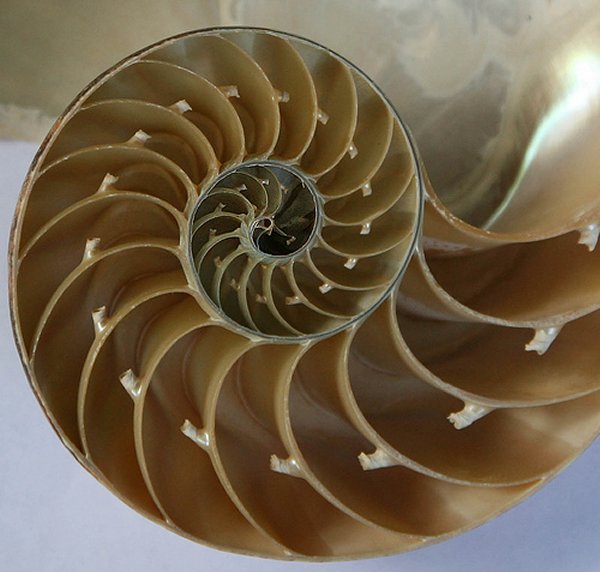
The Chambered Nautilus
Many forms observed in nature can be related to geometry, for example,
the chambered nautilus grows at a constant rate and so its shell forms a
logarithmic spiral to accommodate that growth without changing shape.

Honeycomb
Honeybees construct hexagonal cells to hold their honey.

Symmetry of the Passion Flower
The proportionately of sacred geometry is particularly evident in the construction of flowers.
Such correspondences as portrayed in the above examples as further evidence of the cosmic significance of geometric forms.
Geometric ratios, and geometric figures were often employed in the
design of Indian architecture and Indian spiritual communities often
constructed temples and fortifications on design plans of mandala and
yantra. The Sanskrit term mandala roughly translates to "magic circle"
or "sacred circle". Mandala, ancient and modern, frequently offer
beautiful examples of radial symmetry and contain elements of Sacred
Geometry.

Sri Yantra
Such forms are believed to act as activation templates of consciousness.
Modern psychologists are studying mandalas from a wide field of world
cultures and eras and advocate creating our own mandalas as vehicles of
soul work. It is believed that when we draw mandalas from the centre
outward, we are inspired to process our personal issues and daily
challenges which lead to our gaining increased clarity and energy in our
lives. Similarly we can be informed simply by gazing at such designs.
|
|
|
|