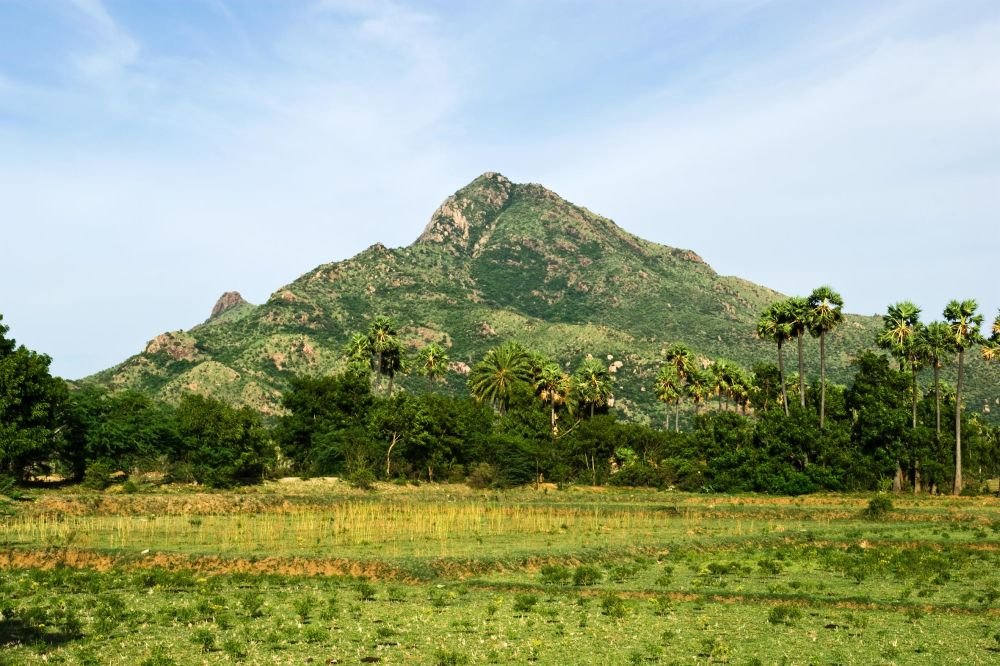
One of the thousand and eight names given to Arunachala by Adi Shankara is giripradakshinapriya – the Lord who loves giripradakshina.

|
|
'Be they of lowly birth, without the advantage of learning, unable to
practise the virtue of liberality, it is of no account. Those who
perform pradakshina of holy Aruna, the Supreme, submit to his rule and
become his devotee, will excel even amongst the most excellent . . .'
[Arunagiri Antadi]
At most holy places located on hills, the Deity is found at the top. But
here at Tiruvannamalai, the Hill itself is the Deity (Lord
Annamalaiyar) and one of the ways in which it is propiated and
worshipped is by its circumambulation. In Sanskrit this going around the
Hill is called 'giripradakshina' (giri = mountain and pradakshina:
Prada = giver of boons; Kshi = destroyer of Karma; Na = giver of Jnana.
Also, Pra-Dakshina = going around with centre kept to the right).
Pradakshina (the Hindu rite of going round the object of worship)
is "All is within me." The true significance of the act of going round
Arunachala is said to be as effective as circuit round the world. That
means that the whole world is condensed into this Hill. The circuit
round the temple of Arunachala is equally good; and self-circuit (i.e.
turning round and round) is as good as the last. So all are contained in
the Self. Says the Ribhu Gita: "I remain fixed, whereas
innumerable universes becoming concepts within my mind, rotate within
me. This meditation is the highest circuit (pradakshina).'
[Ramana Maharshi, Talks with Sri Ramana Maharshi]
In the Tamil language, this process of going around, is called 'giri
valam' (giri = mountain and valam = right side), inferring that one
should keep the Hill to the right when circumambulating.
The Arunachala Puranam declares that: 'the holy Arunachala is the primal, Adi linga. The path around its base is the sacred Yoni. Pradakshina of the Hill is therefore pradakshina of the source of all lingas! So one goes round keeping to the left-edge of the path. A mere step taken, confers the benefit of a Yaga, sacrifice; two steps, the fruit of Rajasuya Yaga; and three that of Asvamedha Yaga.
Going round the hill one gains in health and vigour. The hill abounds
in rare herbs sought by traditional herbalists and the breeze carries
the salubrious wafts from these siddha herbs to the one doing the
holy round. The dust from the feet of such a person, carried and
deposited in towns far away effects immeasurable purification.'
The circumambulation path is 14 kilometres (8½ miles).
Tradition has it that even today a number of siddhars are living on the
hill. There are eight lingams located at the eight directions, which
provides an octagonal structure to the town of Tiruvannamalai. The eight
lingams are: Indra Lingam, Agni Lingam, Yama Lingam, Niruthi Lingam,
Varuna Lingam, Vayu Lingam, Kubera Lingam and Esanya Lingam.

There are two pathways around the Hill, the outer pathway which is the
most commonly travelled and which contains Temples, the Asta Lingams,
Tirthams and Shrines.
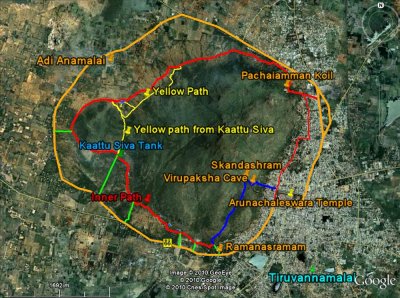
And the inner pathway which winds its way through the countryside at the feet of Arunachala.
According to scriptures, the walk around the Hill should be
conducted at a slow pace either in silence, reciting mantras or
chanting sacred songs. As to the ritual of the spiritual round; one
should abjure all thought of the opposite sex on the day of pradakshina.
After bathing one wears clean white clothes, applies vibhutti and
proceeds, giving alms but without accepting any. Free from fear, anger,
irritation or sorrow one walks on bare feet, without using vehicles or
carrying an umbrella. Without swinging one's arms about, and with a
silent soft tread, one saunters like a queen in her 'tenth-month'. One
bows, first to the holy Hill from each of the eight cardinal directions,
and then to the Lord of that direction enshrined in the linga there. One bows mentally to the incorporeal gods and siddhas
going the rounds and keeps to the side. One could keep silence of
speech and mind; or one could allow thoughts to flow on to the Hill of
Fire; or one could sing and listen to songs of devotional praise.
In the company of those of lofty character, one is able to
halt here and there and enjoy a feast of fruit and milk. Otherwise,
simple food free of flesh can be taken.
Certain days are
regarded as particularly auspicious for circumambulation The fruit of a Sunday pradakshina is Siva's abode (enter the solar region and attain Liberation); that of Monday is merger in Siva-form (live happily in a world free from senility and death); that of Tuesday is termination of debt and cyclic death (freed from all doubts and becomes Emperor); that of Wednesday is divinity through skill in philosophy and art (attain Wisdom and Omniscience); that of Thursday is lordship over gods and god-men (venerated by all Devas and may even become a renowned Guru); that of Friday is lordship of the Lotus Lady (may hope to reach Vishnu's abode). A Saturday pradakshina
confers the astronomical benefits of a nine-planet conjunction in the
Eleventh House (worldly success and protection against plantery
influences).
The above effects are magnified if circumambulation is done on Sivaratri,
New-year day, or during the three months, mid-October to mid-January.
The fruits are believed to increase by a factor of one crore if done on
the two solstices; or on the day the moon is in the Magha asterism
during February-March; or during the pre-dawn hour; or during solar
eclipse or Vidhipaada Yoga.
It is also regarded as particularly auspicious to perform
"Girivalam" during every Full moon day (poornima) to coincide with
siddars' movements, and the heady perfumes of herbal plants surrounding
the Hill.
Once a sadhu who went regularly around the Hill, requested
Sri Ramana for a Vedantic text. A devotee casually remarked, "He only
goes round the Hill. What will he do with any Vedantic text?" To which
Sri Ramana retorted, "What better sadhana can there be than going round
the Hill?"
Hindu mythology also explains the signficance of
circumambulation, in a narrative relating that the Goddess Parvati on
the advice of Sage Gautama circumambulated the Hill everyday in order to
have her desires fulfilled.

Another story says that Sage Durvasa, who cursed two vidyadharas
stated that, "The curse cannot be lifted by any act except that of
circumambulating the Arunachala Hill." He then proceeded to relate what
Siva Himself had declared in an assembly of devas and others: "He who
circumambulates with devotion the Arunachala Hill which is my form,
attains a form like mine. He becomes the Lord of the entire world and
reaches the highest state". The two vidyadharas then advised
King Vajrangada who was suffering, "The Lord of Aruna Hill is a
repository of compassion and His glory is great. Circumambulate the
Aruna Hill on foot as a means of release from suffering".
|
|
|
|