An Ancient Peace Chant
May the
Goddess Waters be auspicious
for us to drink. May they
flow, they flow, with
blessings upon us.
May the Earth be pleasant and
free of thorns as our place of
rest. May She grant us a wide
peace.
May the Divine Waters which
grant us blessings, may they
sustain us vigor and energy,
and for a great vision of
delight.
May we partake of that which
is their most auspicious
essence, as from loving
mothers.
May the Heaven grant us peace,
and the Atmosphere. May the
Earth grant us peace, and the
Waters. May the plants and the
great forest trees give us
their peace. May all the Devas
grant us peace; may Brahman
grant us peace. May the entire
Universe grant us peace. May
that supreme peace come to us.
May that peace dwell in me.
Take this firm resolve: May
all beings look at me with the
eyes of a friend. May I look
at all beings with the eyes of
a friend. May we all look at
each other with the eyes of a
friend.
[Shukla Yajur Veda (36.12-15,
17-18) translation by Vamadeva
Shastri]
This article "Our Sacred
Earth," by Mathew McDermott
originally appeared in an
online copy of Hinduism
Today. With
permission of the copyright
holders, the Himalayan
Academy, the
following article on Hinduism
and the Environment (with
accompanying photographs), is
reproduced below.
Hinduism and the Environment
[By Matthew McDermott]
Ishavasyam
idam sarvam - "This entire
Universe is to be looked upon as
the Lord." Shukla Yajur Veda,
Ishavasya Upanishad - 1
The above three words in
Sanskrit and eleven in English
express the essential Hindu
outlook on the world. It is a
reverential attitude towards all
of life, from the smallest
animal and tallest tree, to the
longest river and mightiest
mountain, and even the stars and
planets. Writing in Living with
Siva, Sivaya Subramuniyaswami
urges: "Let's worship the Earth.
It is a being - intelligent and
always giving. Our physical
bodies are sustained by her
abundance. When her abundance is
withdrawn, our physical bodies
are no more. The ecology of this
planet is an intricate
intelligence. Through sacrifice,
which results in tapas and
sadhana, we nurture Mother
Earth's goodwill, friendliness
and sustenance. Instill in
yourself appreciation,
recognition. We should not take
advantage of all this
generosity, as a predator does
of those he preys upon."
On the Abrahamic view of man and
world, Swami Dayananda Saraswati
shares, "If one believes that
God created the Earth with its
flora and fauna for human
consumption and pleasure, the
attitude cannot be expected to
be kind to nature."
A quick glance at the headlines
of the science and environment
section of any major news outlet
in the world today - let alone
specialist publications
dedicated to covering ecological
issues - shows that it is the
latter attitude and not the
classically expressed Hindu
viewpoint that holds sway in the
world today, no matter the
continent or nation. The Hindu
Declaration on Climate Change,
presented in December 2009 at
the Parliament of the World's
Religions in Australia,
expresses clearly the state of
affairs: "Our beloved Earth, so
touchingly looked upon as the
Universal Mother, has nurtured
mankind through millions of
years of growth and evolution.
Now centuries of rapacious
exploitation of the planet have
caught up with us, and a radical
change in our relationship with
nature is no longer an option.
It is a matter of survival. We
cannot continue to destroy
nature without also destroying
ourselves."
How far we have drifted from the
reverential sentiment expressed
in "My salutations to you, O
Bhudevi, consort of the
all-pervasive Lord, forgive me
for placing my feet upon you."
Ether, air, fire, water, earth,
planets, all creatures,
directions, trees and plants,
rivers and seas - they all are
organs of God's body.
Remembering this, a devotee
respects all species. Srimad
Bhagavata Mahapurana (2.2.41)
Wherever you look in Hindu
scripture, you find references
reinforcing the central pillar
of Hindu environmental thought:
All is God, all is Divine, all
is to be treated with reverence
and respect, all is sacred. As
O.P. Dwivedi points out, three
grand concepts build on this
truism: Vasudeva sarvam (the
Supreme resides in all beings);
Vasudhaiva kutumbakam (the
family of Mother Earth - the
original "global village"); and
Sarva bhuta hita (the welfare of
all beings - Hinduism and
Ecology). Add to those the law
of karma - by which the effects of
our deeds return to us - and you
have a deep repository of
ecological thought and practice.
At the highest level, there is
no distinction in composition
between the world we perceive
and the Divine. Rather than
being created out of a separate
substance, the Universe and
everything within it, the planet
we inhabit and everything upon
it, is emanated from the Divine.
The process of creation is
analogous to a spider creating
its web. The Mundaka Upanishad
states: "As a spider spins and
withdraws its web, as herbs grow
on the earth, as hair grows on
the head and body of a person,
so also from the Imperishable
arises this Universe" (1.1.7).
The Brihadaranayaka Upanishad
(2.5.1) speaks of creatures and
the creation: "This earth is
honey for all creatures, and all
creatures are honey for this
earth. This shining, immortal
person who is in this earth and
with reference to oneself, this
shining immortal person who is
in the body, he, indeed, is just
this self. This is immortal;
this is Brahman; this is all."
Nature's
new severity:
Deforestation in Nepalese
middle hills results in the
washing away of precious
topsoil during monsoons, river
silt-up and swollen rivers
carving greater swathes,
taking away valuable
agriculture land. Banks of
upper watersheds are breaking,
flooding lower areas.
Vasudeva Sarvam, Divinity in
All
The attitude
of Vasudeva sarvam bestows
reverence for all things. It
contrasts starkly with the
dominant outlook today, rooted
in scientific materialism and
dualistic Western metaphysics,
in which humans are separate
from nature and God is separate
from both. While Western
civilization considers human
life to be sacred, Hinduism
views all of life, all of
existence, as sacred. The
mainstream of the modern
environmental movement
recognizes the folly of taking
more from nature than can be
perpetually regenerated - but only
because the eventually resulting
ecosystem collapse would cause
harm to humans. In general, the
environmental movement stops
well short of recognizing
intrinsic value in what is
nonhuman. Frequently, it denies
the sacred altogether.
Vasudhaiva Kutumbakam, Global
Village
Once we
understand that everyone and
everything we see is an
expression and emanation of the
Divine, we naturally embrace the
globe as a village, Vasudhaiva
kutumbakam. As Dwivedi expresses
it, Mother Earth "supports us
with Her abundant endowments and
riches; it is She who nourishes
us; it is She who provides us
with a sustainable environment;
and it is She who, when angered
by the misdeeds of Her children,
punishes them with disasters."
Dwivedi's words are an apt
paraphrase of the Atharva Veda's
63-verse Bhumi Sukta, Hymn to
Earth, which focuses on nature
and the dependence of humans
upon Mother Earth, how She does
not discriminate between
species. To Her, all are
important.
Dwivedi highlights a prayer for
the preservation of the original
fragrance of the Earth so that
it can be sustained for future
generations, and another
specifying that when digging is
done in the Earth, it should be
done in a way that no serious
damage is done to Her body or
appearance. Each reinforces the
understanding that humans are
not separate from the
environment and have no
authority over it, other species
or other humans.
The modern scientific concept
expressed in the Gaia Theory - of
Earth being a giant,
self-regulating organism seeking
to create optimal conditions for
life - is not far removed from the
views expressed in the Prithivi
Sukta (another Vedic hymn to
Goddess Earth), even though the
modern theory makes no reference
to the Divine, or to conscious
causality or emotion in the
creation of natural disasters.
However, with a slight shift of
perspective, it is easy to see
the connection between the
challenges we are experiencing
(global warming and the ensuing
host of environmental changes)
and our misdeeds toward Mother
Earth. We have unbalanced the
atmosphere through excessive
greenhouse gas emissions and
wantonly destroyed precious
forests for logging and
conversion to agriculture. The
resulting upheavals can be
viewed as the manifestation of a
natural response, as the Earth
attempts to restore a more
natural order and thus protect
her many and varied forms of
life.
Sarva Bhuta Hita, Welfare of
All Beings
Once we
understand Mother Earth's
protection of life, we can
understand how humans should act
toward one another and all other
forms of life. Thus, we arrive
at Sarva bhuta hita, "enhancing
the common good of all beings."
When we know that all is sacred,
all is God, and we are all
children of Mother Earth, our
behavior and even our desires
change accordingly. We want to
enhance the common good and
balance our individual needs
with those of the extended
family of life. It becomes
natural to follow dharma. But
even then, it is not necessarily
easy to determine the best
course of action for supporting
the common good in specific
situations.
The
Impact of Automobiles:
Transportation is one of the
greediest energy consumers
and one of the largest
sources of greenhouse gas
and other air pollution. the
contribution of fossil
fuel-based transport to a
country's total emissions
varies from nation to
nation. In rich nations, and
increasingly in rapidly
expanding economies such as
China, India and Brazil,
motorized transport is one
of the most important areas
in which we can reduce our
environmental impact.
Powerful reductions can be
achieved through moving away
from the internal combustion
engine and toward
electric-powered transport
and increased bicycle usage,
along with greater public
transportation and
construction of more
walkable communities.
Karma
An
understanding of karma ties
together these three grand
concepts, informing us that our
current condition is the
combined product of our past
actions (in this life and
previous incarnations) and
actions that we take today. In
this way, we are constantly
creating our future, in the
months, years, decades and even
lifetimes to come. Clearly, our
actions also influence our
family and community, today and
into the future.
Consider climate change, one of
the most pressing environmental
issues of our time, as a lesson
in karma. How did we cause
greenhouse gas concentrations to
rise so high that they are
forcing myriad climatic changes?
Through well over a century of
burning fossil fuels, through
cutting down forests and through
increased raising of animals for
meat. Many of our parents,
grandparents and
great-grandparents (to a lesser
degree) all did this without
thought of the future
consequences. Indeed, it wasn't
until the last decades of the
20th century that we began to
recognize that there might be a
long-term problem with this
behavior. It's clear as day: we,
the human race, created the
threatening circumstances we and
future generations now face. Our
environmental karma is of our
own creation.
As a global civilization, we
continue the same practices
today, even though the negative
effects are becoming more and
more apparent by the month. In
some ways, it will be extremely
hard to stop our harmful
practices, not to mention
reversing the damage we have
already caused.
Who will suffer the worst of the
environmental problems we have
created? Certainly not our
parents. Even those of us who
are adults today may not bear
the brunt of them. It will be
our children, grandchildren and
great-grandchildren who suffer
the consequences.
Perhaps
It Is Possible to Bring
Forth a New Era
There is
the doctrine of the four
yugas. We are living in the
Kali Yuga, which started
around 3102 BCE. This is the
worst of all the four ages,
and things are going to go
downhill. However there is a
very important point which
is often overlooked. The
same texts that talk
about these ages, like the
Manusmriti, also say that
the king is the maker of the
age. That is, the sequence
of the ages can be reversed
by a political initiator, to
put it in modern idiom. This
is found in the Mahabharata
and in many scriptures from
ancient India in which the
king said that he
established the golden age
in this age of the Kali
Yuga. So here we have a very
clear provision of
intervention to prevent
environmental degradation,
especially by the state.
[Dr.
Arvind Sharma, Professor of
Comparative Religion at
McGill University, Montreal]
Supposing a forest at the
headwaters of a large river is
excessively cleared. The loggers
may accrue immediate economic
benefits, but over the years
great numbers of animals may die
due to habitat loss, and
disastrous flooding may result
as hillsides wash away and cause
blockages downstream. Similarly,
emissions of invisible
greenhouse gases create
atmospheric overload and
dangerous climatic changes
decades after the actions that
caused them. Such long-term
environmental changes, one
leading to another, cannot be
easily halted or reversed.
God is
Everywhere
Hindu
philosophy is based on the
truth that there is one
Supreme Power that is the
sustaining force of the
entire creation. Personal
transformation starts with
realisation of this Supreme
Power within one's own self.
The aspirant will then be
able to experience that
power all around him. Thus
he understands that this
power is universal, nondual,
indivisible and eternal. He
sees unity in diversity. He
will not see his fellow
human being as different
from him and so does not
fear. Such a person is full
of compassion and unlimited
love. He will work towards
peace and prosperity of not
only mankind but all of
nature. This is accomplished
only through faith and
surrender to that Supreme
Power and under the able
guidance of the spiritual
teacher who is an embodiment
of that power. Healing the
Earth is possible by
exchanging ideas and
restoring spiritual values.
Peace is much needed in
today's word. Unless each
individual changes his
behaviour and thinking of
his own progress and for the
world at large, peace cannot
be established.
[Yogini Sri Chandra
Kali Prasada Mataji, Sri
Kali Gardens Ashram, Andhra
Pradesh]
The Five Elements
In the Hindu
conception of the cosmos and the
environment, the five great
elements (pancha mahabhutas) are
central: space (akasha), air
(vayu), fire (agni), water
(apas) and earth (prithivi). All
emanate from prakriti (cosmic
matter). Though each element has
its own form and
characteristics, all are
interconnected and
interdependent. The Taittiriya
Upanishad tells us: "From
Brahman arises space, from space
arises air, from air arises
fire, from fire arises water,
and from water arises earth."
Akasha, space, is the most
subtle of the five, and there is
no place where it is not. Akasha
is not nothingness, like the
popular conceptions of outer
space; on the contrary, akasha
is absolute fullness. K.L.
Seshagiri Rao explains, "Akasha
represents openness, brightness,
expansiveness and the fullness
of blooming capacity."
Vayu, air, manifests on Earth as
the atmosphere, the protective
blanket of gases that surrounds
the planet, regulating
temperature and preventing
excessive solar radiation from
reaching Earth's surface. Air
connects and affects everything,
from animals breathing in and
out, to plants exchanging oxygen
for carbon dioxide. Weather,
which so defines daily life, is
a function of air in
collaboration with the other
elements. Even rocks are subject
to wind erosion.
Agni, fire,
has been worshiped since ancient
times. Fire purifies, fire
destroys, fire inspires. From
the Sun, to lightning, to fire
in its mundane and sacred forms,
agni brings warmth and
visibility to the world. The
Vedas sing its praises: "I
magnify the Lord (Agni), the
divine, the priest, minister of
the sacrifice, the offerer,
supreme giver of treasure. To
you, dispeller of the night, we
come with daily prayer, offering
to you our reverence" (Rig Veda
1.1.1&7).
Water, apas, is the source and
sustainer of life. Its immense
sacredness is rivalled only by
its practical value to human
agriculture, health, enjoyment
and the development of
civilization. In the form of
Earth's rivers, water is so vast
in its life-giving and
life-sustaining properties that
it is worshiped as the mother of
life, as Mother Ganga.
Stop
All Killing and Exploitation
Reverence is
the root of Hinduism,
reverence for all life.
People worship trees, they
worship mountains, they
worship the Universe, the
spiritual world. Now it is
all gone. Hinduism can save
the world from global
annihilation. Hinduism has
the potency and the power.
But today people don't pay
attention to our great ones.
It has
seemed to me that there can
be no peace on Earth, that
there can be no peace among
nations, until we stop all
killing. Stop all killing!
No sentient creature must be
killed. If I kill an animal
for food, I will not
hesitate to kill a fellow
human being whom I regard as
an enemy. Humanity will
learn one day that there is
no other way to peace than
vegetarianism. Life is a
gift of God.
Among
all the creatures, man is
the only one who has been
given the power to meddle
with the ecological balance.
Therefore, he has great
responsibility to see that
all types of life are
preserved. All life should
be regarded as sacred, for
there is but one life that
flows into all. This one
life sleeps in the mineral
and the stone. This one life
stirs in the vegetable and
the plant. This one life
dreams in the bird and the
animal. This one life is
awake in man.
[Dada
J.P. Vaswani, Sadhu Vaswani
Mission, Maharashtra]
Earth, the
densest of the five elements, is
the ground upon which life takes
place. It is the body of the
Divine, a living organism,
metaphysically, metaphorically
and biologically. Hindus have
cognized this for millennia,
knowing that all creatures are
intimately connected to the
Earth. Without its gifts we are
nothing. In the latter half of
the 20th century, modern science
has caught up with this truth,
conceiving of Earth as a
self-regulating organism called
Gaia, a name for which Dharani,
Bhudevi or Bhumi - Hindu names for
the Goddess - could easily be
substituted.
Though self-regulating and
dynamically interacting, the
five great elements of existence
can be pushed out of balance by
human action, creating
conditions inhospitable to life
in general. What are the
imbalances confronting the
Earth?
Akasha is being thrown out of
balance through excessive and
constant noise, as is found in
modern cities and towns with
never-ending motor vehicle
traffic, the hum of air
conditioners and computer
servers, blaring music,
omnipresent advertisements
appealing to the lower aspects
of our being, televisions and
video screens shoehorned into
every available space. Needless
to say, repose, reflection and
sattvic living become difficult
in such conditions.
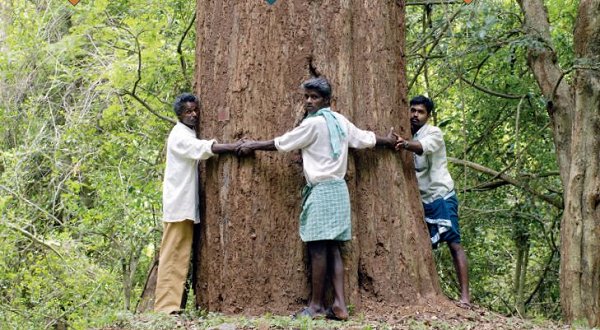
True
wealth: Men encircle an
endangered rosewood tree, the
largest in Yanaipallam, Tamil
Nadu.
Unbalanced
vayu is seen in air pollution,
especially over cities. This is
caused by industrial activity,
power generation from fossil
fuels, and the exhaust of
internal combustion engines.
Brown smog is the most visible
form of air pollution, but an
excess of greenhouse gases also
upsets vayu, causing climate
change, raising temperatures and
acidifying oceans. Any
disturbance to vayu can also
interfere with agni, as in its
solar form agni is the energy
which heats the air, powers the
water cycle, and helps enable
life to grow. Each of those
processes is affected by
pollution.
The element water has been
drastically disturbed by human
activity. We have dumped human
sewage and industrial effluent
into rivers and oceans; farmers
have irrigated so aggressively
that water tables have become
lowered, and have allowed runoff
of chemical fertilizers and
pesticides into streams; we have
built massive dams and diverted
entire rivers at the expense of
wildlife and the people who live
in the watersheds; and we have
disposed of non-biodegradable
trash and plastics in rivers,
ponds and wetlands. The same
activities that unbalance vayu
and agni, causing climate
change, also affect water,
causing ocean acidification,
coral bleaching and glacial
melting.
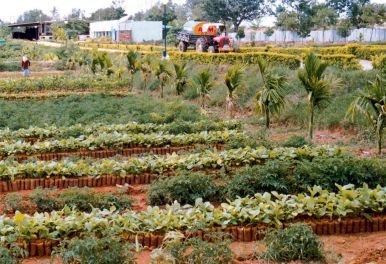
Thousands
of potted saplings being
propagated for the fifty
million tree project.
Fifty
Million Saplings
Mother Earth
is adorned with mountains,
hills, plains, heights,
slopes, forests, plants and
herbs. Strength-giving and
nourishing. She takes care
of every creature that
breathes. She gives shelter
to all who are seekers of
truth, who are tolerant and
have understanding.
Much
has been said about
protecting the environment,
but the common man must
understand how he can
contribute to this effort,
Protecting the environment
and making the world a
better place for all living
beings starts right from our
house. Plant trees.
His
Holiness Jagadguru Sir Sri
Sri Balagangadharanatha
Swamiji, 71st pontiff of Sri
Adichunchanagiri
Mahasamsthana Math, resolved
to maintain the ecological
balance by adorning Mother
Earth with a new patch of
green. In association with
the government of Karnataka,
Swamiji formed the Karnataka
Vanasamvardhana Trust with
the goal of planting five
crore saplings (50 million).
The project was completed in
2010 with the help of
several organisations.
Swamiji provided tree guards
to protect the plants and
supplied tractors to help
with the work. His message
is,
"Come,
let us join together in
protecting the environment;
each one of us is required
to contribute to reduce our
carbon footprint on this
Earth."
Earth
unbalanced is the most obvious.
Vast tracts of forest are
cleared for timber and
agriculture - often for industrial
monoculture farming or cattle
ranching. Mining for coal,
bauxite, gold and hundreds of
other minerals scars
mountainsides and removes
mountaintops. Human demand for
resources - extremely inequitable
between rich and poor nations - is
causing habitat loss and species
extinction at a level
unprecedented in the modern
history of the planet. Human
population is increasing at the
expense of virtually every other
species. To sustainably supply
our current levels of resource
consumption would require one
and one half planets. By 2030,
that increases to two planets.
We can hope that a new balance
will eventually be reached; but
the vast majority of climate
scientists say that in that new
balance, the Earth will be less
fertile than now. Earth has
undergone radical changes many
times. Ice ages come and go in
predictable cycles. Species are
decimated and new life emerges.
Temperatures oscillate, oceans
rise and fall. This is not the
first challenge to life Earth
has faced, but it is the first
in which we, the human race, are
playing a major role.
Treatment of Other Creatures
The Hindu
vision of existence and this
planet is replete with examples
of how consciousness permeates
everything, from the obvious and
animate (humans, animals,
plants) to the less obvious and
inanimate (rivers, stones,
mountains). No part of existence
is without the divine presence.
Nothing exists separate from
God. The practical manifestation
of this understanding is the
virtue of ahimsa, nonviolence in
thought, word and deed. Seeing
the presence of God in all life
and therefore not harming it is
the foundational ethic of Hindu
thought.
The Hindu reverence for the cow
epitomizes this respect for all
creatures. The cow symbolizes
all other animals and the Earth
itself. It is the nourisher,
ever-giving and undemanding,
representing life and the
sustenance of life. The cow is
generosity incarnate, taking
nothing but water and grass and
continuing to give and give
milk. It also symbolizes
dignity, strength, endurance,
maternity and selfless service.
The cow and her life-giving
gifts, foremost among them milk
and ghee, are essential in Hindu
worship. Through the labor of
the bull, where mechanized
agriculture is not the norm,
fields are plowed and grains and
vegetables are grown. Veneration
of the cow instills the virtues
of gentleness, receptivity and
connectedness with nature.
Protection of the cow is
important both ethically and
practically.
Mahatma Gandhi observed, "One
can measure the greatness of a
nation by the way it treats its
animals. Cow protection to me is
not mere protection of the cow.
It means protection of all that
lives and is helpless and weak
in the world. The cow means the
entire subhuman world."
We may question whether the
subhuman world is weak and
helpless. In many ways, it is
modern humans that are the
helpless ones, absent high
technology. But Gandhi's words
are profound at the core. The
way in which a people treats
animals - with respect and dignity
on one end of the spectrum, or
as commodities for human
ownership, use and disposal at
the other - says much about them
and likely indicates the way in
which they treat one another as
well.
A central part of treating
animals with respect is not
killing them for food. That
said, both traditional and
current Hindu teachings contain
various views on meat-eating.
Priests and religious leaders,
as well as those people pursuing
yoga and meditation, tend to be
vegetarian. On the other hand,
soldiers, police officers and
others whose duties require the
maintenance of aggressive
qualities generally eat meat.
Furthermore, many people may eat
primarily vegetarian diets out
of economic necessity as much as
ethical virtue, but will eat
meat on special occasions.
Swami Dayananda Saraswati cites
the Tirukural, saying, "Killing
animals and eating their flesh
is against all morality." Swami
Tyagananda of the Ramakrishna
Order offers, "In the tradition
I come from, we are not fanatic
about vegetarianism, but we
recognize that food that is
filled with sattva, which is
vegetarian food, can be helpful
in one's own spiritual
practice." Professor Arvind
Sharma reminds us that
historically Hinduism has been
more guarded than Jainism in
espousing strict vegetarianism:
"A passage in the Manusmriti
says there is nothing wrong with
eating meat or drinking wine,
but abstention therefrom is
highly meritorious. It's a
no-fault position; you can eat
meat, but it's better not to."
However, knowing what we do now
about the impact of a
meat-centric diet on the
environment - combined with modern
problems of hunger and land use,
plus deplorable modern methods
of raising livestock - the merits
of a vegetarian diet go far
beyond furthering an
individual's spiritual progress.
Adopting a vegetarian diet
benefits everyone and
everything. It dramatically
lowers one's environmental
impact, since raising animals
for food requires far more
resources, in terms of energy
and land, grow than growing
vegetables of the same caloric
value and nutritional content.
The modern industrial,
chemical-based farming methods
of growing grains and vegetables
are damaging to the environment,
but the factory farming of
animals is even more so. A study
carried out in the Netherlands
revealed that if enough meat
eaters adopted a vegetarian
diet, the costs of mitigating
the damages caused by climate
change would be reduced 70
percent by 2050. Even if large
numbers of people merely stopped
eating meat from ruminant
animals, the cost of combating
climate change would drop by 50
percent. For more information
about the Climate benefits of
changing diet go to this link here.
What Will it
Take to Avert Dire Climate
Change?
The
average per-capita carbon
footprint for people living in
the United States is
approximately 18 tons per
year, though it has fallen in
the past few years due to
recession. The average in
Europe is about half that,
with China coming in at about
6 tons. In India the number
drops to roughly two tons. If
the goal is to keep
temperature rise below two
degrees Celsius - the threshold
above which many dangerous
climatic change are said to
become unavoidable - and if we
accept that every human as the
right to similar levels of
development, then two tons is
roughly what each human being
needs to produce. In this one
statistic the enormity of
combating climate change
becomes clear.
In this
section of Brazil, cattle
farming has replaced the
tropical rainforest.
What Can We Do?
Humanity will
not make progress in resolving
the myriad environmental
problems we face without
dedicating time, effort and
willpower. Determined action is
needed on all levels: personal,
community and national. Even in
ancient times - when the world
population was much sparser than
today and our potential impact
was miniscule in
comparison - rulers and rishis
alike recognized that guidance
and regulation of human
activities was needed to protect
the environment.
Increasingly,
wind turbines offer an
alternate source of energy in
many regions of the world.
In numerous
places, the Vedas and other
scriptures encourage
environmental protection. "Do
not harm the environment; do not
harm the water and the flora;
Earth is my Mother, I am Her
son; may the waters remain
fresh, do not harm the waters. .
. . Tranquil be to the
atmosphere, to the earth, to the
waters, to the crops and
vegetation." The sacred law
books are even more specific,
for example: "Let him not
discharge urine or feces into
the water, nor saliva, nor
clothes defiled by impure
substances, nor any other
impurity, nor blood, nor
poisons" (Manu Samhita IV. 56).
Fines are specified for offenses
against the environment, such as
damaging trees. Professor Arvind
Sharma explains, "Harming a tree
was considered on par with
physical assault of a person. In
one verse Manu tells us how much
you have to compensate a person
you have physically injured. In
the next verse it says: 'For
injuring any kind of tree a fine
should be imposed proportionate
to its utility.'"
Hindu Virtues Versus
Consumerism
Hinduism's
numerous classic restraints
and practices, the yamas and
niyamas, offer lots of
practical guidance for those
wishing to minimize their
impact on the environment.
If we are to observe
non-stealing, asteya, we
cannot use natural resources
at unsustainable rates; when
we do so, we jeopardize the
life of future generations.
This is effectively a form
of stealing. If every human
on the planet consumed
resources at the level of
the United States, we would
need 45 earths to supply
everyone's needs. That
decreases slightly if
everyone lived like the
average European or Japanese
citizen, but still not to
ecologically sustainable
levels. To reach that point,
consumption like that of the
average Thai citizen, or
less, is required.
If
more people practiced,
santosha, contentment, we
would greatly reduce the
impact of consumerism on the
planet - from rising
greenhouse gas emissions, to
chemical pollution, e-waste
from countess short-lived
electronic products, and the
myriad consumer goods that
get used and thrown away
each year in the wealthy and
growing nations of the
world. Contentment involves
living in constant gratitude
for your health, your
friends and those belongings
which you do own, not
complaining about what you
don't possess, as well as
viewing every moment in life
as an opportunity for
spiritual growth and
development. All of this has
great positive environmental
impact. Being contented in
the moment, living in the
eternal now, insulates you
from consumerism, allowing
you to embrace a simple
life, caring for what you
have and living within your
means.
Three types
of forests were identified:
shivan, forests that provide
prosperity; tapovan, forests for
contemplation; mahavan, natural
forests where all species can
find shelter. Vedic scholar and
environmental campaigner Ranchor
Prime shares, "Once some of the
original forest was cleared . .
. Vedic culture required that
another kind of forest be
established in its place. To
completely remove the forest was
simply not acceptable. It was
the source of natural wealth,
such as fodder, timber, roots
and herbs. Moreover, the trees
guaranteed the fertility of the
soil and purified the air and
water."
In recent memory, and
historically, we have a number
of examples of communities and
individuals applying the
principles of good environmental
stewardship that are latent in
Hindu thought.
What Are the Greatest
Treasures?
Gold mining, like at this
site, is tearing up the
Brazilian rainforest and ruining
many of the sacred rivers,
inset, a devastating strip
mining operation in Colorado.
The Bishois,
founded by Guru Jambheshwar in
the 15th century, are sometimes
called the first
environmentalists of India.
Originally from the Marwar area
of Rajasthan, they now number
one million and live more widely
across India, practicing
environmental conservation,
protection of trees and animals
as part of daily religious duty.
Two of the sect's 29 injunctions
are directly concerned with
environmental protection:
1) Be compassionate to all living
beings, and
2) Don't cut green trees. Not
killing animals is a given.
Having
Concern for Others
The
approach that we should take
the maximum wealth available
to us from nature, be it oil
or metals, and that we
should maximize our power
with nuclear weapons - these
contribute to our global
problems. Our Hindu dharma
has given us certain
important values to
implement in our day-to-day
lives, including being
satisfied with whatever we
have. Learn to share, learn
to give first, and then
enjoy. This attitude will
bring about harmony in
society.
Hinduism
is a tradition which has
always cared for the growth
and religious sensitivities
of each and every
individual - not only cared
for but helped them equally
to grow individually. Today
the absence of this attitude
has created agitation and
given rise to crime and
imbalance in society. The
attitude that, "I shall grow
at the cost of others" is
considered improper in the
Hindu religion. It is a
great sin against ahimsa,
the principle of
nonviolence, to be
insensitive to the rights
and demands of others and to
afflict paint or hurt on
them - not only physically,
but by hurting their
religious sentiments, their
belief systems.
[Swami
Avdheshanand Giri, Juna
Peeth and Acharya Sabha,
Uttarakhand]
In the early
1970s, the Chipko movement took
to tree hugging to prevent
felling of forests in Chamoli
district, Uttarakhand. Women
from villages recognized that
economic and environmental
devastation would result from
the logging that had been
authorized by the Government
Department of Forests and staged
a direct action campaign to stop
it. One need not be part of a
spiritual community to uphold
environmental protection. There
is much that each of us can do,
if we observe the traditional
virtues with an environmental
focus and take to heart the
environmental themes in Hindu
scripture and the teachings of
Mahatma Gandhi.
Though Gandhi was not directly
concerned with the environment,
and still less with conservation
of nature, many of his teachings
have environmental implications.
In fact, his life and message
have been inspirational for
generations of environmental
writers and campaigners. His
concerns about
industrialization, about the
treatment of animals and the
virtues of vegetarianism, about
the importance of recycling,
about preserving and
strengthening local production
of goods, all have direct
applicability to today's
problems. His aphorism, "There's
enough in the world for
everyone's need but not
everybody's greed," is as vital
today as it was a hundred years
ago. Indeed, on the streets of
Copenhagen during the COP15 UN
climate change conference in
December 2009, campaigners
prominently passed out round
stickers displaying the words
"Need Not Greed" and the iconic
image of Gandhi, simply dressed,
walking staff in hand.
Central to applying that
aphorism are two ethics: sanyam
(restraint) and maryada
(limitation). As Professor
Arvind Sharma puts it, "You
refrain from drinking or eating
too much not because there are
laws against doing that, but out
of a sense of propriety and
decency." You practice restraint
and limitation not because you
are forced to, but because it's
part of your lifestyle.
Another key is the principle of
aparigraha, simplicity, which is
closely tied to santosha,
contentment. When we live every
day with a sense of gratitude
for our health, while seeking
serenity in life, it becomes
that much easier to live simply
and not identify with what we
have or don't have, what our
neighbors have that we don't, or
what is being advertised as the
key to happiness. Gandhi
advised, "Live simply, so others
may simply live."
Environmental
Protection As a Spiritual
Practice
Hinduism
sees the cosmos as pervaded
by the Divine. So, taking
care of the Universe is the
same as worshiping the
Divine. Environmental
protection, preventing
environmental degradation,
becomes a form of spiritual
practice, a form of worship.
I think this ideal of
oneness provides us the
foundation for understanding
the close connection we have
with the environment.
Ramakrishna
Paramahansa, the founder of
the order to which I belong
experienced divine immanence
in a radical way. In a state
of samadhi, he once stood
before a patch of green
grass and experienced
excruciating pain when a
person walked over that
grass. It's not simply a
theoretical concept; in
actual practice we really
are one. It is one big ocean
of matter in which ever
material object, including
our own body, is part. I
sometimes call existence the
four oceans. As the level of
matter, there is one
continuous whole. Similarly,
at the level of thought,
when we speak about the
cosmic mind, each mind can
be seen as a small wave in
this ocean of thoughts and
ideas. Even at the level of
emotions and feelings, it's
one big ocean. And, of
course, at the level of
spirit it's one big ocean.
This oneness is something
which mystics have realized,
and we also can realize it.
That is why I feel that in
helping and taking care of
the environment we are
really taking care of our
own self. By hurting the
environment we are hurting
ourselves.
[Swami
Tyagananda, Ramakrishna
Mission, Boston]
What Is
Being Done?
As awareness of the seriousness
of our current environmental
problems grows, a number of
Hindu organizations have begun
taking action to help reduce the
environmental impact of their
activities and address some of
the bigger problems, such as
deforestation and climate
change.
With tens of thousands of
pilgrims visiting Tirumala's Sri
Venkateswara Temple daily and
about 30,000 of them being fed
by the communal kitchen, a lot
of energy is required to cook
those meals. Prior to 2008,
generators powered by diesel
fuel were used; but since then,
solar-powered cookers have been
installed, massively reducing
the greenhouse gas emissions.
Just a few months ago, Tirumala
took action to stop plastic
litter pollution, replacing the
plastic bags used to distribute
prasad with ones made of cloth,
paper or jute, and using paper
or reusable cups, instead of
plastic ones, for serving tea
and water.
In Uttarakhand, Swami Chidanand
Saraswati has made preservation
of the environment a top
priority. He has been working to
raise public awareness and
influence government policy to
reduce pollution of the River
Ganga.
On a
Personal Level
While
some environmental issues
seem beyond the control of
the individual, there is
still much a person or a
family can do. Many lists of
things you can do to green
your life focus on myriad
small steps, such as
recycling. But to get an
overview, there are three
important areas on which to
concentrate: what you eat,
how you use energy and how
you get around.
1.
Your Diet: The environmental
benefits of being
vegetarian, particularly
when you also eat
organically grown produce,
are numerous. A vegetarian
diet reduces your personal
carbon emissions by over one
ton per year, compared to
someone who eats meat, while
a vegan diet reduces it even
further.
2.
Your Power: If your
electricity supplier offers
an option to use renewable
energy, choosing this is a
great way to lower your
home’s environmental impact.
Whether you have such an
option or not, there are
many ways to reduce your
power consumption and thus
be more Earth friendly: go
solar, improve insulation,
install timers and motion
sensors, air-dry your
clothes, use rechargeable
batteries, turn off lights,
use on-demand gas water
heaters and LED lights, hand
tools rather than power
tools, etc.
3.
Your Transportation: Choose
the least damaging way of
getting from point A to
point B, the one with the
lowest carbon footprint.
Aviation, for example, is
hugely energy intensive.
Just one long flight a year,
say New York to Los Angeles,
or London, nearly equals in
carbon emissions the entire
yearly emissions of the
average Indian citizen. A
train or bus creates a small
fraction of the pollution.
Choose a car with high fuel
efficiency and share the
ride with others. For short
daily journeys, walking and
bicycling are by far best
for the environment - and for
your health and finances.
[Matthew
McDermott, Senior Writer
forTreehugger.com and
Planetgreen.com]
People are
becoming more aware of the
wide-ranging effects of
deforestation: it accelerates
erosion in mountain areas,
destroys habitat for animals and
imperils resources that are
essential for people's
livelihoods. It contributes to
climate change by reducing the
ability of the Earth to absorb
greenhouse gas emissions and
exacerbates the damage done by
cyclones and rising sea levels.
Reforestation
or afforestation programs can
help stop such environmental
damage. A number of groups have
begun undertaking this work.
Soham Baba Mission has begun
planting trees around Kolkata
and in the Sundarbans. In
coastal areas such as these,
healthy forests will reduce
damage from cyclones and, in the
future, from rising sea levels.
Adichunchanagiri Math has just
completed a program of planting
50 million trees in Karnataka.
Groups such as the Pan Himalayan
Grassroots Development
Foundation are helping local
peoples restore their community
forests, thereby improving water
security, maintaining
biodiversity and, ultimately,
helping local farmers maintain
their livelihoods while ensuring
that the environment is also
protected. And by absorbing
greenhouse gas emissions,
forestation can help slow
climate change, thereby reducing
the melting of glaciers hundreds
and thousands of miles away.
Critical Mass
One hundred
fifty years ago, Earth was still
an open planet. Human
populations and their impact
were well within its capacity to
absorb any harm caused. Today,
with the population of China or
India alone equal to that of the
entire planet in 1850, human
activity has expanded and
escalated to the point where we
are crashing into inflexible
ecological boundaries. Earth is
closed. We have reached critical
mass; our actions, which used to
be limited in impact, now impact
the entire planet. Nevertheless,
I am growing to believe that our
crisis presents an evolutionary
opportunity in human
consciousness - an opportunity to
address lingering inequity,
waste and squander, a time where
positive change is possible.
A Hindu Declaration on Climate
Change
The Hindu
tradition understands that man
is not separate from nature,
that we are linked by spiritual,
psychological and physical bonds
with the elements around us.
Knowing that the Divine is
present everywhere and in all
things, Hindus strive to do no
harm. We hold a deep reverence
for life and an awareness that
the great forces of nature - the
earth, the water, the fire, the
air and space - as well as all the
various orders of life,
including plants and trees,
forests and animals, are bound
to each other within life's
cosmic web.
Our beloved Earth, so touchingly
looked upon as the Universal
Mother, has nurtured mankind
through millions of years of
growth and evolution. Now
centuries of rapacious
exploitation of the planet have
caught up with us, and a radical
change in our relationship with
nature is no longer an option.
It is a matter of survival. We
cannot continue to destroy
nature without also destroying
ourselves. The dire problems
besetting our world - war,
disease, poverty and hunger - will
all be magnified many fold by
the predicted impacts of climate
change.
The nations of the world have
yet to agree upon a plan to
ameliorate man's contribution to
this complex change. This is
largely due to powerful forces
in some nations which oppose any
such attempt, challenging the
very concept that unnatural
climate change is occurring.
Hindus everywhere should work
toward an international
consensus. Humanity's very
survival depends upon our
capacity to make a major
transition of consciousness,
equal in significance to earlier
transitions from nomadic to
agricultural, agricultural to
industrial and industrial to
technological. We must transit
to complementarity in place of
competition, convergence in
place of conflict, holism in
place of hedonism, optimization
in place of maximization. We
must, in short, move rapidly
toward a global consciousness
that replaces the present
fractured and fragmented
consciousness of the human race.
Mahatma Gandhi urged, "You must
be the change you wish to see in
the world." If alive today, he
would call upon Hindus to set
the example, to change our
lifestyle, to simplify our needs
and restrain our desires. As one
sixth of the human family,
Hindus can have a tremendous
impact. We can and should take
the lead in Earth-friendly
living, personal frugality,
lower power consumption,
alternative energy, sustainable
food production and
vegetarianism, as well as in
evolving technologies that
positively address our shared
plight. Hindus recognize that it
may be too late to avert drastic
climate change. Thus, in the
spirit of vasudhaiva kutumbakam,
"the whole world is one family,"
Hindus encourage the world to be
prepared to respond with
compassion to such calamitous
challenges as population
displacement, food and water
shortage, catastrophic weather
and rampant disease.
Sanatana Dharma envisions the
vastness of God's manifestation
and the immense cycles of time
in which it is perfectly
created, preserved and
destroyed, again and again,
every dissolution being the
preamble to the next creative
impulse. Notwithstanding this
spiritual reassurance, Hindus
still know we must do all that
is humanly possible to protect
the Earth and her resources for
the present as well as future
generations.
[Presented for Consideration to
the Convocation of Hindu
Spiritual Leaders, Parliament of
the World's Religions,
Melbourne, Australia, December
8, 2009]
Insights from the Vedas &
Ayurveda
Vamadeva Shastri (Dr. David
Frawley)
The
Upanishads teach us that
everything is Brahman
("Sarvamkhalvidam Brahman") or
Satchidananda,
Being-Consciousness-Bliss,
differing by apparent names and
forms only, not by essential
nature. This does not mean that
God created the world, but that
God and the world are one as the
manifest and unmanifest aspects
of the same ocean of
consciousness. All life is not
merely interdependent but is one
at its core with the Supreme
Truth.
The famous Bhumi Sukta, or Hymn
to the Earth, of the Atharva
Veda speaks of the mystical
origin of the Earth in the
meditations of the rishis:
"Which in the beginning dwelled
in the waters of the ocean,
which the wise seers found by
their magic wisdom power, the
Earth whose heart is in the
supreme ether, covered by truth
and immortality - may that Earth
grant us light and strength in
the highest kingdom" (XII.1.8).
This Earth is meant as a place
of worship and as a place to be
worshiped, not merely as a
playground for us to pursue our
own personal gratification. This
honoring of the Earth as an
altar for inner and outer
worship should be the basis of
our relationships with the Earth
and with the entire world.
This Vedic honoring of the
sacred nature of all life is
called yajna, sometimes
translated as "sacrifice," but
which really refers to a sacred
way of life and action that
recognizes the divine presence
in all things and strives to
live in harmony with it. Our
lives should be a ritual in
which we strive to pursue a way
of right action in harmony with
the rhythms of nature and of the
spirit through which nature
works.
The practice of yoga arose as
the inner sacrifice, or
antaryaga, the offering of
speech, breath and mind into the
divine flame of awareness or
Agni within our hearts. The yoga
asana itself is meant to
establish a sacred connection
with the Earth. Yoga itself
should be a sacred art of
communing with all of life.
Ayurveda
Ayurveda
warns of epidemic diseases, both
physical and psychological in
nature, that can arise through
damage to our environment. The
Charaka Samhita (III.6.23)
discusses in detail
disease-causing effects of
polluted and disturbed air,
water, land and seasons as a
cause of destruction of entire
countries. Twenty-eight factors
of damage to air, water and land
are listed, of which we can find
all occurring in the world
today. Besides harmful factors
to the outer world, they include
perverse and selfish behavior on
the part of human beings, their
fall from ethical behavior and
disregard for spiritual
practices, particularly
unrighteous conduct by the
rulers of a country and, above
all, violence and war.
Charaka states that when natural
time cycles like the seasons
become disrupted, the situation
becomes most dangerous. Yet he
also states that such collective
problems and diseases can be
avoided and countered by health
practices like pancha karma, by
a sattvic life and the practices
of yoga and meditation. Clearly
our disruption of the
environment has consequences
both of a material and spiritual
nature, though these may take
some more decades to fully
manifest, as nature works on a
slower time cycle than human
beings. We must reconnect
ourselves with universal peace
and once more come to honor the
Earth and nature in order to
solve this dire situation.
Climate Change in Photos
[Thomas Kelly, photographer]
Most of the
photos in this Insight were
taken by Thomas Kelly, a
resident of Nepal, as part of
project called Climate Change
Globally, in which he documented
the impact of global warming in
Nepal, Mongolia and South
America. He writes: "I captured
images showing deforestation in
the Himalayan regions, major
flooding in the southern Nepal
belt (ripping apart and silting
of agricultural land), the
change of bird migration
patterns, the permafrost melting
in northern parts of Mongolia
leading to invasive shrubbery
taking over lichen fields (a
favorite and essential food for
the reindeer), an invasive plant
species Mikania micrantha
(Michaha Jhar) that is spreading
at an alarming rate in Chitwan
National Park (strangling
indigenous plant and tree life
and affecting the eating
patterns of the Greater
One-Horned Rhino), the
aggressive water hyacinth
spreading over fishing ponds
(impacting fishing patterns),
glacial lakes bursting, the
drying up of high Himalayan
forests (resulting in forest
fires), the drying up of water
springs needed for drinking
(irrigation is also drying up,
and the water mills used for
grinding wheat have stopped).
It's incredible what a ripple
climate change can have. You
wouldn't think builders would be
affected, but of course they
are. Construction experts say
traditional knowledge about how
to build houses is dying out.
Now homes have thinner walls and
the roofs need less support. It
just isn't as cold as it used to
be, nor does it snow as much, so
we're forgoing traditional
insulation and construction
techniques and materials."
|