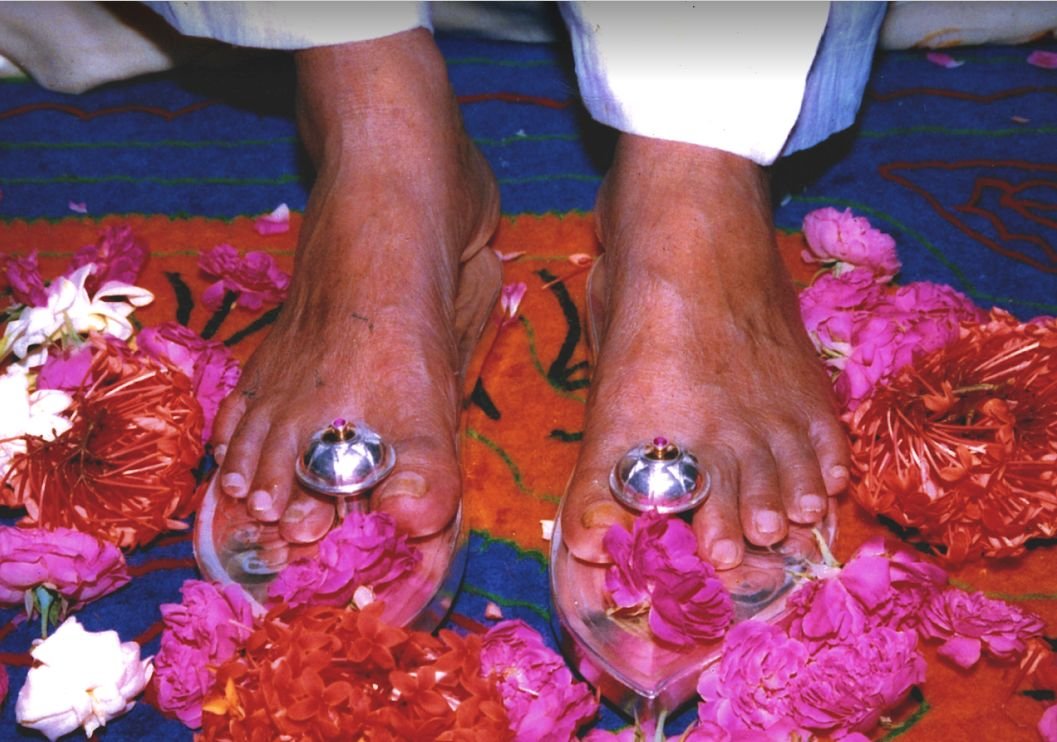
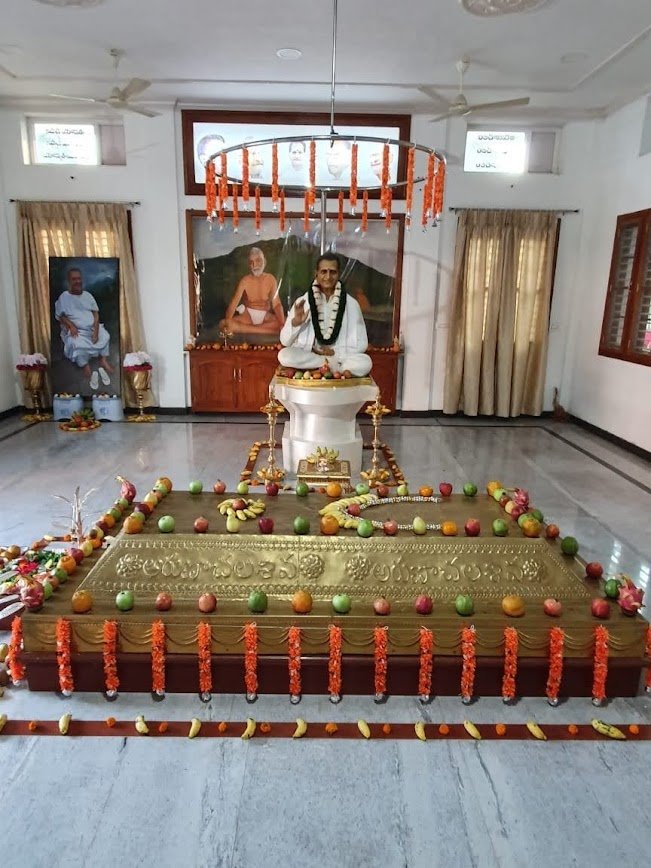
Life of Sri Nannagaru
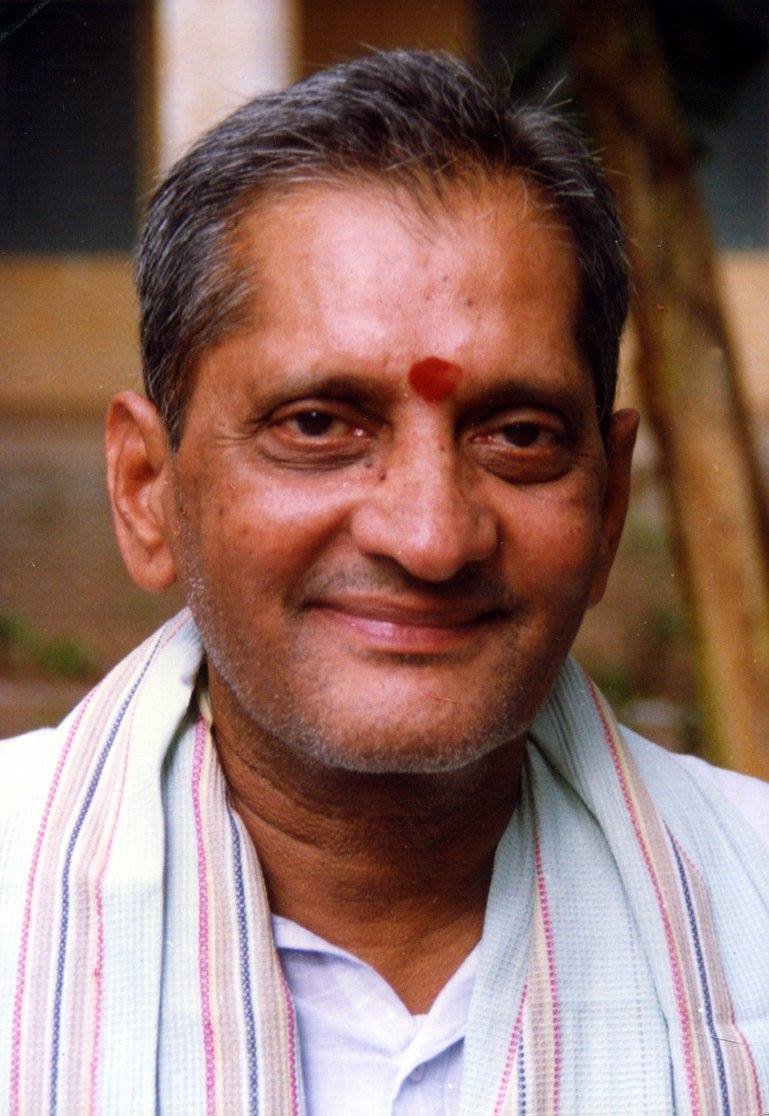
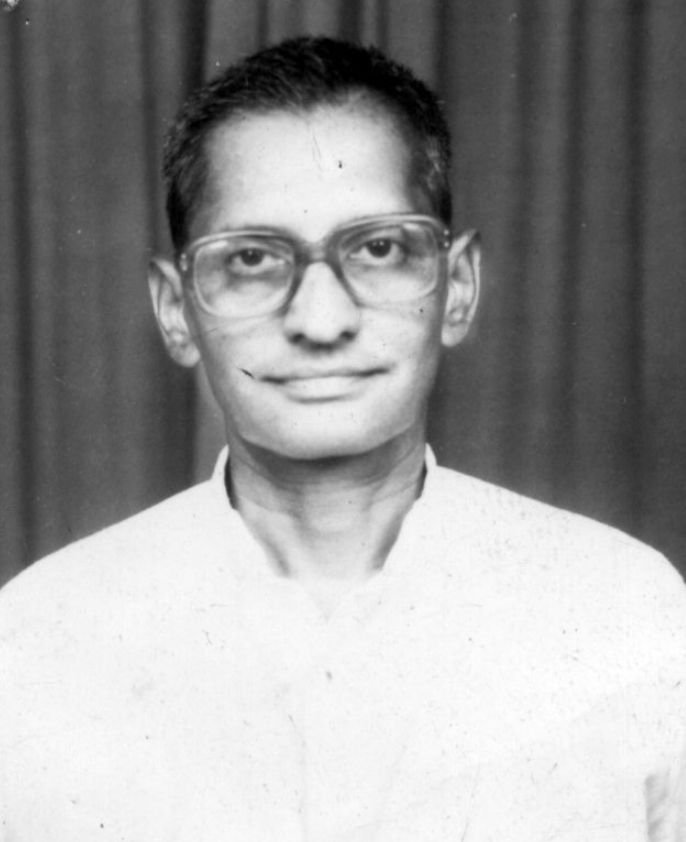
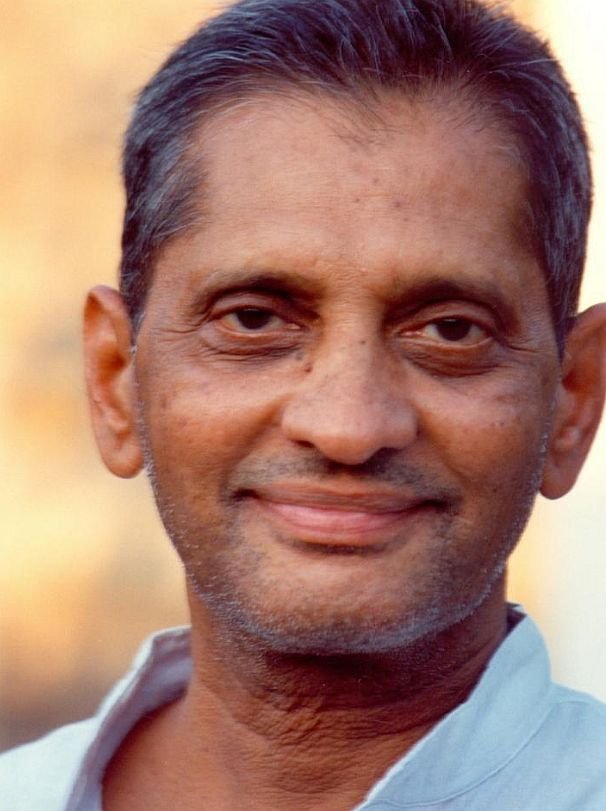
Shri Bhupathiraju Venkata Lakshmi Narasimharaju (B.V.L.N. RAJU), as
christened by his parents, was born on September 23, 1934 at his
grandparent's village of Kommara in the West Godavari District of Andhra
Pradesh. His native place was Jinnuru, West Godavari and his parents,
who were farmers, were devotional, kindly people. His father Sri
Suryanarayana Raju died when he was a child, and it was Bhupathi's
mother; Smt. Rajayamma and grandmother who raised the young infant.
The young boy was gentle, humble and compassionate by nature and his
devout family also left their imprint in his childhood. While still at
school, Bhupathi strove to look after those who were less fortunate by
helping with meals and organizing and extending financial help. Even
though he believed social service done in the right spirit to be
instrumental in freeing one from ego ... he remained unsatisfied.
Hence, at the age of twenty, he went to North India on pilgrimage with
his grandmother. The long tour to the Himalayas and Varanasi inculcated
in him spiritual aspirations and received blessings from Swami Sivananda
of Rishikesh who told the youth to "be good and do good." During the
pilgrimage, Swami Atmananda encouraged Bhupathi to study The Bhagavad
Gita and other scriptural texts. Abiding by such powerful guidance, the
young Bhupathi started living the teachings in his daily life.
While deeply rooted to acquire scriptural knowledge, a significant event brought about a total change in Bhupathi's life.
"In 1957, I had a dream one night. An old man with a staff in his hand,
raised me from the bed and kissed me hard on my cheeks. I was perplexed.
I pleaded with him to leave me alone. The stranger paid no heed to my
words. I had a feeling that he was invading my life. I was seized with
fear and tried hard to wriggle out of his grip. While he was holding me
in his embrace, my pillow fell on to the floor. He lifted it off the
ground, adjusted it on my bed and gently laid me back on the cot. He
looked at me compassionately and left me-as a Doctor would leave a
patient.
"For six months, I was struggling to know who this 'stranger' could be.
One day while reading the daily newspaper in our village library, I saw
an advertisement about a book 'The Great Men of India' by Madras Book
Publishing House. Going through the list of these great men, I felt a
thrill when I read the seventh name: 'Sri Ramana Maharshi'. I felt here
was a man who would draw me to the cave of my Heart. I received the book
by post and it contained a portrait from which I recognized the person
who had appeared before me in my dream six months earlier. The person
was Bhagavan Sri Ramana Maharshi and he lived at Arunachala in Tamil
Nadu and was revered all over the World."
Young Bhupathi who experienced a deep connection with Sri Ramana
Maharshi, quickly made his first visit to Sri Ramanasramam in January,
1959. From then on, he dedicated his life to the service of Sri
Bhagavan. He said:-
"Bhagavan Ramana's name, form and teaching helped me powerfully in my
spiritual progress", and: "It was not my choice that Sri Bhagavan came
into my life. He took me into His fold, thus blessing me, profusely!"
During a visit to Arunachala in 1982, while lying down in an Ashram
Guest Room, Sri Bhagavan blessed him. In Bhupathi's own words:- "Sri
Bhagavan opened the track between the 'Spiritual Heart' and the
'Sahasrara'. I felt the awakening of the 'Amruta Nadi '. From then on,
'Bliss' is being experienced".
It was a new beginning. The young man started to speak on Sri Bhagavan,
gathering thousands of new devotees who had never heard of Arunachala or
Sri Ramana Maharshi. In addition to his widely attended talks, he
wrote, translated and published books on the teachings of Sri Bhagavan
thereby drawing an even wider audience in rural Andhra Pradesh. He was
acclaimed and hailed by his devotees and disciples as 'Nannagaru.'
'Nanna' in Telugu meaning 'Father' and 'Garu' is a honorific. Thus, he
was thereafter endearingly known as 'Respected Father.'
In 1984 Sri Nannagaru constructed at Jinnuru the 'Ramana Kshetram' which
he dedicated to spreading Sri Ramana's direct teaching. He also built
two ashrams at Tiruvannamalai for devotees and started a monthly Telegu
magazine: 'Ramana Bhaskara' and a Telegu-English website to spread his
teachings.
Narrative 'My experience with Sri Nannagaru'
I first came across Sri Nannagaru in Ramanashram at Tiruvannamalai, in
the last days of 1993. A friend had told me that a guru was giving
darshan near the library that evening. Arunachala and Sri Ramana's cave
were sufficient for me, I thought; I felt no particular attraction for
the darshan of yet another guru. It happened that the library was next
to my room, however, and as I returned from the cave that evening I saw a
crowd of westerners outside sitting in silence before a man in his
early 60s who was sitting on a chair. At his feet were a bevy of
well-dressed Indian women. They were all gazing at the man intently. The
man's eyes were drifting slowly from one person to another. I couldn't
help feeling that he looked like the corner-shop grocer. Every now and
then he let out a prolonged belch, and rubbed his stomach.
I sat down, intending to stay until the first mosquito arrived. In
moments I was aware of the depth of the silence in the group around me.
Sri Nannagaru kept gazing at one individual after another, sometimes
resting his eyes on a person for minutes on end. At the same time he
would raise his right hand in an open palm blessing. My body became as
still as a stone. All thought of going anywhere vanished. All thoughts
of any kind vanished. His look was one of the most tender compassion, of
a lover to his beloved; yet there was no sense of anybody doing
anything, wanting anything, trying to create some effect; just the
innocent and empty gaze of love, available to all, and yet intensely
personal, it seemed, with each individual. His body seemed to carry no
tension at all: his whole being flowed unobstructed out of his eyes.
After half an hour or so, he silently bowed, and got up to go to his
room. Nobody moved, and the silence continued for several more minutes.
When I did finally move, I made my way without forethought to Sri
Nannagaru's door. It was half open, and one of his disciples was
standing in the entrance. I asked if I could see Sri Nannagaru, and the
disciple ushered me in. Sri Nannagaru was sitting on his bed. He had
just picked up a newspaper. 'Which country?' he asked. When I told him,
he asked me if I read The Times. When I told him I didn't, he asked me
about the other good newspapers in England. I responded briefly and then
came to my point: 'I was deeply touched by the silence you led us into
just now,' I said. 'But what I really want is to be that silence myself,
wherever I am. I cannot always be in India with someone like you.' 'You
like the silence?' he asked, leaning forward like a delighted child.
'Come to Virupaksha Cave with me tomorrow, and I shall answer your
question.'
I agreed to meet him at 3pm the next afternoon, when he would take me to
the cave in his car. The next day at the appointed time, I piled into
an Ambassador car along with half a dozen of Sri Nannagaru's Indian
devotees. Sri Nannagaru himself led the way in another car. We drove
into town and climbed the short path up to the cave, whose entrance was
already packed with expectant faces. Sri Nannagaru went into the cave,
paid his respects to the place, and returned to sit under the tree
outside. He then proceeded to speak to his Indian audience in his native
Telegu for the next half hour, while I and the other Westerners sat in
the silence. The silence was tangible, even when he was speaking, and it
didn't matter that he never returned to my question. That evening he
sat on the floor in the ashram dining-hall along with everyone else,
quite inconspicuous, in an ordinary dhoti, without any special
attentions or favours. The man seemed to glide rather than walk through
the day.
That evening, when I arrived for his darshan, he motioned me to come and
sit by his side. Every, few minutes, he would look down with an
innocent tenderness, and stroke my head. To begin with, I felt a certain
self-consciousness at receiving such undivided attention in public; but
my awkwardness soon gave way, to a tranquillity and ease that was to
remain with me for weeks afterwards. The next day, Sri Nannagaru was
leaving. I was among the crowd that had gathered to see him off, and as
he made his way to his car he came over to me and held me in his arms.
'Roger,' he smiled, 'Roger': like some lover taking his leave. I have
since witnessed him act in the same way with many, people, treating each
one as if they were the only person in the world. I have never seen
such a living example of the way Krishna must have acted with the gopis.
Some months later, I went to stay with Sri Nannagaru at his village, and
accompany him for a few days on his rounds through Andhra Pradesh. It
was a journey into the heart of rural India. The village was built in
traditional style. The houses were not unlike Spanish haciendas, with
verandahs supported by carved wooden posts and red-tiled roofs. Sri
Nannagaru would sit on his verandah, read the newspaper, and receive the
trickle of people who came to see him. His family, disapproved of the
public attention they were getting, and discouraged Sri Nannagaru from
using their house as an open forum. This was one reason he now travelled
so much. He put me up in a house next door which belonged to a devotee
who had gone away on business.
On my first morning, there was a knock at the door, and I opened it to
find Sri Nannagaru there with a cup of coffee. In the evening he brought
me into the kitchen of his house and stood over me as I made my way
through the food his wife had prepared for me. 'Nice food?' he enquired
in his rudimentary English. 'Very nice food?' when I confirmed my
pleasure, he beamed, insisting on offering me more. Very nice food,' he
repeated. 'Very nice food.'
Over the next week or so we went to several different homes over an area
of perhaps 100 miles, accompanied by one of his few male devotees who
took charge of all the arrangements. At each stop, he and I were ushered
to the table first, while the women hovered around watching us eat, as
he had watched me. Then the men of the family ate, and finally the women
and children sat down. During the day, dozens of people would come and
sit at his feet while he would give them a talk on some aspect of Sri
Ramana's teaching, respond to their problems, or occasionally sit in
silence.
We went to three weddings, blessed the foundations of a new house,
visited a paper factory, and a temple that someone had recently built in
his honour. Sri Nannagaru was the same still presence wherever we went.
He flowed at the same slow pace, and never showed any trace of a
reactive mind. in the car, as we went from one place to the next, he
would gaze at a tiny picture of Sri Ramana that he held in his lap,
apparently lost to us and the journey we were on. Yet as soon as we
stopped, he would be totally present to whatever situation we walked
into.
A number of Westerners have now accompanied him in this way, some for
much longer periods than I. Everyone that I have met confirms the same
experience of prolonged inner silence in his presence, and nothing but
an undemanding simplicity on his part. One, a 70-year-old man from New
York, told me that he had watched Sri Nannagaru weep for an hour while
an old woman told him her story, He himself had not been aware of
anything special happening to him while he was with Sri Nannagaru,
although it was a warm, if uneventful time. Then, a few days after his
departure, he realized that a sadness which had been with him all his
life had completely vanished.
Since his own awakening was not the result of any specific sadhana,
other than a spontaneous love for Sri Ramana Maharshi, it is not
surprising that Sri Nannagaru recommends no particular method or
technique himself. His own way of working with people is clearly to have
them in his presence while going about the business of everyday life.
Being a householder himself, he does not separate the spiritual from the
secular. Much of his day is spent dealing with people's everyday
concerns, and playing his part in the life of his community. He will
talk for hours to his Indian devotees on various aspects of advaita
teaching, but with Westerners, he is invariably silent, except when he
asks about their country and their national press. His economy with
words is partly because of his poor English, but also because he knows
that many Westerners, unlike most of the Indians around him, seem to
value his silence more. Westerners are already full of concepts and
theories, and are usually grateful to experience what lies beyond them.
People come and go from him without any mention of a relationship of
guru and disciple. He responds spontaneously to a person's openness, but
his response carries no weight or demand. He seems to represent an
invitation to fall into the inner heart, where all differences, formal
relations and emotional needs dissolve. Silence was also the teaching
method of Sri Ramana Maharshi, who considered it the only real form of
communication. Yet Sri Nannagaru's presence naturally draws people, and
his Indian followers, being culturally attuned to the guru-disciple
relationship, treat him accordingly.
(By Roger Adams)
Interview at Vishakapatnam 1993
Question One: To what extent are spiritual values beneficial in reducing man's criminal tendencies?
Sri Nannagaru: To a certain extent poverty and ignorance are the reasons
for man's criminal instincts. Other reasons are thinking that there is
happiness in wealth, the environment in which one is brought up and
imitation. However, the most important reason for man's criminal
tendencies is thinking that there is enjoyment only in sensory
pleasures.
People who do not have a purpose in life are attracted to a criminal
way. In some people there is selfishness but no cruelty and in others
there is cruelty but no selfishness. If both cruelty and selfishness are
present, then that person will definitely become a criminal. Nowadays
in certain cities crime has become almost a hobby.
Most importantly moral principles are the foundation for spiritual
values - spiritual values lead to acquisition of knowledge. Man's
criminal instincts are automatically subdued in the effort of a search
for Truth. By clearly explaining the bad effects of illicit instincts,
the criminal will be released from them. As social consciousness grows
that person will become mindful and move away from a criminal
temperament. A criminal nature is a weakness and it is Society that
should take responsibility for it.
Question Two: A flower emits a fragrance as soon as it is born. So did
you have an interest in spiritual matters from your childhood?
Sri Nannagaru: I should say that it was there to a certain extent since
childhood but only started blossoming from my teenage years. Spiritual
values assist in independent thinking. I am used to selfless action and
working without the desire for the fruit of action helped in my
spiritual development. During childhood, although I didn't have a clear
understanding about knowledge, I did have a strong desire to attain it.
Without spiritual thinking, it is not possible to raise one's level of
consciousness. My mind was inclined to spiritual matters more than
towards worldly ones. I didn't have the same liking towards religion
that I had for philosophy and used to think that religion and castes
were polluting society.
Question Three: You are divine and pure in word. You are known for
pleasing both laymen as well as scholars with your nectar-like words.
How is that possible?
Sri Nannagaru: I love my listeners very much and I am at peace with
them. I deal with my devotees with a noble mind and don't bother about
their common follies. I not only teach Self-knowledge but also help in
awakening the good in my devotees and wish for their worldly progress. I
try to make them walk the path of peace. My devotees have a living
faith in me. I look on them as my friends but they treat me as Divine. I
feel they show me more respect than is my due. That is why I take care
thinking about my devotees and while teaching them, never behave
irresponsibly towards them. If they commit a mistake I feel as if I have
done it. Also, on some levels, I share their misery. My teachings, to a
certain extent, help my devotees by making discrimination the centre of
their thoughts.
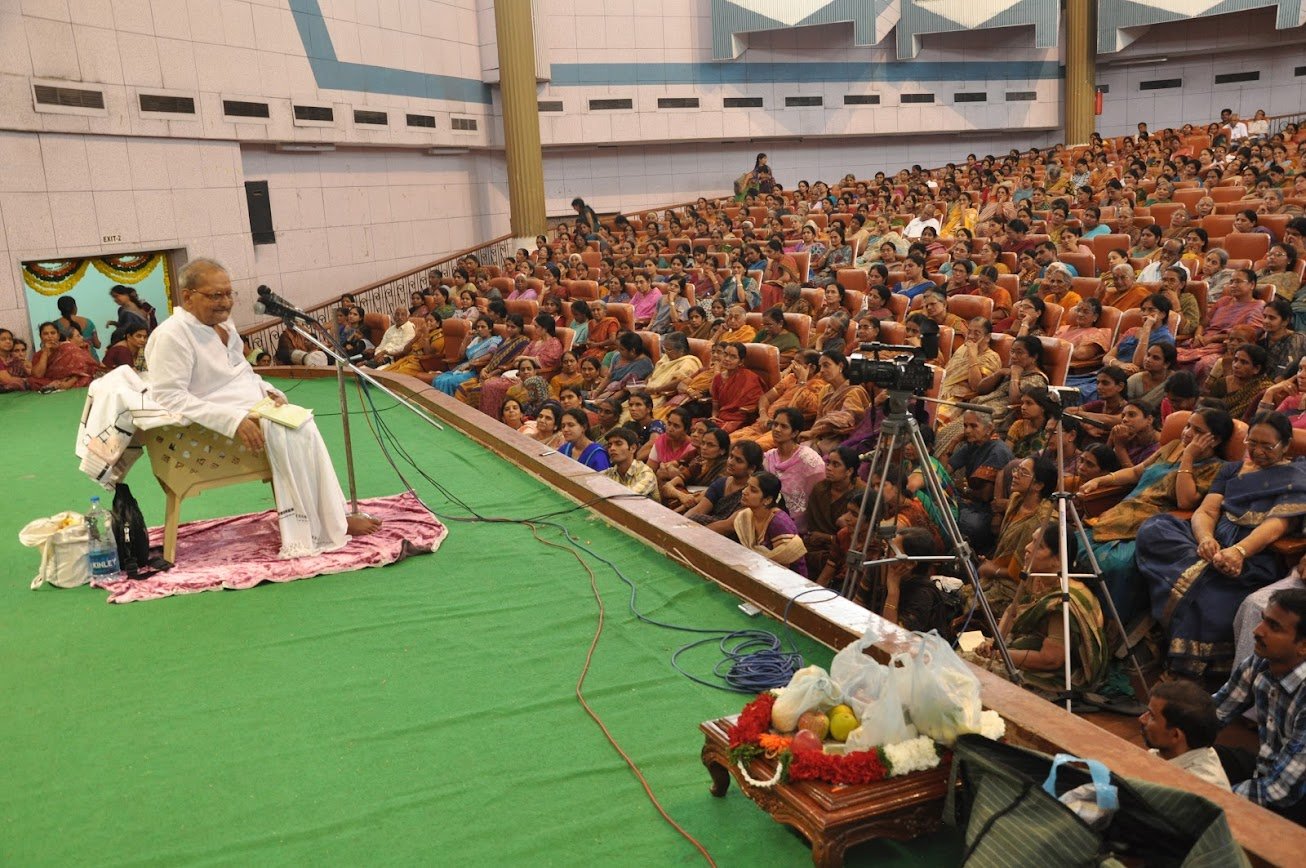
Sri Nannagaru at meeting with Devotees
The relationship between my devotees and myself is not that of
guru-sishya (master and disciple), instead we move like members of the
same family. Whether my devotees life circumstances are for or against -
their relationship of love with me will never get broken. There is
always a mental affinity and they get answers to their day-to-day
problems through my teachings. For one who has no peace there is no
happiness, but, by listening to my words, my devotees get both peace and
happiness. They float in the ocean of peace, love, compassion,
friendliness, respect and affection which flows out from me.
I know my affection towards my devotees is also recognised by them and
that is why I am not able to stop teaching. I try to explain complex
issues through simple words and if they don't understand what I tell
them, I feel it is my mistake. There is no end to the affection and
faith being shown by my devotees. Even if my body dies, I will be living
in their hearts and will take them to a state of no-misery. I teach
them philosophy with small words and short sentences.
Question Four: Parents hope their child will become a Collector, Doctor
or Engineer. But why would they not wish, even in their dreams, that
their child becomes a jnani?
Sri Nannagaru: Generally parents have mostly worldly and materialistic
attitudes. They want only material prosperity as they think that alone
will give happiness. They know about the importance of money but don't
know the value of knowledge. That's why they don't want their child to
become a jnani. Even if an individual has talent, he needs to have the
right opportunity for it to blossom. One, who uses the opportunity that
comes his way at the right time, is a wise man.
Except Self-knowledge all other knowledge is pertinent only for filling
the stomach. Self-knowledge presents the person with freedom, happiness,
peace and development. A person can attain immortality only through
Self-knowledge. Parents who realise the value of Self-knowledge and the
importance of pure consciousness will feel happy if their child becomes a
jnani. Then, the parents will feel that they are sitting on the back of
an elephant.* Even nowadays there are parents who want their child to
become a jnani. In life acquisition of knowledge is most important and
lives that have no connection with knowledge will be as beautiful as a
decorated corpse!
* Riding on the back of an elephant (like a king), symbolises the very height of prosperity in India.
Question Five: Did your parents wish you at any time to become a jnani?
Sri Nannagaru: My parents didn't expect that I would become like this or
like that. I didn't have much help from others for my spiritual
progress. Any seeker of Truth will not necessarily have help from
members of the family. In life, more than the sadhana I did, the Grace
of Arunachala-Ramana helped in my attaining the conscious state. A
sadhaka will not become a siddha if, along with his efforts, he doesn't
have God's Grace. Without the Grace of the Almighty, the mind will not
subdue. Only the subdued mind will be qualified for attaining the Self. I
have attained the state of peace only due to Bhagavan Sri Ramana
Maharshi's blessings.
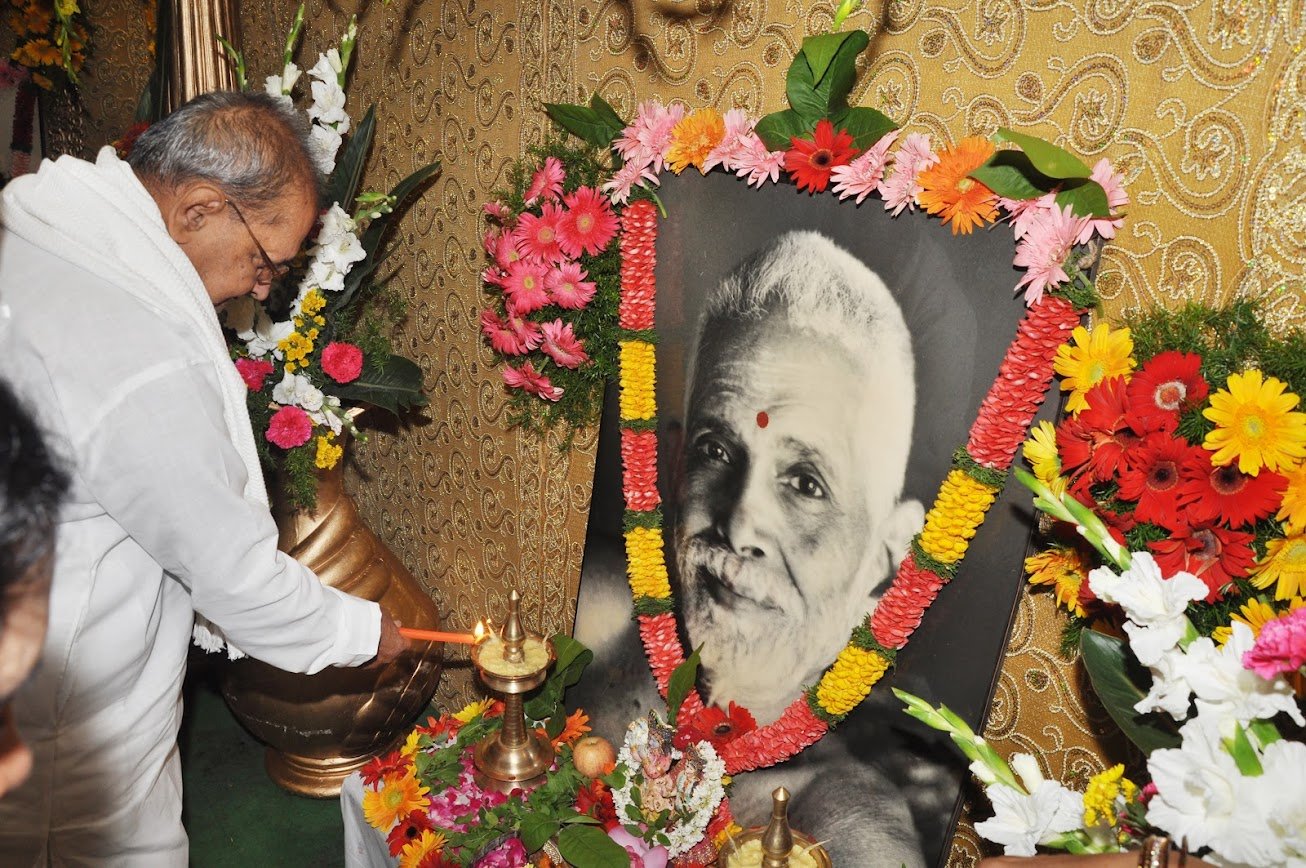
Nannagaru lighting Deepam to Bhagavan Ramana
Question Six: Will parents feel happy if their children attain spiritual knowledge?
Sri Nannagaru: I will briefly give you an example so that you can
understand. Gautama Buddha, Vivekananda, Ramakrishna Paramahamsa,
Aristotle, Iswara Chandra Vidyasagar - all these individuals became
great men. So if their parents were alive now would they feel happy or
not? Definitely they would be happy. So it is with anyone's parents.
Question Seven: What do you think you have achieved? Is there anything further you wish to achieve?
Sri Nannagaru: I have done some social service within my limits. I did
my share in spreading the Akshara Jyothi* programme and have shown
interest in activities that are useful to all. I have done all work
unassumingly without expecting praise from others. The only thing to
achieve is - to know oneself. If someone thinks he has achieved
something, it is equivalent to zeros without a one in front! The truth
of the Self is not restricted to place or time and it is only in that,
that there is true peace and happiness. One who has peace can achieve
freedom. A person is successful if; without depending on external
objects, or on other people, or upon outside circumstances, he attains
happiness.
He, who puts the abilities that God has blessed him with, to proper use,
may be considered to have achieved something in life. He who thus uses
his abilities becomes pure and this purity leads to fitness to realise
the Truth. We can be considered to have achieved the ultimate in life
only when we have attained Bliss Absolute. Those who strive (for
harmony) throughout life get liberated from untruth and ignorance - that
is the only thing to be attained. In life's journey; thoughts, words
and deeds must be conducive to our glorious future. When our objective
is noble, our life will be automatically ennobled and then we will
attain the desired goal and achieve that which is to be achieved.
* Literacy programme
Question Eight: Can we get relief from disease (ill-health) through
observing orthodox customs, mantras and repetition of God's names?
Sri Nannagaru: The custom of madi* is for keeping pure. A cooking vessel
has to be cleaned both inside and outside. In the same way one has to
clean the body and the inner instrument called the mind. Water cleans
the body and mantra purifies the mind. Madi, repetition of the name,
mantra and meditation are useful to keep the mind in check. Yoga removes
ill health and breaks the bond between man and his sorrows. Solitude,
satsang (association with devotes and the wise) and fasting, purifies
the mind and makes it one-pointed. Then one can strive to save and
redeem oneself from sins, curses, insufficiencies, wrong tendencies and
weaknesses.
In the first instance disease enters the mind and then gradually spreads
throughout the body. The body is only a product of the mind and man is a
combination of mind and body - the mind and body influence one another
all the time. If a man has no mind (i.e. mentally afflicted) he is
called a mad person and if he has only mind, without a body, he is
called a ghost. Mental hygiene is as important as physical hygiene but
nowadays man does not give as much importance to the mind as to the
body. The mind of man has become a repository of anxieties, frictions
and abuses and manifests as such. What is inside you is outside.
Repetition of God's name makes the mind pure. A peaceful mind helps to
remove health problems. When the mind is made pure we can get rid of
many maladies. Both mental and physical peace is achieved through
meditation. To attain the wealth of self-realisation both mental and
physical purity is a necessary requisite.
* Madi - wearing clothes which are washed and kept separate and not touching those who have not bathed etc.
Question Nine: Isn't it natural for human beings to get elated in happy
circumstances and dejected in sad ones and try to escape them? What
sadhana should we do if we want to face sad circumstances with
fortitude?
Sri Nannagaru: In the Bhagavad Gita, Lord Krishna advises us to give up
attachment, fear and anger. All three are causes of misery and the Lord
asks us to keep them at a distance. Happiness, unhappiness, attachment
and hatred etc., are called the dwandwas the pairs of opposites, and
they hinder man in the acquisition of knowledge. The Lord has given us
yoga techniques to help us get rid of these pairs of opposites. We must
have a peaceful mind to fight them and we can get rid of them through
worship of the Lord. Having courage in our hands as the antidote, we can
easily face any amount of hardships and difficulties. He who has
reached a state of fearlessness is not even conscious of these pairs of
opposites. Weakness of purpose (heart) is the cause of elation and
dejection (joy and sorrow). Lord Krishna tells us that weakness of heart
is the source of all misery.
When one has God as the centre of his life he does not feel any sorrow.
When there is a liking for something, we do not feel any hardship in
doing a job. He who takes the sorrows of daily life in a joyful attitude
is the real sadhaka. Only a sadhaka attains the goal or siddhi - siddhi
means the knowledge of what already exists. One who is not a sadhaka
can never become a siddha.
We get the ability to face difficulties when we have faith in God. Apart
from God all these joys and sorrows, likes and dislikes are only the
creation of the mind. When that (mind) is destroyed all of them get
destroyed.
Question Ten: Sorrows are like the waves of an ocean, are they not? They
always rise one after another. Are the causes of these sorrows
self-made, the product of karma or the product of selfish elements
around us?
Sri Nannagaru: We, ourselves, cause all sorrows. They come under the
category of accumulated karma. Joy and sorrow, success and failure, gain
and loss all happen according to the results of our past actions
(prarabdha). We had better let the body suffer the prarabdha and try to
acquire knowledge of Reality. There is peace only in Reality. He who has
no peace has no happiness. If we believe with all our heart that all
happenings in life happen by the will of God, we do not suffer under the
influence of them. The pairs of opposites are purely concoctions of the
mind - only spiritual truth is Real. Sins get destroyed through
suffering and the result of merit gets destroyed through enjoyment.
Which is better? There is a chance of our thoughts becoming deeper and
introverted when we suffer (under sorrows) as suffering widens our
outlook. The environment has a great influence over a weak mind but a
strong mind will protect itself from this influence. Imitation is the
nature of weak minds but a balanced mind has equal vision and will get
free of all doubts and malevolent influences and overcome all
difficulties. He who keeps aloof to insignificant and negligible issues
is a wise man. The pairs of opposites do not touch the wise man.
Man must understand that he himself is the cause of his present state.
Selfishness alone is the obstruction of attaining the supreme goal.
Selfish people will not influence a wise man. A man of peace does not
covet temporary gain as he has a vision of the future and does not
differentiate between means and ends. Pleasure that is immediate and
short-lived, may lead to unhappiness and tragedy in the long run. A man
of vision recognizes these fundamental issues.
Question Eleven: Lastly, what suggestions can you give to our readers?
Sri Nannagaru: One should reduce selfishness and do work. One should not
forget that one's happiness lies in the well being of all. One should
learn to think independently. Man can't exist without some amount of
wisdom and he shouldn't habituate the intellect with laziness, as even
in thought there is bliss. Man can overcome a lot of difficulties by
carefully thinking before talking and before starting any work. Unless
Reality illumines the intellect, it won't become pure. If we don't
correct our intellect who else will do it?
We should do our share in educating mankind. We should follow the rules
for health and make others also follow them. Nowadays stress created by
the pressures of life leads to a decrease of mental health. Mental peace
is as important as food and shelter for happiness. With our words and
actions we should inspire others to enter the path of peace and thereby
attain happiness. We shouldn't waste our time with wasteful actions and
thoughts. We should increase respect towards work as we can attain a
peaceful state through labour. We should learn to see the Divine in duty
and Divinity in work and also learn to worship God through work. Rather
than becoming bed-ridden and then dying, it is better to die whilst
working. Doing action one can progress to an action-less state. Some
people limit themselves to working only to fulfil their physical needs
but some are born to live for others. Work and knowledge are not
contrary to one another. The importance of knowledge and peace should be
explained to people and they should be encouraged to acquire them.
Spiritual development is as important as worldly progress. We should
learn patience (and attain equanimity) as patience increases the depth
of the intellect and enlarges the heart. Work and knowledge are like the
two eyes and that is why we shouldn't be careless about them.
Devotion to God is as important as patriotism. We should try our best to
create a social conscience in man. Thoughts should be controlled
because they are the basis for word and deed. If you keep thinking about
things that are neither useful to you or society, ignorance increases.
To attain a state without misery ignorance should be got rid of - as it
is the cause of all problems and more frightening than poverty. By
creating wealth, poverty is removed and by acquiring knowledge,
ignorance can be removed. Knowledge is liberation. Life without
knowledge is useless - such a life is a waste.
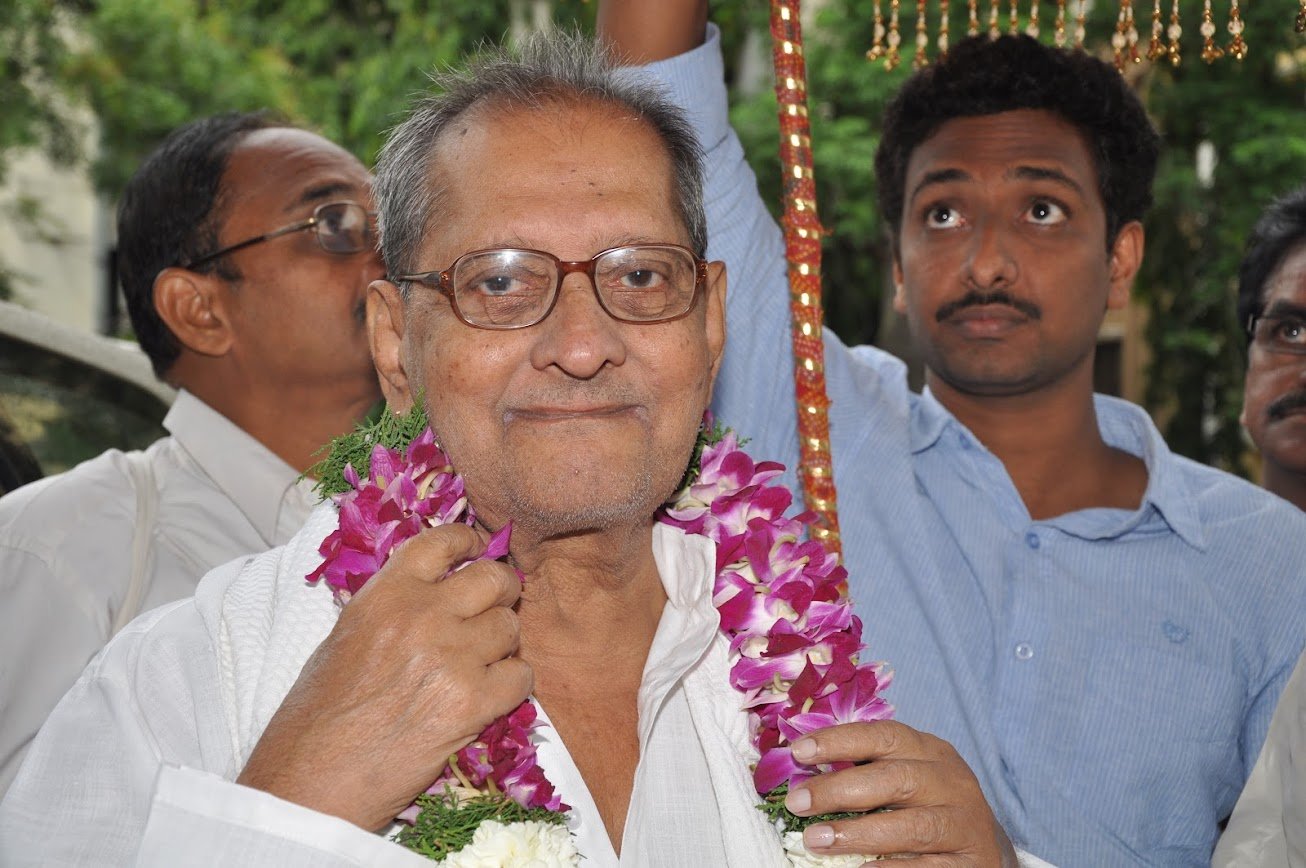
Sri Nannagaru Mahasamadhi
Sri Nannagaru dropped his mortal frame on December 29th, 2017 at 12:00 pm at his native place of Jinnuru, Andhra Pradesh.
Homage to Sri Nannagaru
Nartaki was born a high-caste Brahmin and as young girl of 14
dressed in school uniform, took darshan and received the blessings of
the sage Ramana Maharshi the day before his Samadhi. She lived most of
her life at Arunachala where she remained unmarried in order to fully
dedicate herself to God and selflessly wait upon the poor, deprived and
most disadvantaged of the community.
Nartaki died some years ago, after a long life of prayer and service. In
that life she met and attended to many saints and sadhus. Of Sri
Nannagaru, who she first met when he was 25 (before his realisation) she
said, "I've always believed the essential character of a person remains
the same after realisation. And, of Sri Nannagaru from the beginning, I
noticed two things. Firstly, he was very kind and secondly, he had a
wonderful sense of humour. Both those qualities are evident in the
person he has become. Even on the first occasion I met him, he walked
like a young Emperor. But I never knew then what he would become - that
he would turn into a lake of love."
|
|