King
Vira Vallalan III was an illustrious king who ruled over the Hoysala
empire from 1292 till 1342. His empire at its peak covered a large part
of South India. It had three capital cities, one of which was
Tiruvannamalai, although it was then known as Arunasamudra, or Arunai
for short.
The king was an ardent Saivite and during his stays in Tiruvannamalai he
made many improvements to the Arunachaleswarar Temple. Tiruvannamalai
was near the geographical centre of his empire and this encouraged him
to make protracted stays there, particularly after the destruction of
Dwarasamudra. It seems that during the last fifteen years of his reign
he was constantly in residence at Tiruvannamalai.
King Vallalan's devotion and piety are celebrated in chapter seven of
the Arunachala Puranam, a Tamil poetical work that was written in the
sixteenth century by Ellapa Nayinar. The work is primarily a poetical
rendering of the Sanskrit Arunachala Mahatmyam which was written several
centuries before, but the following verses, dealing with King
Vallalan's quest for a son, are only to be found in the Tamil version.
|
|
452
Now we will tell you the story of King Vallalan to whom God Himself
manifested as a child and then bestowed His grace by giving him a boon.
453
In a famous place called Arunai (Tiruvannamalai) there are mansions with
jewel-bedecked pinnacles and gardens dense with fruit-giving trees
which reach up to the starry firmament. In this place dwell beautiful devadasis equal only to Arundhati (Vasishta's wife) in chastity.
454
Vallalan the king of this renowned city, has a virtuous character,
speaks only the truth, and with great devotion takes care of all beings
as if they were no different from him. He belongs to the Agni lineage
whose fame cannot be described. This king came (to the world) to worship
daily the feet of Parameswara, to do service to him and to praise him.
455
He has no desire for the possessions of others. Excepting his own wives,
he considers all other women as his sisters and treats them
accordingly. In accordance with the law, he is given one sixth of his
subjects' earnings as taxes. He serves with great delight as a patron of
the temple of the Lord who held the poison in his throat.
456
In this place tigers and cows dwell together, drinking from the same tank. The Brahmin preceptors recite the Vedas,
and all the people listen. To obtain grace from the ancient Lord,
people decorate the city, making it a marvel to behold. Maidens sprinkle
water in the street and make magnificent kolams (symmetrical patterns made out of rice flour).
457
There are three rainfalls a month and the abundantly rich harvests never
fail. Those who ask for food are immediately invited and offered food
with the six different flavours. The people, by serving the tapasvins
(those performing tapas) and giving whatever is asked of them, receive
their blessings. In the temple of Siva, the Just One, they light ghee
lamps and do puja regularly.
458
Thus, the great city existed in all its splendour according to God's
design. But even though the king had all possible wealth, he had a
troubled mind because he had no son to speak his name.
459
He asked the ministers, 'Is there anything wrong with the pujas I perform to Siva? Have there been any errors in my [administration of] justice in this country? Among the flowers plucked for puja, are there any defective ones? O ministers, tell me what is to be done?'
460
The ministers said, 'O king, if one gives charity with steadfast faith
and devotion to each and every poor person who approaches us, then by
the grace of the Lord with three eyes who protects and rules us, a son
will be born.'
461
The King replied, 'In order that my good name should flourish [in the
form of subsequent generations], hoist a beautiful banner on high and
spread the following news by striking a murasu drum: ''Whosoever
enters this splendid city where the handsome Lord Arunai lives,
whatsoever they ask, I shall give them''.'
462
Then the ministers said, 'O our king, whose good name flourishes
throughout the world, listen! Are we capable of giving away whatever the
devotees who worship the feet of the Lord, praised by the sastras, and elders and hymn-singing bards take it into their heads to ask?'
463
The king said, 'Will anyone ask for something that is not [available] in
the world? Even if anyone did, no one could give such a thing. So,
quickly do what I have ordered.' The ministers then hoisted the flag on
high and struck the murasu.
464
On hearing that the king of Arunai, where the Lord dwells, had hoisted a
flag, people from all over the world drew near in great numbers to
receive gifts that alleviated their poverty. There were old people,
people carrying a kavadi [a pole with a weight on each end], tapasvins, brahmins chanting the Vedas, wandering minstrels, singers and beggars.
465
To those who came and wanted to perform a marriage ceremony, the king
gave 1,000 pon. In addition he made those who said that they were unable
to redeem their pledges of houses, lands and jewels happy by giving
them 2,000 pon. Afterwards, he gave 300 pon to old brahmins who wanted to perform the upanayanam [sacred thread] ceremony.
466
[Someone asked:] 'The jewelled mantapam and the compound wall in the temple are deteriorating. O Lord, give us funds to repair them.' The king gave 2,000 pon with great devotion and said, 'Renovate them properly'. In addition, 50,000 pon were given to endow maths throughout the land.
467
[The sage] Narada, hearing that King Vallalan, as he proclaimed, was
graciously bestowing gifts daily to blind people, to devotees of Siva,
to the lame, to wandering minstrels, to those afflicted by the disease
of poverty and [many] others, approached that king.
468
When he heard about the arrival of the muni, the great tapasvin,
the king with great love descended quickly from his throne and,
surrounded by all his ministers, approached the holy man, singing his
praises, received him, and offered him a seat free from all impurities.
Once the muni was seated, the king began to speak.
469
'O great muni, you who were born from the tapas of Brahma and who sing with the vina
in your beautiful hands, graciously enlighten me about the purpose of
your visit to this lowly cur.' Then the ascetic replied:
470
'O king belonging to the lineage of Agni, which is one of the three
ancestral lines [Surya, Chandra and Agni] praised by the world-renowned tapasvins
and the praise-worthy ascetics who have conquered the five senses, I
have heard of your flawless munificence and have come to learn about
[it]. Tell me what is on your mind.'
471
'O muni, O great tapasvin whom the rishis learned in the Vedas and sastras
praise, please listen! I have no son to speak my name [at the time of
my death] or to rule my great kingdom [after me]. I have therefore
hoisted a flag so that I can lovingly give whatever in this world is
humbly solicited by devotees of the Lord who shares half His body with
the one whose hair is decorated by dewy flowers. But I know not the will
of God.'
472
Then Narada replied, 'The worthy Dharma Sastras proclaim that
those who perform great charitable acts on this earth will obtain
children. Furthermore, qualified people have also said so. So, by the
grace of the Guru who protects everyone and who delights in wearing the
crescent moon and the surging Ganga in his matted locks, a son will be
born. Now, O king, grant me leave.'
473
Full of love, the muni went to see Lord Siva's abode in Kailash to tell him of the king's justice. As the Siva ganas
[attendants or followers] were standing there, singing His praises,
Narada prostrated himself to the dazzling form of Nandikeshwara, who was
standing in the foreground. Then, beholding the beautiful scene of Siva
with the crescent moon in His hair, surrounded by rishis, he praised the Lord and said:
474
'O Lord of Lords, dwelling in luminous Kailash, praised be Your holy
feet! Desiring a son to speak his name, a king called Vallalan in the
flourishing, flawless city of Arunai, has hoisted a flag to proclaim
that if anyone in the world asks for whatever he wants, he [the king]
will gladly give it. Listen now to the glory of this king.'
475
'He enables justice to flourish and is the guardian of the truth. He
never swerves from righteousness. This great king was born into the
world as the embodiment of the dharma that weeds out sin. He
regards all beings on the earth as his own and treats them accordingly.
He is Your devoted slave. Every day he prays in the following way: ''O
First Cause, Your lotus feet are my refuge!'''
476
Listening to the discourse of the muni who had come before Him,
Lord Siva thought, 'I will ascertain for Myself what this Vallalan is
like'. Then the Peerless One said to the devas, rishis and munis, 'All of you go to your respective ashrams'.
477
Immediately the Lord of Kailash summoned the king of Alakapuri
[Alakesan, the god of wealth]. That king, who came with such a huge pile
of gold that he was honoured by everyone, prostrated himself before the
gracious feet of the Lord, whose body wears the rudraksha and the cobra as His ornaments, and praised Him. Then the Red-hued One graciously spoke a few words:
478
'O king who rules Alakapuri, listen. I have decided to test the
steadfastness of the king who dwells in Arunai. Therefore become My
worthy disciple and accompany Me joyfully with lots of wealth.' Thus
said the Lord of Kailash.
479
Then Paramasiva, who shines with the indescribable Lady as one of His halves, took the form of a sangama
[Saiva monk] that could now be worshipped by everyone. As Brahma and
Vishnu looked on, they felt a joy they had never experienced before. All
the devas showered forth a rain of flowers while the Vedas praised [Him].
480
All the beautiful Siva ganas dwelling in Kailash, the abode of the Lord became andis
[mendicants] by the grace of our most excellent Lord Siva. Coming in a
large group, they reached the beautiful city where Vallalan dwells and
were praised by those who knew the ways of the king.
481
The mendicants proclaimed: 'Are there no highly virtuous mothers who
regard their husbands as gods? Are there no young men excelling in
beauty? Is there no one to give food to the hungry? Are there no just
monarchs? Are there no good-hearted ladies who will lovingly invite us
and attentively serve as food?'
482
'Even if gold is given, we don't want [it]. If you give us beautiful
ornaments, we don't want [them]. We desire neither shining rubies nor
long pearl necklaces. If you grant us sovereignty over kingdoms, our
minds are not in that. However, should you offer us food and protection,
we shall eat with great delight.'
483
The Lord, who had given up the deer He was holding to take on the appearance of a sangama, headed for the street in that excellent city wherein dwelled the devadasis, whose lips were like red fruit. His lily-like mouth blossomed, and He cried out like a beggar suffering terrible hunger.
484
'O Ladies,' He said. 'You who have eyes like a fish, whose speech is
like a parrot and whose faces are like the moon; you who wear garlands
of light flowers in your hair and have breasts like young coconuts
rubbed with sandalwood fragrance! How much gold is needed to stay with
you till dawn so that the suffering caused by Kama [the god of love or
lust] with his five arrows is removed?'
485
The devadasis replied, 'O Lord whose beauty defies description!
You who resemble Paramasiva wearing the cobra with lifted head! Listen!
We neither lie nor cheat. You must give 1,000 pon for one lady to
make love all night. If you give this we will join our bodies with
yours and remove the suffering caused by Kama.'
486
Siva immediately handed out the gold that the devadasis had
demanded. Matching up one mendicant with each lady, he signalled to them
with His eyes that they must stay together all night. Thus, in the city
of Arunai, which grants many boons, Siva made the devadasi streets light up with the great assemblies of sangamas embracing all the devadasis.
487
Siva made sure that no devadasi was left unengaged and had
everyone embrace according to the path of the lustful Kama. Then he set
off for the king's palace with His disciple [Alakesan, the god of
wealth], who had experimented with [and followed] the path that leads to
goodness. Seeing them come towards the palace, the king, who was an
expert archer and the ruler of the land, approached the two sangamas deferentially, praised them, invited them inside and seated them there. Then the king began to speak:
488
'Lord, Your golden feet have deigned to come here. Is it [because of] the tapas
I have performed? What is the good deed I am performing in the world?
If, due to my past merit, I am able to give whatever You ask, I will be
honoured and I will receive Your gracious glance.'
489
Siva said: 'O King, listen. May your kindness and your just path
flourish for ever! I have come to you for a purpose that I will now
tell. If you give me a woman to remove the misery caused today by the
five arrows sent by the formless Kama, your fame will shine over the
seven seas.'
490
The king replied: 'I shall do more! For You, Lord, a beautiful marriage
will be arranged.' Hearing this, the Venerable One replied: 'O king,
listen. Marriage is a great bother. Only the devadasis have the skill and knowledge, which is a great treasure, to alleviate the suffering caused by the disease of lust.'
491
'O sangama who teaches wisdom even to those who have made their
minds steady, I shall act according to Your wish.' Then the king called
his guards and said, 'Go immediately and fetch a beautiful devadasi'. The guards set off faster than the wind.
492
They reached the street where the devadasis lived and entered every house. Each time they looked inside the crowded houses they saw a devadasi dancing
and singing affectionately with a Siva devotee wearing kondrai flowers.
'Today it won't be possible to find an available devadasi,' they thought, and returned to the palace to tell the king.
493
The king listened to what his guards told him and became angry. Looking
at his ministers he said, 'Is it the doing of the Lord that my words
should fail? Is there any defect in our pujas? Is it proper to tell that sangama who spoke so clearly that we can't get him a lady because there are none available?'
494
The ministers said: 'O prosperous one! Stop worrying. We, your humble servants, will bring back a beautiful devadasi. Give up your anxiety.' Arriving at the street of the devadasis, they saw the amorous play inside the houses and they addressed the devadasis who had perfumed their rounded breasts:
495
'On this street where there are crowds of lotus-eye ladies living
closely together, if there is one lady who can satiate the lust of the
wise man who has approached our king, she will have bracelets, ornaments
made of rubies and tinkling anklets; she will always eat food with six
flavours along with ghee, curds and milk.'
496
After hearing what the ministers had said, the ladies humbly replied,
'We have already been paid by these devotees to stay with them all
night. After this night is over, we will do what you say.' The ministers
were much disturbed and reported what the devadasis had said to the king.
497
The king said, 'Why is this insignificant thing becoming so difficult
for us?' He grew sad and his mind was filled with anxious thoughts. 'Is
this the working of the Lord's grace? I will fulfil my promise to the sangama who has appeared before us as if He was Siva Himself.' So saying, the king took his bow and quickly went to the street of the devadasis.
498
He spoke to them in the following manner: 'A flag has been hoisted on
high so that those who come here will know that whatever they ask for
will be given. I will give this kingdom to the devadasi who will help me avoid breaking my word to the beautiful sangama who has come today.'
499
'I will give her elephants, horses and as much gold as she wants. She
will have a palanquin inlaid with pearls. If she satisfies the desire of
the Venerable One, I shall give her the great sceptre of authority to
govern this ancient land. I shall serve her and she shall become my own
mother.'
500
'All the rishis who are knowledgeable in the Vedas say that among all worldly pleasures, this is the highest. Therefore, come ladies. If you can remove the desire of the sangama who has come to our land, and in return you ask for my life, I shall give it.'
501
The ladies humbly replied, 'Abiding by your laws, O Lord, we have
already accepted the gold to have pleasure with these pure devotees.
What else can we do?' The king of this land became ashamed and went back
to his famous palace.
502
When he got home two of his wives, Nallamadevi and the young generous
Sallamadevi perceived the change in his moon-like face. Prostrating at
his feet, they said, 'O Lord who can rule [the whole of] this ancient
world! What is the reason for your sadness? Please tell us.' Then
Vallalan, who walks the path of purity, replied to them:
503
'Today a venerable man approached this prosperous king desiring pleasure
with a woman having deer-like eyes. In accordance with his request, I
tried to get a devadasi but none is available in our city.
Because of this I am distressed.' After listening to the king, the
younger wife began to speak.
504
'O king who has made a promise to the devotee suffering from lust, we
don't know what is on your mind. If you think that I, the younger wife,
should offer myself to him, then I shall do so.' The king, who was
blessed by Lakshmi, rejoiced in his mind. He looked at his wife and
said, 'O noble lady, you will go with the devotee into a room and remove
the suffering inflicted on him by the formless Kama.' Then the good
king informed the venerable man.
505
Sallamadevi immediately bathed in perfumed water, dressed up beautifully
and went inside the room. There she skillfully played the vina and sang melodiously. But when she came close to the Supreme One and looked at Him, she saw that the One who wore the rudraksha beads was deep in meditation.
506
Then, thinking that she would make the Venerable One happy, she took
perfumed water and sprinkled it over His dazzling form, speaking to Him
in a pleasant manner. When He didn't even open His eyes to look at her,
she hesitated a moment and then began to speak.
507
'O Lord, alas, is it proper that the king's promise should be uttered in
vain?' Then the beautiful lady placidly bent over and embraced Him. At
that very moment Paramasiva turned into a baby and, to make her happy,
began to cry.
508
When Siva became a child and was crying loudly, the king, thinking that
this was the Lord's doing, came quickly, took the child in his arms,
embraced it and lovingly kissed it on the forehead. But just as the king
was so immersed in bliss, that Immaculate One disappeared.
509
'O Lord, will we ignorant ones know the working of Your divine will? O
embodiment of Truth! You who have three eyes! You who are the Vedas and the Lord of the Vedas!
Pure One! Is it to test us that You have appeared in the form of a
child and then disappeared? What is our destiny now, O Great One?' The
king, along with the queen, lamented in this way.
510
Then the king's heart weakened. As he was crying out loudly, Iswara, who is praised by the excellent tapasvins, appeared mounted on the bull with Parvati, all surrounded by Siva ganas. Brahma and Vishnu followed them. In this way the Lord gave his darshan to the prosperous king dwelling in Aruna. The king prostrated and prayed with fervour:
511
'O Origin of Everything, I surrender! O luminous One who can protect
devotees on earth, I surrender! O Lord wearing the crescent moon and the
Ganga in Your pure, lustrous red matted hair, I surrender! O Immaculate
One, bless me with a son to carry my sceptre and rule with
justice.'
512
'O handsome king, listen! I myself became your son. Hence, at the time
of your death, I will perform the vedic ritual for you.' So saying, the
One bearing the crescent moon blessed the king and returned to Kailash.
Thereafter King Vallalan ruled the land with great virtue.
Apart from this text, there is no other historical evidence to support
the main contention of the story: that King Vallalan, in his efforts to
conceive a son by being generous to all Siva devotees, obtained darshan
of Lord Siva along with a promise that the Lord would personally
conduct his funeral rites. However, there is incontestable proof that he
was a major patron of the Arunachaleswarar Temple (verse 466) since the
additions made are still very much in evidence. One of the inner gopurams bears his name was constructed at his behest.
According to a traditional story which is well-known in Tiruvannamalai, King Vallalan, after building this gopuram, felt great pride in his achievement. Lord Arunachaleswarar noticing that the feeling 'I have built this great gopuram',
was strongly rooted inside him, decided to teach him a lesson. There is
a ten-day festival in which Arunachaleswarar is paraded each day
through the streets of Tiruvannamalai. In the first festival after the gopuram had been built, Arunachaleswarar initially refused to leave the temple via the passage in the centre of the new gopuram.
For the first nine days of the festival He always left the temple via a
different route. On the tenth and last day the king realised his
mistake and became more humble. He broke down and cried before the Lord,
begging him to use the new gopuram for just one day. Lord
Arunachaleswarar saw that the king's pride had abated and granted his
request. This particular festival is still celebrated in Tiruvannamalai.
To commemorate King Vallalan's attack of pride and his subsequent
humility, Arunachaleswarar is only taken through the king's gopuram on the tenth and final day. On the other days other routes are used.
The results of King Vallalan's patronage can
also be seen in other parts of the temple. There are several statues of
him there, one showing him with a full beard, another showing him with
one of his queens and a third as an old man. In the sixteen-pillared mantapam
outside the temple there is another statue of one of his queens in
which she is standing on a projecting platform, supported by lions'
heads, with her hands folded in supplication towards an image of Siva
and Parvati seated on a Nandi. He was also responsible for the Nandi
which was installed to the east of the Kiligopuram. This particular
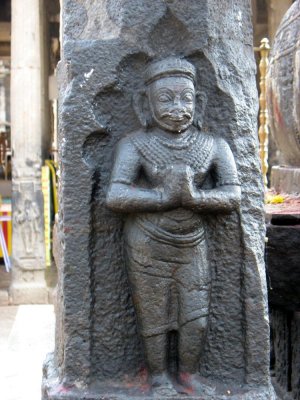
Nandi is covered with a small mantapam. On the right hand pillar there is a carving of King Vallalan and on the left-hand pillar there is a carving of the ganda berunda, the imperial emblem of the Hoysalas.
In the concluding verse of the chapter, Siva undertakes to perform King
Vallalan's funeral rites for him, a task which is normally performed by
the son of the deceased. The promise is still remembered in
Tiruvannamalai and each year King Vallalan's funeral is re-enacted to
commemorate the event. In the month of Masi the temple priests
read out the news of King Vallalan's death to Arunachaleswarar. Then the
image is carried in procession to the village of Pallikonda Pattu,
about three kilometres from Tiruvannamalai, for the performance of the
king's annual sraddha rites. The connection between Pallikonda
Pattu and the life and death of King Vallalan is no longer known. It is
unlikely that he lived there since his palace is thought to have been
located about a mile to the east of the main temple. Until about a
hundred years ago the last remains of what was reputed to be his palace
could still be seen there, but around the turn of the century the land
was levelled and cultivated and the railway line from Villupuram to
Tirupathi now runs across the site.
Whether through divine intervention or mere accident, King Vallalan
eventually fathered two sons, Virupaksha and Thipparasa, and a daughter
whom he married to one of his ministers. Virupaksha succeeded to the
throne after his father's death but he was unable to retain control of
his inheritance. One of Vallalan's generals, Harihara, was sufficiently
powerful to operate independently of the new king. With the aid of his
two brothers, Kampa and Bukka, he defeated all the neighbouring
kingdoms, founded the Vijaynagar empire, which included the Hoysala
territories, and, under the title of Harihara I, became its first king.
Throughout the Arunachaleswarar Temple there are tributes and reminders
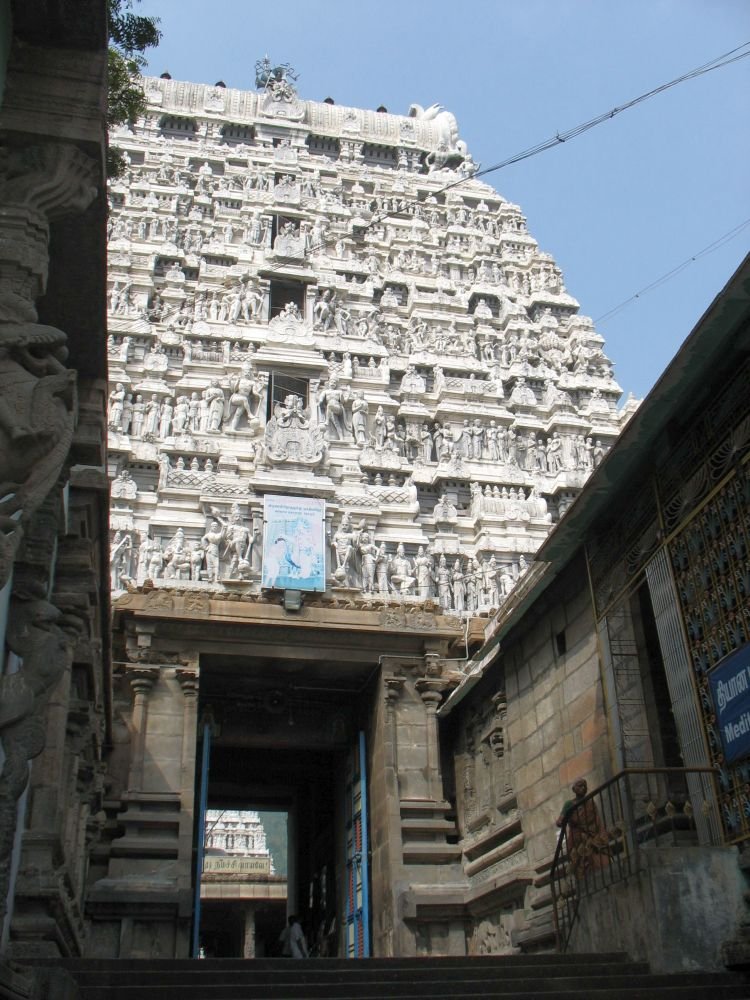
of King Vallalan. One of the major Gopurams at the Temple is the Vallala
Gopuram.
In front of the Gopuram is a small statue of Nandi.

And upon one of the columns of the Nandi platorm is a sculpture of King Vallalan.
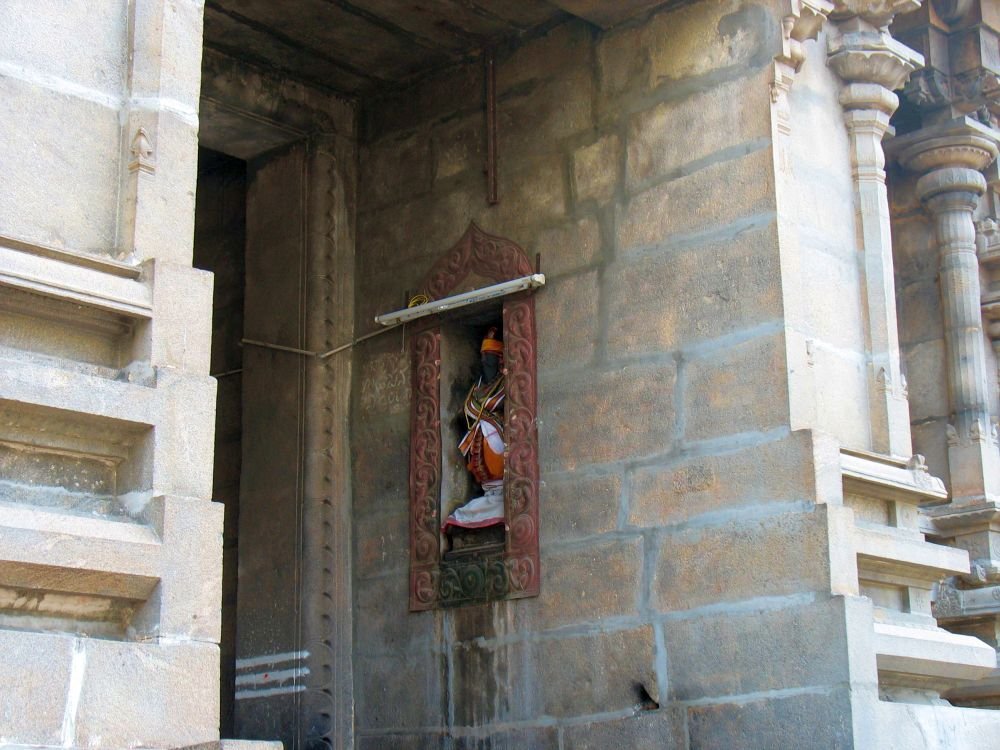
High in a niche on the right side of the walkway through the Gopuram is a
statue of the King, which is daily maintained by the Temple priests.
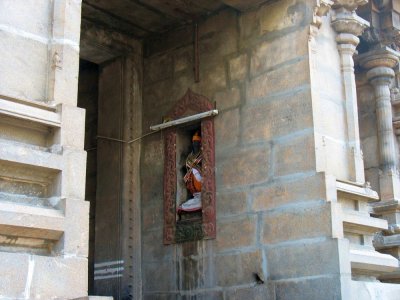
And close up, to view a very good representation of the loved ruler.

|
|
|
|