

Isakki Swamigal also known as Panchamukha Swamigal,
belonged to Tirunelveli District. He was born on May 2, 1917 to father
Chella Perumal Pillai and mother Muthammal. From his early days, he
exhibited strong devotional thoughts and maintained a consistent
spiritual practice. At the age of 13 years whilst still a schoolboy, he
journeyed with his parents to Tiruvannamalai to attend the Karthigai
Deepam Festival. In those days due to haphazard transportation, the
family decided to walk to the Festival town. Thus it was after a long
and arduous march the family finally arrived at Tiruvannamalai. Soon
after arrival they went on circumambulation of Arunachala; on reaching
Nirudhi Lingam, the young boy experienced a strong attraction to Lord
Siva - and felt a powerful urge to meditate at that place. However as he
was only a child, he kept silent about his desire and continued with his
parents upon Arunachala girivalam.
Upon arriving at the Panchamukha Peaks, Isakki Swamigal was to say that
he had the sensation that he was at the foot of Mount Kailash. As his
spiritual thoughts increased, tears flowed from his eyes and his heart
was fully inspired to meditate at that place. It was from that day
onwards that he felt a strong attachment to Panchamukha Darshanam and in
later times spent so much time there that he popularly became known as
Panchamukha Swamigal.
|
|
On the southside, Arunachala manifests as a single form but on the
eastern side - Panchamukha, Arunachala appears as five peak points. The
place that Lord Siva from the "One" divides into five moorthis to
perform the essential functions that keep the world alive:-
Creation - Sadyojata. West. Earth
Protection - Vamadeva. North. Water
Aghora - Dissolution/Rejuvenation. South. Fire
Tatpurusha - Concealing Grace. East. Air
Ishana - Revealing Grace. North-East. Ether
Thus the five faces of Shiva are represented by the
five peaks of Arunachala - Panchamukha Darshanam. Contemplation upon
which has a beneficial effect.
After having experienced Karthigai Deepam and Arunachaleswarar Temple,
the young boy with his parents travelled northwards and took darshan at;
Virinjipuram, Kanchipuram, Thiruthani, Tirupathi, Kalahasti and
Thiruvetriyur. Afterwards they travelled visiting Temples at;
Virudhachalam, Vadalur, Chidambaram, Sirkali, Rameshwaram and Trichy. At
Trichy they worshipped Thayumanavar Swamigal, then proceeded to
Thiruvaranagam and Thiruvanaikaval. The young Isakki Swamigal and his
parents started their journey in the Tamil month of Ippasi and returned
to their village in the Tamil month of Margazhi on Thiruvathira Star
Day.
Upon completion of the pilgrimage, Isakki returned home with his parents
where he uneventfully completed school. Upon reaching maturity, by
arrangement of his parents, he married. Although living the life of a
householder the young Isakki's heart was full of thoughts of Arunachala
and he often visited Tiruvannamalai and while there would stay at Appar
Swamigal Mandapam. When on pilgrimage to Arunachala he would undertake
girivalam and meditate near Panchamukha Point - like this several years
passed. But soon he began to have the thought to remain at
Tiruvannamalai.
Sometime between 1959-1960 in the Tamil month of Avani in the Tamil year
Vikari, Isakki left his house at Tirunelveli and came to Tiruvannamalai
where he lived with his wife and son in a house near Ammani Amman
Gopuram on the southside of Arunachaleswarar Temple. He was at the time
around 42 years of age. Many would come to visit him at his house where
he consulted as a country Doctor practising herbal and traditional
medicine.
For several years Isakki Swamigal daily undertook Arunachala girivalam
and started to become famous amongst locals. Groups of people started to
follow him around the hill chanting 'Om Namah Shivaya,' and 'Arogahara!
Arogahara! Annamalaiku Arogahara!' Increasingly more locals began to
follow him during his giripradakshina. On every circumambulation, when
reaching Panchamukha Point, Swamigal would stop and engage in
meditation. During his days, Swamigal met and saw a number of siddhars
and yogis who went round the hill on giripradakshina.
Swamigal performed meditation at several places around Arunachala. It is
believed that it was at the northside of Adi Annamalai near the Kavasa
Theertham, that Lord Annamalaiyar showered His blessings upon Swamigal,
and gave him the power of healing. It was from this time that he
exhibited a more intuitive approach to his patients. He would sometimes
gather a small piece of earth from Arunachala, make a mud ball and place
it into the ear, nose or mouth of the patient. At other times he would
give a stone or leaf from the Hill for the patient to carry.
People who came for darshan of Isakki Swamigal started to tell him their
problems and ask for his blessings. Some came to Swamigal and requested
he cure their disease. He instructed all to surrender to Lord Siva in
the form of Arunachala and that by performing girivalam of the Hill,
problems would be solved and illness cured. Based on the problems and
diseases concerned, Swamigal advised giripradakshina of one mandala (48
days), two mandala (96 days) or for three mandalas (144 days). Many took
his advice and performed giripradakshina to relieve their difficulties.
To avoid the constantly growing crowds around him, Swamigal moved to
another part of the Hill.
During his life, it is reported Isakki Swamigal performed Arunachala
angapradakshina (pradakshina by rolling the body in a clockwise movement
on the ground) 1008 times. Even today, it is thought that Swamigal in
his astral form performs girivalam twice daily. Close to the statue at
the Panchamukha Shrine it is believed Swamigal performs meditation each
day at noon. Near that place there is a well which he created
specifically in order to supply drinking water for devotees.
There are reputed to be 360 ponds dotted around Arunachala girivalam and
also several natural springs on the Hill itself. Swamigal said that on
the northern side of Arunachala there is a big stone called the 'peacock
dancing stone point,' below there is a spring called 'Arasudayan
Sunaei,' which has cool, sweet water throughout the seasons. At the
southern part of the Hill, there is another natural spring called,
'Pugunthu Kudithan Sunaei,' at this spring the pathway is very narrow
and one has to bend close to the ground in order to enter. Inside, it is
wide and broad and the water is cool and delicious. It is said that at
this place one can always hear the sound of an echo.

Swamigal's Samadhi
Until 1975 from 12.00 to 2.30 p.m. Swamigal performed meditation daily
at Panchamukha Point. He had been to all parts of Arunachala and knew
each and every bit of the Hill. Isakki Swamigal's samadhi is located at
Panchamukha Point. He reached samadhi on January 9, 1991 at the age of
74 years.

Samadhi of Isakki Swamigal
Panchamukha Darshanam
Walking along the outer giripradakshina path, about a hundred yards
after the Kubera Lingam shrine, on the right side there is a shrine with
five small Shiva Lingams on a raised pedestal circumscribed by a round
stone platform entitled 'Arunachala Panchamukha' in Tamil. Arunachala
from this point appears as five peaks otherwise known as Panchamukha -
five faces.
The point known as the Panchamukha Darshanam located on the northeast
side of Arunachala, has been highly revered for many years. It is said
that the great Arunachala Saint Sri Seshadri Swamigal
when as a child (before even visiting the Hill) whilst living at his
native place of Kanchipuram, would draw pictures of Panchamukha Peaks.
Although the fame of Panchamukha dates back to antiquity, it is only in
the last thirty years that it has become a well known and outstanding
aspect of Arunachala girivalam.
One of the reasons for its increasing fame is its association with
Isakki Swamigal. It was his great love and belief in Panchamukha Peak
that inspired many of his devotees to develop their own special
connection with this spot.
It is reported that one of his better known devotees, Mother Umadevi,
developed psychic powers because of the time she spent at Panchamukha
Peaks and the grace of her Guru. It was this grace and spiritual opening
that lead to Mother Umadevi's connection with the late Sri Seshadri
Swamigai - of whom she was in her life regarded by many as a channel and
spokesperson.

The above statue was installed at Panchamukha Shrine while Swamigal was
still living to indicate the spot he favoured during his daily
meditations at Panchamukha Darshanam. The statue also marks the place
that nowadays he is believed to visit daily in his psychic body to give
guidance and encouragement to devotees of Arunachala. The Samadhi of
Isakki Swamigal is in a room about 50 yards from the statue and is
identified by the presence of a Lingam. Interestingly the Samadhi of
Isakki Swamigal was constructed by A.D.M. Panneerselvam as guided by his
own teacher Mother Umadevi.
At the Shrine of the Panchamukha Darshanam, there are five lingams which
were installed at this Shrine comparatively recently. Each of these
lingams correspond both to one of the Hill peaks and to a face of Lord
Shiva in his five-faced aspect (Panchanana Siva). In addition each face
of the Lord represents one of his fivefold aspects.
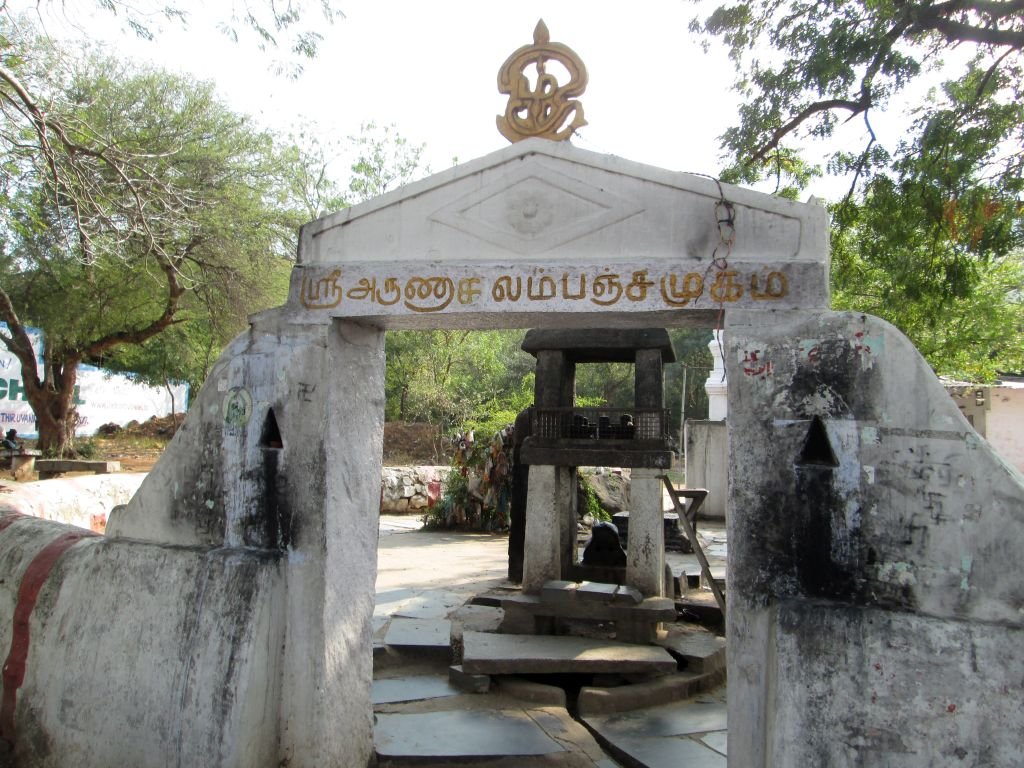
Panchamukha Shrine
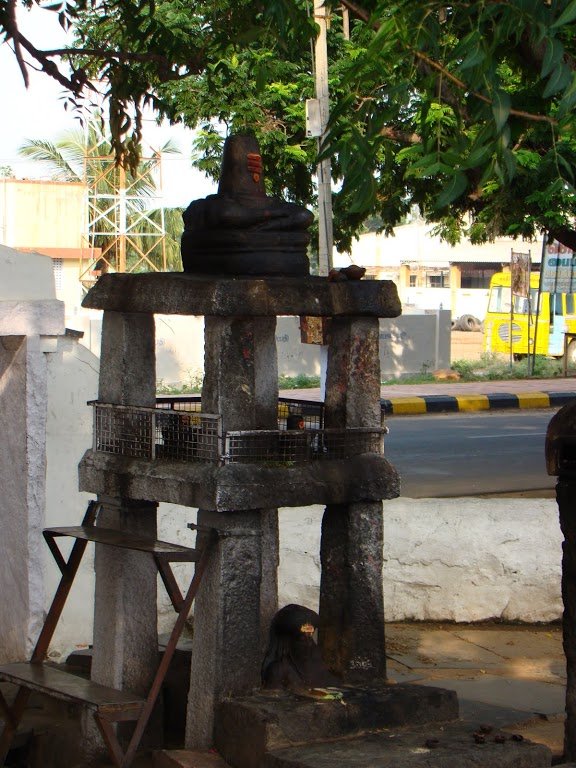
5 Lingams with Statue underneath

5 Lingams at Panchamukha Shrine

Lingam on top of Platform

Recently built Durga Shrine and 5 Peaks background
An explanation of the five lingams, with each corresponding to a face of
Lord Shiva (in his five-faced aspect) and to one of the Hill peaks
follows below:

Panchamukha Darshanam
Ishana - Skyward Face:
Also known as Sadasiva, Ishana Siva is associated with Anugraha Shakti
(power of blessing). This face is skywards. Which means it is on top of
the other four faces which face the four directions. This fifth face of
Shiva represents the creation; balance, annihilation energies and
control and chaos energies. This is the Lord of creation and represents
the mind power (chit-shakti), the element earth (or air according to
some), the ritual knowledge of the Vedas, and the manifesting power of
the mind. It is represented by pure crystal and signifies the top. Among
the senses, this iconography represents the sense of touch and of the
body - the hands.
Tatpurusha - East Face:
The word 'Tat' represents Paramatma. Tatpurusha means the Saguna-filled
Para Brahman form. Also known as Maheshwara and is associated with
Thoridhana Shakti (power of concealment). This represents the form of
Shiva that is in meditation and Blessing the world. Hence this eastern
face is considered as the first face. The word 'Tatpurusha' means 'his
person'. One who is always behind a person to protect is Tatpurusha. It
is represented by yellow and signifies the face. Among the sense organs
it is the sense of smell, and in the bodily organs, the anus.

Panchanana Siva
Protection - Vamadeva. North. Water
Vama Deva - North Face:
The term Vama means left or innocent. If we stand facing east, the north
is to our left. Hence the north facing Shiva is worshipped as 'Vaama
Deva'. Vamadeva also termed as Vishnu is associated with Sthiti Shakti
(power of sustenance). The left of a person is representative of the
Shakti aspect. It represents 'Maya and the feminine strength and
beauty', Hence in the Ardhanarishvara aspect, we find the goddess on the
left side. Represented by red and signifying the navel. In the body
Vamadeva represents egoism (anava), the power of action (kriya-shakti),
and the element of air and among the senses; the sense of sight, and in
the body, the feet.
Creation - Sadyojata. West. Earth
Sadyajata - West Face:
West is called as 'Paschima or Pratyak'. The soul is called as
'Pratyagaatma'. 'Sadyaha' which means 'just now' and 'Jataha' means 'now
born'. Siva makes his presence felt through the countless souls being
born. Hence the name 'Sadyajata'. Sadyajata also named as Brahma and is
associated with Srishti Shakti (power of creation). Since the very
existence of any being starts from birth, the Sadyajata aspect of Lord
Shiva is prayed to first. In the panchanana form he represents the
northern face. In the body he represents the mind and sense of taste and
is represented by white and signifies the foot.
Aghora - South Face:
If we stand facing east, south is our right. Hence the right side is
called 'Bala'. As important as the right hand is for humans, the South
face is important to Lord Shiva. This is also famously known as
'Dakshinamurthi'.
Aghora also referred to as Rudra, is associated with Samhara Shakti
(power of dissolution). Those who worship the Aghora (the non-fearful
one) form of Shiva are called 'Aghoris'. Aghoris generally live in
graveyards and are naked, use things which the world has branded as
'inauspicious', and perform austere tapas; as their main belief is there
is no such thing as 'inauspicious' because all that exists is Shiva.
Aghora is represented by black and signifies the heart. He represents
the element fire and the power of desire.

Older Lingam and Nandi at Shrine
Isakki Swamigal (Panchamukha Swamigal)
"Encircling the mountain at its foot, is a necklace of road, some eight
miles in length. Along this necklace, the pilgrims make their journey,
circumnavigating the mountain, travelling in a clockwise direction. It
is said that a boon comes to those who make the journey and the more
austere the means of travel the greater the boon. Most pilgrims walk
around. Those hoping for a greater boon do the eight mile journey on
bare feet, while those far advanced in age or suffering from physical
disabilities travel by a horse-drawn vehicle or even by taxi.

Isakki Swamigal Panchamukha Darshanam
One man we met on our first visit to Arunachala had done the circular
sacred journey round the mountain in an extraordinary way and had a
truly remarkable boon. This was Isakki Swamigal of Tiruvannamalai. We
met him one evening as we stood by the side of a road coming out of the
town. Along the road towards us, with the beat of drum, sounding brass,
and tinkling cymbals, came a group of men. There must have been a dozen
of them, some carrying a canopy under which walked a man. Surely a
prince must be approaching, we thought. And when the group came in front
of us and stopped, we could see that he was truly a prince of the
spirit. His eyes were shining, a smile lit up his radiant face and
around him was the unmistakable vibration of one who has reached a high
level of attainment. My wife was so overcome that she pushed in through
the crowd of men around him and touched his feet. Then she stood up and
moved to join our friend and myself by the side of the road. Then the
procession moved on with its joyous marching music.
Our friend, Ma Tallyarkan, who was residing at Tiruvannamalai, told us
that it was Isakki Swamigal with a group of his devotees. From her, and
from other people, we heard the story of his journey around the mountain
and his boon. It seems that, lying horizontally on the ground, he
rolled the whole eight miles along the circular route. When he stood up
at the end of it, Lord Siva with his consort Parvati, were standing
before him. With this boon of the Siva-Shakti darshan, came the gift of
healing.
Isakki Swamigal was reported to be able to heal with spiritual power.
Miraculous healings were the result and people came to him in great
crowds. His consulting rooms could not cope with this huge influx, so he
took up a position near the road on the other side of Arunachala from
Tiruvannamalai. It was a quiet, pleasant spot. He went there at about
three o'clock each morning and droves of people surrounded him at that
time. Drawn by his elevated spiritual level, people began to gather
around him, treat him at their guru, and move about with him as we saw
that evening by the roadside.
[Edited from Howard Murphet 1971]
|
|
|
|



