Festivals
Vasantha Utsavam
Vasantha Utsavam is a ten day Festival observed at Arunachaleswarar
Temple, Tiruvannamalai which celebrates the arrival of the spring season
and depicts the blossoming of love. It also re-enacts the famed legend
of the burning into ashes of Kama, the God of Love and the resurrection
of Kama out of the burnt ashes. This festival is celebrated just after
the vernal equinox which corresponds to midday of the Gods day. The 10th
and final day of the festival coincides with the full moon of Chithirai
in conjunction with the Chaithra constellation.
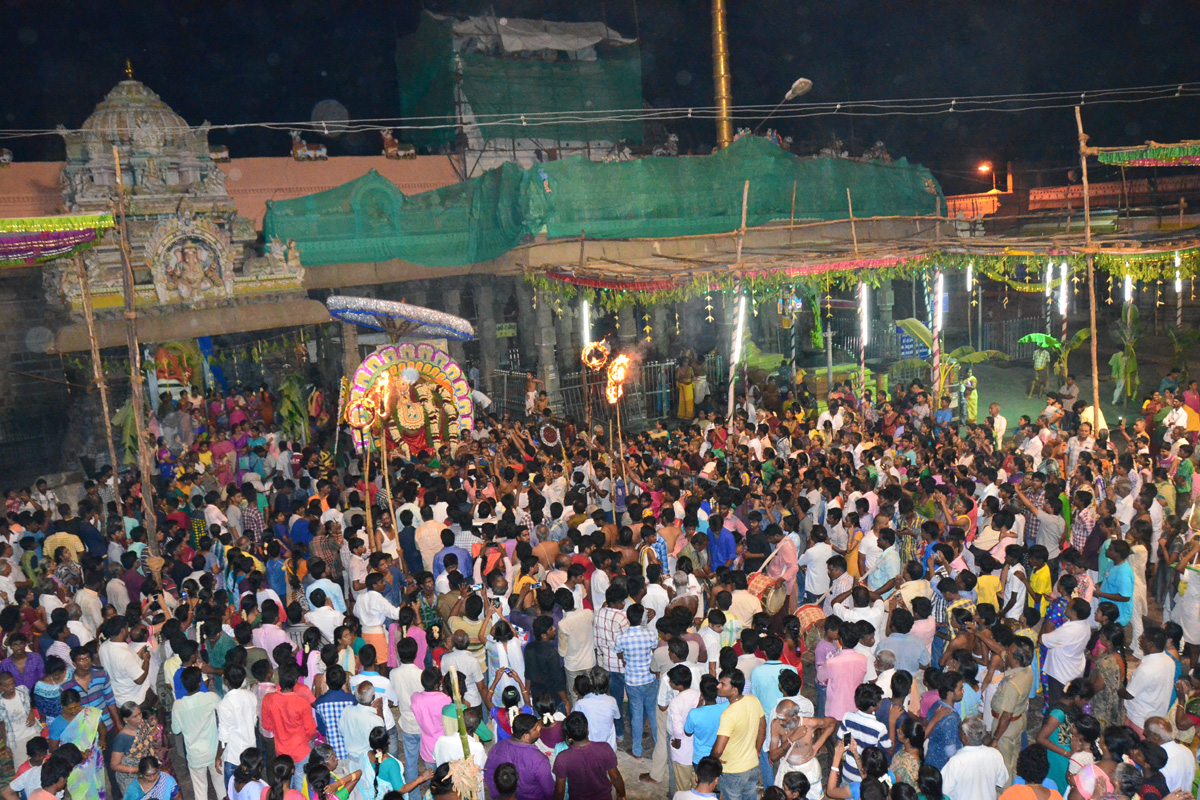
The Gods between Lord Ganesha and the flagpost
| |
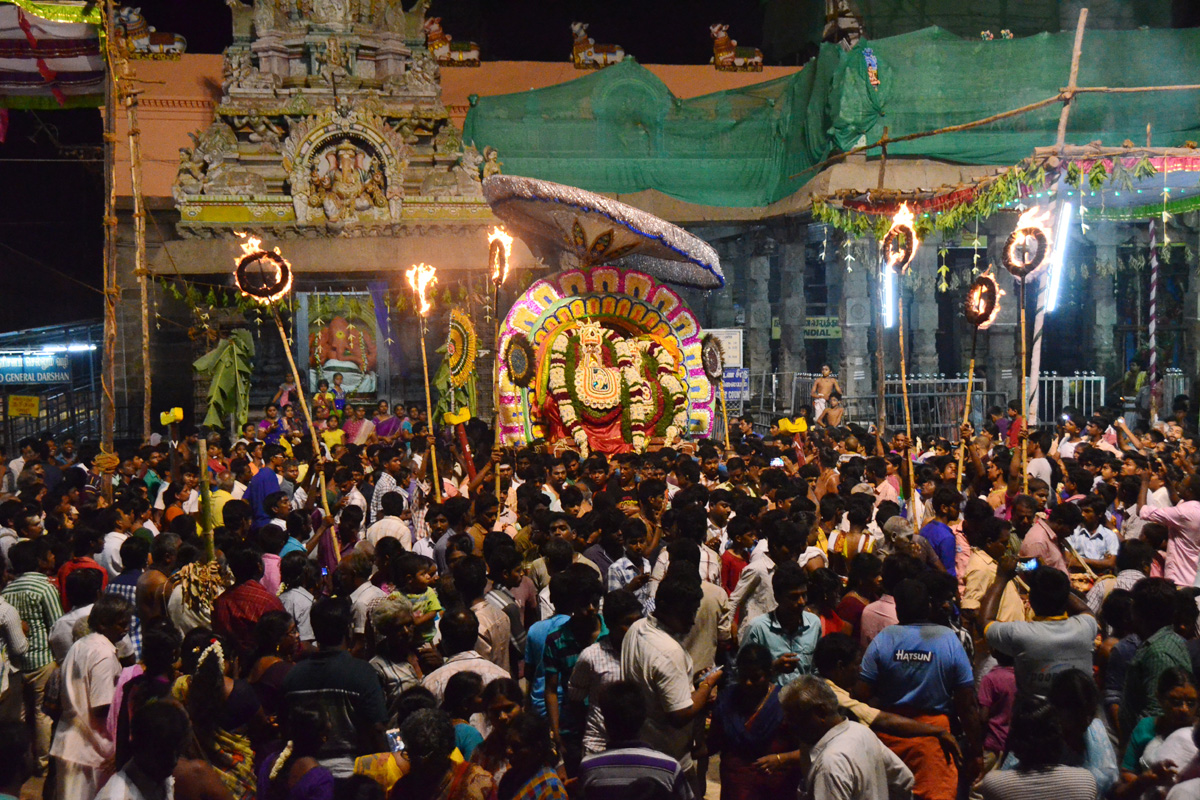
Lord Somaskanda
The deity of this festival is Lord Somaskanda, a form of Siva and
Parvati, whose shrine is located in the south-west corner, second
prakaram of the Arunachaleswarar Temple. After coming out of his shrine,
Somaskanda is installed on the first pandal in front of the golden flag
pole facing the main shrine. Here the Gods are placed under a canopy of
fragrant cooling roots called Vilamichaiver Vimanam (vilamichai root
canopy) hand-made by artisans and worshipped with offerings of flowers,
waving of lights and burning of camphor to the accompaniment of temple
musicians.
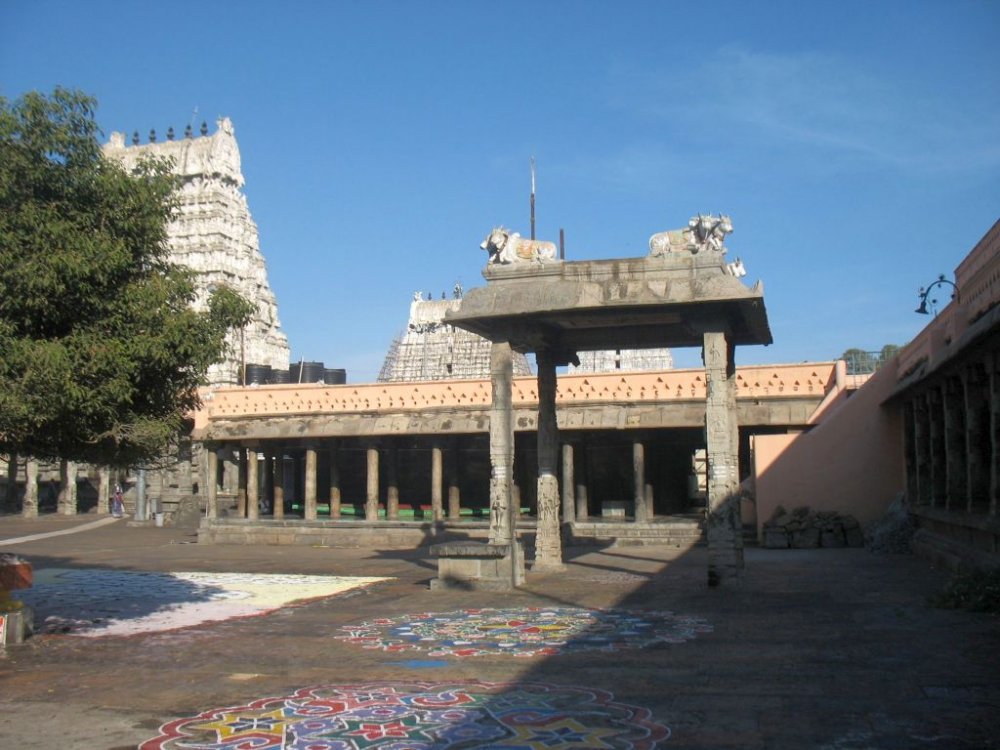
Paneer Mandapam before decorations
Next the Lord is brought to the second pandal, the Panneer Mandapam,
where He is greeted at first with the fragrance of Panneer (rose-water)
which is sprinkled downwards, from the top. An offering of light is made
and a priest climbs on the pedestal and sits at the feet of the Gods
who are decorated with garlands.

Festively ornamented Paneer Mandapam
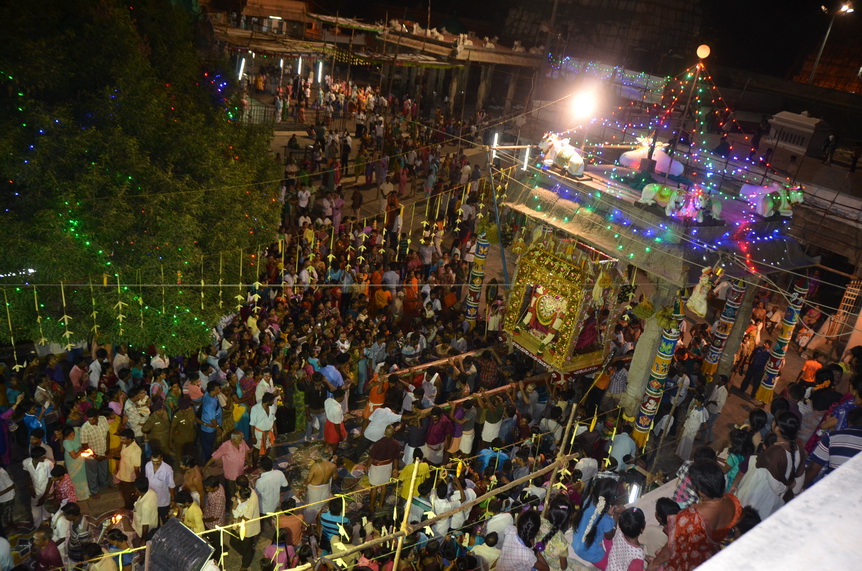
Paneer Mandapam
The Gods then perform a ritual-dance in front of the mirror placed on
the adjacent gallery, with musicians playing in accompaniment. Then the
Gods settle under the panneer mandapam to witness a series of elaborate
rituals.

Dancing in front of mirror
Flowers are showered by a Gandharva Kanni (virgin-nymph) and this is
enacted by a puppet activated with strings attached at a adjacent
gallery. The Gandharva Kanni puppet comes many times and showers buckets
of rose and jasmine flowers onto the Gods. After which a priest pours a
pot of water with five vilva leaves in front of the deities and makes
an offering of lights.

Pulley system on top of adjacent gallery

Gandharva Kanni (virgin-nymph)

Gandharva Kanni showering flowers on the Gods
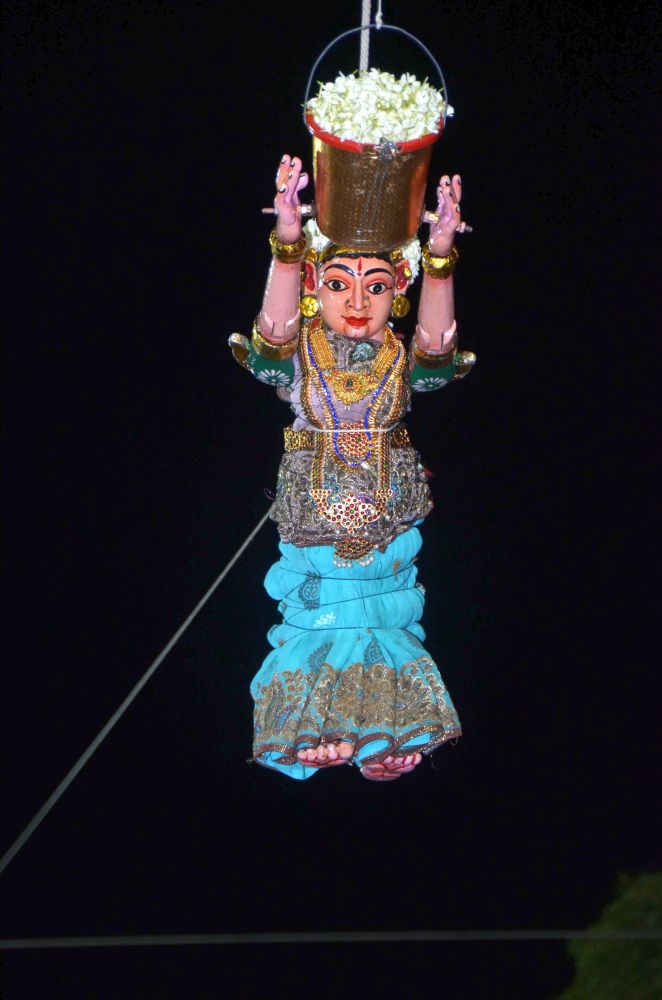
Bucket full of fragrant flowers
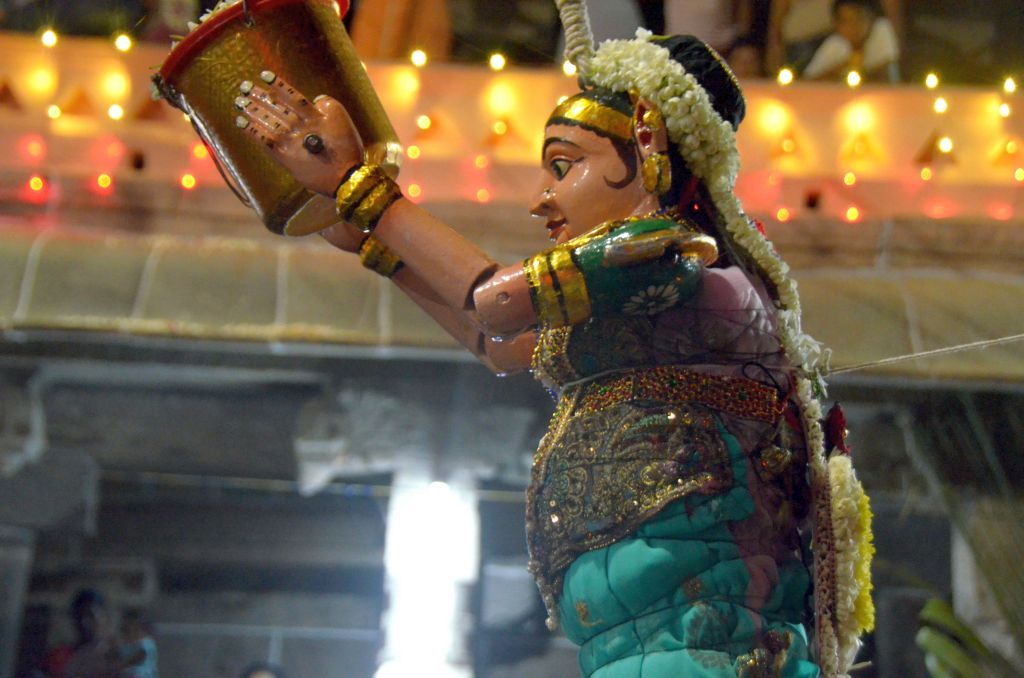
Close-up of Gandharva Kanni
After these rituals, ten processional rounds take place and the gods are
borne on their palanquin ten times around the Makila trees accompanied
by musicians and singers and followed by devotees. At the completion of
each round, the gods dance in front of the mirror and then remain seated
under the panneer mandapam where they receive two floral showers by the
Gandharva Kanni and a light offering.
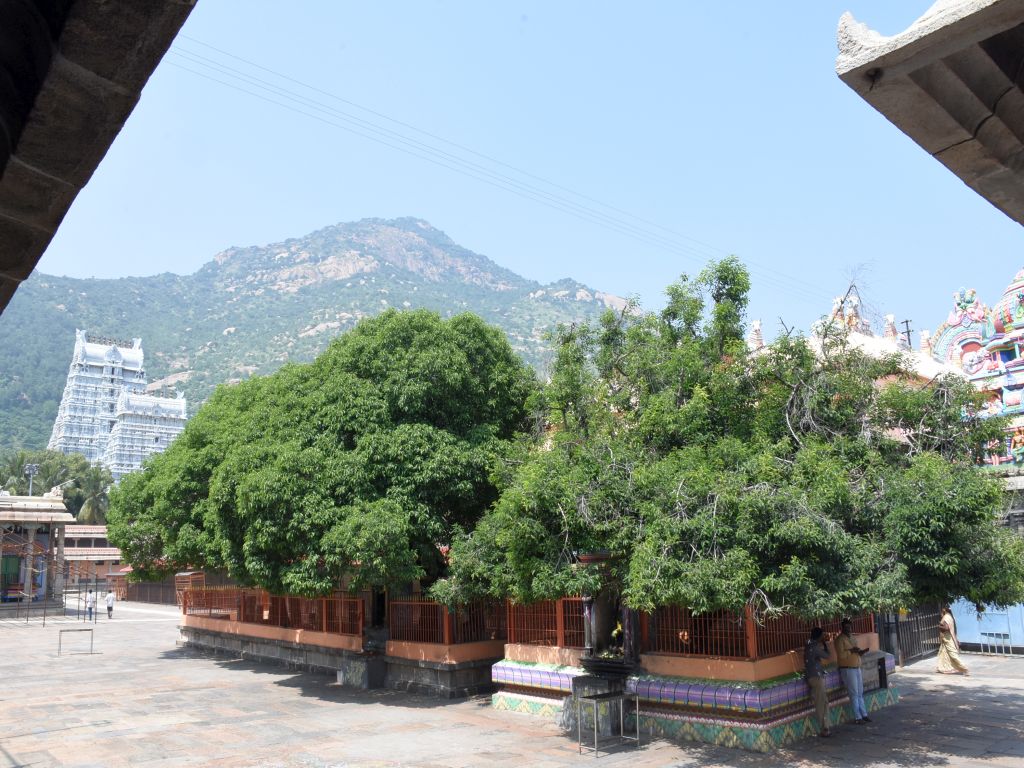
Makila Trees
This mahapradakshina i.e. round the sacred Makila Maram (trees) within
the Third Prakaram - occurs ten times every night for ten days = 100
times. The significance of the 'Makila Maram' comes from the Tamil word
which means to enjoy and denotes joy and exultation. In addition the
word 'makila' is often pronounced 'makuta' which means crown and refers
to the coronation of Lord Siva as the sovereign of the universe.
The third day of Vasantha Utsavam is designated as the birth-date of
Manmatha, also known as Kama the God of love. At 9 p.m. on the fifth and
eighth days the Temple lights are switched off so that the procession
is in the dark. After going around the sacred Makila Maram ten times the
lights are switched back on to great rejoicing.
During this sacred Festival the Jumbo Keswara Lingam, that is set in
stone on the raised platform in the midst of the sacred trees is filled
to capacity with water. Plants and flowers are placed to float inside
the recess of the Lingam, appearing to make the Lingam levitate and
blossom.

Jumbo Keswara Lingam
Kama also known as Manmatha
"When Shakti became Parvati, daughter of the king of Himalayas, She was
doing tapas for Lord Siva. At the same time the great sages, the four
sons of Brahma, Sanakar, Sanandanar, Santanar, Sanatkumarar came to Lord
Siva for enlightenment. The Lord gave them enlightenment in the form of
Lord Dakshinamurti.
Meanwhile the Devas, who were tortured by Surapadma and his brothers
Taraka, Simhamukha, knew that the demons could be killed only by the son
of Lord Siva and Shakti. Disappointed that both the God and Goddess
were doing yoga instead of marrying, they asked Kamadeva to disturb the
meditating Lord Siva with his arrows in order to induce lust for
Parvati.

Kama God of Love shooting arrow at Lord Siva
Kama went to the desolate forest where Siva was deep in meditation. He
was accompanied by spring, and in an instant the entire forest was
transformed into a beautiful garden. The time was ripe and Kama fitted
one of his flower-arrows into his bow of sugarcane and let the arrow
fly, aiming at the heart of Lord Siva. The arrow struck its target and
Siva opened his eyes. He instantly fell in love with Parvati. However,
his anger rose when he realized that Kama had interfered. Siva then
opened his third-eye, and gazed with blazing anger at Kama, the God of
love. Such was the potent power of Siva's gaze that Kama was instantly
reduced to ashes.

Sending cracker on string to ignite Manmatha effigy

Manmatha effigy

Manmatha effigy aflame
Shocked by the death of Kama, the Lord of Love, the Devas realised
further plans would not work. They understood that only sincerity wins
the Lord's grace and thus surrendered in front of Him and pleaded for
mercy. The Lord forgave them and Subrahmanya was brought into life for
the destruction of the demons.
On their request the Lord also brought back to life Kama, however with
the stipulation that Kama would be visible only to his wife. Because of
this Kamadeva is called 'ananga' (one without limbs). From that day on,
Manmatha has not had a physical form. Neither Gods nor mortals can
perceive him. He does his work unobserved, aided by his flower tipped
arrows of love.
The death and resurrection of Kama represent the spiritual truth of how
after the ego is destroyed, one is reborn as pure eternal Being. The
fact that the flames from the third eye of Siva burn Kama signifies that
the third eye of Jnana (knowledge) in one's heart must be opened
in order for the ego (ignorance) to be destroyed for no darkness can
prevail when the light of knowledge shines.
Kama the God of Love
Kama the God of Love, also known as Manmatha, is one of the mind-born
sons of Lord Brahma. Some accounts say he was mind-born son of Lord
Vishnu. Rati was his consort.

Kama, God of Love
Kamadeva is represented as a young, handsome winged man with green skin
who wields a bow and arrows with a parrot as his vehicle. His bow
is made of sugarcane with a string of honeybees, and his arrows are
decorated with five kinds of fragrant flowers.
The flowers on his arrows are: Aravinda (White Lotus), Ashoka, Cuta
(Mango Flower), Navamalika (Jasmine) and Nilotpala (Blue Lotus). Also
known as Unmada, Tapana, Shoshana, Stambhana and Sammohana.
Kamadeva has five arrows which are sometimes associated with five
effects that desire has on one afflicted by it. Kamadeva's five arrows
are said to be fascination, disturbance, burning, desiccation and
destruction.

White Lotus

Ashoka Flower

Mango Flower

Jasmine Flower

Blue Lotus
Chitra Poornima
The 10th and final day of the Vasantha Utsavam festival coincides with
the full moon of Chithirai in conjunction with the Chaithra
constellation.

Devotees performing Chitra girivalam

Crowds - evening of Chitra girivalam
Chitra Poornima is dedicated to Chitragupta, the keeper of deeds in the
house of Yama, (God of death) and to Indra, the leader of the Devas.
This full moon observance of girivalam at Arunachala, is usually the
most heavily attended of the year (other than Karthigai Mahadeepam
Poornima).
Chitragupta is the creation of Lord Brahma and the younger brother of
the god of death, Yama. According to Hindu mythology, Brahma is the
creator of the whole world. He first created sixteen sons from different
parts of his body. Then Lord Brahma created his seventeenth son
Chitragupta from his belly. Chitragupta is also called `Kayastha` as he
was created from the body of Lord Brahma. Chitragupta (Chitra
means picture, Gupta means hidden) represents the hidden picture of life
that is vital, yet unknown.
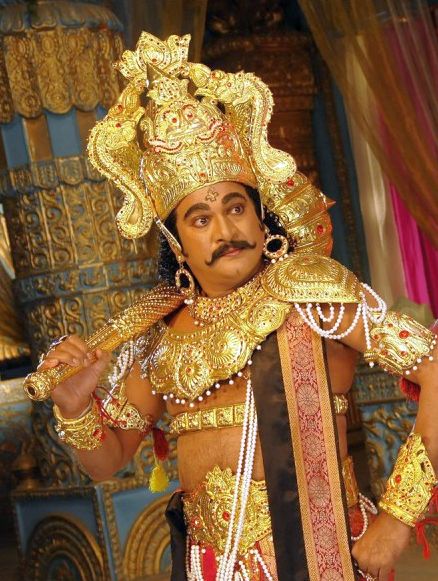
Chitragupta
Chitragupta keeps the good and bad registry of every birth and according
to ancestral belief, it is he who tallies a person's positive karma
against their negative karma and declares the result to the Judge on
High. When the full moon of Chithirai is in conjunction with the
Chaithra constellation, is believed to be the right time to gain
blessings to wash away sin and gain virtue.
It is a general belief that on this night, any religious act of
absolution like bathing in sacred waters or pradakshina around a holy
mountain will propitiate Chitragupta who may obliterate the records of
one's bad deeds as a result. Hence millions come to Tiruvannamalai on
this night to do giripradakshina.
Legend of Chitra Poornima
Brihaspati was the Guru of Indra, the King of the Gods. When Indra
disobeyed Brihaspati, Brihaspati relinquished his role of instructing
and guiding Indra. Consequently during the period of the Guru's absence,
Indra committed many evil acts. When the compassionate Guru resumed his
role, Indra wanted to know what he should do to expiate the wrongs he
had done in his Master's absence. Brihaspati asked Indra to undertake a
pilgrimage.
One day during this pilgrimage, Indra had the sudden realisation that he
had been redeemed from his sins. He looked around and noticed a Siva
Lingam under a Kadamba tree. Feeling sure that it was Lord Siva who had
helped him alleviate his sins, he worshipped the Lingam. Suddenly golden
lotuses appeared in a nearby pond as a manifestation of God's pleasure
and blessing. This legend is ascribed to have occurred on the day of
Chitra Poornima, at Madurai, Tamil Nadu.
This special day has come to be known in Tamil Nadu as Chitra Poornima.
It is advised that during Chitra Poornima one should remember this
story. With intense faith and a contrite heart it is believed that if
one admits to one's sins and resolves never to commit such errors in the
future and also pledges to always obey the Guru, then one's previous
sins will be forgiven.
|
|
|
|