Festivals
Navaratri
Each year Navaratri commences on the first day (pratipada) of the bright
fortnight of the lunar month of Ashvin. The Navaratri festival or 'nine
day festival' becomes a 'ten day festival' with the addition of the
last day, Vijaya Dasami (day of victory) as its culmination.
Origins of Navaratri
There is different mythology connected with this Festival. In one legend
Mahishasura, the King of Demons started a war against the Gods. To
combat him, the Gods combined their powers to give birth to 'Shakti'.
The Goddess fought the demon for nine nights and on the tenth day, the
Goddess slew it - thereby achieving victory over evil.
Another legend is that Goddess Uma the wife of Lord Siva and daughter of
Daksha - the King of the Himalayas - is said to return home for ten days
during Navaratri.
It is believed that Adi Shankaracharya gave upadesa at two primary
locations during the installation of a Sri Chakra at Srisailam (Andhra
Pradesh) and at Koolurmugambika (Karnataka). At the time of the
installations he directed women folk to worship the Goddess and seek Her
blessings for the wealth, prosperity and long life for their husbands
and overall happiness in the family.
| |
Navaratri is celebrated in many ways,
depending on region, local history and family influences. Some see it as
a way to commune with one's own feminine divinity. A widespread
practice honours the Goddess in every woman by inviting young girls to
the family's home and feeding and offering new clothes to the girls.
During the Festival, women also perform tapas and selfless acts.
Kolu Displays
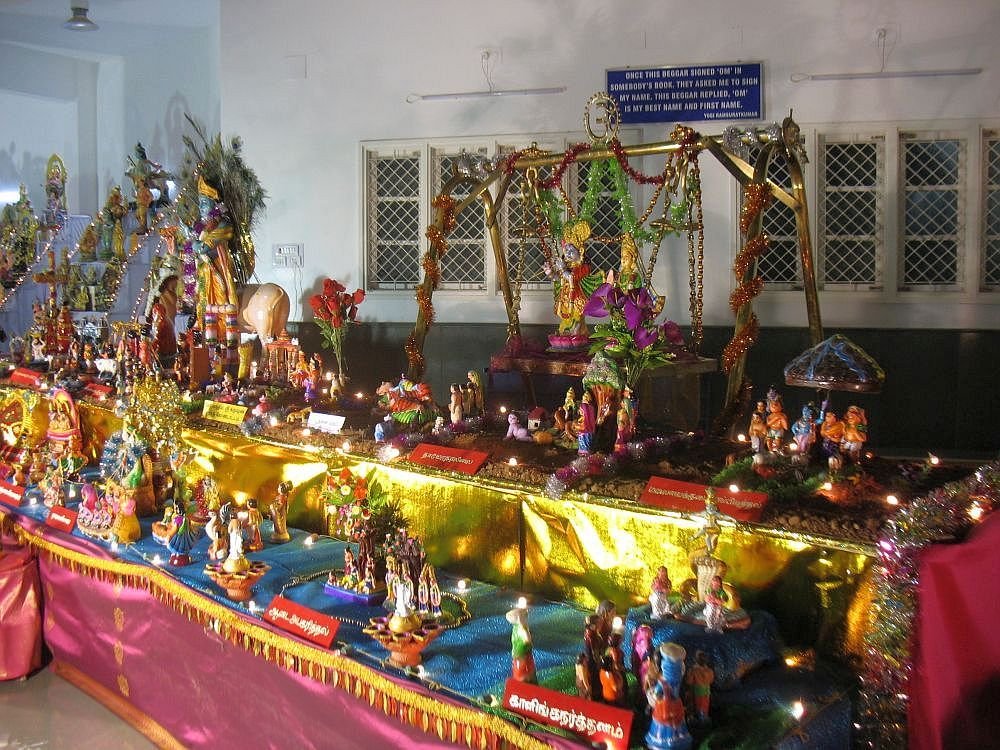
Families in Tamil Nadu traditionally prepare in their homes a Kolu, an
exhibition of small dolls, figurines and artefacts on a stepped,
decorated shelf. At least one murti of Shakti must be present, as well
as wooden figurines of a boy and a girl together to invoke auspicious
marriages.
Kolu Display at Yogi Ramsuratkumar Ashram
Kolu figurines can be simple or very complicated and based upon Gods and
saints, depictions of the epics and puranas, demigods, national
leaders, marriage, musical instruments, shops, current affairs and
scenes from everyday life.

Kolu Display at Dr. K. Shanti's Home
Historically Kolu had a significant connection with the agricultural
economy of Ancient India. In order to encourage de-silting of irrigation
canals the Kolu celebration was aimed at providing demand for clay that
was needed for the celebratory dolls. It is believed that the tradition
of Kolu has been in existence from the reign of the Vijayanagara kings.
Worship of the Goddess
The Goddess is worshipped in different aspects throughout this Festival.
During the first three nights, Durga is revered, then Lakshmi on the
fourth, fifth and sixth nights, and Saraswati until the ninth night.

Durgai Amman Temple, Second Day
Durga (invincible) is the epitome of strength, courage and ferocity. Her
devotees approach Her, sometimes with difficult penances, so that they
may imbibe Her traits and win Her protection. Durga personifies that
aspect of shakti which destroys negative tendencies. The process of
trying to control our senses is likened to the mind which resists all
attempts at control. Durga is the Goddess that wages war to destroy our
vasanas.

Seshadri Ashram, Day 5
A more gentle worship is observed for Lakshmi (also called Annapurna
"Giver of food"). She is the Goddess of abundance, wealth and comfort;
the ever-giving Mother, worshipped for well-being and prosperity. A
traditional way of invoking Lakshmi is to chant the Sri Suktam. In Her
honour, food is prepared and offered to neighbours and visitors - thereby
strengthening community ties.
On the full moon night following Navaratri, it is believed Lakshmi
Herself visits each home and replenishes family wealth. We worship
Lakshmi in order to imbibe ourselves with positive qualities. Lakshmi is
not just the giver of wealth; She is the Mother who gives according to
the needs of Her children.

Angalamman Temple, Day 8
The last three days of Navaratri; exalts the Goddess Saraswati, which is
the form of Shakti that personifies wisdom, art and beauty. The name
Saraswati literally means "flowing one", a reference to thoughts, words,
music and the Saraswati River. Mystically Saraswati is believed to be
the keeper of the Gayatri Mantra, which is chanted during the festival
to invoke Her supreme blessings. Devotees meditate on this mantra as its
considered the door to Divine wisdom. Saraswati is the embodiment of
knowledge and the illuminator of Supreme Truth.
The ninth day is the day of Ayudha Puja which is the worship of whatever
implements are used in one's work. On the eve of Ayudha Puja,
implements connected with one's work are placed in front of the Goddess
Saraswati and on the next day Puja is performed upon the implements.
The tenth day of this Festival is Vijaya Dasami, or the "Festival of Victory", symbolising the moment when Truth dawns within.
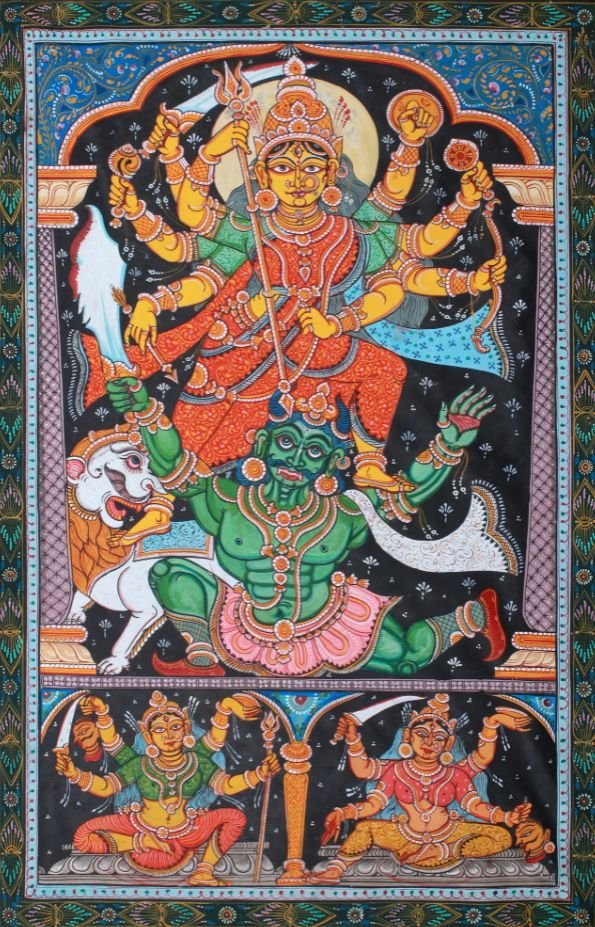
Vijaya Dasami: Mahishasura Mardini
There lived a demon named Mahisha who wanted to become invincible and so
prayed to Lord Brahma for the boon of invincibility. With this aim, he
performed severe penances and austerities and the three worlds trembled
under the strength of his penance. The power of his tapas led Lord
Brahma to grand him a boon. At first the demon Mahisha asked for
immortality, but when Brahma stated that every creature who was born had
to die, Mahisha asked for the boon that no man should be able to kill
him.
Now that Mahisha was invincible, he started doing evil deeds;
terrorising all on earth and boldly commenced to conquer the gods in
heaven. His attack was so powerful that even Indra's mighty thunderbolt
could not drive him away. Mahisha took over Indra's throne and
created havoc. Unable to tolerate this tyranny, the Gods joined together
to create a powerful female form with ten arms - Goddess Durga who
embodies the source of all power. The Gods then bestowed upon Her their
individual blessings and weapons. Armed as a warrior, the Goddess
appeared on the back of a fierce lion to battle with the Mahisasura.
After a fierce combat the Goddess was able to slay the demon with her
trident. She thus earned the title of Mahishasura Mardini - the destroyer
of Mahishasura.
Vijaya Dasami is the day on which this event occurs. It is the tenth day
after the nine nights of Navaratri and signifies the victory of the
Goddess Durga over the powers of darkness. Legend reputes that the
battle between Durga and Mahishasura took place on the slopes of
Arunachala. The Goddess screamed at Mahishasura, "This is a sacred place
where only sages and devotees of Arunachala can reside, therefore do
not incur the wrath of my Lord. It is ordained that I should fight and
kill you." Hence She took him outside the borders of Tiruvannamalai.
After a nine day battle She slayed him and returned to Tiruvannamalai
triumphantly, whereupon She continued her tapas on the slopes of
Arunachala. Thus the Navaratri festival although celebrated all over
India, has the greatest significance in Tiruvannamalai.
Spiritual Practices during Festival
Some of the spiritual practices associated with Navaratri include fruit
and milk fasts, japa (mantra chanting), chanting of hymns dedicated to
Devi in Her different forms, prayer, meditation and recitation of sacred
texts including the Devi Mahatmyam, Sri Lalita Sahasranama and the
Durga Saptashati.
Aspects of the Goddess daily worshipped
Day 1: Goddess Shailaputri Shaila means mountain and
putri means daughter. Since Goddess Parvati is the daughter of the
Mountain God, she is given importance on this day.
Day 2: Goddess Brahmacharini is a form of Durga Devi who reduces anger.
Day 3: Goddess Chandraghanta It is believed she has a third eye and fights against evil demons. During puja, jasmine flowers are offered to placate Her.
Day 4: Goddess Kushmanda Her name means cosmic egg. She spreads energy and warmth to all.
Day 5 Goddess Skandamata This Goddess rules over Budha (Mercury). She is both fierce and loving.
Day 6 Devi Katyayani Women offer prayers to get a peaceful married life.
Day 7 Goddess Kalaratri She is fierce and frightens evil spirits. She is the most destructive avatar of Kali and rules over Shani (Saturn).
Day 8 Goddess Mahagauri She wears only white clothes and rides a
bull. On this day, Kanya Puja occurs which is dedicated to young virgin
girls. The day is celebrated with dance, fun and prayers.
Day 9 Devi Siddhidaatri This Goddess fulfils all wishes.
Day 10 Vijayadasami After 9 nights of prayers, the tenth day is kept aside for Vijayadasami. A day of new beginnings based upon Victory.
Colours of the Festival
A specific colour represents each day of the Festival
Day 1 Yellow signifies warmth and joy. Enhances happiness and positivity in life
Day 2 Green is colour of fertility, serenity, growth and auspicious beginnings
Day 3 Grey represents balance, humbleness and improvement
Day 4 Orange creates calmness and positivity. Invites happiness and creativity
Day 5 White symbolises peace and harmony. Promotes security, purity and happiness
Day 6 Red signifies love, bravery and passion. Invites vitality, energy and beauty into life
Day 7 Royal Blue promotes elegance and grandeur. Signifies charisma, attainment, success
Day 8 Pink symbolises harmony, goodness and love
Day 9 Purple represents peace and nobility. Signifies prosperity, opulence and success
Photographs of Navaratri at Tiruvannamalai
Tiruvannamalai has many beautiful Temples dedicated to the Divine
Mother. Visit the Albums to view the Alangarams of the Goddess during
Navaratri and also to see Kolu displays at Yogi Ramsuratkumar Ashram
with sections depicting the abodes, life and legends of various Gods and
Goddesses.
|
|
|
|