The Brahmmotsavam of Karthigai Deepam Festival in
Tiruvannamalai is not confined to the Temple alone but involves the
whole town. The rituals and ceremonies connected with it have endured
for centuries. On the first 3 days of the 17 day Festival various
functions occur at the Durga Amman Temple, Tiruvannamalai, and on the
last four days of the Festival, functions include Theepal of various
Gods on Ayyankulam Tank, and Hill rounding by the Gods on their chariots
in order that they may give darshan and blessings to those who live
around the Hill. The Deepam itself which is lit on the night of
MahaDeepam, depending on the advice of Priests consulting their
astrological texts, can last from a minimum of 7 days to a maximum of 13
days.
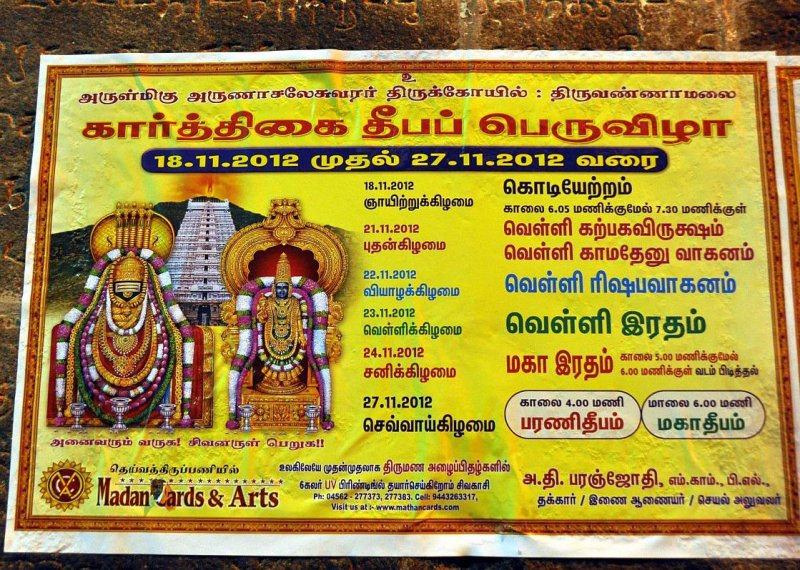
The main Festival lasts for 10 days and begins on Uttradam day with flag
hoisting (dhwajarohanam) marking the beginning of festivities. After
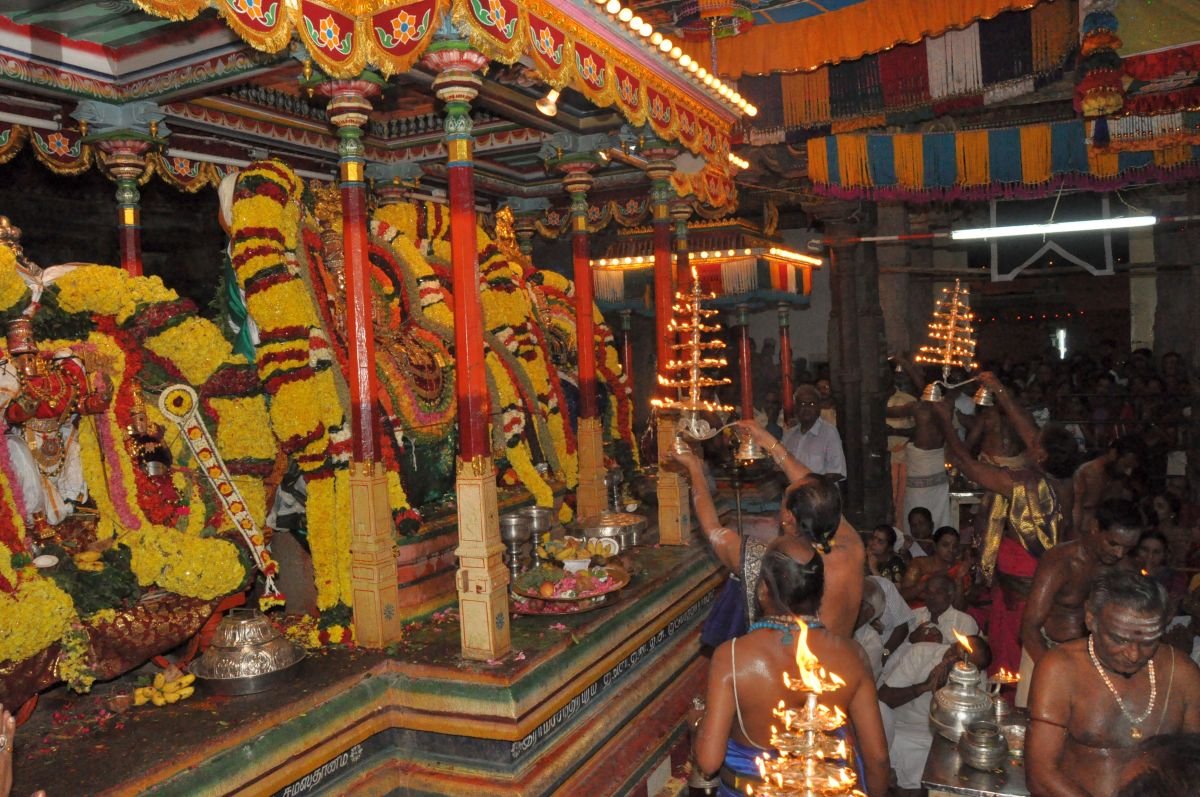
this ceremony, the image of Arunachaleswarar along with other deities
are installed in the Kalyana Mandapam, where they remain housed for the
next 10 days so that visiting devotees may have darshan.
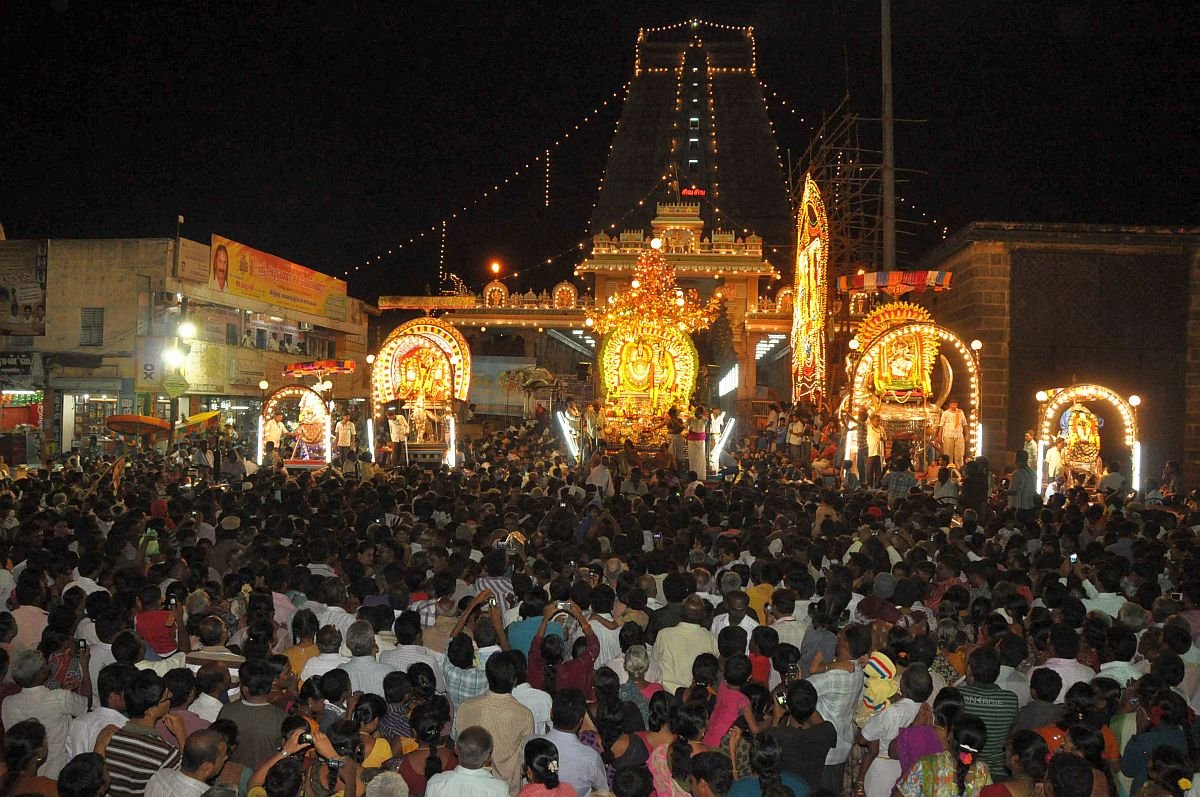
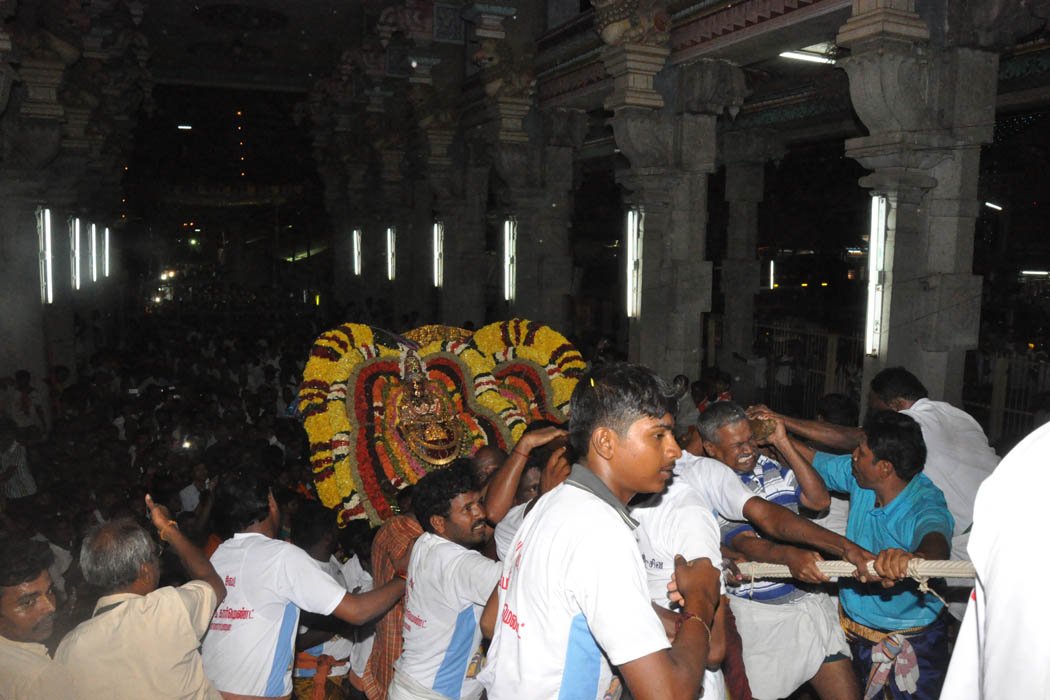
Processions occur both day and day inside the Temple and around the outside perimeter of Arunachaleswarar Kovil.
|
|
The Flame-crowned Mountain
[Narrative by Swami Abhisktananda 1970]
The Festival of Thibam (the Tami form of the Sanskrit dipa) is observed
all over South India. Everywhere on that evening the gateways and
facades of private houses are lit up with innumerable oil lamps. But
there is no question that its most splendid celebration takes place at
Tiruvannamalai itself. Vast crowds gather from far and near, and
hundreds of thousands of pilgrims pour into the town during the days
which precede the darshan of the light. They camp out everywhere - in the
porticoes of the Temple; in the many mandapams in the town or its
suburbs; they find places on the side-walks or under trees - no matter
where - to take a few hours rest between the liturgical celebrations.
Innumerable sadhus whose life seems to consist of an endless series of
pilgrimages) are accommodated in the monasteries, both large and small.
It is also a great Festival for cripples and beggars; the roads and
outskirts of the town become a real "Court of miracles".

Flag Hoisting - First Day Deepam Festival
A permanent Dhvaja Stambha is believed to be a later addition to the
Hindu Temple. Initially, it was temporary and was primarily used to
indicate the beginning of a Festival or other auspicious days and
occasions. Whatever its history may be, the Pancharatra scripture states
that a Temple without a Dhvaja cannot be said to be a Temple!
The Dhvaja Stambha, or Flag Staff, which is an important feature of the
Temple, is located in front of the Siva Sannidhi. A Dhvaja Stambha
usually represents the prosperity and pride of a Temple. But some texts
suggest that the bottom of a flag post symbolizes Shiva, middle portion
Brahma and the top portion Vishnu.
Today, Dhvaja Stambhas are permanent and in the case of Arunachaleswarar
Temple it is plated with a precious metal. The top portion of the flag
staff has three horizontal perches or three branches pointing towards
the Sanctum Sanctorum. It symbolizes righteousness, reputation and
propriety; or the Trimurtis - Vishnu, Brahma and Shiva. At the base of
the Flag Staff is located the Bali Pitha (sacrificial altar for one's
malas, sins). One who hoists the Dhvaja (flag) aloft a Hindu Temple
attains a divine body and enjoys the company of gods." So declares the
treatise Deeparnava.
There is a widespread belief that the Dhvaja Stambha gives an idea to a
devotee from a long distance about the idol installed in the Temple and
about the Vahana or Vehicle used by the deity. It is hoisted when there
is an auspicious ceremony or Festival in the Temple.
Symbolically, hoisting the flag suggests setting out to conquer, and a
devotee comes to the Temple to conquer his ego and gain control over the
baser nature with the help of the Supreme Being. The Sanskrit
word for the flag is 'Dhvaja' and it means whatever is raised. In the
religious sense, whatever raises man to a higher level of understanding
and activity is a 'Dhvaja.' The flag also suggests hope and desire to
overcome ignorance. The Temple visit invigorates the devotee, recharging
him with strength and bravery to face the hardships of daily life
knowing full well that in the ultimate those who have surrendered to the
will of God find victory.
The Dhvaja which suggests the victory of good over evil is a symbol of
victory and superior wealth. It signifies commanding respect, patriotism
and kingship. The Kings of old in order to exhibit their Lordship over
their kingdom and proclaim their continuing rulership would hoist a flag
above their battlements or palace .
God is seen as the King of Kings, an Emperor above all emperors. He is
the Supreme Power, not just on earth but in the entire universe; which
is, after all, His creation. The Hindu mind thus thinks it only
befitting that tribute be paid to this all powerful Master - the Dhvaja
is thus sent aloft. If an ordinary citizen pays tribute to his king and
receives favour, why the surprise when a devotee pays tribute to his
King!
Sometimes the flag or banner hoisted in the Temple acts as a message
board and gives an idea about the deity worshipped in the Temple. It
also suggests which particular incarnation or manifestation of the God
is given importance in the Temple. An interesting minor function of the
Dhvaja is its use as a warning. Just as a city without the king's flag
is a city 'without owner', a mandir without a Dhvaja is open to
harassment by evil elements. The Dhvaja warns, "Beware, your entry is
prohibited!"
[Reference: Indian Temple Traditions - Kalpatharu Research Academy]
Deepam Festival - Fourth Night
Wish Fulfilling Tree and Cow
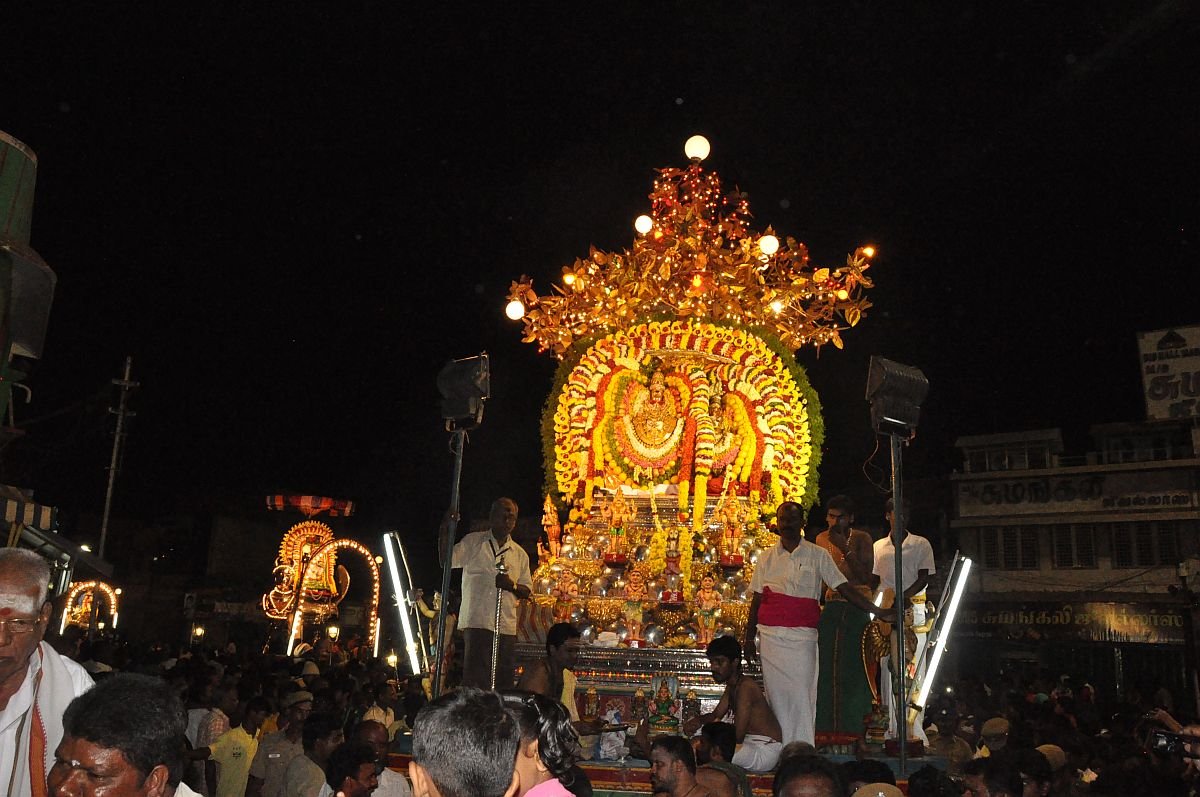
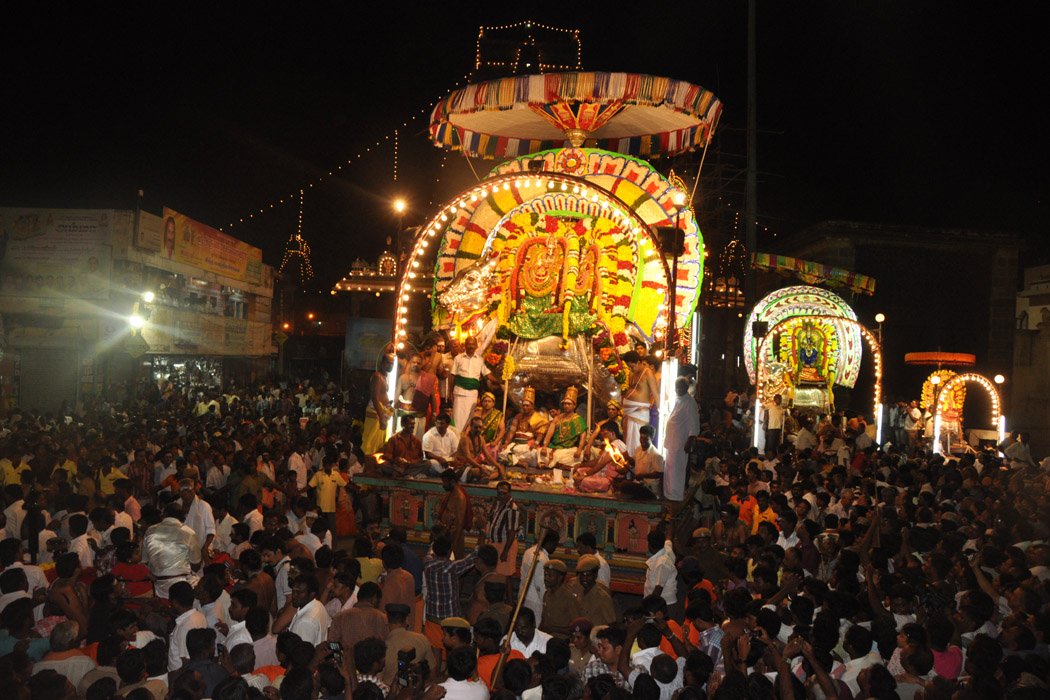
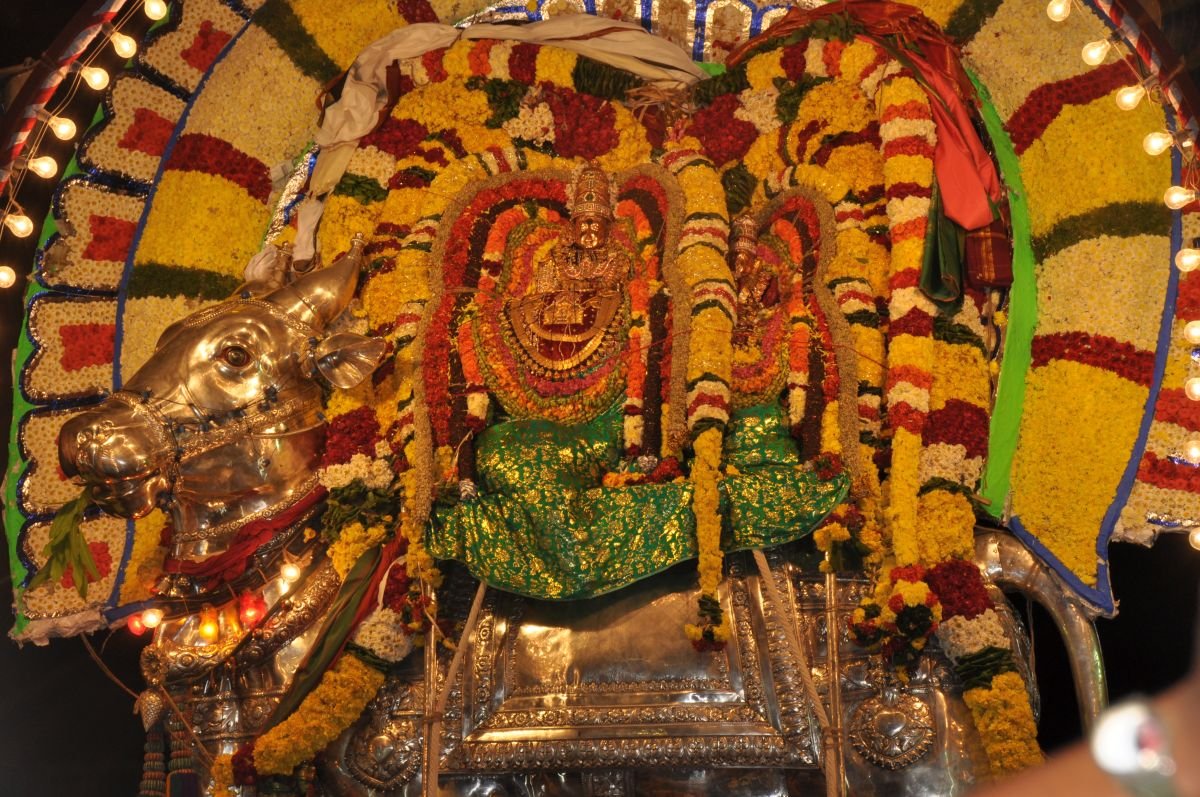
One of the most popular of the processions over the Deepam Festival, is
that of the Kamadhenu, the wish fulfilling cow, and the Kalpavriksha,
the wish fulfilling tree. Both of which emphasis the wish fulfilling
aspect of Arunachala.
The Kalpavriksha is a mythological divine tree said to fulfil all
desires. Its mythology narrates that the wish-fulfilling tree originates
from the churning of the ocean of milk afterwhich the god Indra,
returned with the tree to his paradise. During the Deepam Festival on
the Fourth Night Lord Arunachaleswarar and his Goddess, Unnamulai are
seated under the Kapavriksha Tree.
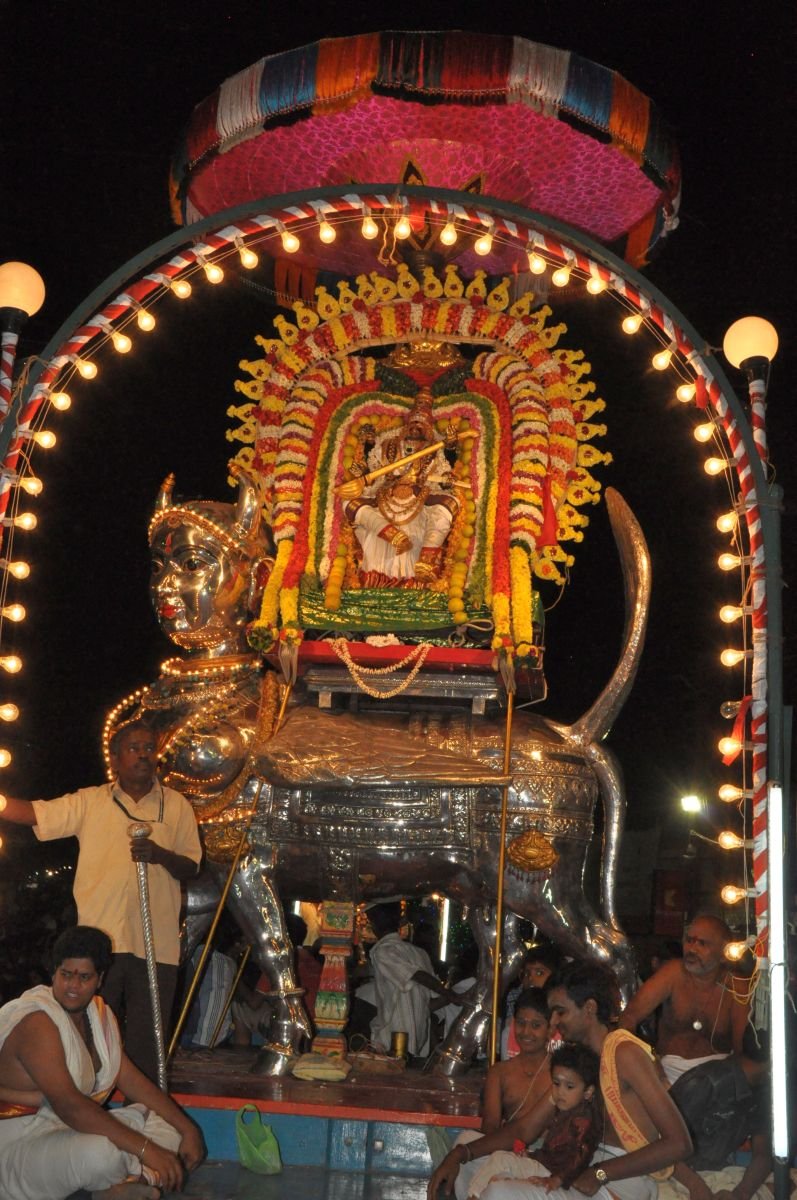
The second Radham appearing of that night is that of Kamadhenu
(literally meaning; the cow; "from whom all that is desired is drawn",
or "the divine cow providing for all needs"). The Kamadhenu is a divine
cow-goddess described in mythology as the mother of all cows who
provides the owner with whatever is desired.
Theories as to the origin of the Kamadhenu are two-fold. One scripture
describes her as the daughter of the creator god Daksha, and another
narrates that Kamadhenu also emerged from the churning of the cosmic
ocean. Upon the divine cow during the Deepam night procession is seated
the Goddess Saraswati.
It is often the wish fulfilling aspect of Girivalam that brings many
pilgrims each Poornima (Full Moon) to the Hill, whatever the difficulty
or weather, to perform circumambulation. In fact many pilgrims prefer it
when the conditions are extreme (cold, heavy sheeting rain, previous
tapas such as fasting and mortification etc) as they believe that the
greater the difficulties they overcome in performing girivalam, the
greater will be the focus of their sankalpa (intention) and success of
their wish.
The now deceased Annamalai Swami explains the power of the Hill as thus:-
". . . It is not an ordinary hill. It is spirituality Itself. It has a
powerful, magnetic pull to the Self. Seekers who come to this place with
the intention of realizing the Self will have untold benefits to do
pradakshina on a full moon.
In the proximity of this holy hill the presence of the Self is more
powerful and more self-evident than anywhere else. Indian mythology
speaks of a wish-fulfilling tree. If you find this tree and tell it what
you want, your wish will be granted. Arunachala also has this
reputation. This is why so many people come here on a full moon night
and walk around it. But very few people come here and ask for their
complete freedom, for undisturbed peace.
Arunachala is a light. It shines. It is the light of the Self, and the
light of the Self will continue to shine on you whether you believe it
or not.
Arunachala is greater than all other religious places. There are other
holy, powerful places in the world, but none have the power of
Arunachala . . . There is a huge amount of shakti, or spiritual energy,
here."
Deepam Festival - Fifth Night
Big Silver Rishba
[Narrative By Swami Abhishekananda 1970]
"The Festival begins nine or ten days before Thibam. Each evening there
are solemn processions round the Temple, which are over and above the
regular worship and the private offerings of puja which go on through
the day.
The day comes to its climax with the procession in the evening, which
lasts almost until midnight. It is led by Ganapati, the commander of the
heavenly hosts (gana-pati). Next comes Karttikeyi, the lord of the
Pleiades, also called Murugan or Subrahmaniyan in Tamilnadu, who like
Ganapati is a murti of Shiva and also his son. Surya, the Sun, comes
next, the great sign of Light. There there is Uma or Parvati, Shiva's
consort; and lastly, on his white bull, Shiva Arunachala or
Annamalaiyar. According to custom they are carried on the Temple cars,
whose dimensions and decoration are on the grandest scale. Every evening
there are different cars, each more impressive than its predecessor. Of
these the most remarkable are the huge car of carved wood, more than
ten metres high, on which the statue is carried on a day during the
Festival and also the silver bull on which Shiva rides on the fifth day.
I was strongly recommended not to miss the night of the silver bull, and
had accordingly arrived in very good time. I passed the time in the
shrine of Sundareshwar, which was under the supervision of my friend
Arunachala Aiyar, Ramana's old companion in the Virupaksha cave.
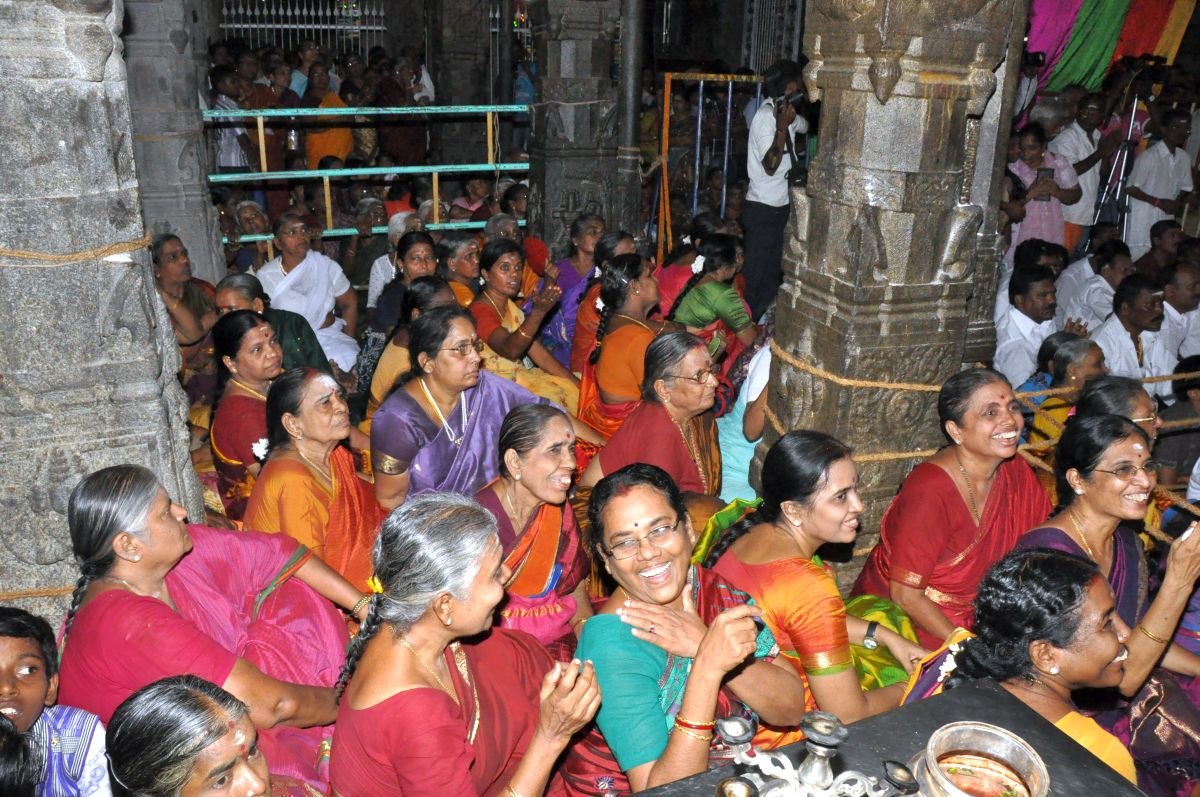
Saminathan was also there that evening. The mandapam was crowded with
people who like us were waiting to see the procession. They plied
me with endless questions, which I answered as well as I could.
Saminathan, not knowing Tamil, remained silent, his eyes half shut, lost
in his prayer. I have to admit that my questioners were much more
impressed by Saminathan and his silence than by the answer that they
sought to extract from me; but they paid even less attention to the
disquisitions which which one or other of the company sought
remorselessly to improve the occasion. They clearly told me so . . .
During this time, in the Kalyana Mandapam, 'the portico of weddings,'
the priests were busy decorating the murtis, using silk and gold
brocade, flowers and valuable jewels. Meanwhile the cars were standing
outside the Temple, and on them also ornaments were being loaded. All
this seemed to go on interminably; but at last there was a sudden blare
of trumpets form the inner courtyard, their sound re-echoing loudly from
the high enclosure walls. Accompanying the trumpets was the low drone
of the tamburas, while the silvery melody of flutes pierced though the
noise of the crowd.
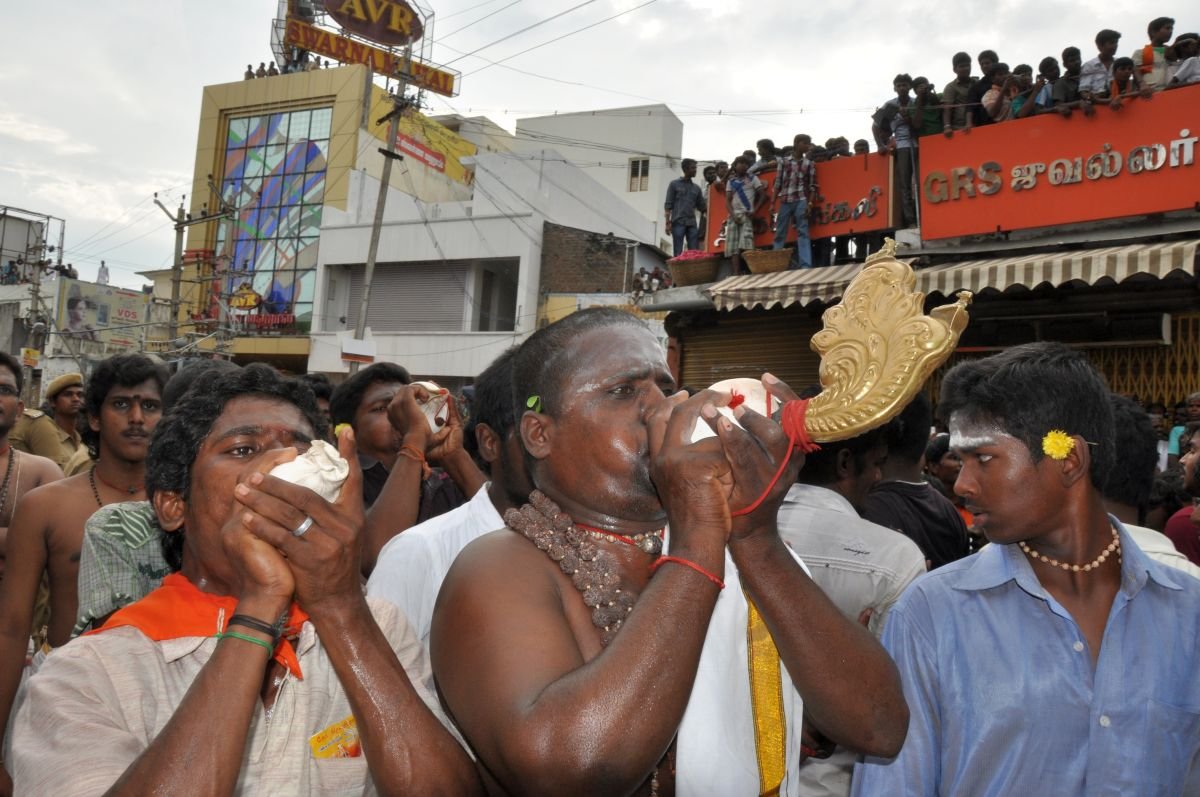
Now the file of murtis with their attendants emerged from their shrines,
and when they passed under porticos or gopurams the echo from the low
vaults become deafening. Soon they came to the Vallalla Gopuram
where were were standing. In front were the torch-bearers, next the
musicians, and last the palanquins, carried on the bare shoulders of the
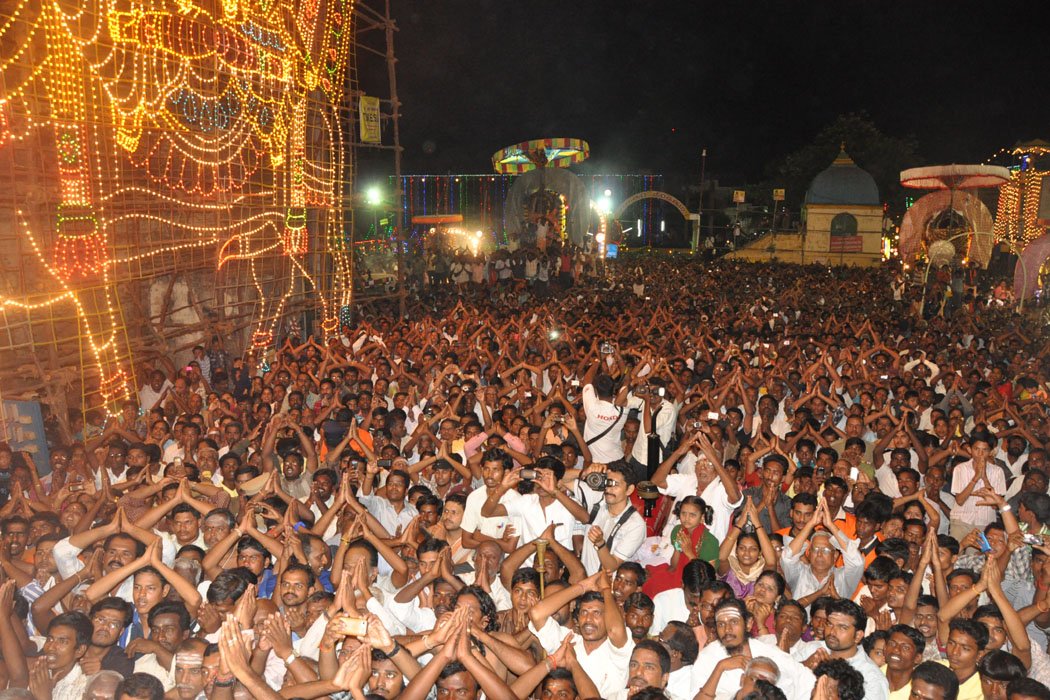
priest. On either side was the tightly-packed crowd with outstretched
arms, giving cries of fervent devotion. Somewhere breaking coconuts on
the ground, while others held out at arm's length gilded trays of
burning camphor. The enthusiasm spread, swelled, multiplied itself
irresistibly. Light, heat, scents, sounds, bodies and souls too, all
were weeded together into a single vast and vibrant outpouring of love
in honour of the Lord of Arunachala.
We followed behind the procession, crossed the outermost courtyard,
passed under the huge gopuram, passed under the huge gopuram over the
East Gate and reached the long colonnade which adjoins it on the east,
where the cars were waiting. The murtis were installed on the cars; and
once again the work of decoration was resumed with renewed zeal;
flowers, jewels, lights in even greater quantity. The crowd was now more
tightly packed than ever. The friend who was guiding me managed to open
a path for me immediately in front of the chief car, where the
palanquin of Shiva Annamalaiyar was mounted on the silver bull.
Over him was held a huge ceremonial umbrella which touched the roof
overhead. Behind the car was a trailer with a dynamo, and thousands of
electric bulbs sparkled all over the palanquin, the platform, the
decorations, among the jewels, silks and flowers which adorned the
statue. Appusastri, who was standing near, was so moved that he cried
out: "How can one doubt any longer that it is the Lord himself upon his
car, who presents himself for our adoration!" Yet this Appusastri was an
old disciple of Ramana and Ganapati Muni, who more than anyone had
lectured me about advaita, proclaiming that whatever appears is maya,
that there is no distinction at the heart of Being, and that it is
vanity to worship God as an "Other" . . . !
Deepam Festival - Maharadham
To get a sense of the excitement and colour of the procession of
Maharadham, read the below narrative written about a previous Deepam.
Reproduced with the permission of Apeetha Arunagiri.
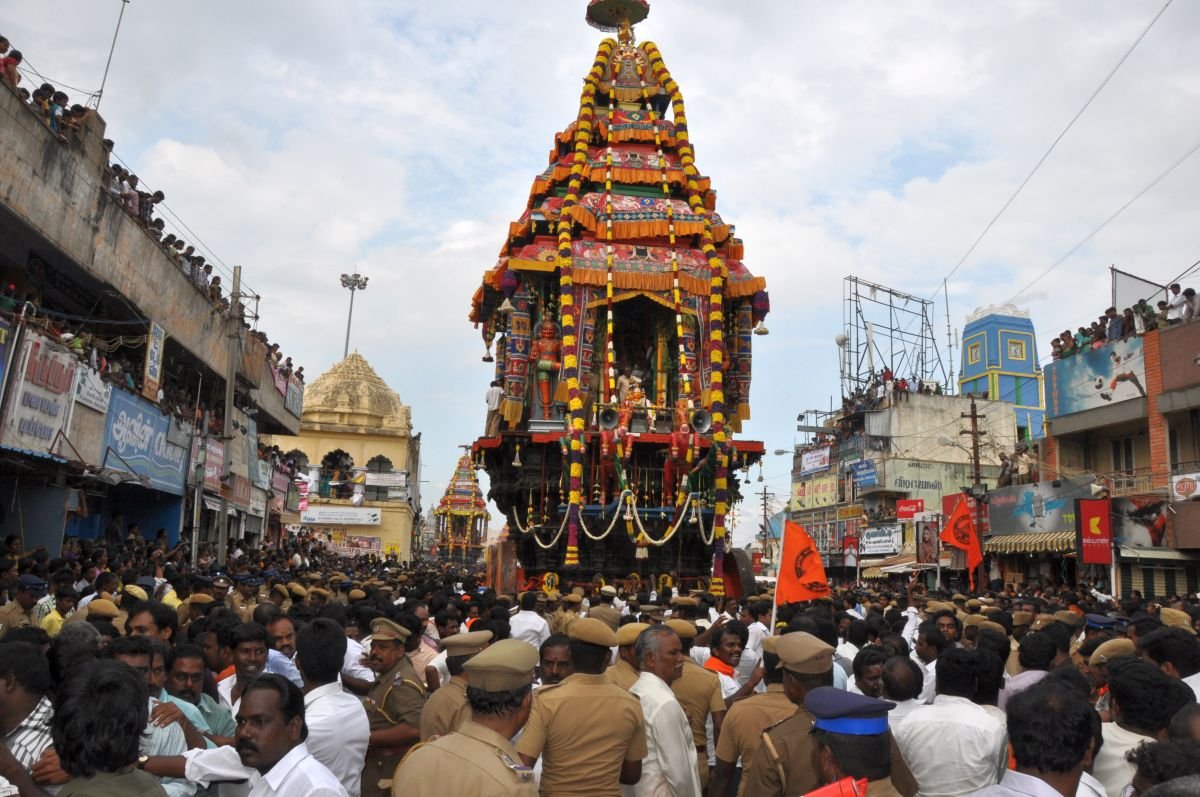
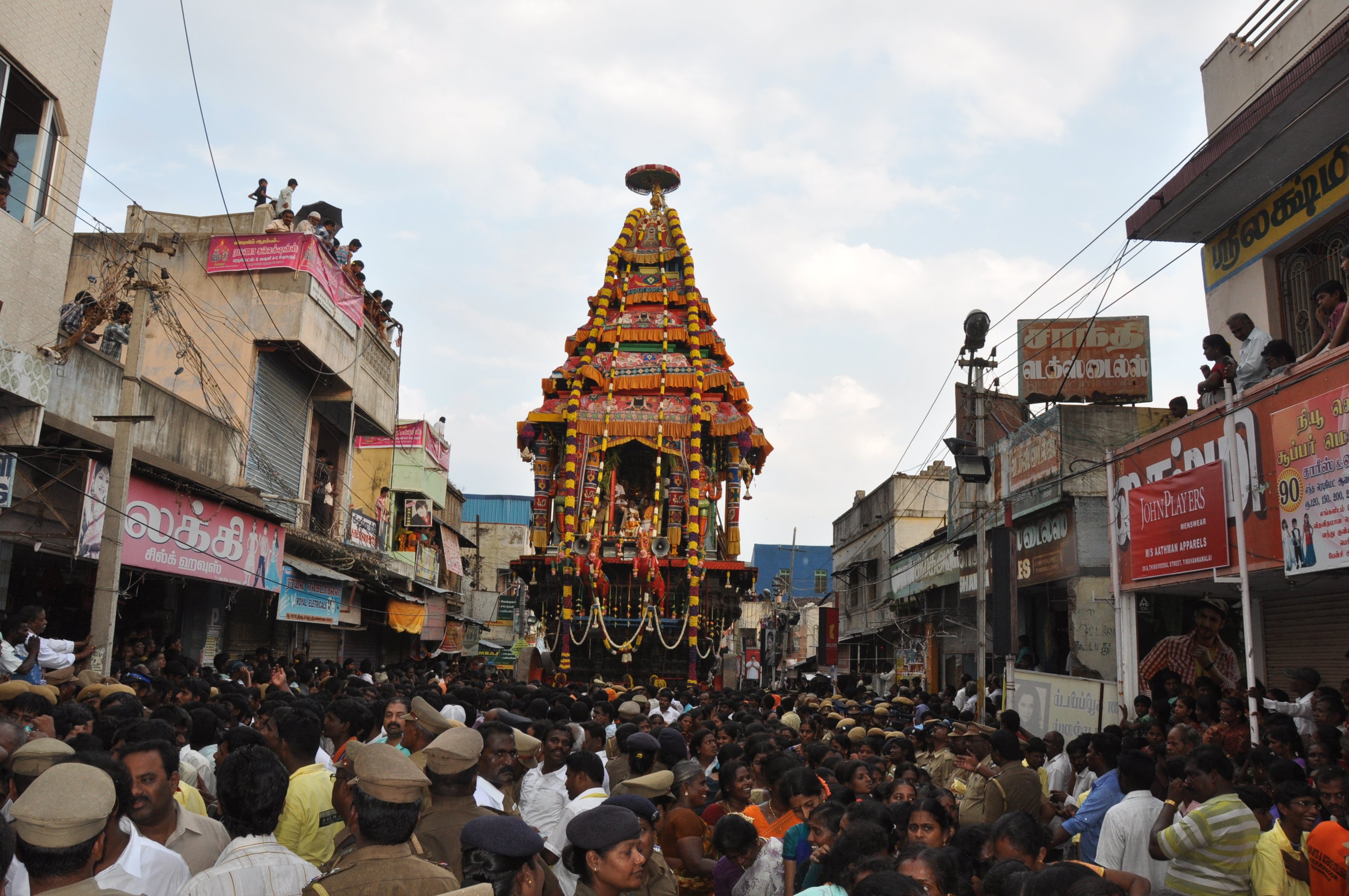
"Three days before the lighting of the Light, it is Big Car Day.
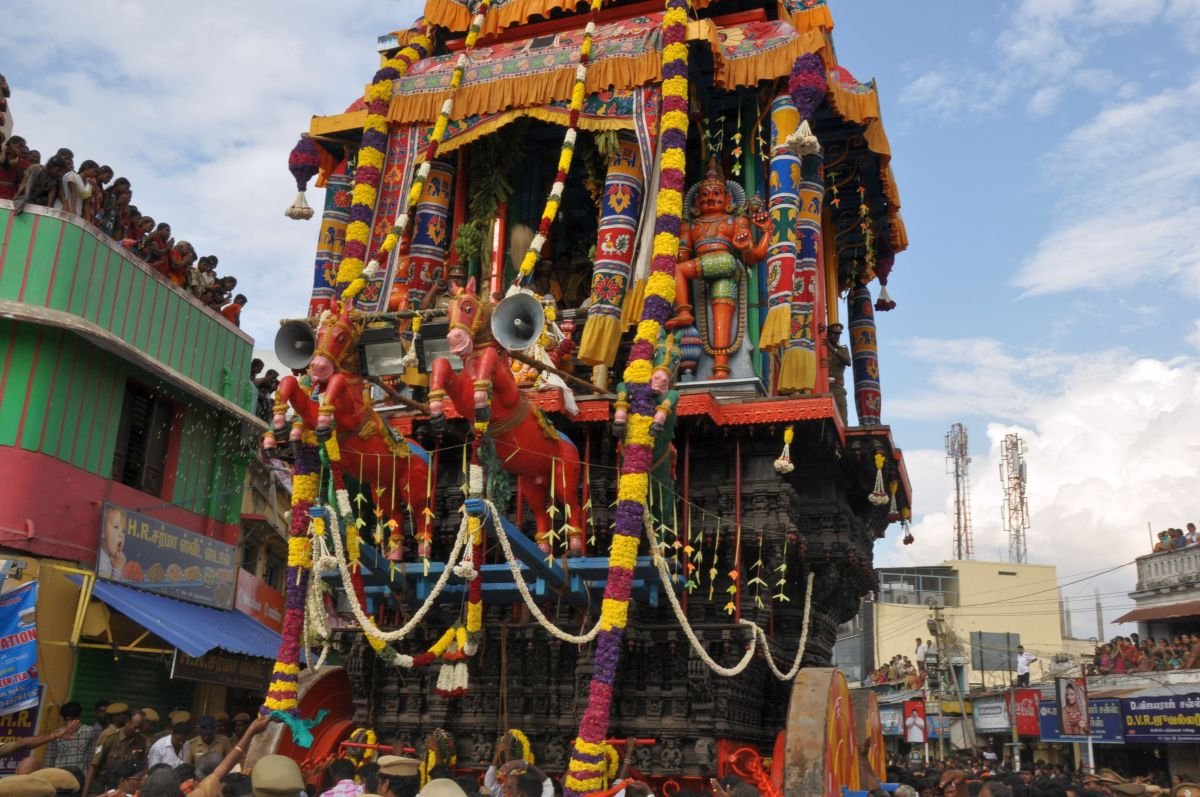
There are several Big Cars, huge wooden carts carved with fabulous
mythological figures telling all the stories, with the biggest wheels in
the world; the biggest car dwarfs all the buildings in town except the
giant Temple towers. It is called The Big Car.
On this day parents or family members also carry their babies around the
procession route. They string a sari on a sugar-cane pole which they
support on their shoulders making a hammock for the child. The babies
carried are ones whose parents asked Arunachala to bless them with so
they are carried in thanksgiving.
The splendid bronze figures of Annamalai and Unnamalai - male and female
personifications of Arunachala, are heavily garlanded and bejeweled,
seated up on The Biggest Car; the towering edifice is covered with long
strips of embroidered cloth and gigantic flower garlands. There are
several big cars pulled before and after The Big Car; there's a
women-only one carrying Abhithakuchalambal, and there's also a kids'
car, which trails flamboyantly at the end.
It's all stupendously awesome.
Years ago we used to walk in to watch the Big Car come up the incline of
one main street around midday; we'd all have lunch in ashram and then
everyone would make their way around to the east face of the hill to
meet the gods coming up Thiruvoodal street. But now there are so many
pilgrims that the schedule has extended interminably. Inauspicious times
of the day intervene so the proceedings stop until the bad hour has
passed, and there's also the time when suddenly everyone goes home for
lunch.
That year it was evening before the Big Car reached that street. My
daughter's two children - Hari and Ani - were very young so we secured a
protected view from the balcony of a cloth shop half way down the
incline, long before the towering, tottering, embroidered, garlanded Big
Car - with it's flouncing umbrella on the very top, appeared above the
roofs of the shops and maneuvered itself into position for the strenuous
haul up towards Arunachala.
Upon the up-roaring signal of its visibility from the crowd, Hari
dropped his pile of coat-hangers and rushed to be held up over the
balcony. His eyes popped, his ears flapped. Even though we'd seen it
before, nothing can prepare us for the majesty of its annual sight.
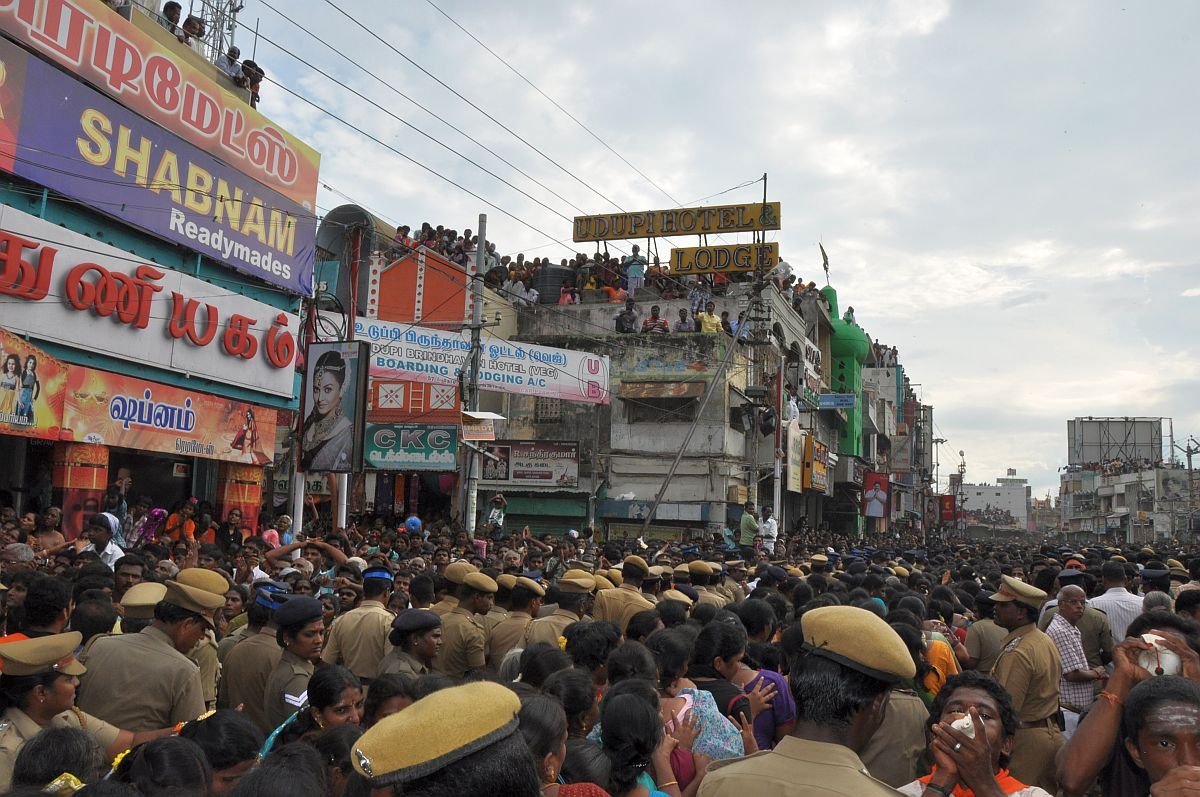
Below us the street was a sea of heads; all balconies and rooftops up
and down the street full of faces and now that the Big Car appeared,
bodies behind us pressed forward, pushing us onto the balcony rails
festooned with dubious electrical fairy lights. It's quite exciting.
Since the divinities are coming, dedicated persons don't wear shoes.
This year we noticed one Policewoman wearing socks to protect her dainty
feet from the yucky street. About five thousand pilgrims pull the cart
around the Temple circuit-route, ladies on one side and gents on the
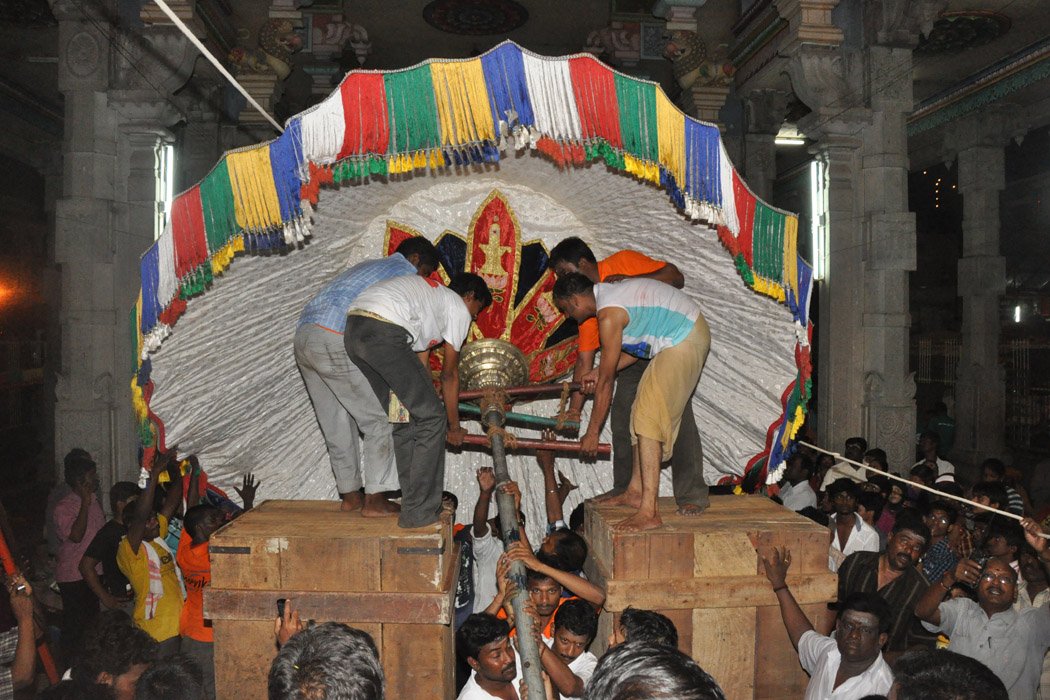
other. When the car stops, big chocks of heavy wood are wedged
underneath the enormous wheels while the pullers take a rest and
offerings are made to their majesties the gods. When ready to start
again, young men with enthusiasm climb up onto the chocks with poles to
steady themselves, and on signal they jump up and down on the slanted
chocks until their force pushes the wheels forward, giving momentum for
the pullers to haul the cart further up the street.
Looking down into the crowd below as the cart passed beneath us, we were
treated to a seething mass of human energy - drums beating in time to
muscles, bystanders shouting encouragement, enormous wheels slowly
turning, the carving on the cart creaking, embroidery panels blowing in
the wind, garlands wavering about, lucky little boys sitting up high
lowering cloth carry bags on strings for people to send up coconuts and
flowers, the Brahmin priests looking down impassively.
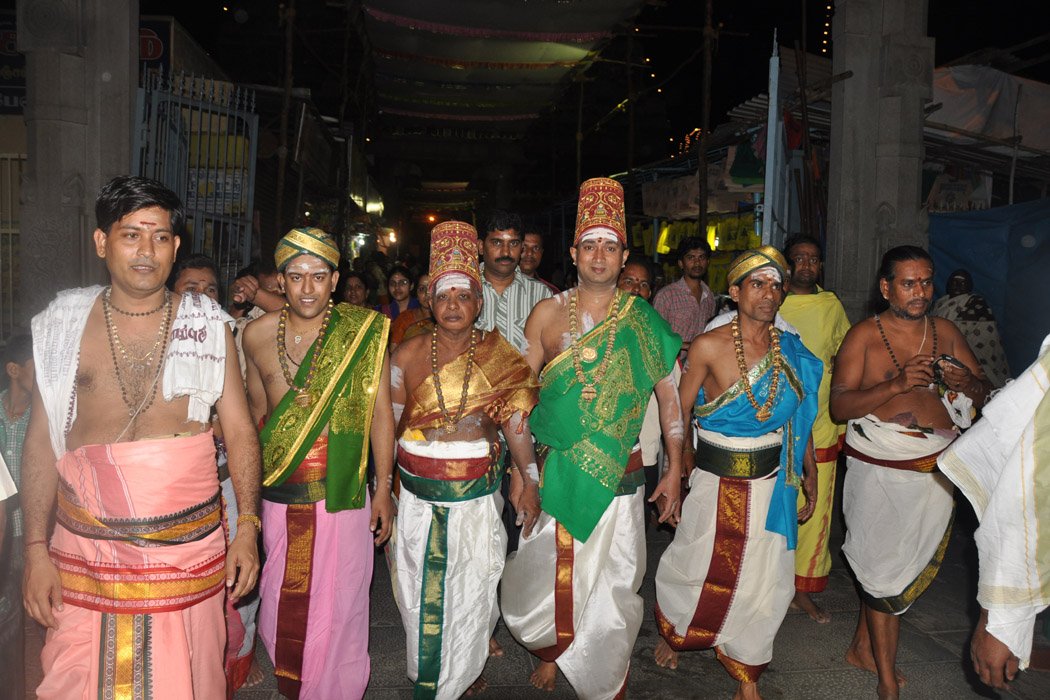
It's the Brahmins particularly - the extravagant courtly costumes, the
imperious faces staring down - that convey the true sense of the gods as
majesties: as the most important personages in our world, out on a tour
of the town, to be saluted by their adoring subjects. And a very large
number of their adoring subjects are sweating, straining at the edge in
the effort required to pull them. The Big Car teeters its way uphill
until the momentum runs out. The chocks are wedged in again. Everyone
breathes.
It will take about ten hours to circumnavigate the Temple."
Deepam Festival - Bharani Deepam 2012
Preparations for this day began months in advance with the local
administration, revenue department, police and Temple authorities.
The lights on Arunachaleswar Temple were placed around the Compound
perimeter and on the Gopurams and burnt brighly each night heralding the
upcoming Festivities.
Wooden levers were fashioned by carpenters, ready to be placed under the
large wheels of the chariots that will be daily used throughout the
Festival.
Fire drills were conducted at the Tanks inside the Arunachaleswarar Temple.
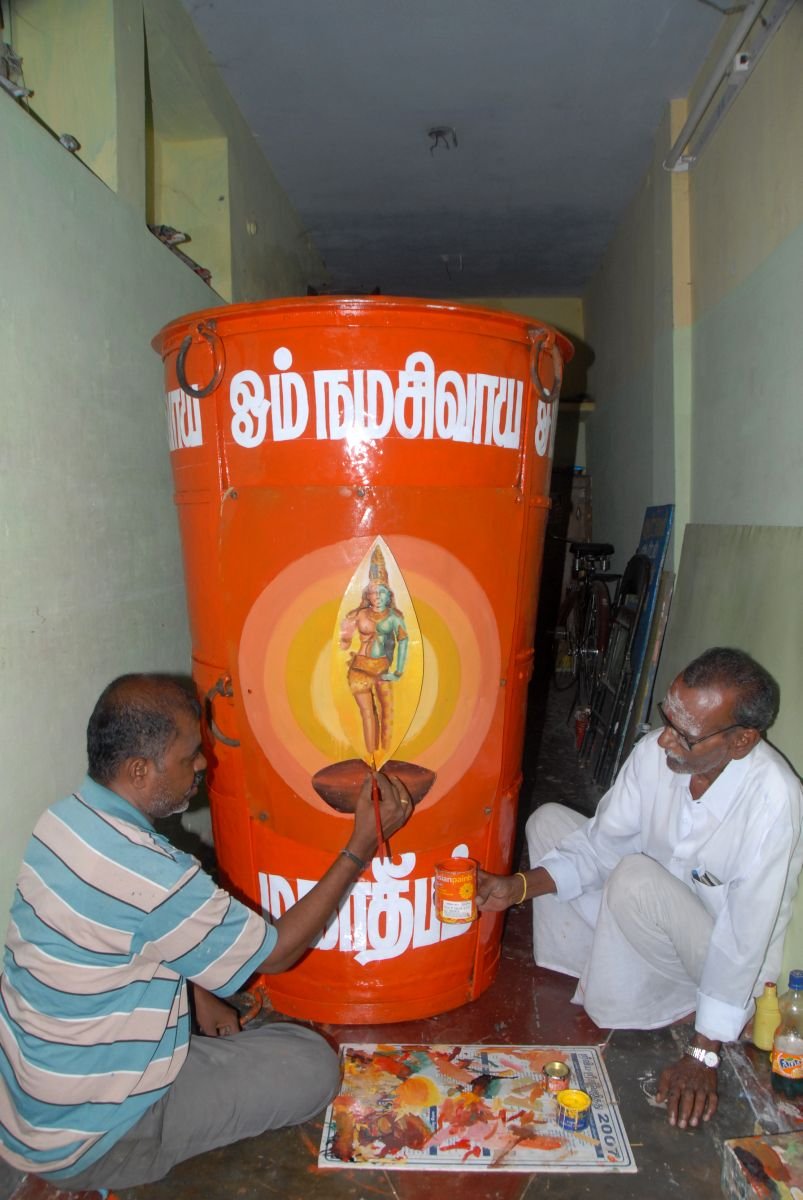
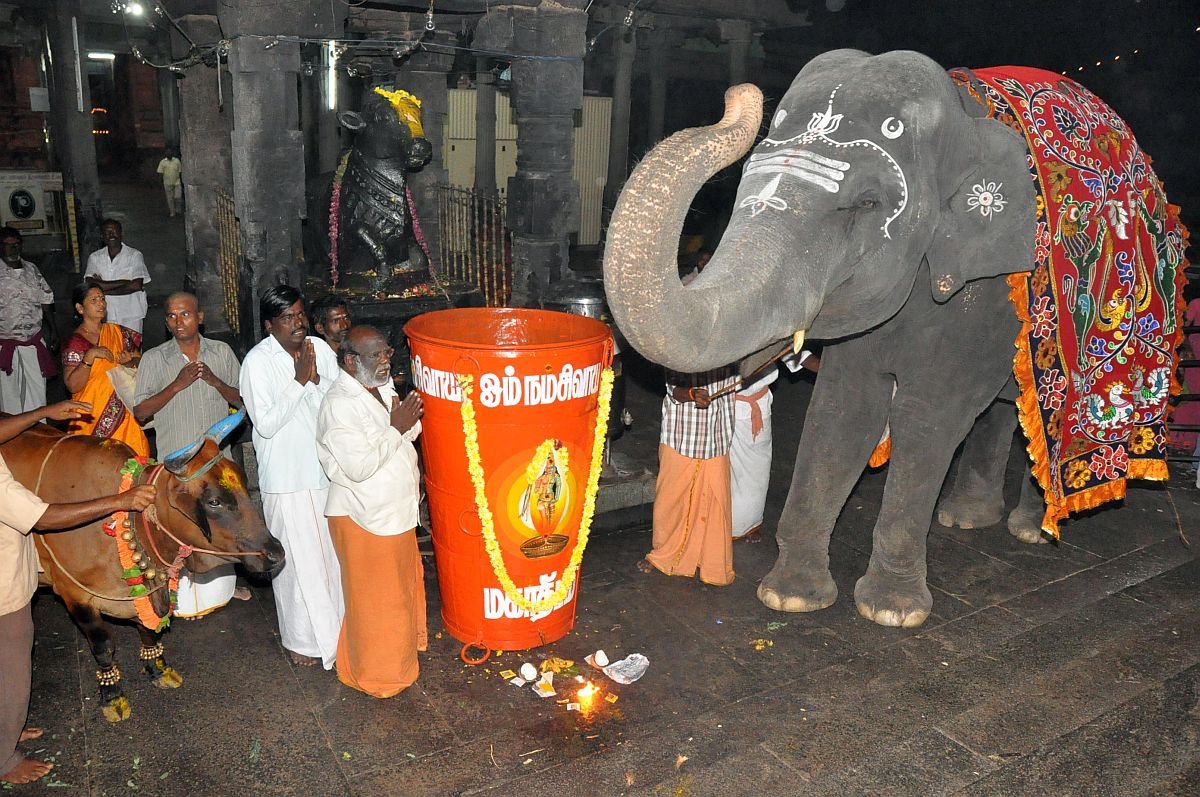
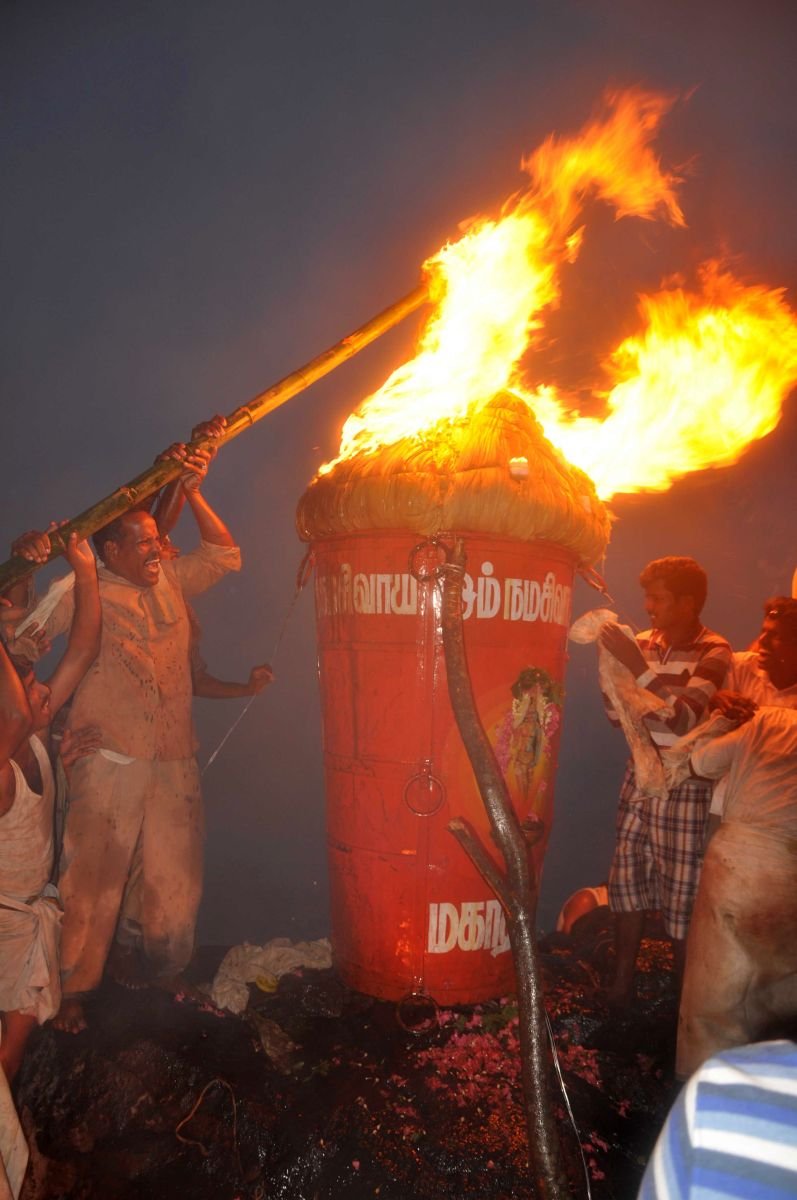
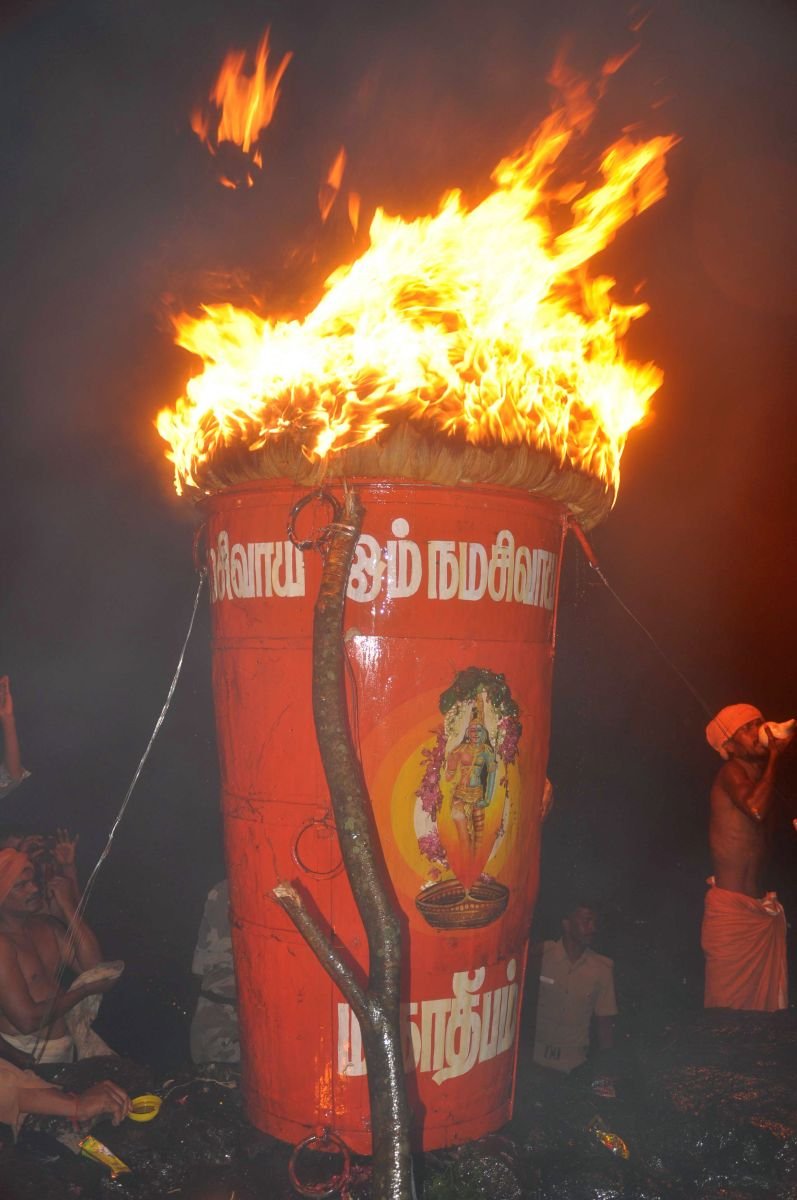
The giant cauldron later to be carried to the top of Arunachala was repaired and repainted.
Arrangements had been made for a mountain of ghee, to be stored in
various rooms throughout the Temple. And previous to the day of
MahaDeepam, Temple staff and volunteers carried huge five-gallon
containers of ghee and large pots of thick, braided cloth wicks to the
top of Arunachala mountain.
Local folk and pilgrims from far afield, climbed Arunachala some in
order to secure a good viewing point for the evening's lighting of the
2012 Deepam cauldron and others so that they could personally deliver
their ghee offerings to top of Arunachala.
Significance
"There is immense significance in this ceremony called Bharani Deepam.
At this time, the universal Lord manifests as the five elements, which
will later fully merge to become one when the Krittika Deepam flame is
lit in the evening. From one to many and many to one. This is the whole
essence of Saivism and the meaning of Krittika Deepam."
Early in the morning before Bharani, a group of fishermen were blessed
by a priest in a ceremony at the Temple. Amidst ringing bells and Temple
music, the priest gave the fishermen a lamp lit from the Bharani Deepam
in the Temple. This lamp, also called Bharani Deepam, was taken to the
top of the Hill by fishermen from hereditary fishing families. Others of
the same hereditary fishing family will remain at the Temple to light
the Deepam flame in the evening outside the Arunachaleswarar Siva
Sannidhi.
One of the reasons that fishermen and not Brahmin priests are
traditionally given the privilege of carrying the Bharani Deepam up the
mountain and lighting the Krittika Deepam in the evening both on
Arunachala and outside the Arunachaleswarar Siva Sannidhi, is because
according to a myth, Parvati (the wife of Lord Siva) was born in a
fishing family.
Just after the early morning Temple ceremony, five earthern pots were
lit. These ghee-filled pots, represent the sacred elements earth, air,
fire, water and ether. As these five flames loom up with red-yellow
light, the famous Festival of Karthigai Deepam officially begins.
A single flame is then taken from the pots and kept burning in the
Temple throughout the day as a symbol of the merging of manifestation
back into God, the one source of all. This single flame is referred to
as the Bharani Deepam.
MahaDeepam
[By Swami Abhisktananda 1970]
". . . However all this was only preparatory for the last and principal
day of the Festival, on which the darshan of the Light is given. This
day is also a day of fasting, as the spirit must be pure and completely
unencumbered in order to receive the grace of this darshan. On this day
one refrains from all food, or at least from taking the normal heavy
meal of rice, until the evening after sunset, when one has actually seen
the light on the crest of Arunachala.
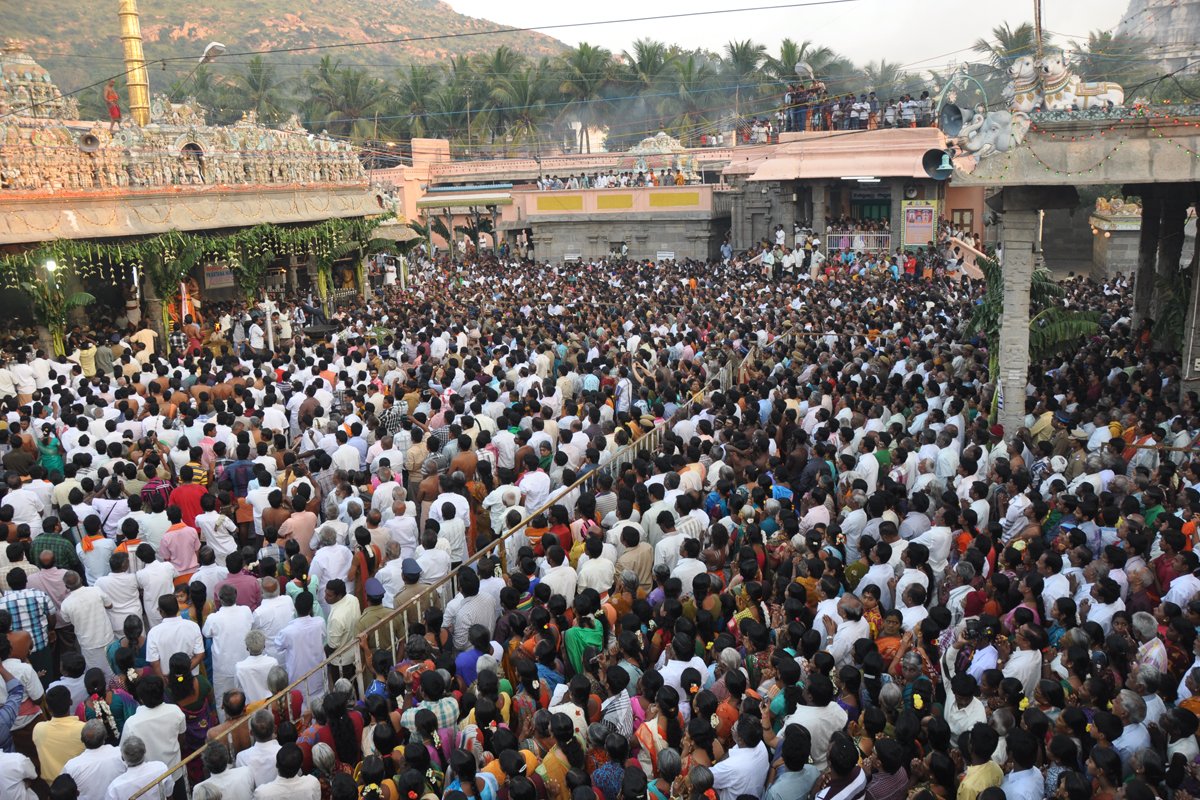
I spent this day at the Esanya Madan . . . and arrived around two
o'clock, at the inner courtyard of the Temple which was already more
than half full. However with the help of friends I managed to insinuate
myself onto a balcony from which I could get an excellent view of
the whole ceremony. By four o'clock it looked as if not a single square
foot in front of the sanctuary remained unoccupied, and yet the crowds
continued to arrive. From my balcony I looked down on a sea of heads,
all exposed without protection to the fiery rays of the sun. In order to
divert the crowd, as they awaited the great moment, a succession of
speakers came to the microphone which was placed quite near me on the
balcony. They had only a limited success, however; and even when Murugan
Das took the microphone, began to sing and invited the crowd to join in
the refrain he carried scarcely half of them with him. Then he chanted
the great mantra "Glory to Shiva!" and at once every tongue took up the
cry, which was bellowed from the loud-speakers and echoed back from the
enclosure walls. Soon there was only the cry of "Om Namah Shivaya! Om
Namah Shivaya!" coming in great waves of sound endlessly repeated from
all sides and uttered in fervent supplication.
Towards five the singing stopped, as a procession emerged from the
Kalyana Mandapam. It was the five murtis (Ganapati and Subramaniyar, the
two sons of Shiva; the Bull Nandi, Shiva's vehicle, Parvati, his
consort; and finally Shiva himself) which were now coming attired in
their most splendid garments and covered with flowers, to mix with the
crowd so that they might have the darshan of the Holy Light. Immediately
in front of the porch of the sanctuary stands a mandapam which was
built in 1202 by Mangayarkarasi to provide a shelter for the Lords of
the Temple during this annual function. The murtis passed through the
crowd in their palanquins carried on the shoulders of the Brahmins. Once
they were in their place, everyone's attention was once more turned
towards the Mountain and the chanting of mantras began again.
The atmosphere became more and more tense. The sun had now disappeared
behind the mountain, and the lengthening shadow of the mighty Linga of
rock gradually spread across the sanctuary, the courtyards and the
Gopurams. The great moment was drawing near for which everyone was
waiting - the appearance of the Flame. Expectation filled every heart and
showed on every face. It increased in harmony with the rhythm of the
cosmos itself; as slowly beyond the horizon the moon rose into the sky,
while in the depths of space the constellation of the Pleiades, of
Krittika, appeared in the same direction.
Suddenly there was the sound of an explosion, like a gunshot. Young
Brahmin torch-bearers came running out of the inner sanctuary,
brandishing their lighted torches at arm's length. Priests offered the
flame of the arati before the murti of Arunachala at its space under the
mandapam. In front of the main gate a huge bronze cauldron, filled with
oil, camphor and clarified butter, burst into a giant flame.
And from the peak of the Mountain also, - on which all eyes had been fixed
for the last full hour, not only in the Temple and the town, but in the
whole countryside around to a distance of many leagues - the flame
mounted up, manifesting both outwardly and in the heart of the faithful,
the mystery of Light which from the beginning has at the same time
hidden and revealed itself in Arunachala.
That is all. The Flame has been seen. Joy and grace have filled all
hearts. The crowd immediately begins to disperse, though it will be more
than two hours before the Temple courts are completely empty. Each one
as he leaves, goes to the bronze cauldron and casts into it his offering
of camphor or of oil to be burnt up in the one great flame - a symbol of
his own departure into the mystery of the Flame.
Meanwhile the Brahmins up above begin their slow and difficult descent
from the Mountain. They had climbed up early that morning in the first
light of dawn, carrying jars of oil and clarified butter. The worthiest
of their number were entrusted with bearing the sacred fire, taken from
each of the Temple shrines, in order to light the Thibam flame. This had
to be done at the very moment when, from their lofty observatory, they
saw simultaneously the red sun disappearing in the west while the moon's
dish came over the horizon in the east.
As soon as I left the Temple precincts amid the crow of faithful, I
joined with many others in once more following the circular road round
Arunachala . . . as I stepped into the cool air of the night . . . all
the detailed features of the Mountain had disappeared. There was nothing
to be seen but the sharp outline of its mystic triangle sketched
against the sky. As the moon climbed majestically towards the zenith, it
shed over it its silvery light, while all around was spread a
mysterious shadow.
The Mountain had become an immense lamp, from the top of which glittered the bright Fame. OM."
Theepal and Hill Round
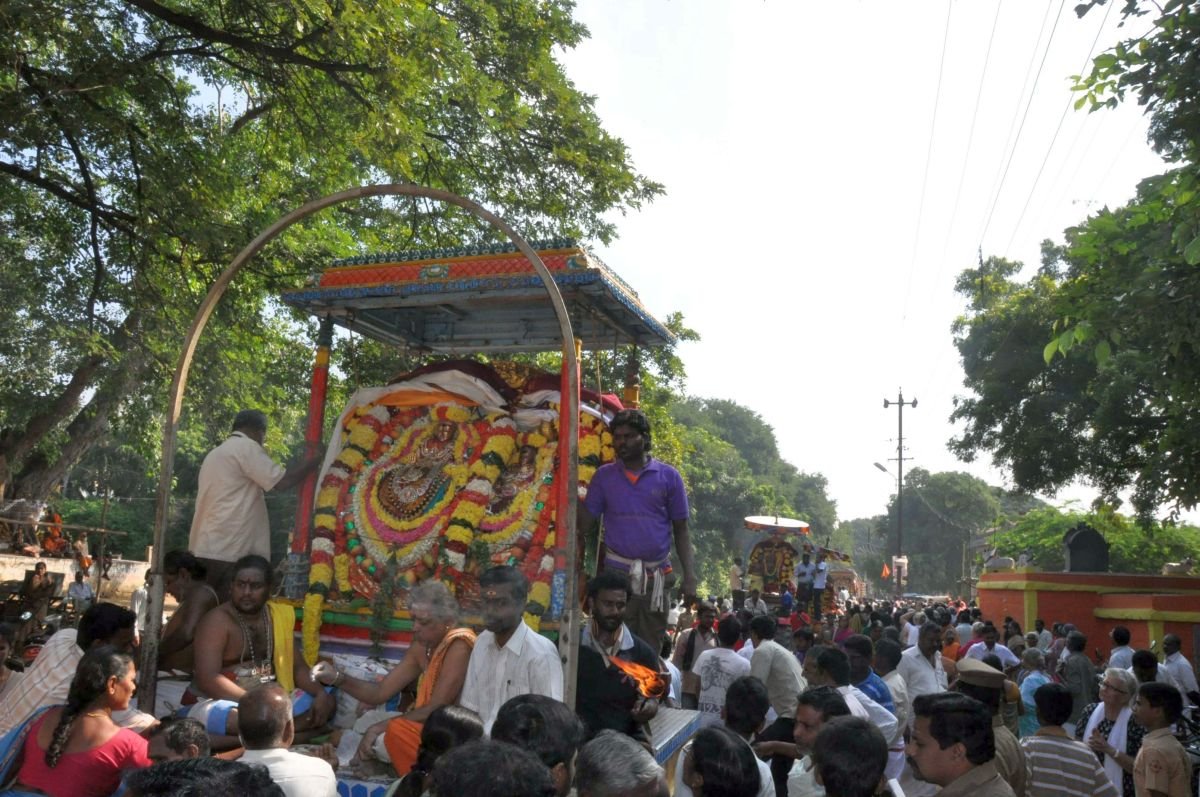
To complete the festivities and functions of MahaDeepam the Gods on four
consecutive days are taken in floats upon the Ayyankulam Tank in front
of the third oldest Shiva Temple in Tiruvannamalai, i.e. Arunagirinathar
Kovil.
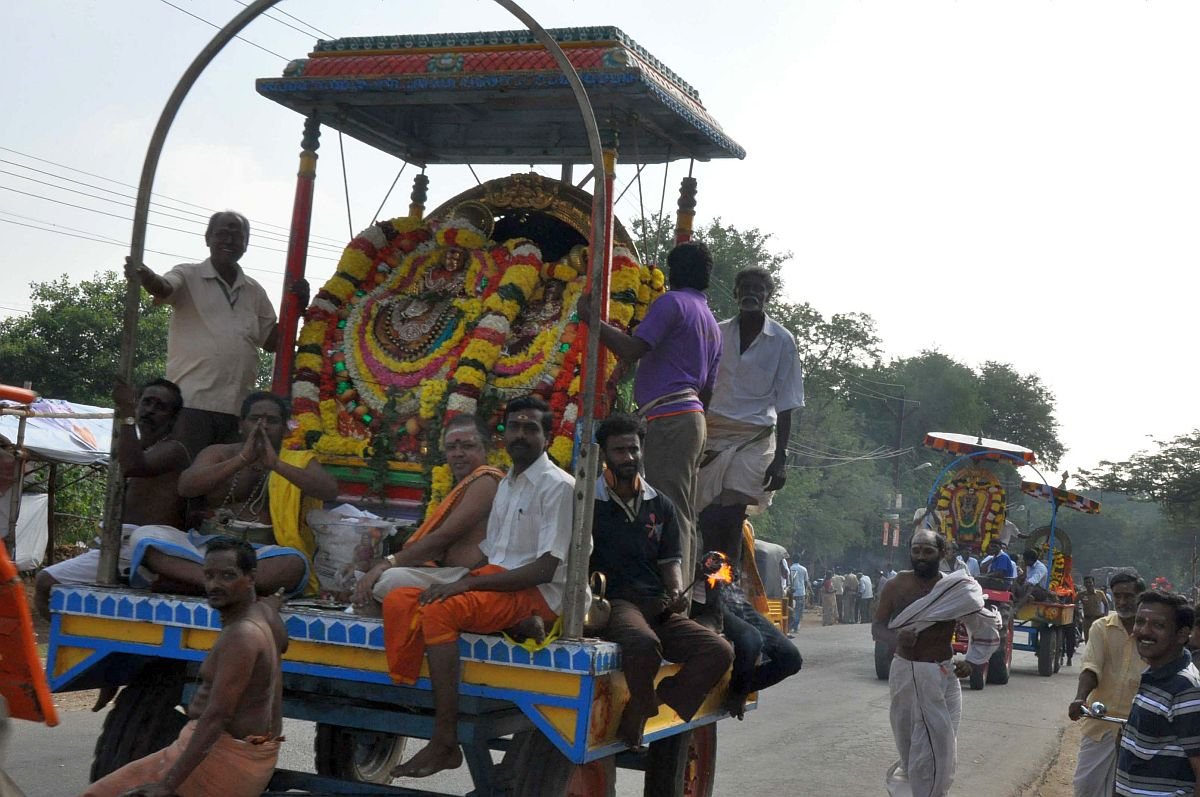
On a day after completion of the lighting of the Deepam on top of
Arunachala, the Gods are ceremoniously taken on procession on decorated
chariots on Hill Round in order that they give their darshan and
blessings to all devotees living around Arunachala.
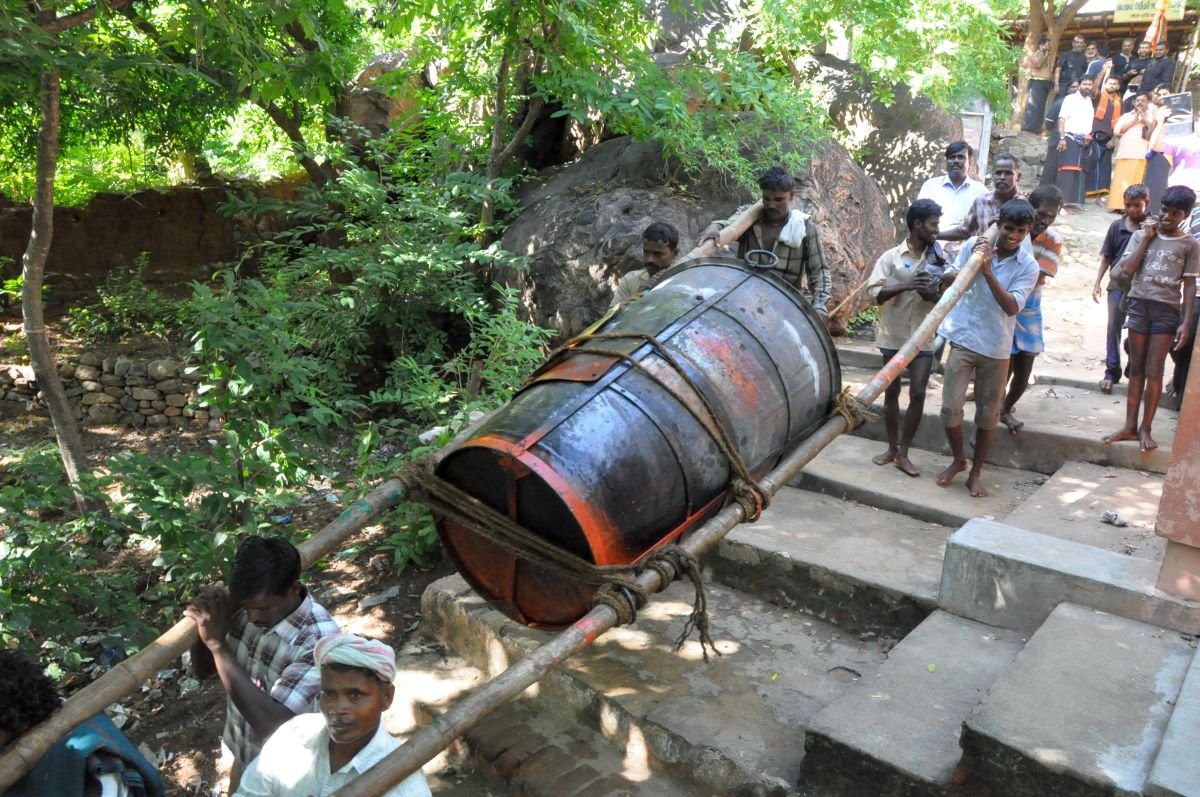
After completion of the Deepam Festival 2012, the cauldron which had
been aflame for nearly two weeks at the top of Arunachala, finally makes
its descent down the Hill where it will be kept inside a store room at
the Big Temple, until next year 2013 - when it will be repaired and
painted and readied for another glorious Flame darshan on top of
Arunachala.
|
|
|
|