However over the years the
difficulties of the climb for
aging gurukkals and other
factors has led to less
emphasis being paid to these
purification ceremonies
occurring on the summit of the
Hill itself and nowadays the
only prayascitta regularly
observed on the summit of
Arunachala is after the
completion of the Karthigai
Festival.
Besides occupying a large
area, Arunachaleswarar Temple
radiates its influence
throughout the whole town due
to its connections with
outlying tanks. The sacred
bath which takes place at the
close of each of the numerous
Temple festivals is performed
either in one of the two
Temple tanks, or in one of the
outlying tanks: Indra
Teertham, Tamari Kulam, Agni
Teertham, and Isanya Teertham.
The last two of these lie at
the extremities of the
circumambulatory route around
the mountain - and in the case
of the Isanya Teertham are
actually situated where
cremation grounds lie.
In
Tiruvannamalai where the Siva
Temple is omnipresent and
all-powerful there are also a
large number of Temples dedicated
to the Goddess and Ganapati. These
are street shrines and community
Temples, all of which relate to
the great Siva Temple. During
Festivals the processions from
these Shrines proceed through the
mada veedhis surrounding the great
Temple and abhishekam of the idols
take place, depending on the
location of the Temple, either at
Isanya Teertham to the north or
Agni Teertham to the south.
Structure of Arunachaleswarar
Temple
Prakarams (Courtyards)
The Temple has five enclosures
(courtyards) and except for the
first and second, each enclosure
is separated from one another by a
wall. These enclosures are called
prakarams which may be open to the
sky or covered with plain or
carved stone slabs.
Prakarams are compared to the body
sheaths: annamaya, pranamaya,
manomaya, vijnanmaya and
anandamaya kosas. In respect of
Arunachaleswarar Temple, the mada
veedhis (4 streets around the
outside of the Temple perimeter
walls) represent the annamaya
kosa, the three open courts one
inside the other represent
manomaya kosa, pranamaya kosa and
vijnanamaya kosa; and the closed
court represents the anandamaya
kosa.
According to tradition, enclosures
are numbered from the centre. At
Arunachaleswarar Temple,
Priests and Temple authorities
call the platform that is
contiguous with the central shrine
to be the first Prakaram. Thus at
Tiruvannamalai there are five
major 'Prakarams' (i.e. corridors)
around the central structure with
a high wall running on all four
sides at the edge of the outer
'Prakarams'. The sixth Prakaram is
regarded as the mada veddhis
(perimeter Temple streets). These
mada veddhis are: Car Street
(east), Thiruvoodal Street
(south), Pey Gopura Street (west),
and Big Street (north). The
seventh Prakaram is regarded as
the 14 km girivalam roadway that
circumscribes Arunachala.
It is believed that one aspect of
the Temple which has determined
the physical form of the town was
the later construction of the
fourth and fifth prakarams. These
extensions caused the relocation
of residences, especially of
gurukkal priests and those serving
at the Temple, who would usually
live around the Kovil in the
square formed by its four
car-streets (i.e. mada veddhis).
At Tiruvannamalai Pey Gopuram
Street (west of the Temple) has
few houses because the mountain
slopes upward almost immediately.
Thus until recent times, most of
the gurukkal Brahmin residences
near the Temple were those on Big
Street. As for the streets east
and south of the Temple, they
follow main regional highways and
are thus crowded with shops and
pilgrim accommodation. For these
reasons Brahmins serving at the
Temple were often located far from
it, almost at the old town limits,
around the Ayyankulam and Indra
Teerthams.
Vimanas
Vimanas should not to be confused
with the elaborate gateway-towers
of Gopurams, which are perhaps the
most prominent features of South
Indian Temples.
Vimana is a term for the towers
above the Garbhagriha (Sanctum
Sanctorum) in a Hindu Temple. A
typical Hindu Temple of Dravidian
style may have many Gopurams which
are usually constructed into
multiple walls in tiers around the
main shrine. The Temple's walls
are typically square with the
outermost wall having four
Gopurams, one at each side
situated exactly in the centre of
each wall. The Garbhagriha and its
towering roof (the central deity's
shrine) are also called the
Vimana. Generally, these do not
assume as much significance as the
outer Gopurams, with the exception
of a few Temples where the Sanctum
Sanctorum's roofs are as famous as
the Temple complex itself. The
structure of the Vimana are
generally believed to be the
docking zone for celestial
vehicles in which gods travel.
During the Kumbhabhishekham
ceremony at Temples; Divine Power
is transferred back to the deities
by performing abhishekam (salutary
bathing) to the Vigrahas and
Vimanas (pinnacles) on the roof
with sanctified holy waters - this
is accompanied by Vedic chanting
and special rites. On the final
day at the designated auspicious
time, the Kumbha is bathed with
charged and sanctified holy
waters - thereupon consecrated and
sanctified pranic powers trickle
down a silver wire and enter the
Deity installed inside the Sanctum
Sanctorum of the Temple.
Specifically at Arunachaleswarar
Temple, these smaller towers known
as Vimanas are found over certain
shrines in the various prakarams.
In the first prakaram, the
Garbagriha is surmounted by a
tower constructed with painted
brick masonry, which consists of 2
false-storeys. This is, therefore,
a shrine-tower on three levels;
the first corresponds to the
height of the walls of the ground
floor and the 2 others to the 2
false-storeys.
The three photographs below are of
Vimanas over Central Shrine of the
1st and 2nd Prakarams.
Annamalaiyar Vimana, Centre
West side of second and first
Prakaram
North east of 2nd prakaram
List of Vimanas over the
Central Shrines are:
1. Arunachala Garbhagriha
2. Amman Garbhagriha
3. Palli Arai (sleeping
chamber)
4. Sambandha Vinayaka (left
side flagpost)
5. Pazhani Andavar (right
side flagpost)
6. Natarajar (right side
entrance 2nd prakara)
7. Somaskandar (northwest
corner 2nd prakara)
8. Venugopala Swami
9. Arumukha Swami
10. Bhairavar
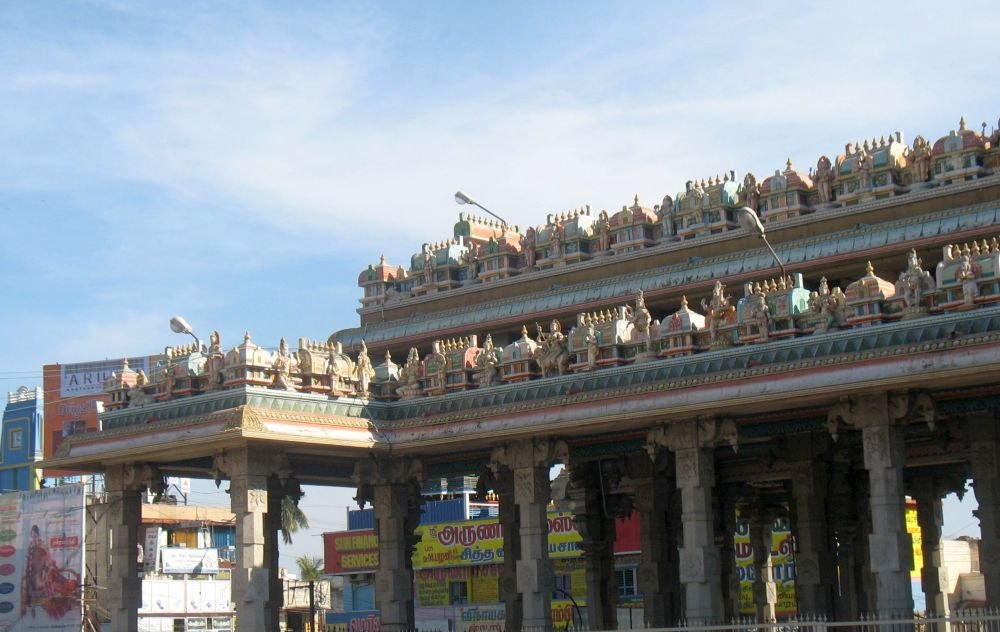
Alankara Mandapam and Gopurams
Alankara Mandapam
To the east of the Raja Gopura is
a small mandapam meant for darshan
of the Panchamoorties during
processions. A fire on July 11,
1996 burnt the previous Mandapam
to the ground. The current
Mandapam built at an estimated
cost of 107 lakhs was part of
major restoration work of the
Temple completed in time for the
Arunachaleswarar Maha
Kumbhabhiskeham of February 27,
2002.
Alankara Mandapam
This current mandapam which is
used for darshan of the
Panchamoorties during festivals,
rises 31 feet at the Central
Eastern Pinnacle and 22 feet on
the North and South sides and
consists of 20 Anivoti Stone
pillars and 24 Chittrakanda Stone
Pillars as well as 44 stone
Bothials and cut stone flooring.
Although this current mandapam
consists of 44 pillars it
continues to be known as the 16
pillar mandapam (pathinaru).
Alankara
Mandapam side view
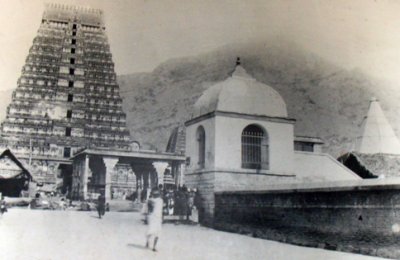
Raja Gopura with previous
Mandapam, 1930's
Gopurams
The entrance to Arunachaleswarar
Temple and courtyard at the
entrance are exactly aligned to
the successive courtyards. It is
therefore always by these axis
that one penetrates inside an
enclosure.
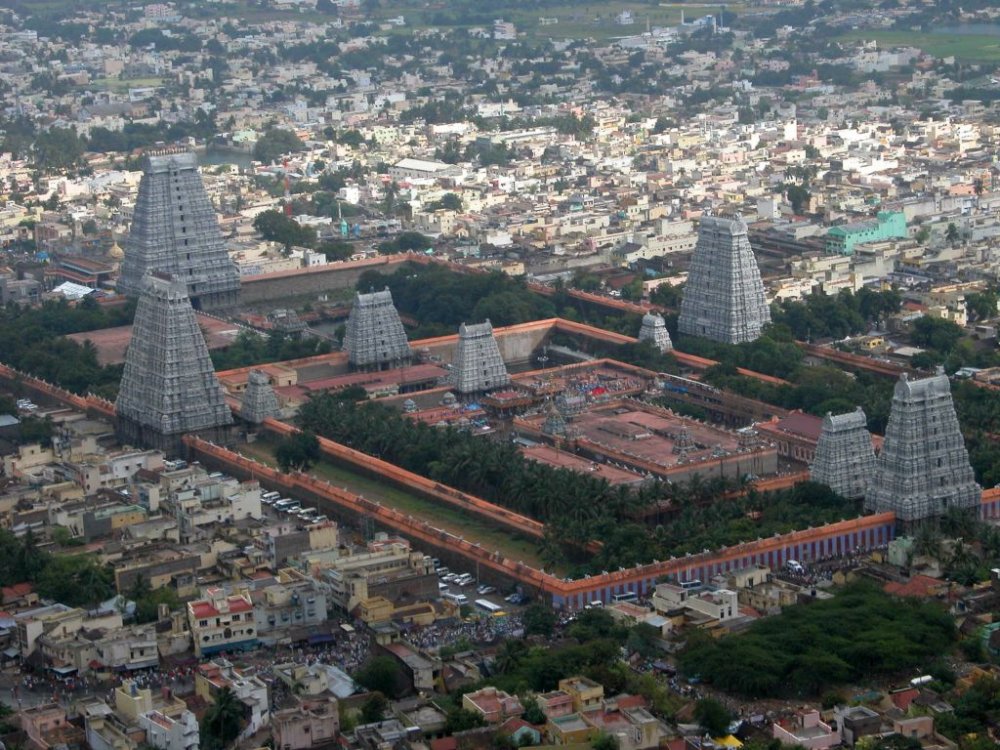
Temple with all 9 Gopurams
There are four big Gopurams on the
Temple's outer boundary; Raja
Gopura (East), Pey Gopura (West),
Thiru Manjana Gopura (South) and
Ammani Amman Gopura (North).
Historians say that the western
Gopura is the oldest. Its base was
built by Vallala Mahara III but
the top belongs to a later style.
Inscriptions attributed this to
Krishnadevaraya of Vijayanagar. It
is said that this King also built
the base of the other three
Gopurams. However examination
suggests that the base of the
Western Gopura was constructed
first and then followed
construction of the South, East
and North Gopurams.
In addition to the four large
Gopurams on the outside wall,
there are also three small
Gopurams on the inner boundary in
the directions of south, west and
north - known as Kattai (smaller)
Gopurams. Additionally there are
two separate Gopurams at the east
namely, Vallala Gopura and Kili
Gopura.
The outermost North and South
walls of the Fifth Prakaram are
1479 feet and 1590 feet
respectively and the Eastern and
Western walls of the same Prakaram
are each 700 feet long.
Surrounding the Fifth Prakaram
stand huge stone walls which rise
to a height of about 30 feet. They
are thick and strong and connect
all four outer Gopurams.
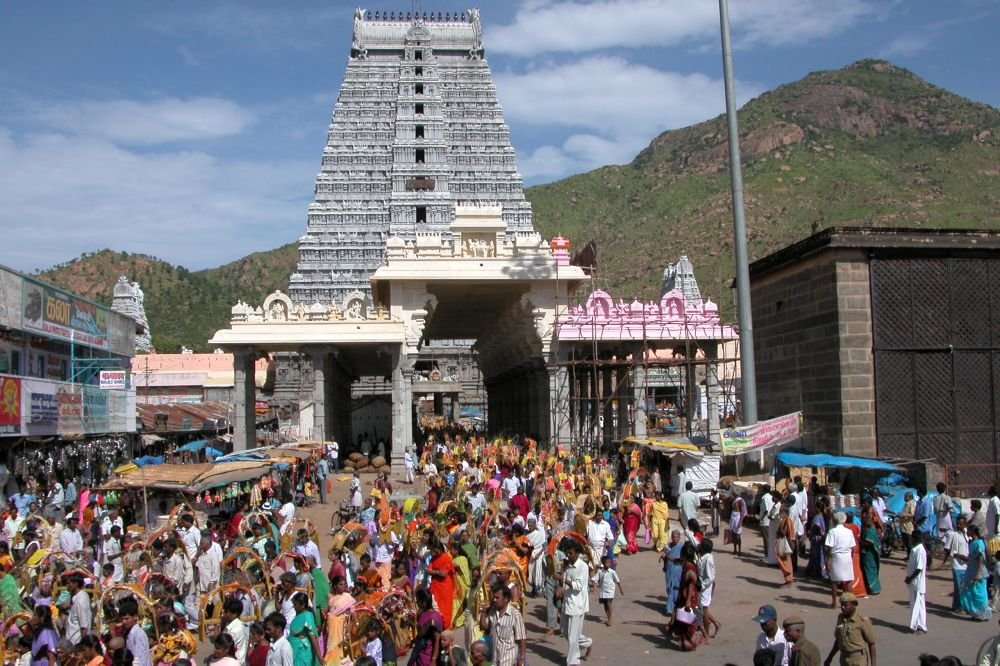
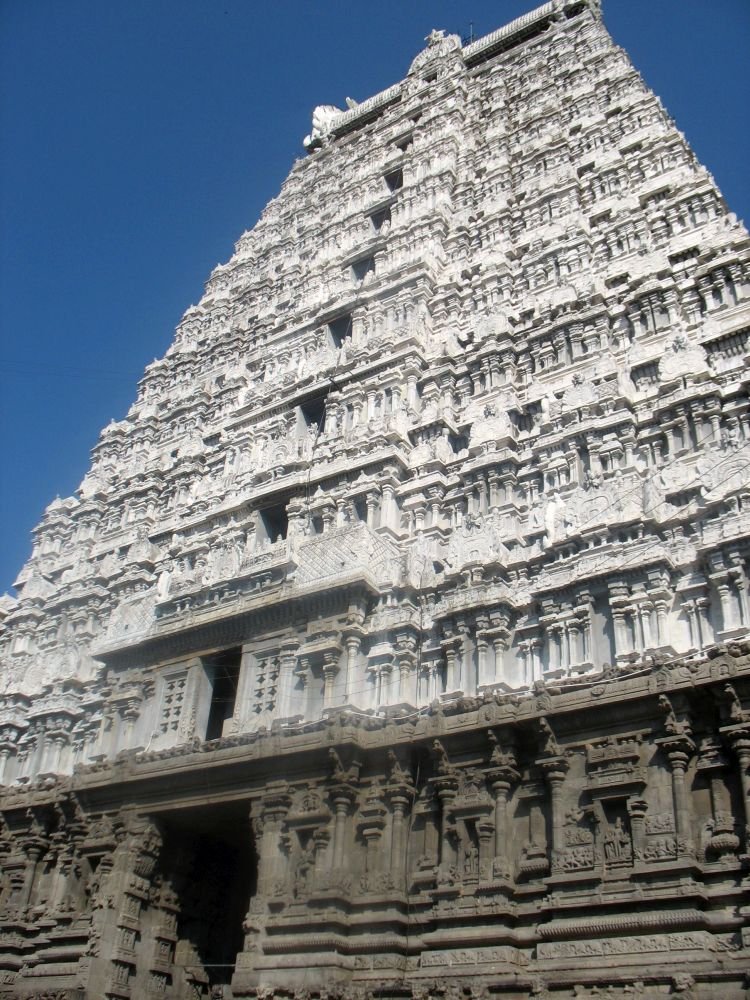
Raja Gopura
The main entrance to
Arunachaleswarar Temple is via the
east gate i.e. the Raja Gopura.
The Gopura was built by
Krishnadevaraya in 1516 A.D., and
completed by the King of Tanjore,
Sevappa Naicken in 1590. The Raja
Gopura is 11 stories in height
(217 feet) and is the tallest
Gopura in this Temple. The Gopura
of the Tanjore Temple built by
Chola Rajaraja is 216 feet in
height and it is believed that
King Krishnadevaraya intentionally
built the Raja Gopura at
Arunachaleswarar Temple one foot
higher so as to eclipse the big
tower in Tanjore Temple. The Raja
Gopura provides the main entrance
to Arunachaleswarar Temple.
Raja Gopura
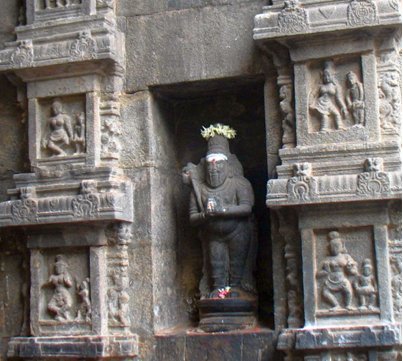
On the northern wall of the
entrance there are two figures.
The upper one is believed to
represent King Krishnadevaraya.
King Krishnadevaraya in niche
Raja Gopuram
In the Temple to the left of the
main Gopura, is also a statue of
the Gopura Ganapati.
The Raja Gopura's base is 135 x 98
feet and believed to be later than
the southern base of Thirumanjana
Gopura. The spire is said to have
been completed by Sevappa Nayak of
Tanjore about 1690 A.D. Although
the spire seems to have little
pilaster, only a small amount of
brick work is actually exposed.
8 Gopurams from top storey of
the ninth - Raja Gopuram
Thirumanjana Gopura
The southern tower of the
outermost court is the
Thirumanjana Gopura. It has nine
storeys and is 157 feet in height.
The meaning of Thirumanjana is
"holy water for bathing a deity".
In this respect each day in the
early morning, holy water is
brought through this Gopura and
poured on the ground near the
flagpost.
Thirumanjana
Gopura left, Kattai South to
right
The base of the Thirumanjana
Gopura is later than that of the
Pey Gopura (West Gopura). It also
differs from the Western Gopura in
that it has a "yali" above the
frontal lotus projection of the
corbel clusters of its upper
course, more prominent lotus
centres and wider niches. The
Thirumanjana Gopura is the most
modern of all the four Temple
Gopurams because of the heaviness
of the plastering and changes
introduced during an earlier
restoration of its pilaster - which
indicates that it is in fact
probably older than both Pey and
Ammani Amman Gopuram spires.
Pey Gopura
One belief is that name of this
Gopura is a corruption of
Melgopura (i.e. West Tower).
However others speculate that the
name of the Gopura i.e. Pey
(demon, ghost) has occurred not by
mistake or misrepresentation. That
in fact the Tower's name is
significant in that it represents
the wild, uncultivated aspects of
the Mountain's west side as
opposed to the cultivated area.
The Pey Gopura has seven storeys
and is 144 feet in height.
According to an inscription dated
1388 A.D., the base of the tower
was constructed by King Ballala
III and the spire around 1516
A.D., by King
Krishnadevaraya. Previously
this tower used to be called the
Periya Gopura (big tower) before
the later and larger Gopurams were
built - but as years passed, the
original name got corrupted into
Pey Gopuram (i.e. ghost tower).
Right Pey
Gopura, Kattai West to left
Its base is similar to that of the
Raja Gopura on the east. The bases
of all the four outer Gopurams are
ascribed to Krishnadevaraya. All
the niches of this base are narrow
and empty. The spire is said to
have been built in 1740 A.D. The
Dvarapalakas are taller than the
windows they stand beside and are
present on each storey from bottom
to top.
Ammani Amman Gopura
The northern Gopura known as the Ammani
Amman Gopura has nine
storeys and is 171 feet in height.
The base of this Gopura is
believed to be later than that of
the Raja Gopura to the east.
Ammani Amman right, Kattai North
to left
It is the spire that is attributed
to Ammani Amman and the date is
approximately around 1810 A.D.
There is a mutt in her name on
northern Orravadai street and a
statue of her installed nearby.
Her samadhi is located next to the
Isanya Mutt in another part of
town.
|