

2002 Arunachaleswarar Temple
Kumbhabhishekam
I remember it
vividly. it was 9:47 in the
morning on June 27, 2002. That
moment was perfectly still like
a calm before a storm. What
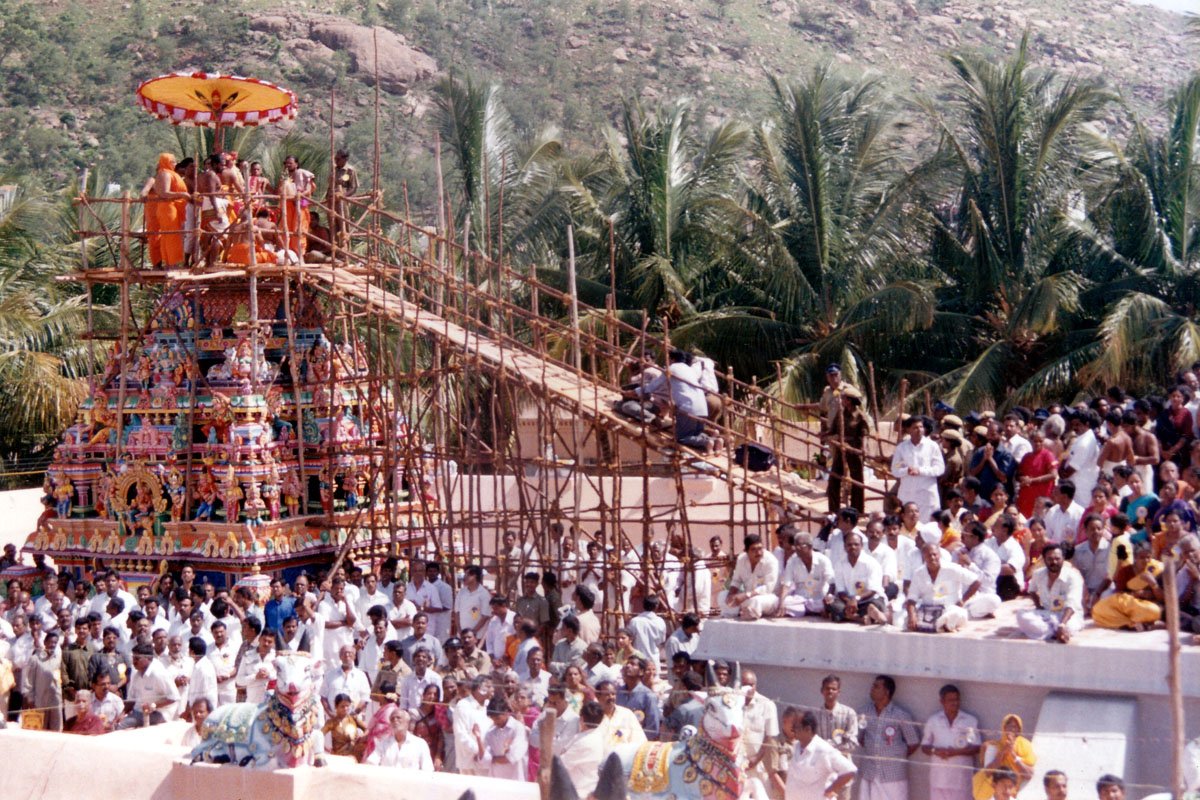
followed was a devotional frenzy
that all good Tamil Nadu
temple-goers know only too well.
Three
hundred thousand devotees were
packed around a 217-foot
rajagopuram (one of four
main outer temple towers) at the
Arunachaleswarar temple in
Tiruvannamalai, South India.
They had been there all morning
some since the night before.
Suddenly, as if in response to
some orchestrated cue, everyone
roared, "Annamalaikku Haro
Hara," "Glory to the Lord
of Annamalai." Six eagles
circled over the temple's sanctum
sanctorum and abhishekams
(water ceremonies) were
simultaneously performed in nine
towers and nine shrines
throughout the temple complex.
The 1,300-year-old temple was
experiencing its fifth known Maha
Kumbhabhishekam. It was
history in the making. The last
such ceremony occurred in 1976.
The two before that were in 1944
and 1903.
|
|
A
Maha Kumbhabhishekam is
held either to formally
consecrate a new temple or
reconsecrate an old one, which
usually occurs at twelve-year
intervals, following renovation,
extensive cleaning and renewal.
The rites culminate with the
priests' pouring sanctified
water over the temple spires,
each of which resembles an
inverted pot, or kumbha.
Leading up to the consecration,
a number of rituals are
performed by the sthapati
(main temple architect) in
charge of the construction or
renovation.

The temple at Arunachaleswarar
is the second largest in India.
Throughout its long history, it
has enjoyed extraordinary
popularity among wealthy
patrons. This remains true
today. Just before the Maha
Kumbhabhishekam of 2002,
more than a million dollars was
spent on temple renovation and
repair. Although a great deal of
this money came from affluent
donors, much was also solicited
through pamphlets, posters and
"door stickers" as well as on
television.
All
nine gopurams were
repaired, renovated and
repainted. The 1000 pillared mandapam
(main temple hall) was
completely cleaned and even
outfitted with electricity. The
temple's entire collection of
ceremonial utensils were
scrubbed and polished. And much
of the old ornamentation was
refurbished with new,
intricately designed carvings
and designs all gold-plated.
During
the ceremony itself, more than
five thousand policemen were on
hand to keep order. The water
and fire rituals commenced in
coordination with the conclusion
of a nine-day annual festival
featuring worship of the Hindu
Goddesses Durga, Amman and
Pitari. The inaugural puja
was held in the newly
constructed yagasala (a
place of fire worship) on the
evening of June 22.
During
the next six days, grand
homas (fire ceremonies)
were conducted at 102 agni
kundams (fire pits) built
in the yagasala just for
this purpose. Each of these homas
was dedicated to a God or
Goddess. Thirty-three were for
Annamalai (a form of Lord Siva),
25 for Amman (a form of Goddess
Shakti), and five each for Gods
Vinayagar, Murugan, Somaskander
and Venugopal. The remaining 24
were committed to the parivara
devathas (canonized saints
devoted to Lord Siva).
Three
hundred Sivacharyas, 15 oduvars
(traditional temple singers) and
120 Vedic scholars from all over
India orchestrated the homas
while 108 tavil players
(temple drummers) and nadaswaram
masters (temple horn players)
provided appropriate festival
music. The grand procession
around the temple was led by
Tyagaraja Gurukkal (69) and
Alasyanatha Gurukkal (54), both
long-time chief priests at
Arunachaleswara Temple.
Doordarshan, Jaya TV
and a local television channel
beamed the Kumbhabhishekam
live as it occurred. All
India Radio also broadcast
a running commentary. Dina
Malar, a renowned Tamil
daily, hired seven photographers
to cover the event. All in all
it was a grand event in Tamil
Nadu, a gracious gift of
upliftment to its motherland of
India, otherwise deeply troubled
by the darker events of 2002.
For
hundreds of years, the town of
Tiruvannamalai and the temple
Arunachaleswara have stood
foremost among South India's
most sought-after spiritual
destinations. Successive South
Indian kings always gave great
importance to them both. They
dug ponds and wells; built gopurams,
compound walls and prakarams
(temple courtyards) and donated
jewels and gold. Famous Indian
kings down through history; like
Rajaraja Chola, Rajendra Chola,
Harihara Bukkar, Krishna Deva
Rayar, as well as the kings of
the Chera, Pallava, Pandya,
Rashtrakotta, Hoysala and Naik
dynasties, were proud to have
Tiruvannamalai as part of their
kingdom. Some of them even made
it their capital. Even when
caught in political crisis, they
held onto Tiruvannamalai.
Historical
details about the
Arunachaleswarar Temple are
revealed in stone inscriptions
on the prakara walls and copper
plates of the temple
itself.These inscriptions,
which refer to a period of time
spanning a thousand years
starting from 750AD, indicate
that the greatness of
Arunachaleswarar was made known
to the kings of the times
primarily through important
South Indian devotional
literature like the Thevaram
and Thiruvasagam.
Aruna
literally means "force" and
achala means "that which cannot
be moved." So, Arunachaleswarar
Temple represents Lord Siva as
indomitable power. The
Arunachaleswarar Siva Temple is
located 125 miles from Chennai,
the capital of Tamil Nadu. Its
day-to-day administration is
currently controlled by the
Hindu Religious and Charitable
Endowments department of
the Tamil Nadu Government.
Tiruvannamalai
and its famous temple are
attracting an increasing number
of pilgrims every year. On a
single festival day, it may
accommodate as many as a million
devotees. And that was before
the million-dollar renovation
and Maha Kumbhabhishekam
of 2002. Certainly, the best is
yet to come.
[Kesav Malli]



|
|
|
|



