Preparations for this day begin one month in advance with the local
administration, revenue department, police and temple authorities.
|
|
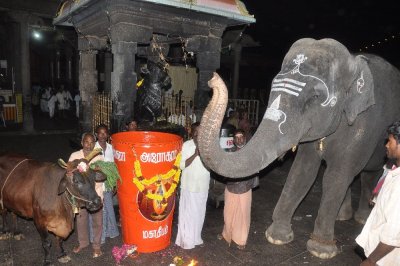
Early on a previous morning, puja was performed on the Deepam Cauldron
pot, with Rukku, the Temple elephant and a cow from the Temple goshala,
in attendance. Once the puja was completed, the Cauldron was carried out
of the Temple compound by the fishing family responsible for the Deepam
lighting.
Many
years previously, the Deepam pot used to remain on top of Arunachala
throughout the year, and was only replaced after years of use and
weathering from exposure on the Hill, had irreparably damaged it.
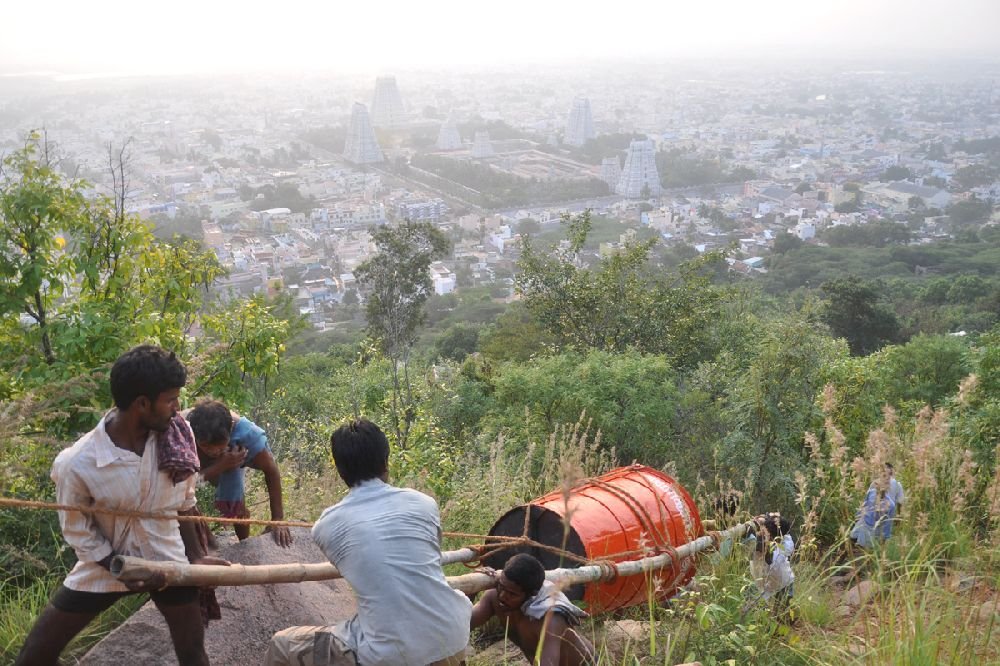
Nowadays, the pot is carried up Arunachala a few days before Mahadeepam.
And after the Festival is over, brought back down the Hill and stored
at the Arunachaleswarar Temple.
Those
who have climbed the Hill, from the Temple at the Virupaksha side know
only too well of the rough, uneven path. Progress is slow, but progress
is certain.

For a few days, temple staff and volunteers have been carrying
five-gallon containers of ghee and large pots of thick, braided cloth
wicks to the top of Arunachala mountain.


The all-pervading quiet of early morning is suddenly disrupted by a mad
clamor of thunderous sound. Ringing bells, pounding drums and piercing
nagaswarams (temple horns) almost overpower the belting voices of
hundreds of devotees who are singing songs in praise of Siva, the Lord
of Arunachala. It is 4:30 am on the 8th December, 2011, and the main
sanctum sanctorum of the massive Tiruvannamalai Siva temple in Tamil
Nadu is packed with souls who have been waiting all night for this
moment.

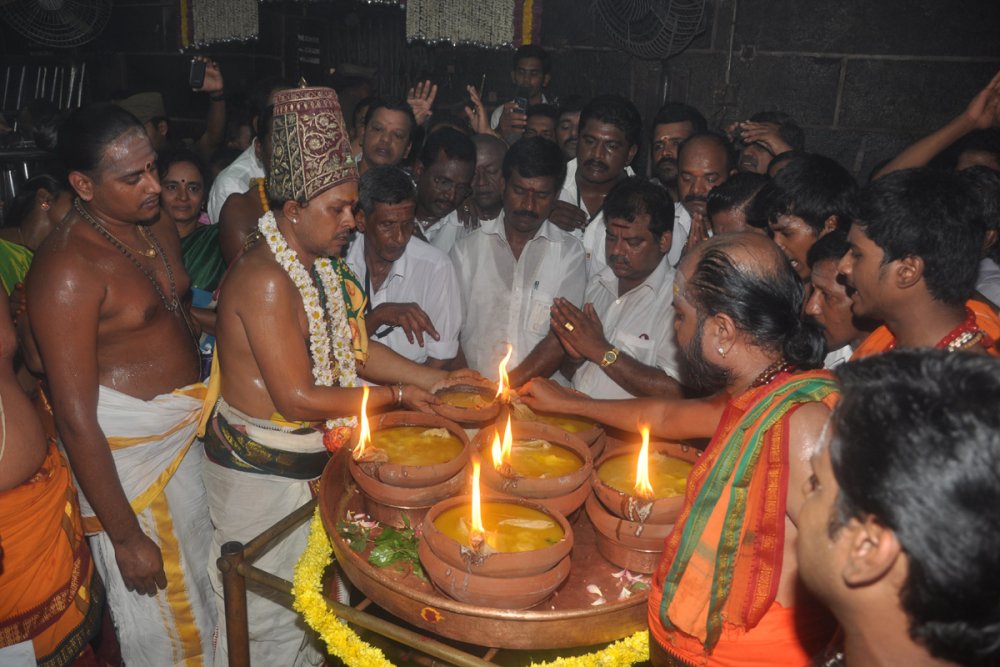
The chief priest has just finished a simple ritual called bharani deepam
and now ceremoniously waves a huge camphor flame in the direction of
nearby Arunachala mountain. Although he is chanting Sanskrit slokas, he
cannot be heard amidst the deafening furor of devotion that surrounds
him. Finally, he touches the flame he is holding to the wicks of five
huge, earthen, ghee-filled pots, representing the sacred elements earth,
air, fire, water and ether.

As these five flames loom up with red-yellow light, the famous, one-day,
South Indian festival of Krittika Dipam officially begins. A single
flame is then taken from the pots and kept burning in the Temple
throughout the day as a symbol of the merging of manifestation back into
God, the one source of all. This single flame is referred to as the
Bharani Deepam.
Significance
"There is immense significance in this ceremony called Bharani
Deepam. At this time, the universal Lord manifests as the five elements,
which will later fully merge to become one when the Krittika Deepam
flame is lit in the evening. From one to many and many to one. This is
the whole essence of Saivism and the meaning of Krittika Deepam."
Town's people and pilgrims from far afield, are climbing Arunachala some
in order to secure a good viewing point for the evening's lighting of
the 2011 Deepam cauldron, others so that they can personally deliver
their ghee offerings to the top of Arunachala and some to just touch the
cauldron that will hold the flame that will be lit that evening. From
the town, the stream of people climbing up the slopes of Arunachala look
like a line of tiny ants.

Around 10:00 a.m. this Bharani morning, a group of fishermen were
blessed by a priest in a ceremony at the Temple. Amidst ringing bells
and temple music, the priest gave the fishermen a lamp in a protected
container that has been lit from the Bharani Deepam in the Temple.

This lamp, also called Bharani Deepam, is taken to the top of the Hill
by fishermen from hereditary fishing families. Others of the same
hereditary fishing family will remain at the Temple and this evening
light the Deepam flame outside the Arunachaleswarar Siva Sannidhi.
One of
the reasons that fishermen and not Brahmin priests are traditionally
given the privilege of carrying the Bharani Deepam up the mountain and
lighting the Deepam in the evening both on the Hill and outside the
Arunachaleswarar Siva Sannidhi, is because according to a legend Parvati
(the wife of Lord Siva) was born in a fishing family.
After
the consecration ritual, the fishermen take off up the mountain. It will
take them about four hours to carry the flame to the top of Arunachala.
All
across India, millions of bonfires are lit on hills and in temples on
Krittika Deepam. But nowhere is this festival celebrated like it is at
Tiruvannamalai. Here it is unique.
Krittika
Deepam occurs annually in the lunar month of Kartika, which occurs in
November/December, on the last day of the 10-day festival called
Brahmotsavam.
It is
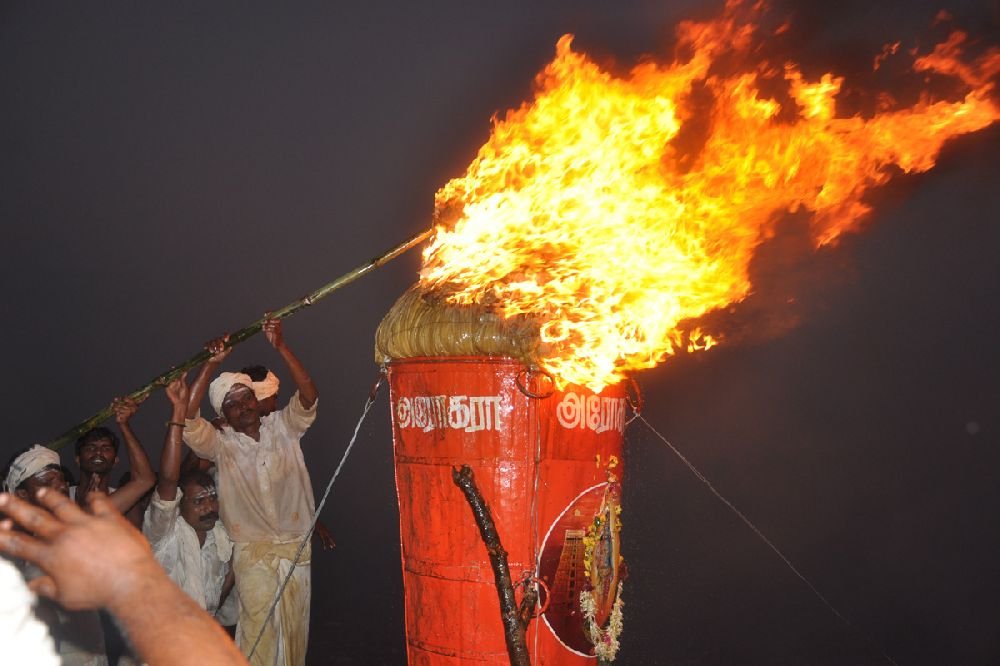
on this auspicious day that, at approximately 6:00 in the evening, a
sacred fire is lit on top of the 2,668 foot Arunachala mountain to
symbolize the merging of all manifest existence back into the one source
of all things. It is said that those who witness this sacred ceremony
personally receive the blessings of Siva and Parvati. All of the
traditional temple rituals that are performed during Brahmotsavam create
a spiritual fervency that culminate with great power on Krittika Deepam
as a grand congregation of devotees, holy men, officials, police
personnel and media squeeze together, shoulder to shoulder, to witness
the festival's magnificent consummation.
As the
day wanes into dusk and night begins to darken the sky, pilgrims stand
or sit, motionless with anticipation, at the base of Arunachala
mountain, preparing to worship God Siva as an infinite pillar of light.

By 5:00 in the evening, the area surrounding the Temple flagpole, as
well as the adjoining terrace, is packed. People are grabbing seats to
observe the dramatic arrival of five exquisitely decorated palanquins,
carrying the Hindu Gods Vinayaka, Subramanya, Siva, Amba and
Chandikeshwara. The devotees are constantly moving and adjusting their
positions to get a better view and to make way for still more people
pouring in.

Suddenly, the crowd's attention shifts to the Temple entrance from
behind the flag pole. Some devotees jump up to get a better view. The
first palanquin arrives with a dramatic flair. It's the Vinayaka Deity, a
form of Lord Ganesha. Exquisitely bedecked with a variety of flowers
artistically arranged, this relatively small Deity seems magically large
in its luxurious setting. More than eight people are carrying the heavy
wooden palanquin. They dance with graceful dignity to the accompaniment
of temple music, devotional singing and Sanskrit prayers. Soon enough,
they reach their designated position in front of the flag pole and come
to a stop.
In a
few minutes, the next palanquin arrives "Subramanya". It's a little
bigger. Unmindful of its weight, those who are carrying this celestial
cargo somehow manage to dance with abandon, rocking the Deity joyously.
Now another palanquin is arriving, rocking to and fro. "Swami, Swami,"
the crowd shouts. Here, "Swami" is referring to Siva. Amba (Goddess
Parvati) is right behind, followed by Chandikeshwara. Within about 30
minutes, five palanquins have arrived in all their spiritual pageantry.
Finally,
the appointed moment arrives. Against the backdrop of a sunset sky,
crowned with the rising star of Kartika, thundering firecrackers,
ringing Temple bells and a frenzy of rhythmic chanting merge to create a
cacophony of chaotic splendor. Camphor is lit in a cauldron by the
Temple flag pole, signaling priests on top of the mountain to light
their flame.
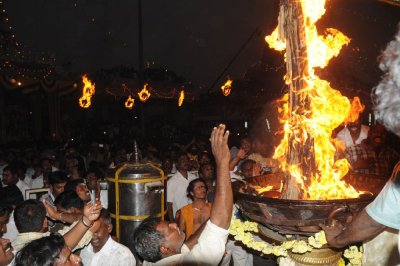
The timing is perfectly synchronized
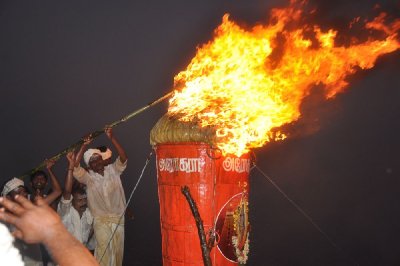
The air is charged as the overpowering sight of light, signifying Siva
in the form of Jyoti (divine light), merges with Parvati to become
Siva/Sakti. Now, finally, Ardhanarishvara is brought out of the Temple
with great ceremonial fanfare. This is the only day of the year that
this particular Deity is ever moved. It is most auspicious.

When that flame is seen by the thousands of devotees below, the entire
countryside explodes with flashing luminescence. Bonfires, lamps, neon
lights and fireworks light the night like day as a surging, thronging,
emotionally charged mass of devotees chant, "Arunachala Siva,"
"Annamalai" and "Annamalai Harohara".

The sight of the Krittika Deepam is magical. It brings an inexplicable joy. People are ecstatic, mesmerized by the light.
The Temple is closed for a day after Krittika Deepam, because it is
believed that, when Arunachala manifested Himself in the Deepam, He
temporarily shifted His abode from the temple to the hilltop.
Long-time pilgrims assert that, even years later, the very
thought of an otherworldly moment like this recreates it, just as if it
is happening fresh and new.
[Abridged from 'Fire on the Mountain']
|
|
|
|