Sacred Geometry
Sacred geometry is geometry used in the planning and construction of sacred structures and sacred spaces.
In nature, we find patterns, designs and structures from the most
minuscule particles, to expressions of life discernible by human eyes,
to the greater cosmos. These inevitably follow geometrical archetypes,
which reveal to us the nature of each form and its vibrational
resonance. They are also symbolic of the underlying metaphysical
principle of the inseparable relationship of the part to the whole. It
is this principle of oneness underlying all geometry that permeates the
architecture of all form in its myriad diversity. This principle of
interconnectedness, inseparability and union provides us with a
continuous reminder of our relationship to the whole, a blueprint for
the mind to the sacred foundation of all things created.
| |
In the ancient world certain numbers had symbolic meaning, aside from
their ordinary use for counting or calculating . . . figures
such as the octagon were related to the number of their sides (i.e.
eight) and that number had a symbolic relevance.
The arrangement of the Asta Lingams around the octagonal perimeter of
Arunachala reflect the geometry of a Cosmogram. The octagonal shape is
surrounded by a total of eight Lingam Temples (Asta Lingams). Each of
these Temples are located at the four cardinal and four inter-cardinal
points. This was also believed by the ancients who originally
constructed the Lingams at their eight cardinal and inter-cardinal
points to represent, characterise and vitalise certain aspects and
qualities of life in relation to specific fields of energy and
influence.
"The formation of matter from energy and the natural motions of the
universe, from molecular vibration to the growth of organic forms to the
motions of planets, stars, and galaxies are all governed by geometrical
configurations of force. This geometry of nature is the essence of the
sacred geometry used in the design and construction of so many of the
world's ancient sacred shrines. These shrines encode ratios of creation
and thereby mirror the universe. Certain shapes found in ancient
temples, developed and designed according to the mathematical constants
of sacred geometry, actually gather, concentrate and radiate specific
modes of vibration. For example, a particular structural geometry and
precise directional orientation of a pyramid shape completely alters the
electromagnetic properties of the space contained within the pyramid.
Three dimensional structure and vibration are absolutely, though
mysteriously connected. This is well known to makers of musical
instruments. It was also known to the makers of ancient temples. Certain
shapes resonate to cosmic frequencies too fine to be registered on the
electromagnetic spectrum. The fineness of the vibration is the key to
their powerful effect."
[Paul Devereux]
Asta Lingams
Arunachala is surrounded by eight lingams (Asta Lingams) each residing
in one of the eight directions of the four cardinal points (South -
Yama, West - Varuna, North - Kubera, and East - Indra) and four
intercardinal points (South East - Agni, South West - Niruthi, North
West - Vayu and North East - Esanaya).
The guardians of the four cardinal directions are called the Lokapalas
and are the deities who rule the specific directions of space. The name
for the eight deities, four of the cardinal and four of the
intercardinal directions is 'Asta-Dikpalas.'
By the turn of the Twentieth Century many of the shrines, temples and
theertams at Arunachala were in a state of neglect and decay. In the
case of the Asta Lingams the areas around the shrines were filled with
squatters and encroachments and the Asta Lingams shrines themselves were
unmaintained and their worship ignored.
It is believed by many that the work done by I.S.V. Arunachala Moopanar
(Moopanar Swamigal) renovating and restoring the Asta Lingams and their
adjacent land, was responsible for helping to re-establish the energetic
power of the sacred geometry of Arunachala.
Moopanar Swami came to Arunachala from Tiruveneli around 1968 and became
very well known throughout the Arunachala area. He was a devout,
spiritual man who placed great emphasis on spiritual service. When he
arrived at Arunachala, things were rather different to the present time
and what particularly distressed Moopanar Swami was the dreadful,
neglected condition of the Asta Lingams (eight Lingams) that surround
Arunachala. Moopanar Swami used to spend a lot of time meditating and
praying at the Arunachaleswarar Temple and he eventually came to believe
that his mission directly imposed by Lord Arunachaleswarar was to
renovate the Asta Lingams.
He was convinced that the restoration of the Lingam Shrines was
essential to the revitalisation of specific fields of energy and
influence surrounding the Hill. Through a combination of various social
reasons, over the last few centuries Temples and Shrines throughout
India had fallen into disuse and decay. This certainly occurred at
Tiruvannamalai where the situation had become so bad that The Asta
Lingams were even taken over by squatters and homesteaders. It is said
that Moopanar Swami would even resort to driving the squatters off the
Lingam premises with a stick!
The Hill which is octagonal in shape is surrounded by a total of eight
Lingam Temples (Asta Lingams). Each of these Temples are located at the
four cardinal and four inter-cardinal points. This was also believed by
the ancients who originally constructed the Lingams at their eight
cardinal and inter-cardinal points to represent, characterise and
vitalise certain aspects and qualities of life.
Asta lingams:
Indra Lingam (East)
Agni Lingam (South East)
Yama (Ema) Lingam (South)
Niruthi Lingam (South West)
Varuna Lingam (West)
Vayu Lingam (North West)
Kubera Lingam (North)
Esanya Lingam (North East)
The Lingams have the dominant Navagraha of the God to whom they are
associated. It is believed that placating a specific Lingam will bring
various benefits that are associated with the respective
Navagraha.
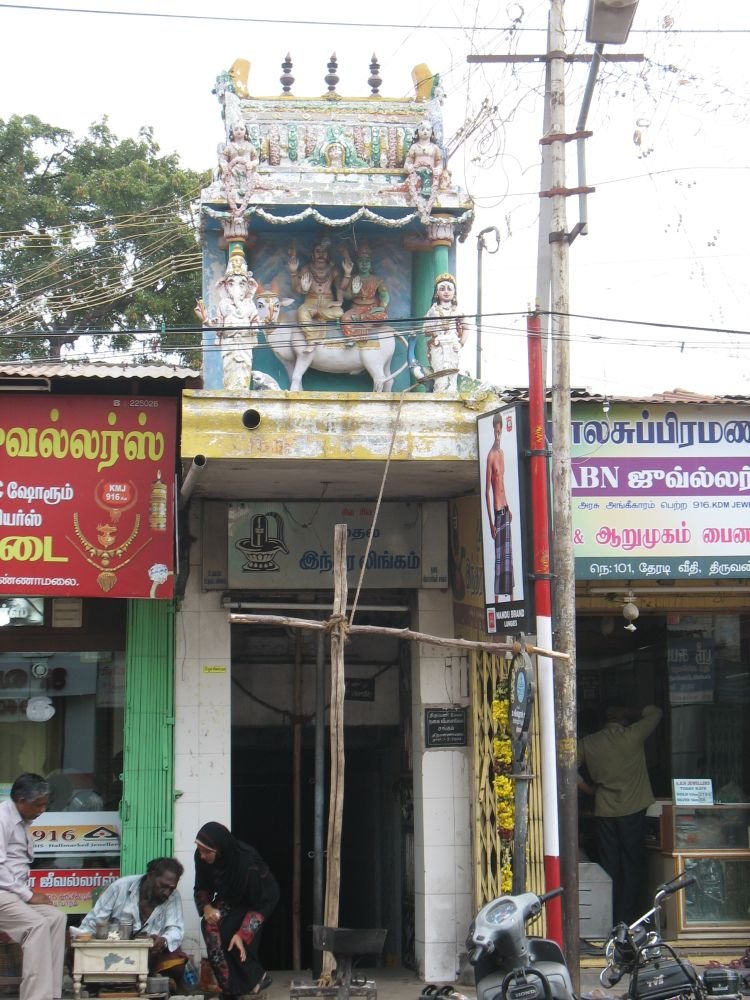
Indra Lingam (East)
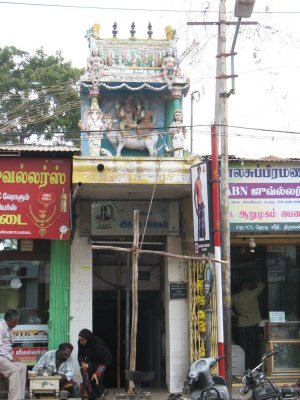
The Indra Lingam has east as its direction. It is associated with the
celestial Lord Indra. This Lingam is situated on Car Street close to the
eastern tower of Arunachaleswarar Temple.
Lord Indra is the king of Heaven according to Hindu mythology. His
consort is Indrani. His vehicle is the celebrated four-tusked white
elephant Iravathi. Indra manifests seated on his elephant wielding in
his hand the weapon Vajra with which he destroys ignorance and bestows
spiritual knowledge on his deserving devotees.
The Indra Lingam is dominated by the Navagrahas, Lord Surya and Lord
Shukra (Venus). Devotees are blessed with long life and with prosperity,
on worshipping Indra lingam.
Agni Lingam (South East)

The Agni Lingam has south-east as its direction. It is situated close to
Seshadri Ashram on Chengam road and is the only Lingam located on the
right side of the Girivalam Path.
Lord Chandra (Moon) is the dominant Navagraha of Agni Lingam. Lord Agni,
is the God of the fire of Knowledge. He has seven hands and seven
tongues. Agni is the light of the lives of all creatures and is invoked
in the performance of Homa. His vehicle is the goat Saga who serves as
the sacrificial beast in the fires of Homa.
Worshipping this Lingam helps devotees get relief from disease, to
maintain good health and also helps them face problems and difficulties
in their lives.
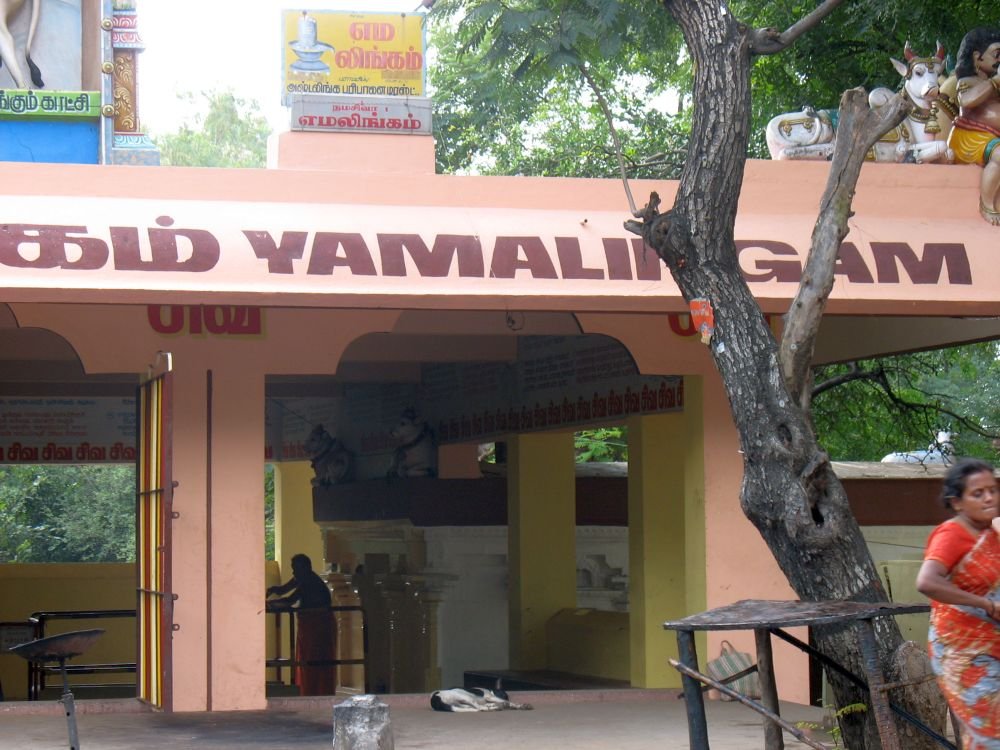
Yama Lingam (South)

The Yama Lingam has South as its direction. It is associated with Yama
the God of death. It is situated beside the cremation grounds on Chengam
road.
The dominant Navagraha of this Lingam is, Mangala (Mars). Yama is
portrayed sitting on his mount, a powerful black buffalo named Mahishan
and with two monstrous dogs by his side. He is supposed to carry a
huge lasso with which he drags each being at the time of death to face
heaven or hell according to the being's karma.
Devotees get rid of their financial constraints on worshipping the Yama
lingam. This Lingam is also conducive for longevity of life span
Niruthi Lingam (South West)

The Niruthi Lingam has South West as its direction. It is situated on
the Girivalam pathway near the Shantimalai Compound. It is associated
with Lord Rahu.
Niruthi is the king of the Asuras (demons) and he jointly rules the Southern realm along with Yama. His associate is a dog.
Legend reports that king Nala bathed in Niruthi Lingam Theertham to be
relieved of sins incurred due to his karma. This Lingam is specially
renowned to help people recover from the bad effects of black magic and
other negative energies.
Health, wealth and fame are the beneficial aspects of this lingam. It is
also beneficial for couples to worship at this Lingam if they wish to
have a child. Worshipping this Lingam is believed to help devotees
achieve detachment to worldly desire.
Varuna Lingam (West)

Varuna Lingam has the West as its directions. This lingam is situated on
the outer girivalam pathway about one kilometre before the village of
Adi Annamalai.
Varuna's vehicle is Makara (that lives both on land and water) which is
an animal with the head and front legs of an antelope and the body and
tail of a fish.
This Lingam has Lord Shani as its dominant Navagraha. Varuna Theertham, a
holy tank, is located here. Devotees are protected from illness,
particularly water related diseases.
Legend has it that the eye of Varuna is Surya and when Surya appears in
the constellation of Makara, its a special event and honoured as
Makara Sankarathi. This day falls each year in mid-January and is
celebrated as Pongal Festival in Tamil country.
Varuna is the king of appreciation and enjoyment. He governs the whole
world. He is the God of rain and God of all the waters in the three
worlds. He surveys the deeds of man according to his karma and keeps
them under his control. Placating Varuna is believed to wash away
accumulated sins.
Vayu Lingam (North West)
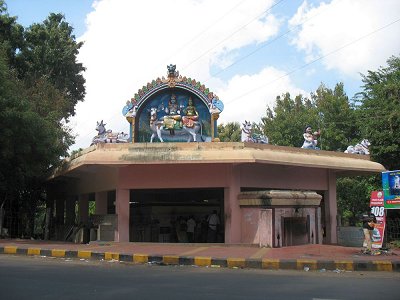
Vayu Lingam has the north-west direction as its direction. It is
situated on the girivalam pathway, about one kilometer after the village
of Adi Annamalai
Vayu is the Hindu god of wind and he is often associated with Indra. His
vehicle is the deer. Kedhu (Kethu) is the dominant Navagraha of this
Lingam. As Vayu is the God of wind, He provides creatures with vital
life-giving breath thus sustaining the entire Universe.
It is reported that at any time of the day, and in every season, when
one enters this shrine one is always greeted by a gust of wind.
Relief from heart diseases, stomach problems, lung problems and general
illness are conferred to the devotees on worshipping this Lingam.
Kubera Lingam (North)
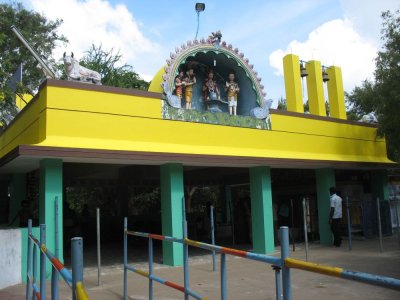
Kubera Lingam has the North as its direction. It is located on the
girivalam pathway before entering the town and a few hundred metres
before the Panchamukham.
The Kubera Lingam has Lord Brihaspati (Guru or Jupiter) as its dominant
graham. He has three legs and eight teeth. His vehicle is a female goat.
His abode is in the capital of the Himalayas. His consort is Yakshi. He
is the Chief of the Yakshas who safeguards the riches of the Devas. He
is a very friendly with Shiva.
It is believed that Lord Kubera came to this place to worship Arunachala
in order to maintain his wealth and prosperity. Hence a Shiva lingam
was installed and consecrated at a point exactly north from the
mountain.
Kubera is the God of wealth and material possessions. He does not create
wealth, but he is believed to be the one who distributes wealth amongst
his devotees.
Esanya Lingam (North East)
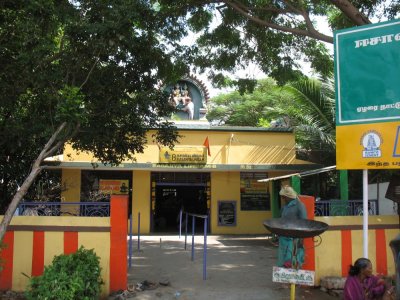
Esanya Linga has the north east as its direction. It is located on the
old girivalam road to town, beside the main cremation grounds.
This lingam was installed by Esanyan and has Lord Budha (Mercury) as its dominant Navagraha.
Esanya is one of the seven Rudras of Shiva. He is covered with
ashes and surrounded by ghosts, he has matted locks and fierce eyes and
is seated on a tiger skin. He holds the crescent moon and the river
Ganga in his locks. His body is adorned by coiled serpents. In his hands
he holds the mortal drum and the trident of Shiva.
Devotees are blessed with peace of mind on offering prayers to Easanya Linga.
Life and Work of Arunachala Moopanar (I.S.V. Arunachala Moopanar)
It was late evening, Saturday, April 10, 1999, when I.S.V. Arunachala
Moopanar (lovingly referred to as Moopanar Swamigal), shed his mortal
coil to reach the Feet of Lord Annamalaiyar, as Lord Siva is known in
Tiruvannamalai. He was seventy-six years old. It was a great loss to all
those who had come to know and love him for his selfless life as a sivathondan,
servant of Siva. In Tiruvannamalai, where he had spent the last
thirty-five years, he was referred to as the 64th Nayanar (the saints of
Tamil Saivism)--a place he richly deserved.
Moopanar led a married life for twenty-two years. Having no children, he
adopted his elder brother's son and daughter when the former remarried
on the demise of his first wife. When the daughter reached marriageable
age, she died suddenly through illness. This was traumatic for Moopanar.
The son was then in the 8th standard, and Moopanar viewed his own life
to date. He questioned, "Is this all there is to life? There has been no
real happiness so far. Am I going to spend the rest of my life looking
after the boy?" Dispassion set in, and soon he felt the need for a more
meaningful life. It was then that he made the momentous decision to
leave everything behind and come to Tiruvannamalai to serve Lord Siva by
offering sambrani dhupam, a traditional temple incense, to the Lord.
Thus it was that, having made provisions for his family, he arrived in
Tiruvannamalai around 1965. On his arrival he met the chief priest,
Ramalinga Sivachariar. The priest told him that what he had in mind
would neither provide a roof over his head nor food for his hungry
stomach. Ramalinga Sivachariar offered him a job selling panchamritam,
a sacred blend of five fruits, at the temple shop jointly run by him
and another priest. He also encouraged Moopanar to carry on with his
Siva puja (his puja items, now stored in the premises of
the Kubera Lingam, are worth not less than Rs.30,000/-). For the next
five years he ran the panchamritam shop. There was neither gain nor loss. This too, he felt, was not his destiny. The opportunity to do thirupani,
temple renovation, came when the owner of Udupi Brindhavan Lodge
offered him free board and lodging. Freed from the burden of earning a
living, he embarked on his ashtalinga thirupani in earnest. In the beginning he was given encouragement and help by one Ramanananda Swami.
The fourteen kilometre circumference of the holy Arunachala Hill is
dotted with several small shrines, including the Astalingams (eight Siva
icons). Neglected over the years, these shrines had fallen into a sad
state of disrepair. Moopanar felt it was his destiny to restore them to
their original glory. With this in mind, he approached the temple
authorities, as all these shrines belong to the temple. The officer
asked, "How are you going to carry out your renovation?"
Moopanar replied, "There will be no committee. Siva is the boss, and I
am the servant." The officer told him to carry on, if he had that much
faith in himself. The temple would not interfere as long as he did not
seek financial assistance from them. Thus began the arduous task of
restoration. He first started on a small scale, doing minor repairs.
Later, as more money came in, he undertook restoration on a grander
scale--providing electricity, drilling bore wells and building tanks for
water storage. Cottages for the devotees have been built at Yama
Lingam, Niruthi Lingam, Palani Aandavar Koil, Surya Lingam, Varuna
Lingam, Vayu Lingam and Kubera Lingam.
Moopanar told devotees, "I am not doing this out of desire. I am a sivanadiyar, slave of Siva, born a human and a Shaivite, and doing Siva puja
(worship rite) for more than 25 years. If I do not carry out the
repairs and restoration, there is no point in having taken birth. I have
come for that purpose."
Toward the end of 1998 he had to discontinue his elaborate Siva puja
due to ill health--diabetes, high blood pressure and a heart
attack--brought on by stress caused by opposition from certain quarters
that stood to lose when Moopanar went to court to repossess property
that rightfully belonged to the Astalingams. Over the years he had
successfully gone to court more than once to reclaim Astalingams
property. At the time of his death, there was a court case pending for
Esanya Lingam, the eighth Astalingam, where work is currently in
progress. From memory, he could give the actual acreage of each shrine.
On the first of every Tamil calendar month, he would walk around the hill at night, performing abhishekam, ritual bathing, and puja at every shrine. In the early days, barrels of water and items for abhishekam
would be carried in a push cart from shrine to shrine by a devoted band
of followers. This went on for many years. Following his heart attack
at the end of 1998, he was unable to walk around the hill.
Swamiji had great compassion for cows. Every morning, on the way to the
temple, he would stop at the cowshed to feed the cows and calves tidbits
that he would pick up from the hotel. Through his devotees, he had
contributed a few animals to the temple. At his request one devotee
built a permanent shelter for the animals. On a regular basis he would
have agathi leaves bought for the cows, a treat for them. Only after darshan of Lord Annamalaiyar and Unnamulai Amman would he have breakfast himself.
A man of discipline and self-control, he never imposed himself on
anyone. Though he had free lodging, whenever the hotel was full, he
would sleep in the corridor. He never visited old people or young
children without taking some food for them. He would buy loose flowers
for the Lord on his way to the temple every morning.
When Moopanar was hospitalized following a heart attack in early April,
1999, his devotees wanted to take him to Chennai for treatment. He
refused. If he should die, it had to be in Tiruvannamalai. He was
adamant about this and he breathed his last in this sanctified place.
He was well-read and could recount stories from the Puranas. His
stories would be interspersed with plaintive refrains from songs in
praise of Lord Siva. In the early days he had accompanied the chief
priest when the latter conducted temple consecrations in various parts
of Tamil Nadu. Moopanar was assistant in charge of everything.
Moopanar appointed five trustees to carry on the work after him. He also
put some money in fixed deposit, the interest from which was to help to
maintain the shrines he had restored.
A large crowd gathered for his funeral. Garlands were in abundance, so
much so that the path to the cremation site was lined with them. No one
would accept money for services rendered during the funeral. Even the
hospital where he received treatment refused to accept any form of
payment from the trustees. Though small in stature, he was a giant among
men. He feared no one.
There are plans afoot to have a statue of Moopanar erected in the
grounds of Kubera Lingam. Palms together, he will be facing the hill. It
is hoped that the trustees fulfill Moopanar's dream by completing the
restorations he dedicated his life to.
[Rajeswari Nagalingam]
Wheel of Time
A specific theory of the relevance of the Asta Lingams has been
propounded by Monica Bose in her book ‘Hill of Fire', in which she
associates the Asta Lingams to the traditions of Vaishnavism rather than
Shaivism. But both theories depend upon the correlation of sacred space
mirroring the Universe.
"Giripradakshina or circumambulation of the Hill . . . . is
traditionally performed following the movement of the planets around the
unmoving sun, which means keeping the Hill always at one's right. The
eight cardinal points are marked by Shrines, Tanks and Mandapams, for
those edifices date from an earlier medieval period when the Vaishnava
faith was in the ascendant over the Shaiva faith, and the Hill was then
regarded as the Wheel of Time in the hands of Mahavishnu, the Lord of
the Sun."

If one believes that at one time the Vaishnava faith was in the
ascendant over the Shaiva faith in this area, then the Wheel of Time
referred to in Monica Bose's book, ‘Hill of Fire,' refers to the Discus
(i.e. Chakra) of Lord Vishnu.
Chakra means wheel or force field. Legend says that it was made by Shiva
and gifted to Vishnu as a token of love. The story goes that Vishnu
offered a thousand lotuses to Shiva every day. One day in order to test
the sincerity of Vishnu, Shiva hid a lotus. But in order to complete his
worship Vishnu plucked out one of this eyes and offered it in place of
the missing lotus to Shiva. In his pleasure at the sacrifice, Shiva gave
his prized weapon, the chakra to Vishnu.
The Vishnu Purana identifies the chakra with the human mind whose
"thoughts, like the chakra, flow faster than even the mightiest wind."
When used as a weapon, the distinguishing feature of the chakra is its
ability to return to the hand of he who throws it. Thus does Vishnu
describe himself:
"The world rests as the lotus in the palm of my hand, the cosmos revolves around my finger like a discus. I blow the music of life through my conch and wield my mace to protect all creatures."
Vishnu holds the chakra as a terrible weapon but also to preserve the
Universe as whenever this energy is released it would instantaneously
end time and causation. Hence the chakra is representative of the Wheel
of Time.
|
|
|
|