
"Kolam is a traditional Indian folk art widely used to
decorate the thresholds and courtyards in front of houses. In South
Indian villages, the courtyard in front of each house is decorated every
morning by drawing traditional designs called kolam. The decoration of the floor with kolam
designs is carried out by young women who deftly draw with pinches of
flour held between the thumb and the first finger and letting the powder
fall in a continuous line by moving the hand in desired directions. On
festive occasions, the kolam designs are more elaborate and complicated. Although kolam (termed Rangoli in north of India) is practised in most parts of India, the geometric patterns that constitute the kolam and manner of constructing them vary from region to region. A kolam
may be made up of a single, unsegmented, closed thread of line or it
could be made up of superimposition of two or more closed threads of
lines, each constituting one component of the global kolam pattern. Kolam drawing is practised extensively in South India by women of all ages. Children, mostly girls, learn the art of drawing kolam
patterns from childhood and could acquire an astonishingly large
repertoire of designs, which they can draw readily from memory."
[R. Narasimhan, Indological Essays]
|
|
Kolams are generally drawn while the surface of the
ground is damp so that design will hold better. Occasionally, cow dung
is used to prepare the surface as it is believed to have antiseptic
properties and also provide contrast with the design upon it. Originally
kolams were created with rice flour to feed visiting creatures such as
ants and birds. It is a sign of invitation to welcome all into the home,
including Lakshmi, the Goddess of prosperity and wealth. Kolams are not
only geometric and line drawings, but also can incorporate art work and
closed shapes. Folklore tradition mandates that the lines of a Kolam
must be completed so as to symbolically prevent evil spirits from
entering the inside of the shapes-and thereby are also prevented from
entering the inside of the home.

Floor Kolam for Durga Puja
Known as Kolam in Tamil Nadu, it is also known as Rangoli in many parts
of India, Muggulu in Andhra Pradesh, Rangavalli in Karnataka, Poovidal
or Pookalam in Kerala, Chowkpurana in Uttar Pradesh, Madana in
Rajasthan, Aripana in Bihar and Alpana in Bengal. Some choose to draw
kolams with rice flour, which is the traditional medium others use
sandstone or limestone powder, and in the case of huge pavement
paintings some artisans may use rock salt dyed into a variety of
colours.
Kolams may incorporate abstract designs; magical, philosophical,
religious motifs, philosophic or religious motifs independently or
mingled together. Motifs may include fish, birds, and other animal
images to symbolise the unity of man and beast. The sun, moon and other
zodiac symbols are also used.
The following motifs represent:-
Downward pointing triangle = woman
Upward triangle = man
Circle = nature
Square = culture
Lotus = womb
Pentagram = Venus and the five elements.
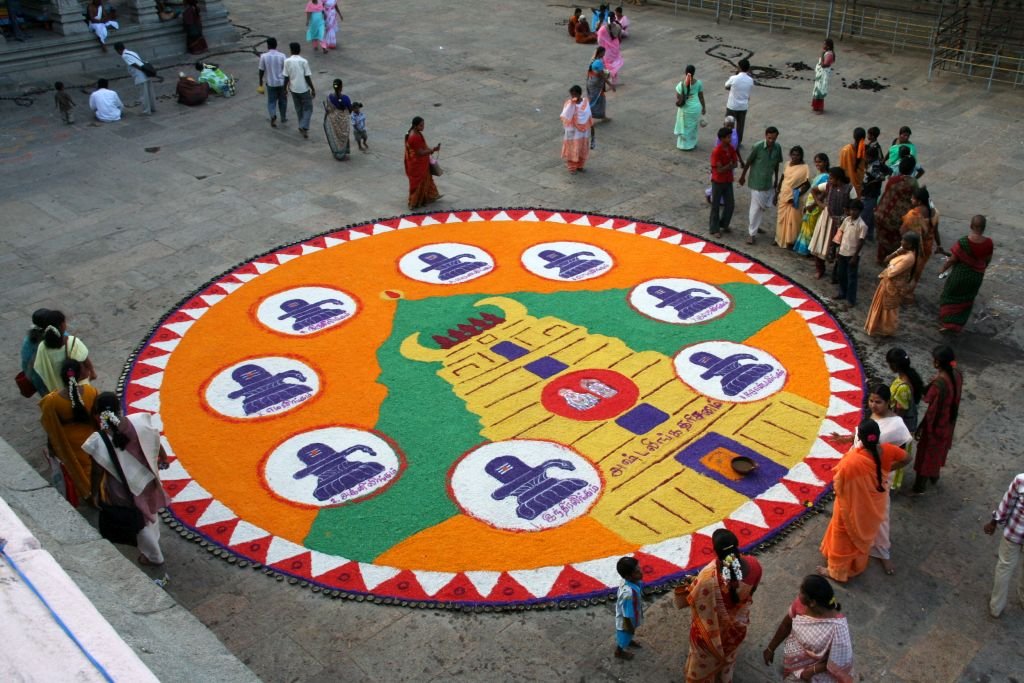
Mahashivaratri Kolam, Arunachaleswarar Temple
|
|
|
|




_(3281504533).jpg)