The distinction between myth and what we occidentals
describe as 'reality' does not exist in India where even the passage of
time is illusory. A religious festival merges myth and sacred time with
the ordinary temporal flow.
Arunachala
was worshipped long before the Vedic culture penetrated the southern
peninsular millennia ago. In the south Lord Siva was the notion of most
awesome significance and Arunachala became the embodiment of Lord Siva.
[Kailash Mountain of Tibet is his abode where he meditates, but
Arunachala Mountain is The Lord Himself]. Lord Siva showed himself as
the eternal principal in the form of an endless column of Light, the
light of consciousness through which realization is possible. Invisible
it is to mortal eyes, it is called the Mahamangalam, the Great
Auspiciousness. Arunachala Mountain is an icon or indicator of this
presence of power.
It was
in comparatively recent history that the Vedic Divine personalities such
as Lord Siva evolved on the subcontinent; they up-staged the primeval
pantheon of elemental divinities worshipped since time before mind:
Fire, Water, Space, Air and Earth. Sacred places associated with these
most ancient divinities all lie in the South; Arunachala is The Fire
Place.
|
|
Agni is
the ancient deity commonly known as the god of fire. This element has
three forms and the form significant for Arunachala is the most subtle
form of light. Arunachala is an invisible column of light signifying
consciousness. In case you do not know I should mention that Human
consciousness veils our original identity and paradoxically it is the
means by which we can recognize our original identity - or true nature,
prior to consciousness. This realization confers freedom from the
bondage of embodiment. The light of the Deepam flame on Arunachala is
lit according to the lunar calendar exactly as the moon rises into
Karthigai month so it is called Karthigai Deepam; it reminds us of our
inevitable enlightenment.
The original myth
associated with Arunachala Deepam is this: Aeons ago the gods Brahma
and Vishnu challenged one another; each claimed to be able to reach the
end of the universe. Brahma (the Creator) headed up into the sky in the
form of a swan, and Vishnu (the Preserver) headed down into the earth as
a boar. Neither managed anything much, except attempts at trickery -
both cunningly claimed to have found the end. The Destroyer of Ignorance
- Lord Siva - pronounced the justice of this situation: that no
embodied being has precedence over any other; that only what is prior to
consciousness is real. What is real is quality-less. It is eternal,
univocal throughout all dimensions of all worlds.
Deepam Festival lasts fourteen days. The Big Temple displays its
treasures every night of the first nine days in processions around the
circuit of streets in town. Millions of pilgrims come, perhaps two
million sometimes, perhaps more; they camp out in the temple complex and
fill every available hut, home, shop, guesthouse, ashram, room, corner,
balcony, corridor, niche, stone bench, and nook under trees and rocks.
They all walk around the hill; some many times because it is exceedingly
auspicious to do so. Lord Siva may very likely grant a pilgrim's
wishes.
Many
years ago when my daughter was small, the old infirm lady who lived with
us - an elderly Brahmana woman of ninety-nine-odd years - used to
bundle her pots and pans, condiments, clean white saris - she'd bundle
them all up in a cloth and scoot off by rickshaw into town for Deepam
every year. She had an age-old arrangement with a family in the main
street, she used to camp on their verandah for the ten days, staying
awake at night to worship the gods as they came past. The divinities
would no doubt reward her for all her trouble.
Although
we are tempted to conjecture that the motivation to partake of this
exceeding auspiciousness arises from other-worldly concerns lured by the
possibility of relinquishment from the cycle of birth and death, this
is not entirely true. For the Hindu it is considered monumentally
difficult for an individual to achieve the freedom from attachment to
this world that is essential for absolute freedom. It is love of this
world that fires the hearts of the devotees; the possible fulfillment of
desires sustains arduous pilgrimages. The number of pilgrims walking
around Arunachala has increased so much during the past ten years that
we now have a mini-Deepam every single month. A famous film star's
pronouncement that Arunachala grants wishes at full moon as well as at
Deepam is what started it all off. Since then, the entire town has to be
frozen of incoming traffic for the duration of the moon's radiant
fullness and thousands of extra buses are scheduled. The ostensibly
other-worldly Deepam festival is actually a tremendous affirmation of
confidence in life on Earth.
Hawkers
come with their wares: food in particular and pictures of gods, film
stars and politicians. Hawkers bring spiritual books, protective
talismans, plastic toys and bunches of grapes, things to hang on your
rear vision mirror and stand on your TV, wind chimes, socks, belts,
warmers for heads, underpants, bangles, molded plastic divinities, fruit
trees, pillows and blankets, jewels, hair clips, watches, fruit trees
and motor bikes - to name a few conspicuous items. The religious
festival becomes a vast marketplace. The Holy Hill is garlanded with
opportunities.
Beggars
come by the busload with their leprous legs and stumpy arms and their
begging bowls; some have little vehicles. Sadhus come in orange - the
mendicant's uniform. Businessmen also come. Families come with plastic
carry bags of clean clothes and blankets. With their shaven scalps
smeared with turmeric paste; they wash their saris, dhotis and shirts in
the tanks beside the hill-round road route and walk with one wet sari
end tied modestly about their body - the other held by a family member
up ahead, the cloth streaming out to dry in the breeze. Skinny people
with big feet and wide eyes: these are the true-blue pilgrims who camp
on the flagstones of temples and mandapams. Modern middle class families
stay in expensive hotels. Groups come with musical accessories and
flower garlands, voices joining footsteps. The Hill becomes garlanded in
humans, encouraged by the voices of the hawkers and bucket loudspeakers
blaring from the frequent stands selling tapes of devotional music.
A recent
upsurge in progress has resulted in the construction of several sheds
along the way, in which pilgrims can rest and watch TV. A special cable
was laid to provide video images of the festival happenings including
much film of pilgrims walking around the Holy Hill so that resting
pilgrims can even see themselves perhaps, by courtesy of our recent
technological achievements.
It is
widely believed that the provision of Free Food at Deepam is rewarded by
the Lord more than any other provision of Free Food! Down at little
shrine area in the only remaining virgin forest adjacent to my house, on
one side of the road every year we have The Big Temple servants feeding
ten thousand persons a day, and on the other side another group feeding
another ten thousand. Crowd Control Barriers sprout and the vast
distribution of free food manifests itself all along the Hill Round
Route.
We
wandered down to the little shrine area around midday on the seventh day
of last year's festival - the day of The Lighting. The Free Food queue
in the crowd control barrier on one side of the road extended back for
more than a kilometre, forming a static block against the jabbering
stream of thousands not interested in free food just then. The field
behind where the forest watchman lives was full of onionskins, vegetable
peelings, big pots being filled with food and big pots on fires. Full
steaming-hot big pots were carried on palanquins by strong men across to
the awning on the roadside where more big pots of hot food were lined
up and many men were dishing spicy rice onto leaf plates for the long
barricaded queue of hungry Tamilians extending out of sight.
We ate
our free food on a bench segregated from the crowd by thorns, watching a
big fight between temple bouncers and persons trying to eat their food
too near to the distribution spot, thereby creating untold congestion in
a greatly congested situation. There was no alternative since there was
nowhere to go to eat, because the sea of human beings takes up every
available space. Discarded leaf plates smeared with spicy rice covered
the road and particularly the shoulders of the road, where one had to
wade through a great mess in order to move. Huge religious festivals
have an agonizingly sordid side. But the ecstasy is something else.
Three
days before the lighting of the Light, it is Big Car Day. There are
several Big Cars, huge wooden carts carved with fabulous mythological
figures telling all the stories, with the biggest wheels in the world;
the biggest car dwarfs all the buildings in town except the giant temple
towers. It is called The Big Car.
Our
temple elephant leads the procession. Several elephants come for Deepam,
most of them beggars; they walk from wherever they come from. On this
day parents or family members also carry their babies around the
procession route. They string a sari on a sugar-cane pole which they
support on their shoulders making a hammock for the child. The babies
carried are ones whose parents asked Arunachala to bless them with so
they are carried in thanksgiving.
The
splendid bronze figures of Annamalai and Unnamalai - male and female
personifications of Arunachala, are heavily garlanded and bejeweled,
seated up on The Biggest Car; the towering edifice is covered with long
strips of embroidered cloth and gigantic flower garlands. There are
several big cars pulled before and after The Big Car; there's a
women-only one carrying Abhithakuchalambal, and there's also a kids'
car, which trails flamboyantly at the end. It's all stupendously
awesome.
Years
ago we used to walk in to watch the Big Car come up the incline of one
main street around midday; for years and years and years, we'd all have
lunch in ashram and then everyone would make their way around to the
east face of the hill to meet the gods coming up Thiruvoodal street. But
now there are so many pilgrims that the schedule has extended
interminably. Inauspicious times of the day intervene so the proceedings
stop until the bad hour has passed, and there's also the time when
suddenly everyone goes home for lunch.
That
year it was evening before the Big Car reached that street. My
daughter's two children - Hari and Ani - were very young so we secured a
protected view from the balcony of a cloth shop half way down the
incline, long before the towering, tottering, embroidered, garlanded Big
Car - with it's flouncing umbrella on the very top, appeared above the
roofs of the shops and maneuvered itself into position for the strenuous
haul up towards Arunachala. Upon the up-roaring signal of its
visibility from the crowd, Hari dropped his pile of coat-hangers and
rushed to be held up over the balcony. His eyes popped, his ears
flapped. Even though we'd seen it before, nothing can prepare us for the
majesty of its annual sight. Below us the street was a sea of heads;
all balconies and rooftops up and down the street full of faces and now
that the Big Car appeared, bodies behind us pressed forward, pushing us
onto the balcony rails festooned with dubious electrical fairy lights.
It's quite exciting.
Since the divinities are coming, dedicated persons don't wear
shoes. This year we noticed one Policewoman wearing socks to protect her
dainty feet from the yucky street. About five thousand pilgrims pull
the cart around the temple circuit-route, ladies on one side and gents
on the other. When the car stops, big chocks of heavy wood are wedged
underneath the enormous wheels while the pullers take a rest and
offerings are made to their majesties the gods. When ready to start
again, young men with enthusiasm climb up onto the chocks with poles to
steady themselves, and on signal they jump up and down on the slanted
chocks until their force pushes the wheels forward, giving momentum for
the pullers to haul the cart further up the street.
Looking
down into the crowd below as the cart passed beneath us, we were treated
to a seething mass of human energy - drums beating in time to muscles,
bystanders shouting encouragement, enormous wheels slowly turning, the
carving on the cart creaking, embroidery panels blowing in the wind,
garlands wavering about, lucky little boys sitting up high lowering
cloth carry bags on strings for people to send up coconuts and flowers,
the Brahmin priests looking down impassively.
It's the
Brahmins particularly - the extravagant courtly costumes, the imperious
faces staring down - that convey the true sense of the gods as
majesties: as the most important personages in our world, out on a tour
of the town, to be saluted by their adoring subjects. And a very large
number of their adoring subjects are sweating, straining at the edge in
the effort required to pull them. The Big Car teeters its way uphill
until the momentum runs out. The chocks are wedged in again. Everyone
breathes. It will take about ten hours to circumnavigate the temple."
Many are
the occasions of inspiration throughout this festival but the
outstanding event is the lighting of the Light.
This
year my dog and I walked with our friend around to the temple dedicated
to the feminine aspect Unnamalai lying on the west of Arunachala where
the Shakthi - the female power point of the hill - peeks up from behind
the main protuberance. This peeking point is a perfect little inverted
vulva; it even has a little clitoris sticking up, perhaps it's a bush.
Unnamalai Temple has a gorgeous stone-pillared mandapam, or hall, now
newly painted and overflowing with pilgrims. And across the road, on the
hillside, spreads a newly cleared Restawhile Park with a modern iron
umbrella above cement benches. The Restawhile Park is a perfect viewing
place for the lighting of the Light.
Underfoot
is conspicuously sordid by this time in the Festival so our walk to the
temple had meandered around piles of garbage. We passed a balloon man
with his happy crowd of prospective little buyers and the nice clean
boys selling 'Healthy Milk Drinks' next to the stacked plastic bottles
of unhealthy pop shop. Outside Unnamalai a stall selling cheap
audiotapes was blotting out existential consciousness entirely yet the
ceremonies in the temple were going strong - assisted by other
loudspeakers, and the pilgrims were slapping their cheeks and bowing
down in obeisance the way they do. None of the local dogs were visible;
we noticed this, my dog and I.
We sat
for awhile under a tree near to the shrine next to dear sadhu Ramana in
yellow, who spends all his livelong days sweeping the hill round
roadway; he had merged with the tree and didn't look too enthusiastic.
Across from me on the hillside sat the irascible sadhu, for once amused,
and behind him rose a crassly painted modern iron umbrella sheltering
the concrete benches which provide sadhus with such an excellent place
to dry their cloths, two sadhus were folding dry orange dhotis
diligently and behind them the cheeky little Shakthi and the great peak
loomed resplendent in the distance.
As dusk
approached we sat down near to the sadhu to wait for the flame to
appear. We could smell human shit there; we watched pilgrims daintily
picking their barefoot way across the weeds hoping to avoid any mess
before sitting down nicely cross-legged to stare up at the mountaintop.
Gradually the Restawhile Park's uncontaminated spaces filled with quiet
orderly pilgrims. We had to wait about an hour, and we foreigners
couldn't help but notice that nobody was eating, smoking, talking or
drinking. Some had lit incense. For thirty kilometers radius surrounding
Arunachala at this time several million people were waiting
suspenseful, staring up to the top of the hill, as they always do.
Up on
the narrow rocky top of the mountain stands a gigantic copper lamp
laboriously carried up that morning by a team of old blokes in
loincloths who are traditionally honored with this task. The east face
is swarming with humans on their way up with clay pots of ghee to
replenish this lamp; a colorful pilgrim snake weaves the traditional
path and more adventurous persons scramble up in other directions. The
almost top plateau becomes a mini-market, even bangles and balloons can
be bought up there, and many will spend the night beside their wares.
The very top is standing-room-only of course - for men only; bare feet
negotiate the brittle remains of broken clay pots softened by the sticky
ghee surface of centuries. Everyone takes up flowers and incense to
enhance the honour of presence.
A
special ceremony in the Big Temple in town early this morning
accompanied a flame-seed from the inner sanctum out into the enormous
flagstone courtyard where it first lights another flame-seed set waiting
beside another huge copper lamp, before traveling carefully up the path
on the east face to the top. There it will be sheltered by the priests
in breathless expectation of the rise of the auspicious full moon. Any
parts of this ritual which are now left out or compromised by human
weakness are just the effects of the degeneration of the times.
The
moment our Celestial Orb appears on the eastern horizon the giant lamp
on the very top will be lit and the moment the little flame on top
appears, the priests in the Big Temple will light the big lamp in the
vast courtyard so packed with humans now chanting "Om Namo Sivaya" that
if the festival is pelting rain - as it sometimes is - it is surprising
how the heat of so many bodies keeps them somewhat warm and dry. The
temple elephant also waits with the crowd; this is part of her job. She
loves festivals.
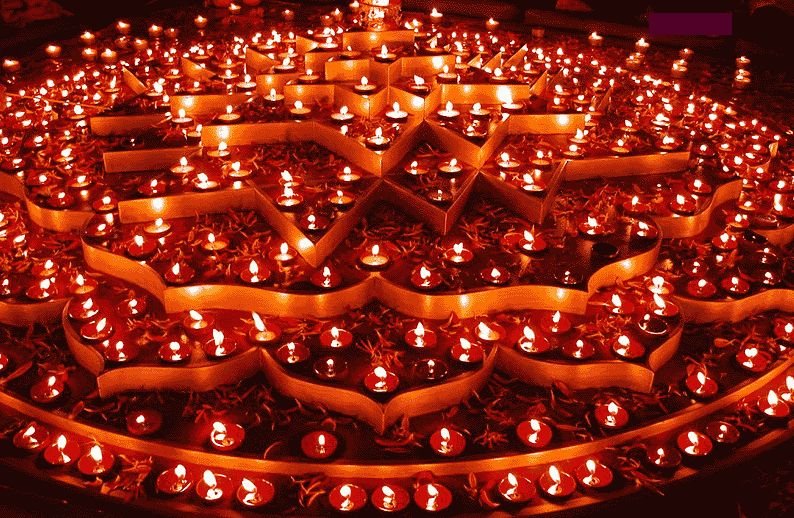
The appearance of the light on the top will also signal orchestration of
thousands and thousands of small Deepam lamps set waiting outside huts
and households as far as eye can see. This is the Festival of Light,
remember? Many household lamps are mountains of sweet rice-flour, with
ghee to carry the flame, as Pati used to make for us during those years
between the infirmity preventing her movement into the main street of
town for Deepam, and her death. After the flame has consumed the ghee,
family members share the tasty mountain in tribute to Arunachala. Even
dogs get some sometimes.
At the
cattle market on the south side of the mountain, thousands of immaculate
cattle face the mountain, bells tinkling to the chewing of their cud
and the cattlemen squat together in huddles - blankets across scrawny
shoulders, by the little bonfires that contribute their own rustic
gesture of affection for this wondrous world. Light is eternal.
Very
frequently it rains at Deepam. Most of the year it doesn't rain but at
Deepam, it does. This year it is not raining and we are waiting in the
Restawhile park on the western side of the mountain; Bibidog has her
front paws crossed, she's panting. Samadhi and I have stopped refraining
from sniffing; we are suffocated with Presence. The silence deepens
towards the golden glow heralding the auspicious first appearance of the
flame. Our moon is on its way.
A soft
golden glow stirs our suspense. Then an irrepressible upsurge of human
aspiration arises, it's palpable: everyone stands up. Loving palms are
brought together above uplifted heads while millions and millions of
voices carry the stupendous sound "Ahrhoroghorah!" up to the appearance
of a tiny little flame.
Ahrhorghorah! I don't need to tell you what that means!
[Apeetha Arunagiri]
|
|
|
|