Pancha Bhoota Sthalams
Agni Lingam (South East)
Agni Arunachala Mythology
Lord Agni Narrative
Pancha Bhoota Sthalams
The Pancha Bhoota are five great elements, which, according to Hinduism are the basis of all cosmic creation.
These elements are:
Earth (Prithvi)
Water (Varuna)
Agni (Fire)
Air (Vayu)
Ether (Aakasha)
The Pancha Bhoota Sthalams refer to five temples dedicated to Lord Shiva
that each represent a manifestation of the five prime elements of
nature. The Temples are located in South India; four in Tamil Nadu and
one in Andhra Pradesh. The respective elements are believed to be
enshrined in each of the lingams located at the five temples.
|
|
The five grand temples associated with the five basic elements are:
1. Earth - (Bhoomi or Nilam) - Kanchipuram - Ekambareswarar Temple
2. Water - (Neer) - Thiruvanaikaval - Jambukeswara Temple
3. Fire - (Agni or Nerupu) - Tiruvannamalai - Annamalaiyar Temple
4. Wind - (Vaayuvu or Kaatru) - Srikalahasti
5. Sky - (Akaasam or AAkayam) - Chidambaram - Chidambaram Temple
At Arunachaleswarar (Annamalaiyar) Temple, the
element manifested is Fire. The Shiva Linga here represents the element
fire and is called Jyothi Lingam. Shiva is said to have manifested
himself in the form of a column of effulgence, whose zenith and nadir
could not be found by either; the Hindu God of creation, Brahma or the
Hindu God of preservation, Vishnu. A celebration of this manifestation
is seen even today in the age old traditions observed during the
festivals of Mahashivarathri and Karthigai Deepam. Agni Lingam
explains the mythics of life-duty, virtue, self-sacrifice and ultimately
liberation by and through an ascetic life.
Agni Lingam (South East)
Arunachala Hill and the Lingam inside Arunachaleswarar Temple are both
regarded as Swayambhu Lingams (i.e. self-manifested). In addition to the
Hill and Lingam inside the Temple's Siva Sannidhi, Arunachala is
surrounded by eight Manusi (man-made) Lingams known as the
Asta Lingams, with each residing in one of the eight directions of the
four cardinal points (South-Yama, West-Varuna, North-Kubera, and
East-Indra) and four intercardinal points (South East-Agni, South
West-Niruthi, North West-Vayu and North East-Esanaya).
The guardians of the four cardinal directions are called the Lokapalas
and are the deities who rule the specific directions of space. The name
for the eight deities; the four cardinal and four intercardinal
directions - is 'Asta-Dikpalas.'
The arrangement of the Asta Lingams around the octagonal perimeter of
Arunachala reflects the geometry of a Cosmogram. Each of these Shrines
(located at the four cardinal and four inter-cardinal points) were
believed by the ancients who originally constructed the Asta Lingam
Shrines to represent, characterise and vitalise certain aspects and
qualities of life in relation to specific fields of energy and
influence.

Agni Lingam, Arunachala Girivalam Roadway
The Agni Lingam has south-east as its direction. It is situated close to
Seshadri Ashram on Chengam road and is the only Lingam out of the Asta
Lingams which is located on the right side of the Girivalam Path.
Lord Chandra (Moon) is the dominant Navagraha of Agni Lingam. Lord Agni,
is God of the fire of Knowledge. He has seven hands and seven tongues.
Agni is the light of the lives of all creatures and is invoked in the
performance of Homa. His vehicle is the goat Saga who serves as the
sacrificial beast in the fires of Homa.
Worshipping this Lingam helps devotees get relief from disease, maintain
good health and also helps them face problems and difficulties in their
lives.
Agni Arunachala Mythology
Fire or Agni is the fourth element of the Panchabhutas. The essential
character of Fire is to generate heat and according to Hindu Mythology,
Agni is one of the Eight Guardians that guard our Universe known as
Asta-dik-palakas.
In Indian mythology there are mentions of various types of fires. The
four important ones are fire of the earth, fire of the sky, fire of the
stomach (can mean hunger or digestive power) and the fire we commonly
use.
There is a wealth of mythology attached to Arunachala connected to its
association with fire and what is related to fire i.e. light and the
sun.
A special association of Arunachala as Agni Kshetra, is that of fire
walking. There is a festival called Thee-midi Utsavam in Tamil Nadu. On
the day of this Festival, people walk on burning charcoal - which is not
observed at Arunachala per the agama rules. However in the Tamil month
of Aadi on the day of Pooram (Pushya) star, this fire walking festival
is performed directly in front of the Unnamulai Shrine (the consort of
Lord Arunachaleshawara).
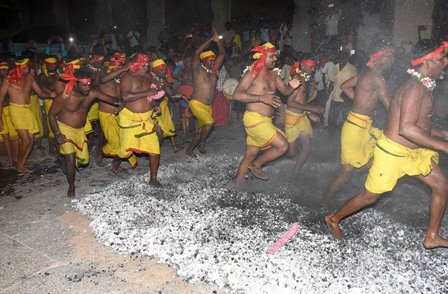
Firewalking at Arunachaleswarar Temple
To further enhance Arunachala as Agni Kshetra, the Kaman Festival
(Manmatha Dahanam) is celebrated in front of Lord Arunachaleswarar every
spring.
Manmatha Dahanam
The Devas, who were being tortured by the demon Taraka, knew that they
could only be saved when a son of Lord Shiva and Parvati killed the
demon. Observing that the Gods were concentrated only on yoga, the Devas
asked Manmatha to disturb the meditating Lord Shiva with his arrows in
order to induce lust in Lord Shiva for Parvati. Manmatha refused since
he knew that it would be fatal for him. But the other Devas threatened
to curse him if he didn't obey. Knowing that it was better to be killed
by the Lord than by the curses of Devas, Manmatha went with his wife,
Rati, to the abode of the meditating Shiva.
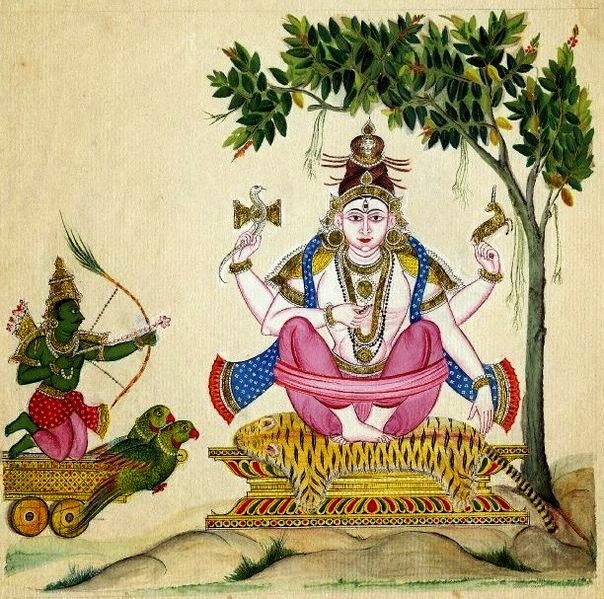
Manmatha shooting his arrows at Lord Shiva
Manmatha shot a flower arrow on the Lord which awakened Shiva from his
meditation. The next moment fire from the Lord's third eye burnt
Manmatha. Shocked by the death of the God of Love, the Devas realised
their plots would not work and that only sincerity would win the Lord's
Grace - they thus surrendered to Lord Shiva and pleaded for mercy. The
Lord forgave them and resuscitated Manmatha but agreed to let him live
only in a disembodied form. After sometime a boy was born to Lord Shiva
and Parvati named Kartikeya, who went on to defeat the demon Taraka.
Lord Agni Narrative
According to tradition Agni has ten forms:-
Ordinary fire
Lightning
Sun
Digestive fire
Destructive Fire
Fire using sticks in sacrificial ritual.
Fire given at initiation
Fire kept in house for domestic purposes
Southern fire of ancestors used in certain rituals.
Funeral fire in cremation
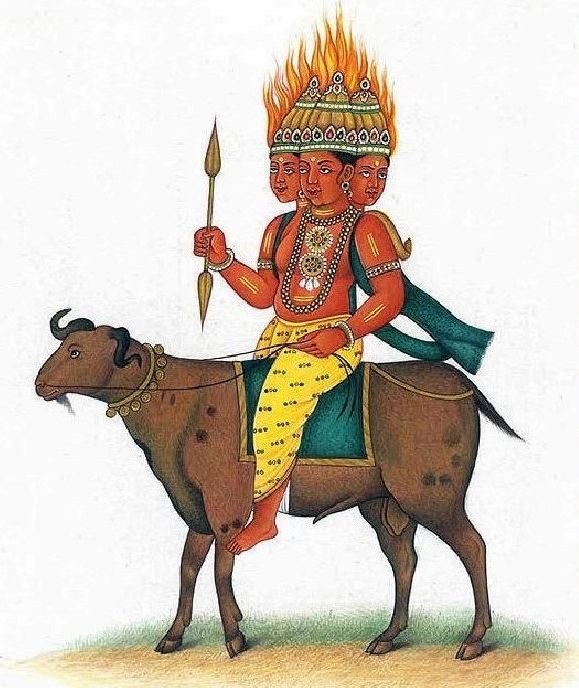
Lord Agni
Agni, the God of Fire, is one of the most prominent of the deities of
the Vedas. With the single exception of Indra, more hymns are addressed
to him than to any other deities:
"Bright, seven-rayed god, how manifold thy shapes
Revealed to us thy votaries: now we see thee
With body all of gold; and radiant hair
Flaming from three terrific heads, and mouths,
Whose burning jaws and teeth devour all things.
Now with a thousand glowing horns, and now
Flashing thy lustre from a thousand eyes,
Thou'rt borne towards us in a golden chariot,
Impelled by winds, and drawn by ruddy steeds,
Marking thy car's destructive course with blackness."
Various accounts are given as to the origin of Agni. He is said to be
son of Dyaus and Prithivi; is called the son of Brahma (Abhimani); and
reckoned amongst the children of Kasvpa and Aditi - thus one of the
Adityas. In later writings he is described as a son of Angiras, king of
the Pitris (the fathers of mankind); and the authorship of several hymns
is ascribed to him. In pictures he is represented as a red man, having
three legs and seven arms, dark eyes, eyebrows and hair. He rides on a
ram, wears a poita (Brahmanical thread), and a garland of fruit. Flames
of fire issue from his mouth and seven streams of glory radiate from his
body.

Another aspect of Lord Agni
Agni is an immortal who has taken up his abode with mortals as their
guest. He is the domestic priest who rises before the dawn, and who
concentrates in his own person all the various sacrificial offices which
the Indian ritual assigns to a number of different human functionaries.
He is a sage, the most divine among the sages, and acquainted with all
forms of worship; the wise director, the successful accomplisher, and
the protector of all ceremonies, who enables and instructs men to serve
the gods in a correct and acceptable manner. He is a swift messenger,
moving between heaven and earth commissioned both by gods and men to
maintain their mutual communication; to announce to the immortals sacred
hymns and to convey to them the oblations of their worshippers; or to
bring them (the immortals) down from the sky to the place of sacrifice.
He accompanies the gods when they visit earth and shares in the
reverence and adoration which they receive. He makes the oblations
fragrant; without him the gods experience no satisfaction.
Agni is the lord, protector, king of men. He is the lord of the house,
dwelling in every abode. He is a guest in every home; he despises no
man, he lives with every family. He is therefore considered as a
mediator between gods and men, and as a witness of their actions; hence
to the present day he is worshipped, and his blessing sought on all
solemn occasions, as at marriage, death, etc. In old hymns Agni is
spoken of as dwelling in the two pieces of wood being rubbed together to
produce fire; and it is thought of as remarkable that a living being
should spring out of dry (dead) wood. Strange to say, says the poet, the
child, as soon as born, begins with unnatural voracity to consume his
parents. Wonderful is his growth, seeing that he is born of a mother who
cannot nourish him; but he is nourished by the oblations of clarified
butter which are poured into his mouth, and which he consumes.
The highest divine functions are ascribed to Agni. Although in some
places he is spoken of as the son of heaven and earth, in others, he is
said to have stretched them out to have formed them, and all that flies
or walks, or stands or moves. He formed the sun, and adorned the heavens
with stars. Men tremble at his mighty deeds, and his ordinances cannot
be resisted. Earth, heaven, and all things obey his commands. All the
gods fear, and do homage to him. He knows the secrets of mortals, and
hears the invocations that are addressed to him.
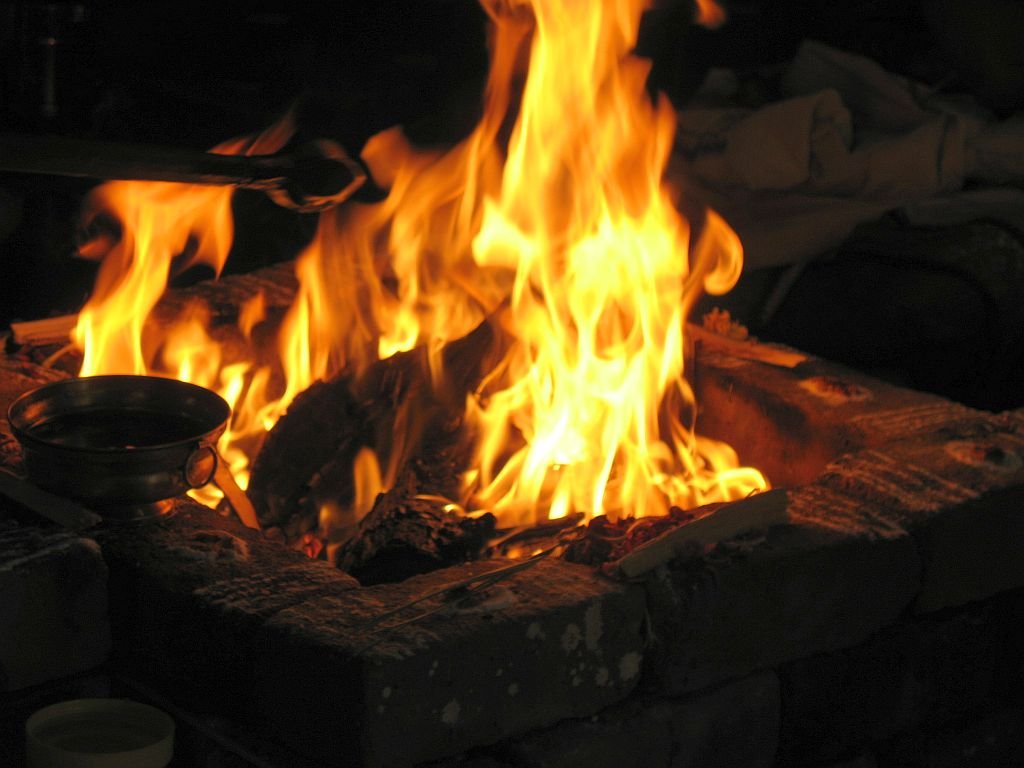
Lord Agni as Homam, sacrificial fire
The worshippers of Agni prosper, are wealthy, and live long. He watches
with a thousand eyes over the man who brings him food, and nourishes him
with oblations. No mortal enemy can by any wondrous power gain the
mastery over him who sacrifices to this god. He also confers and is the
guardian of immorality. In a funeral hymn, Agni is asked to warm with
his heat the unborn (immortal) part of the deceased, and in his
auspicious form to carry it to the world of the righteous. He carries
men across calamities, as a ship over the sea. He commands all the
riches in earth and heaven; hence he is invoked for riches, food,
deliverance, and in fact all temporal good. He is also prayed to as the
forgiver of sins that may have been committed through folly. All gods
are said to be comprehended in him; he surrounds them as the
circumference of a wheel does the spokes.
The main characteristics of this deity are: -
"Great Agni, though thine essence be but one,
Thy forms are three; as fire thou blazest here,
As lightning flashest in the atmosphere,
In heaven thou flamest as the golden sun
It was in heaven thou hadst thy primal birth;
By art of sages skilled in sacred lore
Thou wast drawn down to human hearths of yore,
And thou abidest a denizen of earth
Sprung from the mystic pair,* by priestly hands
In wedlock joined, forth flashes Agni bright;
But, oh! ye heavens and earth, I tell you right,
The unnatural child devours the parent brands
[*The two pieces of wood from which fire is produced]
But Agni is a god; we must not deem
That he can err, or dare to comprehend
His acts, which far our reason's grasp transcend;
He best can judge what deeds a god beseem
And yet this orphaned god himself survives:
Although his hapless mother soon expires,
And cannot nurse the babe as babe requires
Great Agni, wondrous infant, grows and thrives
Smoke-bannered Agni, god with crackling voice
And flaming hair, when thou dost pierce the gloom
At early dawn, and all the world illume,
Both heaven and earth and gods and men rejoice
In every home thou art a welcome guest,
The household tutelary lord, a son,
A father, mother, brother, all in one,
A friend by whom thy faithful friends are blest
A swift-winged messenger, thou callest down
From heaven to crowd our hearths the race divine,
To taste our food, our hymns to hear, benign,
And all our fondest aspirations crown
Thou, Agni, art our priest: divinely wise,
In holy science versed, thy skill detects
The faults that mar our rites, mistakes corrects.
And all our acts completes and sanctifies
Thou art the cord that stretches to the skies,
The bridge that scans the chasm, profound and vast.
Dividing earth from heaven, o'er which at last
The good shall safely pass to Paradise
But when, great god, thine awful anger glows,
And thou revealest thy destroying force,
All creatures flee before thy furious course,
As hosts are chased by overpowering foes
Thou levellest all thou touchest; forests vast
Thou shear'st, like beards which barbers' razor shaves.
Thy wind-driven flames roar loud as ocean's waves.
And all thy track is black when thou hast past
But thou, great Agni, dost not always wear
That direful form; thou rather lov'st to shine
Upon our hearths, with milder flame benign,
And cheer the home where thou art nursed with care
Yes! thou delightest all those men to bless
Who toil unwearied to supply the food
Which thou so lovest - logs of well-dried wood
And heaps of butter bring, thy favourite mess
Though no cow possess, and have no store
Of butter, nor an axe fresh wood to cleave,
Thou, gracious god, wilt my poor gift receive:
These few dry sticks I bring - I have no more
Preserve us, lord ; thy faithful servants save
From all the ills by which our bliss is marred;
Tower like an iron wall our homes to guard,
And all the boons bestow our hearts can crave
And when away our brief existence wanes,
When we at length our earthly homes must quit.
And our freed souls to worlds unknown shall flit.
Do thou deal gently with our cold remains
And then, thy gracious form assuming, guide
Our unborn part across the dark abyss
Aloft to realms serene of light and bliss.
Where righteous men among the gods abide."
In a celebrated hymn of the Rig-Veda, attributed to Visishtha; Indra and
the other gods are called upon to destroy the Kravyads (the
flesh-eaters), or Rakshas, enemies of the gods. Agni himself is a
Kravyad and as such takes an entirely different character. He is then
represented under a form as hideous as the beings he (in common with the
other gods) is called upon to devour. He sharpens his two iron tusks,
puts his enemies into his mouth, and devours them. He heats the edges of
his shafts, and sends them into the hearts of the Rakshasas.
In the Mahabharata, Agni is represented as having exhausted his vigour
by devouring too many oblations, and desiring to consume the whole
Khandava forest, as a means of recruiting his strength. He was [at
first] prevented from doing this by Indra; but having obtained the
assistance of Krishna and Arjuna, he baffled Indra, and accomplished his
object.
According to the Ramayana, in order to assist Vishnu when incarnate as
Rama, Agni became the father of Nila by a monkey mother; and, according
to the "Vishnu Purana," he married Swaha, by whom he had three
sons - Pavaka, Pavamana, and Suchi.
There is also yet another form of Agni known as Vadavagni
(Vadava-agni - "marefire") and represents Agni's most terrible form, which
remains hidden deep under the sea. It's waiting for the 'right' moment
to destroy the world.
Hindu scriptures mention an ancient belief that the escape of this fire
from under the ocean will, in the end, consume the current cycle of
creation and prepare the universe for the next cycle of creation.
Agni has many names; those more generally known are the following:-
Vahni, "He who receives the horn, or burnt sacrifice."
Vitihotra, "He who sanctifies the worshipper."
Dhananjaya, "He who conquers (destroys) riches."
Jivalana, "He who burns."
Dhumketu, "He whose sign is smoke."
Chhagaratha, "He who rides on a ram."
Saptajihva, "He who has seven tongues."
|
|
|
|



